Salty One Gose

I’ve never made a gose before! This confession is probably not terribly surprising for those who know my brewing preferences, because I find most sour beers a little too annoying to deal with. Kettle sours take time, and other sour processes are prone to contamination of subsequent batches in the same equipment. Plus, I find many sours just a little too sour to be drinkable beyond a half glass. That said, gose is only lightly tart and lower alcohol, which puts it into the space of beers I enjoy. I think the main thing deterring me from the style in the past was the annoyance of having to dial in the sourness without overshooting (undershooting?) the pH.

Then, I spotted a neat recipe in the January 2025 Zymurgy magazine–a brew called “Salty One Gose” that won gold in the European Sour Ale category at NHC 2024. Crafted by Jonathan Hernandez of Waterville, Maine, the beer drew my interest because it used kettle soured sauergut added to the main kettle in order to hit the perfect level of sourness. So, you’re essentially blending wort for a desired result.

I modified this beer only slightly from the original recipe. The published version was 6 gallons, so I reduced it towards a 5.25 gallon batch. I also adjusted the amount of pilsner malt required downwards, anticipating high efficiency (as is typical of my batches with minimal grain volumes). I used a mix of Viking and MCM malt, because I had a pound of the latter on-hand to use up. Finally, I used whole Saaz hop cones from South Dakota; hops are a minor consideration for this style, so I wasn’t too concerned about alpha level, aroma, or flavor.

Coriander choice took some thought–although I have it on-hand for cooking, it had been in the pantry for a few years, and I was worried about freshness. So, I ordered a small quantity online; the package didn’t document origin of the spice, but when I smelled the crushed seeds they had the fresh lemon quality I was looking for.

Recipe Name

  • 1 gallon sauergut (added to kettle at boil)
    • 1 lb. pilsen light DME (Briess)
    • 1 pkg. Wildbrew Sour Pitch (Lallemand)
  • 3.5 lb. white wheat malt (Briess)
  • 2.5 lb. pilsner zero malt (Viking)
  • 1 lb. pilsner malt (Montana Craft Malting)
  • 2 oz. rice hulls
  • 0.5 tsp. BrewTanB, added to mash
  • 1 oz. Saaz whole hops (est. 1.5% alpha), 60 minute boil
  • 0.5 tsp. BrewTanB, 10 minute boil
  • 8 g. coriander seed, crushed, 10 minute boil
  • 13.1 g kosher salt, added at end of boil
  • 1 pkg. Köln Kölsch-style yeast (Lallemand)

Target Parameters

  • Full volume mash with 5 minute rest at 131°, 40 minute rest at 147°, 30 minute rest at 161°, and 10 minute rest at 168°
  • 1.042 o.g., 1.007 f.g., 4.6% abv, 5 IBU, 3 SRM
  • Mash water adjusted to 37 ppm Ca, 20 ppm SO4, and 51 ppm Cl.

Procedure

  • Two days before the primary brew day (April 3), I measured out 1.1 gallons of RO water (4.164 kg), added 1 lb. of Briess pilsen light dry malt extract, 1.5 tsp. (7.5 mL) of 88% lactic acid, and then boiled this for 4 minutes. Next, I chilled the wort to 90°, before pitching the entire packet of the lacto culture.
  • I started the initial culture on the evening of 3 April 2025, kept a heating pad under it, and wrapped it in a blanket, to hold temperature at 85° to 90°.
  • By April 5, the pH looked to be around 3.2 or 3.3 as measured by pH strips. This was brew day!
  • I mashed in with 6.5 gallons of RO water and mineral adjustments, with 0.9 g gypsum and 2.6 g calcium chloride. I heated the strike water to 134°; once the grains were added, I held the temperature at 131° for 5 minutes, before heating to 147° for 40 minutes, raising to 161° for 30 minutes, and then mashing out at 168° for 10 minutes.
  • Because I had such a low volume of grains, I had exceptional mash efficiency at 1.034 with 6.9 gallons, for 89% mash efficiency.
  • As the main runnings were coming to a boil, I boiled the saurgut prepared earlier and added it to the kettle, getting a pre-boil gravity of 1.035.
  • I brought the kettle to a boil, adding hops, BrewTanB, coriander, and salt per the recipe. After a full 90 minute boil, I turned off the heat and chilled to 72° before transferring to the fermenter.
  • I chilled the wort to 64° in the fermenter, holding it at that temperature for initial fermentation.
  • I brewed the beer on 5 April 2025, and had a starting gravity of 1.043.
  • I kegged the beer on 18 May 2025, with closed transfer. Final gravity was 1.009, for 4.5% abv.
  • My tasting at the time of kegging showed it to be an exceptional beer–the coriander flavor and aroma were perfect, as was the salt balance. After the initial carbonation and tastes, I decided to up the carbonation to about 3.2 volumes.

Tasting

  • Appearance
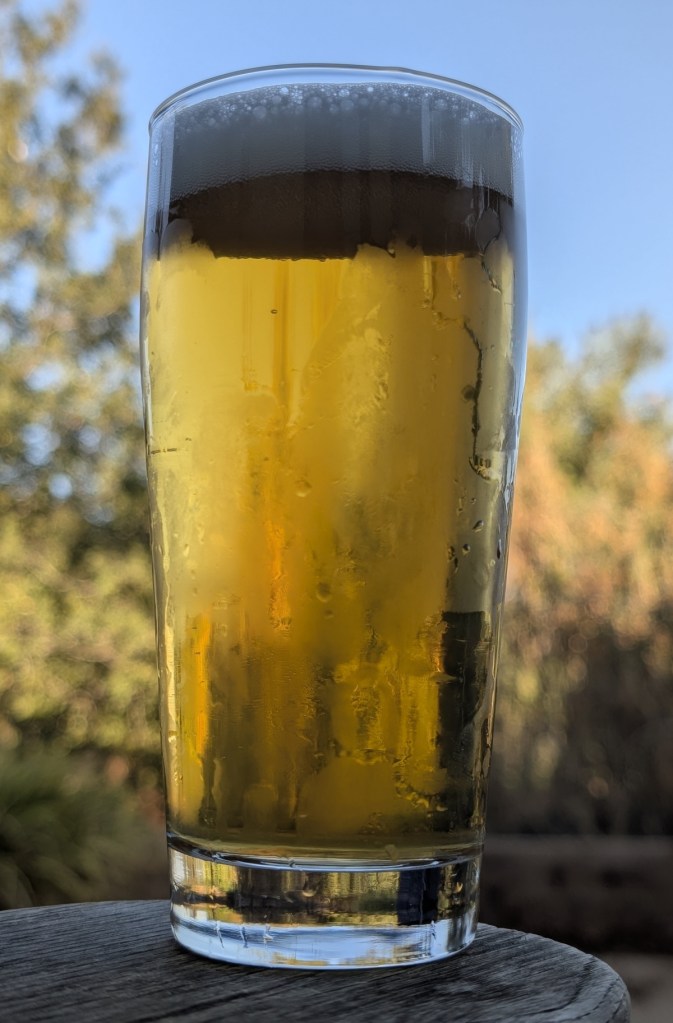
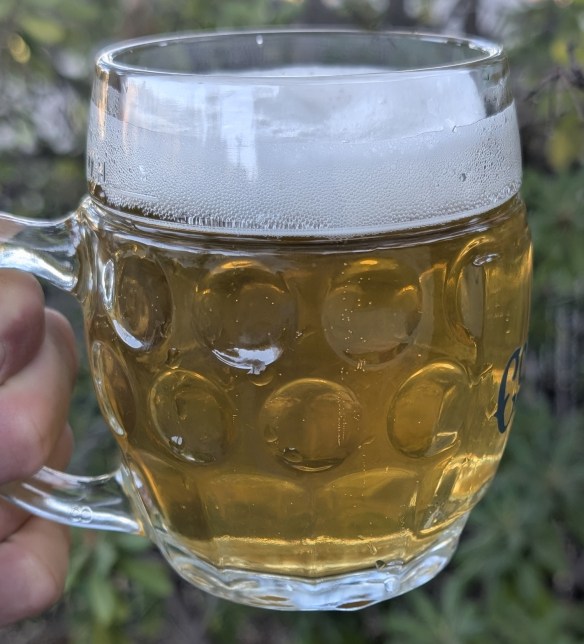
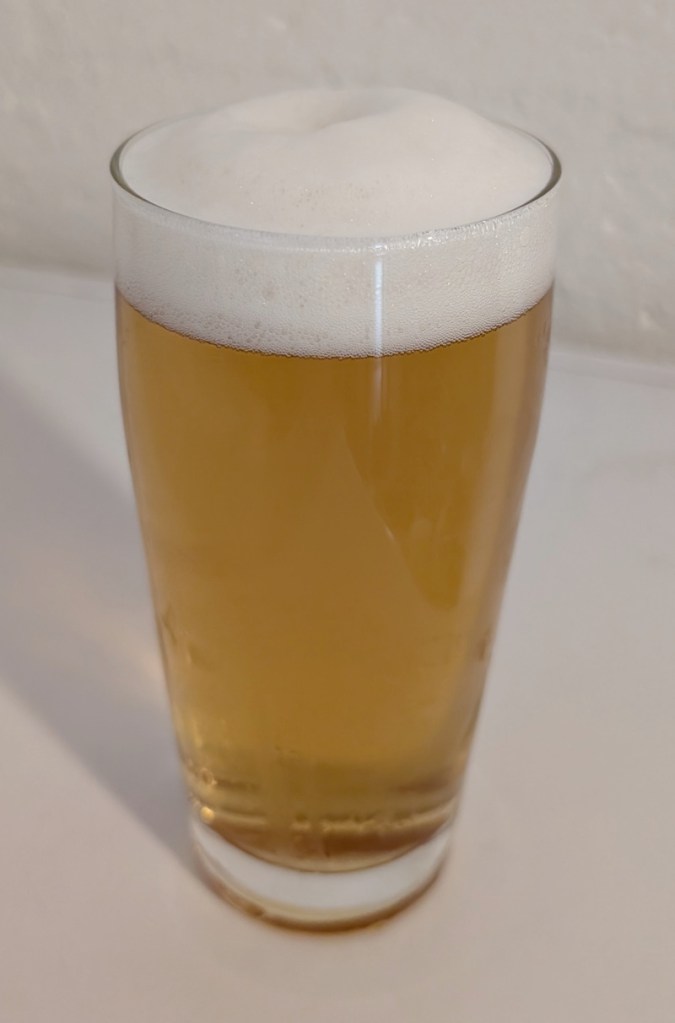
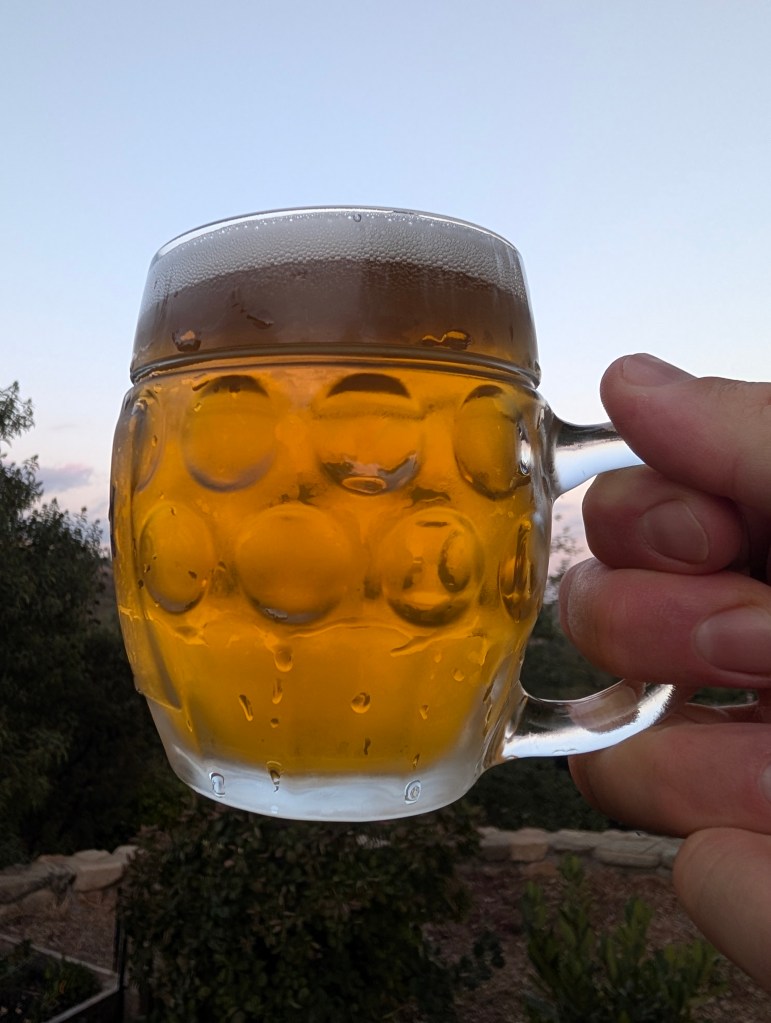
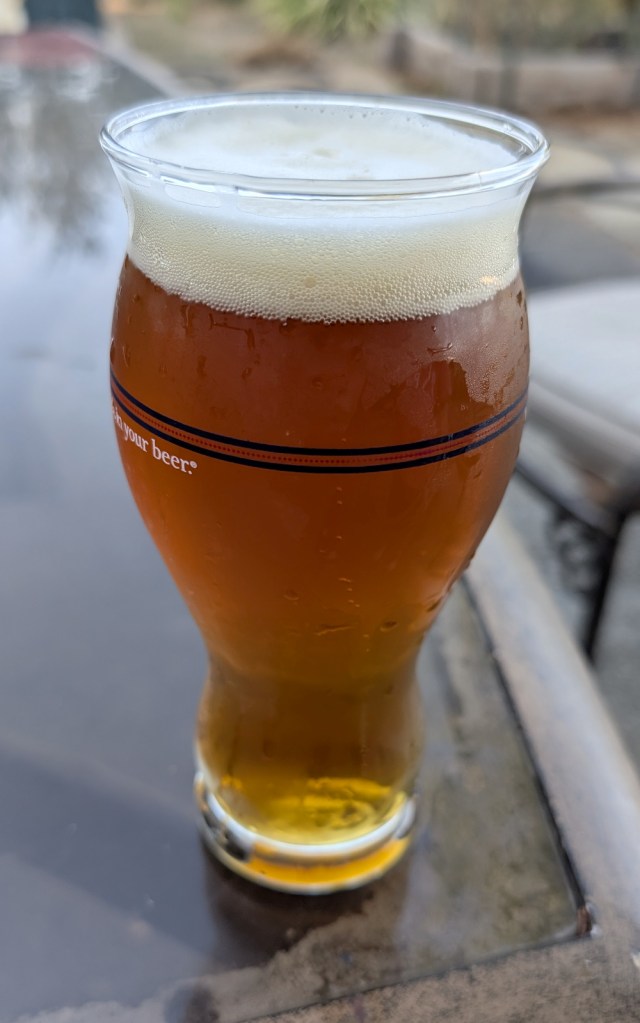
    • A light yellow, moderately hazy beer, pouring with a fluffy white head of excellent persistence; the head leaves lacing down the side of the glass.
  • Aroma
    • Bright, medium-light aroma of coriander and fresh sea breeze; a light bread dough aroma behind that
  • Flavor
    • Lightly and pleasantly tart; a light lemony coriander flavor alongside fresh sea breeze from the salt. “Doughy” malt flavor of medium intensity. Low bitterness, with no hop character to speak of.
  • Mouthfeel
    • Rounded mouthfeel, high level of carbonation, dry mouthfeel on the finish, medium-light body. Very drinkable and very refreshing!
  • Would I Brew This Again?
    • Yes! This is an amazing beer and a solid first attempt at a gose. I had to adjust the carbonation upwards a bit, because it was a bit flabby on my first few pours, but once that was dialed in it notched the beer to perfection. The coriander and salt balance are spot-on, as is the level of tartness. I might use K-97 next time around, to retain the haze at a slightly higher level for longer, but this is just an awesome beer as is. I especially like the partial kettle sour method, so that I was able to hit a low level of acidity with minimal fuss.
  • Overall
    • 10/10

Patersbier 2025

I love the concept of a patersbier (“Father’s Beer”), as a relatively light and low alcohol yet flavorful take on a Belgian ale. As with many Belgian ales that were associated with the monastic traditions, there is plenty of romance and a good dollop of fantasy around these brews. I’m not particularly interested into delving into historicity–I’m more interested in making a beer that I want to drink!

This particular version is a bit of a kitchen sink beer, intended to sweep out odds and ends from my brewing supply. Even so, I aimed to have a sturdy malt backbone. Hops were chosen, again, to use up a few varieties. I knew a Belgian yeast was in order, so Lallemand’s Abbaye Belgian fit the bill. It’s very different from the previous patersbier I made, which was a SMaSH with pilsner malt and Cascade hops.

Along the lines of my Brew Year’s Resolution to make more small batches, this was a 3 gallon batch. I also did a quick brew day, with 30 minute mash and 30 minute boil.

Patersbier 2025

  • 2.75 lb. Vienna malt (Weyermann)
  • 2 lb. 2-row malt (Great Western)
  • 0.5 lb. Caramel Munich 60L malt (Briess)
  • 0.5 lb. Munich II malt (Weyermann)
  • 0.25 lb. Caramel Malt 120L (Briess)
  • 0.25 tsp. BrewTanB, added to mash
  • 1 oz. Styrian Goldings hop pellets (3.2% alpha), 30 minute boil
  • 0.5 oz. Crystal hop pellets (4.5% alpha), 30 minute boil
  • 1 pkg. Abbaye Belgian ale yeast

Target Parameters

  • 1.045 o.g., 1.015 f.g., 3.9% abv, 13 SRM, 26 IBU
  • Full volume mash at 158° for 60 minutes
  • Claremont tap water, no adjustment

Procedure

  • I heated the mash water to 164°, added the grains, and held at 158° with recirculation for 30 minutes. Then, I raised the mash to 168° for 10 minutes before pulling the grains.
  • In total, I collected 4 gallons of runnings with a gravity of 1.037, for 66% mash efficiency.
  • I brought the kettle to a boil and added hops per the recipe. After 30 minutes, I turned off the heat and chilled the wort to 68° before transferring to the fermenter.
  • Starting gravity was 1.044. Once I pitched the yeast, I let it ferment at ambient. I brewed the beer on 12 March 2025.
  • I kegged the beer on 24 March 2025. Final gravity was 1.013, for 4.1% abv. I added 1.5 oz. of corn sugar dissolved in ~0.5 cup of water and boiled, in order to do natural carbonation. I finished off the carbonation with forced CO2. At the time of kegging, a pleasant and spicy yeast character was evident.

Tasting

  • Appearance
    • Medium amber beer, clear, ivory head with good persistence.
  • Aroma
    • Moderately high yeast aroma with good phenolic character; spicy notes, some red apple. Some bready and caramel notes come through as the beer warms up.
  • Flavor
    • Spicy yeast character at the forefront; medium level of malt character with a malty, bread crust quality. Medium-low level of hops.
  • Mouthfeel
    • Light body, medium level of carbonation, dry finish.
  • Would I Brew This Again?
    • This is good for what it is–easy drinking and lots of yeast character. It’s a bit thin on the body, so might benefit from a touch more crystal malt. The yeast character is perfect! As compared with my previous patersbier, I like the 2025 recipe much better.
  • Overall
    • 7/10

Otter-Squatch Wheat Ale

A light wheat ale is an American homebrew classic, but it has been awhile since I last made this style. I threw together a simple recipe, which is upside-down from my usual blend of 60/40 wheat/2-row. There was no particular reason for this, other than it just seemed like the thing to do. I had a hop variety on-hand called Sasquatch, and decided to use those up here. My preference on American wheat ales is a little fruity/citrusy yeast character, rather than super clean or super phenolic. Lutra kveik seemed like a perfect yeast choice along those lines; clean-ish, but not overly clean, and potential for some interesting flavors. “Lutra” is also the scientific name for a genus of otters; along with Sasquatch hops, I ended up calling this batch “Otter-Squatch Wheat Ale.”

Otter-Squatch Wheat Ale

  • 6 lb. 2-row malt (Great Western)
  • 4 lb. white wheat malt (Briess)
  • 4 oz. rice hulls
  • 0.5 tsp. BrewTanB, added to mash
  • 1 oz. Sasquatch hop pellets (7.5% alpha), 20 minute boil
  • 0.5 tsp. BrewTanB, 10 minute boil
  • 1 oz. Sasquatch hop pellets (7.5% alpha), 5 minute boil
  • 1 pkg. Lutra kveik (Omega OYL-071), dry

Target Parameters

  • 1.046 s.g., 1.009 f.g., 23 IBU, 4 SRM, 4.9% abv
  • Full volume mash, 60 minute mash at 152°, 10 minute mash-out at 168°
  • RO water with added minerals to hit target of 78 ppm Ca, 86 ppm SO4, 74 ppm Cl, -55 ppm RA

Procedure

  • I started with 7.3 gallons of RO water, adding 4.25 g of calcium chloride and 4.25 g of gypsum to hit my target water profile. Then, I heated the water to 157° before adding the grains, to hit a mash temperature of 152°.
  • I held the mash with recirculation at 152° for 60 minutes, before raising the mash to 168° for 10 minutes.
  • At the end of the mash, I removed the grains and heated to a boil. In total, I collected 6.6 gallons of runnings with a gravity of 1.039, for 69% mash efficiency.
  • I heated the runnings to a boil, boiling for 60 minutes and adding hops per the recipe. After 60 minutes, I turned off the heat and chilled 85° before transferring the beer to the fermenter and pitching the yeast.
  • Starting gravity was 1.044, and I brewed the beer on 28 February 2025. I fermented the beer at room temperature ambient, between 60 and 65°.
  • I kegged the beer on 24 March 2025. Final gravity was 1.009, for 4.6% abv. I added 3.25 oz. of corn sugar to get some natural carbonation and scrub any oxygen from the transfer process. At the time of kegging, the beer had a very mild flavor and was quite drinkable! I finished up things with a bit of force carbonation, after the beer sat for a few weeks.

Tasting

  • Appearance
    • Lightly hazy, light yellow beer, which pours with a creamy and long-lasting white head.
  • Aroma
    • Doughy and tart, lemony aroma, at a moderate level of each.
  • Flavor
    • Moderate doughy malt character, light tartness to yeast and a very slight phenolic note (peppery, perhaps?). The latter is almost imperceptible; I can’t quite describe it. Medium-low bitterness.
  • Mouthfeel
    • Light bodied, moderately high carbonation, slightly dry finish. Crisp!
  • Would I Brew This Again?
    • This is a tasty beer! It defies styles a little bit; it’s probably closest to an American wheat ale, but not quite on target. It’s very drinkable! The kveik flavors probably aren’t for everyone, but work well in this particular batch.
  • Overall
    • 9/10

Snowdrop Kölsch 2025

This kölsch recipe is one of my favorites, and I have brewed it annually since 2023. The recipe is pretty dialed in, except for the fact that on this brew I misread it and added a half pound of Munich II when assembling my grain bill. Oops! I anticipated it would up the maltiness a bit in a way that’s outside the norm for this beer (and style), which was indeed the case.

My supply of Edelweiss hop blend (business closed) and Köln Kölsch-style yeast (discontinued by manufacturer) is dwindling. I need to start thinking about my next iteration of the recipe. The hops are manageable, but it still is a bummer that I don’t yet know of a good dry yeast alternative! K-97 takes waaaay too long to clear and has a vinous character I don’t quite care for in some cases.

Snowdrop Kölsch

  • 9.5 lb. pilsner malt (Rahr)
  • 0.5 lb. Munich I malt (Weyermann)
  • 0.5 lb. Munich II malt (Weyermann)
  • 0.5 tsp. BrewTanB (mash)
  • 1 oz. Edelweiss hop pellets (5.8% alpha), 45 minute boil
  • 0.5 tsp. BrewTanB, 10 minute boil
  • 1 Whirlfloc tablet, 5 minute boil
  • 2 oz. Edelweiss hop pellets (5.8% alpha), 5 minute boil
  • 1 pkg. Köln Kölsch-style yeast (Lallemand)
  • 1 oz. Biofine Clear (added to keg)

Target Parameters

  • 1.048 s.g., 1.011 f.g., 25 IBU, 4 SRM, 4.9% abv
  • Full volume mash, 60 minute mash at 152°, 10 minute mash-out at 168°
  • RO water with added minerals to hit target of 50 ppm Ca, 5 ppm Mg, 6 ppm Na, 54 ppm SO4, 72 ppm Cl, 0 ppm HCO3, -38 ppm RA

Procedure

  • Starting with 7.25 gallons of RO water, I added 0.4 g of sea salt, 1.4 g of epsom salt, 1.7 g of gypsum, and 3.6 g of calcium chloride, in order to reach my target water parameters.
  • I heated the strike water to 158° before adding the BrewTanB, grains, and 1 tbs. of 10% phosphoric acid (for pH adjustment).
  • I held the mash at 152° (with recirculation) for 60 minutes, and then heated the mash to 168° for a 10 minute mash-out, before pulling the grains.
  • In total, I collected 6.6 gallons of runnings with a gravity of 1.041, for 68% mash efficiency.
  • I brought the runnings to a boil, adding hops and finings per the recipe. After 60 minutes, I chilled the wort to 66° and transferred to the fermenter. I pitched the yeast during the transfer.
  • During fermentation, I held the temperature at 62°.
  • I brewed this beer on 17 February 2025. Starting gravity was 1.049.
  • I kegged the beer on 9 March 2025, using a closed transfer. It was pretty hazy at this point in the sample glass and will likely take awhile to drop clear.
  • Final gravity was 1.011, for 5.0% abv.
  • I added BioFine Clear on 24 March 2025, and put the beer on tap on 26 March 2025. It was brilliantly clear by this point! I had overshot the carbonation a bit, so it took some time to work things down. I used the pressure release valve on the keg and also served without the gas line connected, which over the course of a few days got it closer to “pouring without a massive dose of foam.”

Tasting

  • Appearance
    • Pours with a low yet very persistent white head. The beer itself is brilliantly clear and light yellow. This is probably the best looking kölsch I have ever made! The Biofine Clear definitely came through.
  • Aroma
    • Lightly fruity yeast character with a red apple quality. Low hop and malt character; slightly floral hops.
  • Flavor
    • Moderate level of maltiness and medium bitterness. Slightly fruity yeast character. The malt flavor is not quite as grainy as I personally would like in a kölsch–it’s more of a down-the-middle malty quality–but still nice. It’s a very drinkable beer!
  • Mouthfeel
    • Medium-light body, medium-high carbonation, smooth finish, crisp.
  • Would I Brew This Again?
    • This is a great recipe! The malt flavor is not quite as delicate as I would prefer (hence the 9/10 instead of 10/10), but that’s my fault for messing up the grist. I overcarbonated the beer just a little too, but that will amp down over time.
  • Overall
    • 9/10

Stygimoloch Bock 2025

One of my favorite recipes has been Stygimoloch Bock, which looms large in my mind for its rich maltiness and drinkability. Somewhat surprisingly, then, my records show that I brewed this only twice before, in 2019 and 2020. Time for another batch!

The recipe is pretty well locked in, so I made only the smallest of adjustments. I swapped out the Caramel Munich 60L by Briess for CaraMunich by Weyermann, to get a 100% German malt bill. I also used Perle for the bittering hops (versus Magnum or Mt. Hood in previous versions) and swapped in Diamond lager yeast. So, I suppose that means it’s a very different recipe in some ways across versions, but the malt is the core here, and the proportions on that are fairly unchanged.

Stygimoloch Bock 2025

  • 9 lbs. Munich II malt (Weyermann)
  • 5 lbs. Munich I malt (Weyermann)
  • 8 oz. CaraMunich II (Weyermann)
  • 4 oz. melanoidin malt (Weyermann)
  • 1 oz. Carfa Special III malt (Weyermann)
  • 0.5 tsp. BrewTanB, added to mash
  • 1.15 oz. Perle hop pellets (6.3% alpha), 60 minute boil
  • 0.5 tsp. BrewTanB, 10 minute boil
  • 1 Whirlfloc tablet, 5 minute boil
  • 3 pkg. Diamond lager dry yeast (Lallemand)

Target Parameters

  • 60 minute infusion mash, 152°, full volume mash
  • 1.068 o.g., 1.017 f.g., 6.8% abv, 23 IBU, 16 SRM
  • Claremont tap water, with carbonates knocked back by addition of 6.5 mL 88% lactic acid, to hit target parameters of 44 ppm Ca, 8 ppm Mg, 89 ppm Na, 50 ppm sulfate, 110 ppm Cl, 20 ppm bicarbonate.

Procedure

  • I neutralized the carbonates in the tap water with 6.5 mL of 88% lactic acid in 7.65 gallons of water, along with a half of a Campden tablet to take care of chloramines.
  • I heated the water to 159° and added the grains, holding at a mash temperature of 152° for 60 minutes, with recirculation.
  • After 60 minutes, I raised the mash to 168°, held it there for 10 minutes, and then removed the grains.
  • In total, I collected 6.4 gallons of runnings with a gravity of 1.055, for 64% mash efficiency.
  • In order to raise the gravity a bit, I brought the runnings to a boil and boiled hard for 15 minutes before adding the hops.
  • Once the hops were added, I proceeded with 60 more minutes of the boil, adding finings per the recipe.
  • After boiling for a total of 75 minutes, I turned off the heat, and chilled down to 72° before transferring into the fermenter and cooling down to 50°. It took around 3 hours before I pitched the yeast.
  • I brewed this beer on 18 January 2025. Starting gravity was 1.067.
  • Starting fermentation temperature was 50°; I raised it to 51° on 21 January, and then to 60° on 10 February 2025. I cold crashed to 34° on 13 February 2025.
  • I pulled the beer to room temperature on 17 February 2025 to make room in the fermentation chamber, and then kegged it on 18 February 2025, with a non-closed transfer.
  • Final gravity was 1.020, for 6.3% abv.
  • I cold conditioned the beer until 26 March 2025, when I put it on tap. The beer was brilliantly clear at this point.

Tasting

  • Appearance
    • Brilliantly clear, deep amber beer, which pours with an ivory head of moderate persistence. It’s simply gorgeous!
  • Aroma
    • Toasty dark bread crust and dark fruit aroma in addition to rich maltiness. Clean yeast profile, hops perceptible.
  • Flavor
    • Rich maltiness with bread crust quality alongside that. Moderate bitterness, but the malt is definitely the center of attention.
  • Mouthfeel
    • Medium-full body, moderate carbonation, smooth finish, with only a slight lingering bitterness. Slightly dry, but not cloying.
  • Would I Brew This Again?
    • This recipe is a winner! It’s a perfect beer to close out the winter months and welcome cool spring afternoons and evenings. I wouldn’t change a thing about it at this point.
  • Overall
    • 10/10