Clonal Common 2021

I like a good steam beer (a.k.a. California common) every once in awhile, and I last made a batch back in 2015. I hadn’t thought it was that long ago, but my notes don’t lie! This year’s version was largely the same recipe, but made with the base malts and caramel malts I had on hand. As before, this batch parallels recipes from BYO and Zymurgy, with only the most minor modifications.

Clonal Common 2021

  • 9.5 lb. Viking 2-row Xtra pale malt
  • 1 lb. Viking caramel 100 (crystal 40 equivalent)
  • 0.5 lb. special roast malt (Briess)
  • 1.15 oz. Northern Brewer hop pellets (7.3% alpha), 60 minute boil
  • 1 Whirlfloc tablet, 5 minute boil
  • 0.85 oz. Northern Brewer hop pellets (7.3% alpha), 10 minute whirlpool
  • 1 pkg. San Francisco Lager yeast (WLP810), prepared in 1L vitality starter

Target Parameters

  • 1.049 s.g., 1.015 f.g., 4.5% abv, 34 IBU, 9 SRM
  • Claremont tap water, treated with Campden tablet to remove chlorine
  • Full volume infusion mash at 152°, 60 minutes

Procedure

  • On the morning of my brew session, I made a 1L vitality starter to kick-start the yeast.
  • I heated 7.25 gallons of water up to 158°, to hit a 152° mash temperature target. I held it here for 60 minutes, before raising to and holding at 168° for 10 minutes. I added a bit of 88% lactic acid to the mash, to adjust pH.
  • I removed the grain basket, and noted 6.5 gallons of wort with a gravity of 1.045, for 72% mash efficiency.
  • Next, I brought the runnings to a boil, boiling for 60 minutes and adding the hops and kettle finings per the recipe. At the end of this, I turned off the heat and whirlpooled (with circulation) for 10 minutes with the whirlpool hop addition.
  • I chilled the wort, transferred it to the fermenter, and then chilled it down to 60° in the fermentation chamber before pitching the yeast.
  • I brewed this beer on 24 April 2021, and fermented at 60° for the first week. I pulled it out to finish up at ambient on 1 May 2021, and it looked like fermentation was pretty much done by this point.
  • I kegged the beer on 9 May 2021. It had a final gravity of 1.015, for 4.6% abv. I hit my numbers pretty well for this batch!

Tasting

  • Appearance
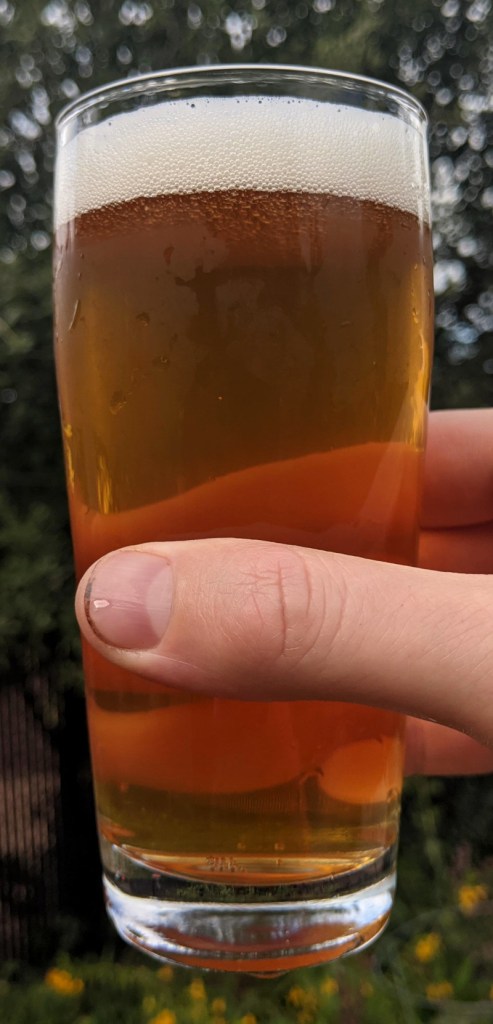
    • Deep gold/light amber color, and very clear, approaching brilliant. The beer pours with a creamy ivory head that is quite persistent. Overall, though, this batch is just a touch lighter in coor than is appropriate by the BJCP style guide.
  • Aroma
    • The beer has a light caramel aroma, with a slight “woody” hop character as appropriate for this style.
  • Flavor
    • This has a moderately high level of bitterness and a nice woody character to the hop flavor. This one tastes moderately malty with a light caramel note and a slight bit of toastiness. Yeast character is very clean. Overall, this one tilts towards bitterness rather than maltiness.
  • Mouthfeel
    • Medium-light body and moderate level of carbonation, with a clean, off-dry finish.
  • Would I brew this again?
    • Overall, this is a pretty nice California Common! There’s not much to say otherwise; I think the overall recipe is pretty well locked in. If I wanted to be a stickler for BJCP guidelines, I should adjust the color slightly with a bit of Carafa Special III or something like that. I also wouldn’t mind a tiny hint of fruitiness in the yeast character, and thus might try fermenting at a slightly higher temperature next time. All that aside, I’m pleased with this one!
  • Overall
    • 8.5/10

Easy Days Ale

My lighter-colored beers lately have been primarily lagers, but it is nice to switch this up from time to time. So, I decided to create an experimental ale recipe that hit the target of being sessionable, flavorful (with some malt character and a bit of hop character too), and light in color. It doesn’t really conform to any style, although I guess you could make an argument that it’s an American(ish) blonde ale. No matter what you call it, it’s pretty darned good! I also have the memory of sharing a few glasses of this with a good friend who was going through a pretty rough spot in life…although it sounds cheesy (and perhaps it is), so much of brewing isn’t just the end product, but the memories that go with each glass and the people with whom it is shared.

Easy Days Ale

  • 4 lb. Finest Maris Otter Malt (Crisp)
  • 4 lb. 2-row Xtra Pale Malt (Viking)
  • 1.5 lb. white wheat malt (Briess)
  • 11 oz. caramel 10L malt (Briess)
  • 4 oz. Melanoidin malt (Weyermann)
  • 4 oz. rice hulls
  • 0.25 oz. Magnum hop pellets (10.1% alpha), 60 minute boil
  • 1 Whirlfloc tablet, 5 minute boil
  • 0.8 oz. Simcoe hop pellets (12.7% alpha), 15 minute whirlpool
  • 1 pkg. Safale American ale yeast (US-05)

Target Parameters

  • 1.047 s.g., 1.011 f.g., 4.7% abv, 18 IBU, 6 SRM
  • Claremont tap water, treated with Campden tablet to remove chlorine
  • Full volume infusion mash at 154°, 60 minutes

Procedure

  • I mashed in with 7.25 gallons of water at 160°, to target 154° for 60 minutes, with recirculation. I added 7.5 mL of 88% lactic acid, to reduce the mash pH. After 60 minutes, I raised the mash to 168° for 10 minutes, before removing the grains.
  • In total, I collected 6.4 gallons of runnings with a gravity of 1.041, for 67% mash efficiency.
  • I brought the runnings to a boil, adding hops and finings per the recipe. After a 60 minute boil, I turned off the heat and added the whirlpool hops for a 15 minute whirlpool.
  • After the whirlpool, I chilled the wort down to ~75°, before putting it into the fermentation chamber and chilling it the rest of the way to 68°.
  • I brewed the beer on 16 April 2021, and it had a starting gravity of 1.048.
  • I fermented at 68° until 23 April 2021, when I moved the beer to ambient temperatures.
  • I kegged the beer on 6 May 2021, and noted a final gravity of 1.015. This is a bit higher than expected, working out to 4.3% abv.

Tasting

  • Appearance
    • Medium gold with slight haze, moderately persistent white head
  • Aroma
    • Lightly malty; light bread dough character, with a light hint of caramel. No hop aroma.
  • Flavor
    • Moderate doughy, light malty character; relatively low, clean bitterness; a light tartness from the wheat that is pretty pleasant.
  • Mouthfeel
    • Moderately light body; smooth finish; moderate carbonation.
  • Would I brew this again?
    • This is a very solid session ale; it’s nothing spectacular, but I’m OK with that. I think it would benefit from a little more hop character; the bitterness is fine, but I think a little dry hop charge or a hop stand would help to liven this up a bit. It’s very drinkable, and makes a nice go-to on the tap selection. The malt character is pretty nice; it’s a little more interesting than the usual “2 row+crystal” malt zone that many ales of this type occupy.
  • Overall
    • 9/10

What’s Brewing? May 2021 Edition

Once again, this month’s update slides in just under the wire…it has been a busy month outside of the brewery, and a busy one in the brewery! For a variety of reasons, I haven’t been brewing the past two weekends, although I did some other fermentation projects as well as a whole mess of kegging.

Beer Batch Updates

  • My California Common is now kegged, as of 9 May 2021.
  • I kegged the session ale (Easy Days Ale) on 6 May 2021.
  • I brewed the 2021 version of my white IPA on 14 May 2021, and got it kegged on 29 May 2021. Right now, I’ve got the dry hops bagged and doing their thing, with a plan to pull them out after 3 days of dry hopping at near-freezing temperatures.
  • I brewed my Dunkel-Osteus (Munich dunkel) on 8 May 2021, and kegged it at the same time that I kegged the white IPA.
  • I brewed a Schell’s Pilsner Clone on May Day, and it’s currently cold-crashing prior to kegging.

What’s On Tap?

  • Clonal Common 2021 (my California common) is on tap, and drinking very nicely. It has dropped pretty clear, and as before is a really nice take on the style.
  • Easy Days Ale, a lighter session ale that isn’t made to any particular style parameter, has been drinking super easily. It’s a really refreshing beer, and I’ve been going through it pretty quickly.
  • The schwarzbier is on its very last stretch, and will likely be finished soon. I’ve been savoring that one, because it’s just that good.

What’s Coming Up?

  • I’m planning to brew another batch of my orange summer wheat ale next weekend, to have it ready to drink about two weeks later.
  • I’ll do this year’s edition of “Mow the Damn Lawn” in June also, if all goes well.

Other Notes

  • Last weekend had a ton of fermentable food projects.
    • My sauerkraut supply is getting low, so I laid in a new batch of that.
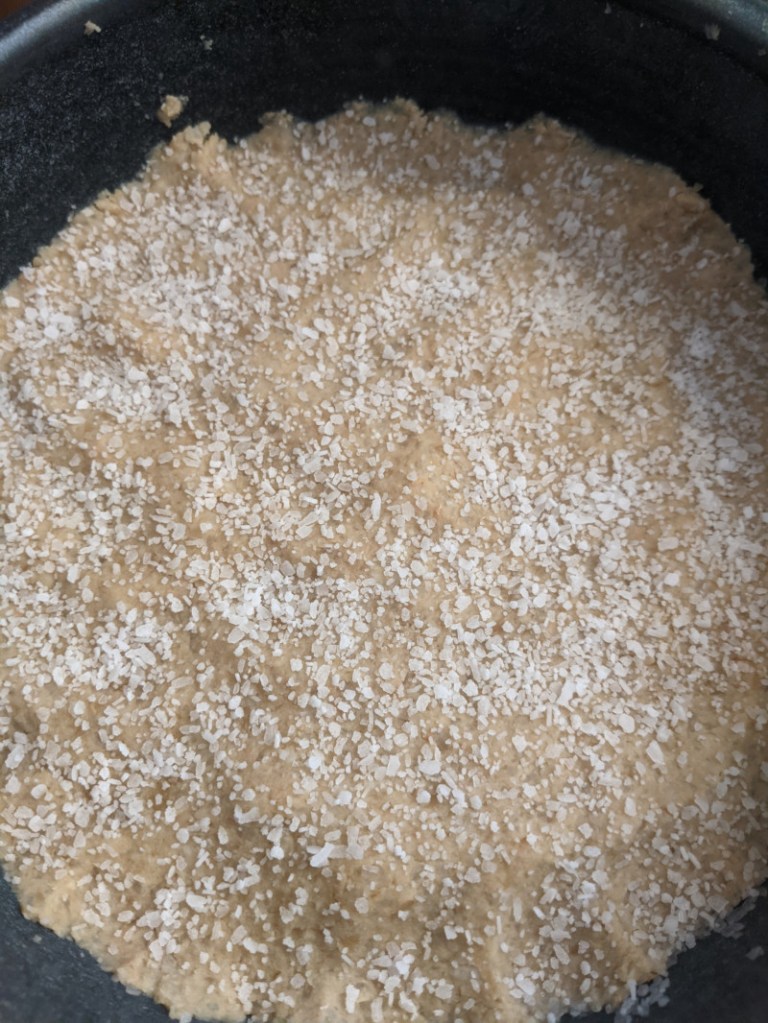
    • For a new experiment, I made a batch of miso. The March/April issue of Zymurgy magazine had a tutorial, and I was intrigued enough to give it a go. It was quite a production, but I am hopeful that this will be well worth the effort. I had to soak the soybeans overnight, simmer them for about 6 or 8 hours, cool them, and then mash them in with koji rice grains. The concoction is now fermenting at room temperature, getting pressed under a 5 pound bag of flour atop a plate.
Miso at the start of fermentation, appearing as a beige paste with white flakes of salt on top, in a dark blue crock
Proto-miso, as it looked at the start of fermentation.

Pliny the Elder Clone

Pliny the Elder is probably one of the most highly regarded and sought-after beers in the US, but I think I’ve only had it once. I remember it being pretty good, but not mind-blowing…but then again, that was awhile ago. Even so, I thought it would be fun to make a clone to fill the “high ABV beers” space for a little while.

The clone recipe is from the Brew Your Own Big Book of Homebrewing, although various versions are fairly readily available elsewhere. I scaled it down to ~3 gallons, because I didn’t really want a massive quantity of something around 8 percent abv.

Pliny the Elder Clone

  • 7.75 lb. 2-row Xtra pale malt (Viking)
  • 4 oz. Carapils malt (Briess)
  • 3 oz. caramel 40L malt (Briess)
  • 9.6 oz. corn sugar (added to boil)
  • 2.55 oz. Magnum hop pellets (10.1% alpha), 90 minute boil
  • 0.3 oz. Chinook whole hops (13.1% alpha), 90 minute boil
  • 0.65 oz. CTZ hop pellets (15.8% alpha), 45 minute boil
  • 0.6 oz. Simcoe hop pellets (12.7% alpha), 30 minute boil
  • 1.35 oz. Centennial hop pellets (8.1% alpha), 15 minute whirlpool
  • 0.6 oz. Simcoe hop pellets (12.7% alpha), 15 minute whirlpool
  • 1 pkg. Safale American ale yeast (US-05)
  • 2 oz. Columbus (Tomahawk) hop pellets (14.2% alpha), dry hop in keg
  • 1 oz. Centennial hop pellets (8.1% alpha), dry hop in keg
  • 1 oz. Simcoe hop pellets (12.7% alpha), dry hop in keg

Target Parameters

  • 1.071 s.g., 1.010 f.g., 8.2% abv, 276 IBU (100+ IBU at best!), 5 SRM
  • Claremont tap water with Campden tablet to remove chloramine
  • Infusion mash at 150° for 60 minutes, with pour-over sparge

Procedure

  • I mashed in with 3.75 gallons of water at 159° and 4 mL of 88% lactic acid, to hit a mash temperature of 150° for 60 minutes, with recirculation after 10 minutes. Then, I heated to 168° and held there for 10 minutes. Then, I removed the grain basket, and sparged slowly with 1.6 gallons of hot water.
  • After the mash, I collected 4.75 gallons of runnings with a gravity of 1.054, for 79% mash efficiency. Sparging seems to be the ticket for great efficiency in these high gravity small batch mashes.
  • I brought the runnings to a boil, adding hops and finings per the recipe.
  • After a total of 90 minutes on the boil, I chilled down to 70°, transferred to the fermenter, and pitched the yeast.
  • I brewed this beer on 10 April 2021. Starting gravity was 1.072, right about where I wanted it! I fermented at 66°.
  • I kegged the beer on 23 April 2021, and dry hopped with a sack of hops in the keg. There was quite a bit of trub on the bottom of the fermenter!
  • Final gravity was 1.015, for 7.6% abv.

Tasting

  • Appearance
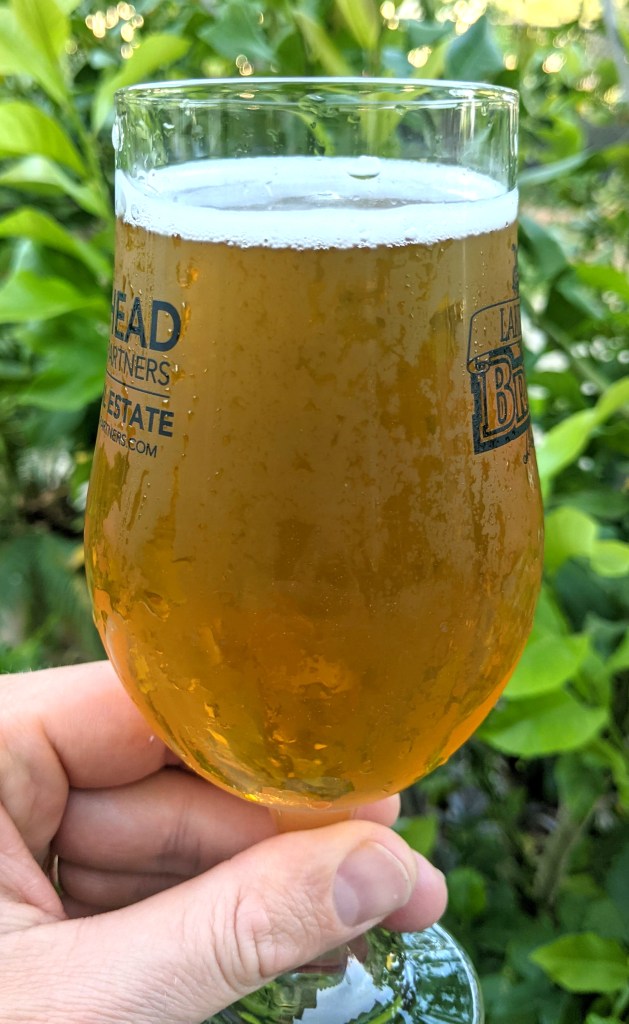
    • The beer has a rich gold color, with a slight chill haze. It took about two weeks in the keg before it dropped fairly clear. There is a low ivory head that is fine and fairly persistent.
  • Aroma
    • The aroma is hop forward, with an initial citrus and very slight tropical fruit character, and a light caramel malt quality. Fermentation profile is pretty clean.
  • Flavor
    • The flavor is very hop forward, with a high level of bitterness (no surprises). The bitterness has a citrus pith character, with slight grapefruit, and fairly clean. The bitterness is not quite as complex as I might like. The malt character is fairly low, with a slight doughy character.
  • Mouthfeel
    • The beer has a medium body with moderate carbonation, and an extended bitter finish that isn’t overly dry. I feel that the body could be a bit lighter on this one.
  • Would I brew this again?
    • The beer is okay, but the hops feel a bit one-note. This is a surprise, given the quantity of hops involved as well as the dry hop in the keg. I might switch in some more aggressively tropical hops next time, to make this a bit more interesting. I would also mash this at a slightly lower temperature, to dry out the final product a bit. Finally, I would adjust my dry hop strategy–this quantity of hops really generates a lot of detritus, even after sitting for awhile, and I think it would be better served by dry hopping in the fermenter with a careful transfer under CO2.
  • Overall
    • 5/10

Alta California Lager 2021

One of the best beers I have ever made was the 2019 edition of Alta California Lager, a Mexican-style light lager. Although I can buy excellent commercial examples easily enough at the grocery store, it is a fun challenge to make this somewhat unforgiving style. The 2020 version was okay, but not quite as good. That round used flaked corn instead of cereal-mashed grits, and I also had to use tap water (because I brewed it near the start of the pandemic, and wasn’t going out much) instead of mineral-light water built from RO.

My main changes for the 2021 version were to modify slightly for my Foundry system parameters, build up from RO water, throw in some BruTanB for clarification/oxidation mitigation, and use gelatin at the time of kegging for fining. I also went back to a cereal mash instead of flaked corn, in order to up the corn flavor and also hopefully get slightly better clarity. It’s also just a bit fun to do a cereal mash (sometimes)!

Alta California Lager 2021

  • 6 lb. Pilsner Zero malt (Viking)
  • 2 lb. Vienna malt (Weyermann)
  • 2 lb. corn grits
  • 4 oz. rice hulls
  • 0.45 oz. Magnum hop pellets (10.1% alpha), 60 minute boil
  • 0.5 tsp. BruTanB, 10 minute boil
  • 1 Whirlfloc tablet, 5 minute boil
  • 0.8 oz. Sterling hop pellets, 5 minute boil
  • 1 tsp. Fermax yeast nutrient, 5 minute boil
  • 1 pkg. Mexican Lager yeast (WLP940), prepared in 1.75L starter

Target Parameters

  • 1.046 s.g., 1.011 f.g., 4.6% abv, 21 IBU, 4 SRM
  • 6.5 gallons of RO water with 1.5 g CaCl to hit target parameter of 17 ppm Ca and 29 ppm Cl
  • 60 minute full volume infusion mash with cereal mash, 152°

Procedure

  • I made a 1.75L starter with 175g of DME, on March 4 (two days before brewing). I cold crashed the starter on the morning of the brew day (March 6), because fermentation had slowed greatly, but not quite stopped.
  • For the cereal mash, I used 2 pounds of corn grits plus 0.5 lb. pilsner malt. I had to add ~1 gallon of water to get the right consistency. I added another ~0.5 gallon due to absorption over the course of the cereal mash. I held the mash around 158° to 160° for 5 minutes before bringing it to a boil. It was closer to a 40 minute boil instead of the planned 30 minutes, to compensate for the fact that the boil stopped as I added cold RO water.
  • For the main mash, I added 6.5 gallons of RO water with 1.5 g CaCl in the main mash tun. This was heated to 150°. I added the hot cereal mash first, and then added the dry malts and stirred them. After adding the cereal mash, it hit around 146 to 148°; not bad! I let the mash settle for 10 minutes before recirculating at 152°. I did a 75 minute mash, just to be safe with full conversion. An iodine test showed full conversion after 65 minutes. Then, I raised the mash to 168° for 10 minutes, before removing the grains.
  • In total, I collected 6.75 gallons of runnings with a gravity of 1.039, for 70% mash efficiency.
  • I boiled for 15 minutes before adding the hops, to bring down the volume and bring up the gravity a touch. So, this meant a 75 minute boil total. Everything else followed the schedule in the recipe.
  • After the boil, I chilled the beer down to ~70°, transferred to the fermenter, and chilled down to 48°. I oxygenated for 40 seconds and then pitched the yeast.
  • I brewed this beer on 6 March 2021.
  • Starting gravity was 1.045, and I fermented at 50°.
  • I raised the beer to 54° on 12 March 2021, and then to 60° on 15 March 2021. On 29 March 2021, I cold crashed and let it sit near freezing until kegging on 5 April 2021.
  • I did a closed transfer, and then briefly opened the lid to add 1 tsp. of gelatin in 1 cup of water, for fining.
  • Final gravity was 1.012, for 4.3% abv.

Tasting

  • Appearance
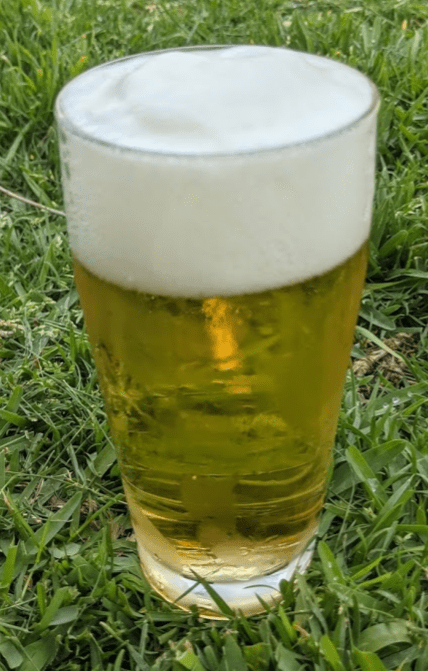
    • Brilliantly clear, light yellow beer with a persistent and fine white head. Gorgeous!
  • Aroma
    • Very clean and crisp, with a subtle, slightly sweet note (probably from the corn) along with a grainy malt note.
  • Flavor
    • The flavor profile is pretty subtle and unobtrusive on this one, making it a very easy drinking beer. There is a very light corn (not DMS!) note, layered on top of the grainy malt character. Bitterness is pretty low and very clean.
  • Mouthfeel
    • Medium-light body, moderately high carbonation, smooth and light finish.
  • Would I Brew This Again?
    • Absolutely! This is a really delightful beer, and I’m so glad that I made it again. It drinks so easily, especially on a warm afternoon, and is just about a perfect beer. The extra work for the cereal mash was perhaps worth it? The gelatin certainly helped the clarity, and I think the fact that I used BruTanB, did a closed transfer, and then purged the keg before adding the gelatin, followed by additional purges, probably helped stave off early oxidation. I’m so impressed by this beer! I might try it next time with flaked corn, and gelatin. My only other very minor note is that I could mash a touch lower, to lighten up the body a bit more…perhaps a 90 minute mash at 145° or so? That’s the only reason I gave it a 9.5 instead of a perfect 10!
  • Overall
    • 9.5/10