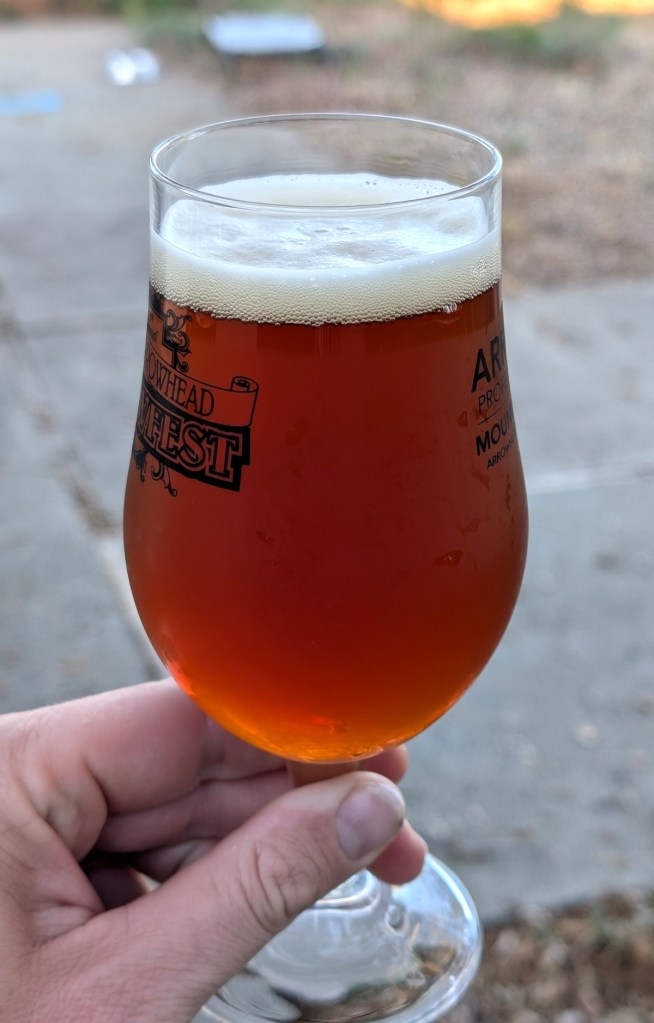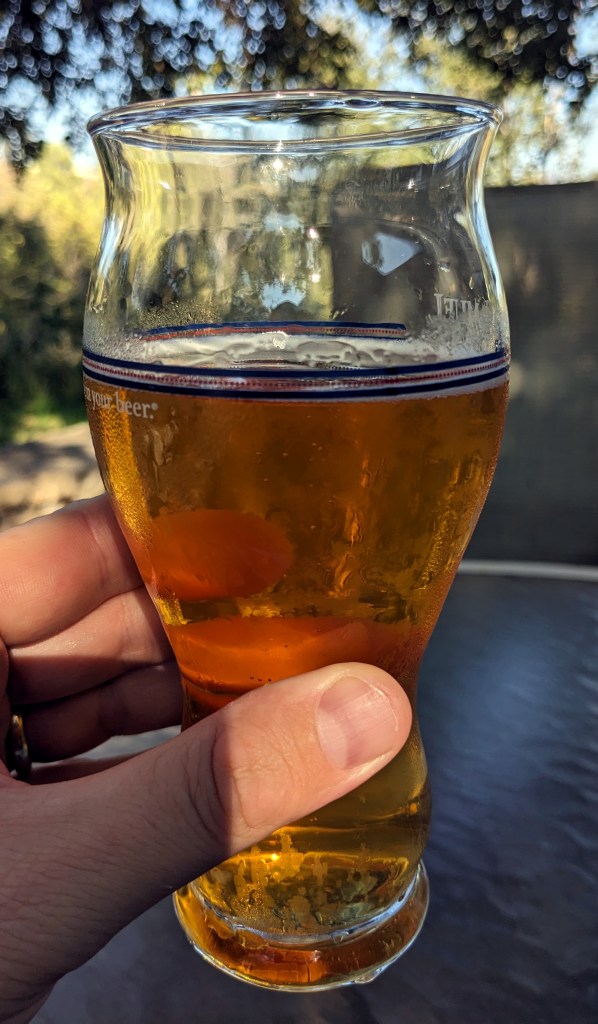
Totality Blonde Ale

It has been nearly six years since I’ve done a proper blonde ale, because pilsners are now my go-to for a light, drinkable brew. In the interest of returning to my roots, I made some light modifications to Gordon Strong’s New World Blonde Ale in Modern Homebrew Recipes. I have made a version of this previously, and the main edit here was to the hops. I wanted a beer that would be relatively simple to brew and ferment, but also with some interesting hop character. The name is a nod to the recent total eclipse–enhanced by the astronomically-themed hop varieties.

For a little extra fun, I drafted a bottle label for the beer — the stylized sun matches the pattern of prominences and the visible corona shape visible on April 8, 2024.

beer label with blue background and stylized sun in total eclipse surrounded by stars, with text that says Totality Blonde Ale, Farke Brewing, 5.2% abv, April 8, 2024

Totality Blonde Ale

  • 4.75 lb. 2-row malt (Briess)
  • 4.75 pilsner malt (Rahr)
  • 8 oz. Munich I malt (Weyermann)
  • 4 oz. Caravienne malt (Dingemanns)
  • 0.25 tsp. BrewTanB (added to mash)
  • 0.5 oz. Galaxy hop pellets (15.3% alpha), 10 minute boil
  • 0.25 tsp. BrewTanB, 10 minute boil
  • 1 Whirlfloc tablet, 5 minute boil
  • 0.5 oz. Galaxy hop pellets (15.3% alpha), 5 minute boil
  • 1 pkg. California Ale dry yeast (White Labs, WLP001)
  • 2 oz. Eclipse hop pellets (17.6% alpha), dry hop in keg
  • 1 oz. Galaxy hop pellets (15.3% alpha), dry hop in keg

Target Parameters

  • Full volume infusion mash to hit target of 152°, 60 minutes, no sparge
  • 1.047 o.g., 1.010 f.g., 4.8% abv, 16 IBU, 5 SRM
  • Water built from RO to hit 49 ppm Ca and 87 ppm Cl

Procedure

  • I formulated the strike water with 7.25 gallons of RO water and 5 g of CaCl, to match the desired water profile. I heated the water to 157°, before adding my grains and 0.9 mL of 88% lactic acid. I held the temperature at 152° for 60 minutes, with recirculation, before raising the mash to 168° for 10 minutes and then pulling the grains.
  • In total, I collected 6.5 gallons of runnings at 1.041, for 71% mash efficiency.
  • I brought the kettle to a boil and added hops and finings per the recipe. After a 60 minute boil, I turned off the heat and chilled to 68°. Once transferred to the fermenter, I pitched the yeast.
  • I brewed this beer on 12 April 2024. Starting gravity was 1.049.
  • I fermented the beer at 68°, and evidence of vigorous fermentation was visible by 14 April 2024.
  • Final gravity was 1.009, for 5.2% abv. I kegged the beer using a closed transfer on 11 May 2024, and added the hops in a baggie (very quickly opening the lid to the keg). I attempted to remove them a few days later after carbonation, but they had sunk to the bottom already.

Tasting

  • Appearance
    • Gold beer with very slight haze. Pours with a persistent and fluffy white head that leaves slight lacing on the glass.
  • Aroma
    • Medium-light hop aroma; some peach, maybe a bit of orange. This is alongside a light malty aroma, with slight caramel/candy aspects.
  • Flavor
    • Medium bitterness and medium maltiness. There is maybe a slight fruity nature in the beer, but it’s quite subtle; probably from the hops? As it warms, it becomes “peachier” in nature!
  • Mouthfeel
    • Medium body, moderate carbonation, smooth and slightly dry finish.
  • Would I Brew This Again?
    • This is a pretty decent blonde ale! It comes in perhaps a touch more bitter and dry than I would like, and the slight haze (probably from the dry hops) is a minor style ding, but overall it’s quite drinkable. I enjoy revisiting this classic style! The peach character–presumably from the Galaxy hops–is really nice
  • Overall
    • 8/10

Humboldt’s Hefeweizen 2024

I have made weissbiers (hefeweizens) a few times previously, with decent but not consistent results. This is a style that can be quite enjoyable or quite awful, so I invested some time into learning more of the underlying ingredients and techniques for a tasty, traditional recipe. An article at brau!magazine was incredibly useful, with lots of detailed suggestions. I reformulated my previous Humboldt’s Hefeweizen (because I like the name) for this batch.

My first big decision–perhaps the most important–was yeast choice and fermentation control. Without a good yeast character, you don’t have a good hefeweizen (in my opinion). I am fairly committed to using dry yeast whenever possible because the convenience can’t be beat, and I wanted to give Lallemand’s Munich Classic another chance. My previous attempt was okay, but had little of the yeast character I wanted. That batch was fermented cool (~65°), and I knew I should up the temperature a bit to get more “oomph” to the yeast. So, I aimed for 67°. Working backwards, I decided a ferrulic acid rest would be critical–my previous batch didn’t use that, and I think that factor also set back beer quality.

My second decision concerned the grist. Past beers were ~45 to 55 percent wheat, and I wanted to increase that. This time around, I aimed for over 60 percent wheat, in hopes that it would 1) be more true to style; and 2) tilt the head quality in a positive direction.

I had fun formulating the batch and figuring out what would give the best results. The end product was definitely worth it!

Humboldt’s Hefeweizen 2024

  • 6.75 lb. red wheat malt (Briess)
  • 4 lb. pilsner malt (Rahr)
  • 0.5 lb. rice hulls
  • 0.5 tsp. BrewTanB (mash)
  • 1 oz. Sterling whole hops (4.5% alpha estimated), 45 minute boil
  • 0.5 tsp. BrewTanB, 10 minute boil
  • 1 tsp. yeast nutrient (White Labs WLN1000)
  • 1 pkg. Munich Classic Wheat Beer yeast (Lallemand)

Target Parameters

  • 1.049 o.g., 1.010 f.g., 5.2% abv, 14 IBU, 5 SRM
  • Full volume mash, no sparge, 113° mash for 20 minutes, 145° mash for 45 minutes, 162° mash for 30 minutes
  • RO and Claremont tap water, mixed to hit 10 ppm Ca, 4 ppm Mg, 18 ppm Na, 16 ppm SO4, 19 ppm Cl, 3 ppm CaCO3, RA=-7, effective hardness=10 ppm.

Procedure

  • I collected 2.5 gallons of Claremont tap water and neutralized it with 1.76 mL of 88% lactic acid and a small bit of Campden tablet. Then, I added 5 gallons of RO water, to hit my mash water profile.
  • I started the mash at 113° for 20 minutes, to enable a ferulic acid rest. Then, I raised the mash to 145° for 45 minutes, and finally ended at 162° for 30 minutes. Once the mash was done, I pulled the grains and heated the runnings to a boil.
  • The kettle had 6.6 gallons of runnings with a gravity of 1.040, for 65% mash efficiency. This was a touch lower than I anticipated, but that may be due to the high amount of wheat.
  • Once the kettle was boiling, I added finings per the schedule and then turned off the heat after 60 minutes. A slightly greater boil vigor was used to increase gravity. I chilled the wort to 66° and then transferred to the fermenter.
  • I brewed this beer on 14 April 2024. Starting gravity was 1.048, nearly exactly to target.
  • After pitching the yeast, I started fermentation at ambient for a few hours, and then transferred the fermenter into my fermentation chamber set for 67°. Fermentation seemed to take off pretty quickly!
  • I kegged the beer on 24 April 2024. The beer had an amazing aroma–a decent amount of spicy phenol and a hint of banana; exactly what I was looking for! I carbonted to a higher level, around 3.5 volumes of CO2.
  • Final gravity was 1.014, for 4.4% abv.

Tasting

  • Appearance
    • Pours with a merangue-like, tall, gorgeous white head that sticks around for ages and leaves gorgeous lacing on the glass. The beer itself is straw yellow and hazy beer. It’s exactly as a fresh hefeweizen should be!
  • Aroma
    • Yeast at the forefront, with a medium-high level of yeast character–primarily clove plus a touch of banana.
  • Flavor
    • Even balance of clove and banana, and a light dough malt character behind that. Low level of bitterness.
  • Mouthfeel
    • Light body. medium-high carbonation, smooth, lightly dry finish (from the hops?).
  • Would I brew this again?
    • This is the best hefeweizen I have made. Everything ran perfectly, and I wouldn’t change a thing. The yeast quality is perfect, head is perfect, all is amazing. It had a sulphur aroma and flavor early on; this faded in a few days.
    • Overall
      • 10/10

Rated “PG” for Pineapple Guava

Even though I have lived here for nearly 16 years, I didn’t grow up in southern California, and so I’m always learning something new about the the kinds of fruits and vegetables that grow in this climate. Last fall, I noted a bunch of fruit on a tree adjacent to our home, and upon examination found that it was rather tasty in aroma. A little internet research revealed the source–feijoa, or pineapple guava!

green fruit with white bloom on the surface -- the fruit are somewhat egg-shaped, and laying on the ground

Pineapple guava (I’ll use that name throughout) are native to parts of South America, including Brazil, Argentina, Uruguay, and Paraguay, and have been cultivated in many areas with appropriate climate (apparently they are particularly popular in New Zealand). A member of the myrtle group, rather than a true guava, pineapple guavas produce a small (one to two inch across), green-skinned fruit that tastes and smells almost exactly how the name sounds. Somewhat counter-intuitively, they are not ready to eat until they drop from the tree and onto the ground!

Once I found this fruit, I knew that it would be perfect for enhancing a sour beer–something low abv, refreshing, and spritzy. I chose a Berliner Weisse-style grain bill (50% pilsner, 50% wheat malt), aiming for ~1.030 s.g. I didn’t want a highly hopped beer, so I used ~1 oz. of South Dakota Saaz hops. I didn’t know the alpha acid, but if I added them late enough it didn’t really matter. For this beer, I wanted an easy sour, with a clean character that would let the fruit shine through. Wildbrew Philly Sour was an obvious choice, enhanced by the fact that I wouldn’t have to worry as much about contamination of other batches. The fruit is a fair bit of effort to pick and process, so I stuck with a 2.5 gallon batch, aiming for one pound of fruit per gallon of beer.

The results were totally worth it! This is one of the best experimental brews I made in a long time, and it was really fun to highlight something that I picked from our yard.

Rated “PG” for Pineapple Guava

  • 2 lb. pilsner malt (Rahr)
  • 2 lb. red wheat malt (Briess)
  • 2 oz. rice hulls
  • 1 oz. Saaz whole hops (est. 3.5% alpha), 10 minute boil
  • 0.5 tsp. BrewTanB, 10 minute boil
  • 0.5 tsp. yeast nutrient (WLN1000), 5 minute boil
  • 0.5 pkg. Wildbrew Philly Sour yeast (Lallemand)
  • 2.5 lb. pineapple guava puree

Target Parameters

  • 1.031 o.g., 1.006 f.g., 3.2% abv, 8 IBU, 3 SRM
  • Full volume mash, no sparge, 152° mash for 60 minutes, 10 minute mash-out at 168°
  • Claremont tap water, neutralized with 88% lactic acid and treated with Campden tablet

Procedure

  • Starting with 4.75 gallons of tap water, I added 1/4 Campden tablet and 3.2 mL of 88% lactic acid to remove the carbonates. I heated the strike water to 156°, before adding the grains along with 0.7 mL of 88% lactic acid. I held the mash at 152° with recirculation for 60 minutes.
  • After the 60 minute mash, I raised the temperature to 168° for 10 minutes, before pulling the grains.
  • Overall, I collected ~4.5 gallons of runnings with a gravity of 1.025, for 76% mash efficiency.
  • I boiled for 60 minutes, adding finings and hops per the recipe.
  • After turning off the heat, I chilled the wort to 85° and transferred to the fermenter. I pitched a half packet of Philly Sour and sealed up the fermenter.
  • I brewed this beer on 2 April 2024. Starting gravity was 1.033, and I fermented the beer at 80°.
  • I picked the fruit way back in December, peeled it, and put everything into the deep freezer until beer time. I thawed the fruit or a day or two, pureed it, and then pasteurized at 161° for 30 seconds. I let it cool a bit, and then added to the fermenter. All of this happened on 3 April 2024, very early in fermentation.
  • I kegged the beer on 18 April 2024. Final gravity was 1.009, for 3.1% abv.

Tasting

  • Appearance
    • Hazy straw color, like the appearance of grapefruit juice. Pours with a thick white head that persists well.
  • Aroma
    • Quite prominent guava fruit aroma at the forefront, with a little doughy character behind that.
  • Flavor
    • The beer is fairly tart, but not puckeringly sour, at first impression. The tropical fruit character is definitely there, but it’s subtle–notes of guava (unsurprisingly) dominate. Some doughy wheat character hides behind it all, at a low level. Barely perceptible bitterness.
  • Mouthfeel
    • Light body, spritzy carbonation, slightly dry finish.
  • Would I Brew This Again?
    • Yes! This is a perfectly refreshing beer, well suited for the warming afternoons of spring. It is crisp, but not watery. The fruit is gorgeous on the aroma and perfectly restrained on the flavor. It’s that rare fruited beer where you can pick up the fruit character, but it takes a few seconds to process the flavor. This batch was a good bit of extra work in the fruit process, but absolutely worth it. I have sometimes seen some dismissive comments about Philly Sour being too one-note in character, but that is perfect for this beer as a way to let the subtle fruit notes take center stage. I know that I’ll never find a beer like this commercially, and that’s so much of the fun of homebrewing!
  • Overall
    • 10/10
dark green tree
The feijoa tree in all of its glory — the tallest branch is perhaps 8 or 10 feet off the ground

10 Years of All-Grain Brewing

Looking back through old blog posts, I realized that my first all-grain beer was just over 10 years ago! It was a little intimidating to get started–those days were before the now ubiquitous all-in-one systems, back when the most visible mode of brewing was a shiny (and expensive, and space-hogging) three-tier system. Thankfully, I discovered batch sparging, and this tipped the scales enough for me to try at all-grain.

I have learned a ton since then, so wanted to jot down some of the lessons for posterity. Here we go!

  • Crush is probably the most important factor for me. It can be make-or-break, especially when first learning process, and it has been so worth it to get a mill of my own so that I can dial in this variable. This has made my extraction efficiency quite predictable!
  • For those going into all-grain brewing nowadays, I would suggest either brew-in-a-bag (especially for smaller batches or smaller budgets), or an all-in-one. The Anvil Foundry has been a great investment, and makes my brew sessions all the more enjoyable. A three-tier system just isn’t worth it for me, and I would say even batch sparging is not a good route if you have the cash for all-in-one or brew-in-a-bag.
  • Mash temperature matters, but not as much as I thought. I used to obsess over being within a fraction of a degree, and that was not mental energy well spent. If you are 5 or 10 degrees off — sure, that’s going to affect your intended results. But if you are within 1 or 2 degrees, it’s almost certainly not going to be noticeable.
  • It’s worth having a stash of bulk base malts. At one point, I had three or four bags on-hand, and now I’m down to 2-row and pilsner as my usuals. Perhaps I should pick up a bag of Maris Otter and/or Vienna, but I just don’t brew enough for styles that require them. I don’t think I’ve ever gotten Munich in bulk, but it’s so strong as a flavor that I don’t use it much.
  • Decoctions can be fun. It’s worth giving a try sometime. Same for cereal mashes. But, you can make great beer without them.
  • The biggest benefit of all-grain brewing for me? I get endless recipe control, and it opens up a ton of (grain) ingredients and styles that would be hard to do otherwise.
  • All-grain brewing is no substitute for good temperature control.
  • Sometime soon, I need to do an extract batch. Just for fun, and to see if what I have learned will generate something awesome.

Above: A series of images over the years showing my evolution of all-grain brewing. From left to right, top row: my first mash tun; an early decoction effort; second row: grains ready for a brew; a full sack of malt; a very full mash tun for a high gravity beer; third row: checking temperature; the Anvil Foundry in an early brew.

Eagle Face Oatmeal Stout 2024

dark stout with tan head in tall, slightly bulged-out craft beer glass, sitting on table
Eagle Face Oatmeal Stout, in a Spiegelau stout glass. I know that beer can be enjoyed in nearly any glassware, but this sure does look pretty!

I have brewed this one many times before, and it is a house favorite. After a two-and-a-half year hiatus, I once again returned to my favorite oatmeal stout recipe. This version has two significant departures — firstly, I returned to the use of 2-row rather than Maris Otter in the recipe. The very first brew used 2-row, and I have more frequently used Maris Otter since. The biggest change here, though, was to try out BRY-97 instead of Nottingham or another higher attenuation English ale yeast. I figured it would be a worthy experiment, creating a more “American” take on the style.

Eagle Face Oatmeal Stout 2024

  • 8.5 lb. 2-row malt (Briess)
  • 1.25 lb. flaked oats (Quaker)
  • 1 lb. 80L caramel malt (Briess)
  • 1 lb. Victory malt (Briess)
  • 0.5 lb. chocolate malt (Bairds)
  • 0.5 lb. roasted barley (Crisp)
  • 0.25 lb. chocolate malt (Simpsons)
  • 1.1 oz. Magnum hops (10.1% alpha), 45 minute boil
  • 1 Whirlfloc tablet, 5 minute boil
  • 1 pkg. American West Coast Ale dry yeast (BRY-97, Lallemand)

Target Parameters

  • 1.058 o.g., 1.015 f.g., 5.6% abv, 35 IBU, 48 SRM
  • Full volume mash, no sparge, 156° mash for 60 minutes, 10 minute mash-out at 168°
  • Claremont tap water, treated with Campden tablet

Procedure

  • I mashed in with 7.75 gallons of Claremont tap water, heated to 163°. I also added 3 mL of 88% lactic acid.
  • I held the mash, with recirculation, at 156° for 60 minutes, before raising to 168° for 10 minutes and then pulling the grains.
  • I collected 6.75 gallons of runnings with a gravity of 1.050, for 72% mash efficiency.
  • I brought the runnings to a boil, adding hops and finings per the recipe. After 60 minutes, I turned off the heat and chilled to 68°.
  • I transferred the wort to my fermenter, pitched the yeast, and started it at ambient (~65°) in my back room.
  • I brewed the beer on 6 January 2024. The starting gravity was 1.056.
  • I kegged the beer on 18 March 2024. Final gravity was 1.020, for 4.8% abv.

Tasting

  • Appearance
    • Very deep brown & clear beer that pours with a fine tan head, with decent persistence.
  • Aroma
    • Clean, chocolate and coffee aroma, with a touch of roastiness. Not much for hop or yeast aroma.
  • Flavor
    • Roasty coffee in the malt profile, and a bit of subtle graininess behind that. Moderate level of bitterness.
  • Mouthfeel
    • Medium body, moderate carbonation, very slightly dry finish.
  • Would I Brew This Again?
    • This recipe is still a winner! My 2024 edition is a touch drier than I recall in past versions, likely because I went with BRY-97 rather than Nottingham. The return to 2-row also probably lightens the flavor a bit. I would consider this one an Americanized version of the style, but I’m ok with that. All of the past versions have been great, but this one is probably most “drinkable” (in terms of having more than one glass). I served the beer at a recent gathering, and it was certainly quite popular! It’s nice to know the recipe has a bit of flexibility–this version might be better for the warmer days of spring, and the “traditional” recipe targeted better for cold winter nights.
  • Overall
    • 9/10