Andy’s Orange Wheat Ale Bottled

Yesterday (March 24), I bottled up the orange wheat beer, skipping a secondary fermentation stage. The beer had fermented for 11 days and reached a final gravity of 1.013. With a starting gravity of 1.042, the ABV is 3.9%. Because my sources suggest a higher amount of carbonation for the American Wheat style, I used 1 cup + 2 tbs. of corn sugar boiled in 2 cups of water for the primer. I ended up with 35 12-oz. bottles, 7 16-oz. bottles, and 2 22-oz. bottles.

The beer has much of what I’d expect for a wheat ale and the strain of yeast that I used. The appearance is pretty cloudy, and when tasted at room temperature there is a distinct banana finish, with no clove or citrus flavor apparent. When I cool the beer down, however, the banana is much diminished and a distinct citrus note pokes through. The color is perhaps a little darker than I anticipated, but this may be due to the fact that I used liquid rather than dry malt extract. In any case, I think this is going to be a nice warm-weather beer!

Andy’s Orange Wheat Ale

The brew season really is nearing its end; as my hectic spring schedule looms and the temperatures continue to rise, it’s time for one final(?) batch. Of course, I want something that will be refreshing and thirst-quenching in the coming warm months. What’s better for that than a light and flavorful wheat beer?

One of my favorite local brews is Hangar 24‘s Orange Wheat Beer. According to their web page, whole oranges are used in every step of the brewing process. The result is a slightly citrus aroma and flavor in every sip. . .although I couldn’t find any clone recipes out there (Hangar 24 isn’t very widely distributed yet, which is probably part of the reason for the lack of clones), I decided to try and put something together that approximates it. Various blood orange weisen recipes provided direction for how to treat the oranges.

The result is my Orange Wheat Ale. It’s probably one of the most experimental beers I’ve ever brewed, so here’s hoping the end result works!

Andy’s Orange Wheat Ale

  • 8 oz. 10°L crystal malt
  • 6 lbs. Bavarian Wheat Liquid Malt Extract (3.3 SRM; 65% wheat, 35% barley)
  • 2 oz. Liberty hops pellets
  • 1 package American Wheat Ale Yeast (Wyeast Labs #1010)
  • 8 fresh Valencia oranges

Directions

  • I heated 3 gallons of water to ~164°, and steeped the crystal malt for one hour. The temperature dropped pretty quickly to around ~158°, and easily held there. Then, I sparged with a half gallon of water.
  • I heated the brew kettle to a boil and added the liquid malt extract. I rinsed out the malt container with another half gallon of water, to bring the total volume in the kettle to four gallons.
  • Meanwhile, I zested the peel of eight medium-sized Valencia oranges (fresh-picked, without the nasty wax coating you get in the grocery store), resulting in 1.1 oz. (wet) of peel. I was very careful not to go down to the white part of the peel, which is too bitter. Then, I peeled and sliced up three of the oranges (the remainder went to make fresh juice – delicious!). I put those oranges and orange peel in a hop sack and placed them in a saucepan with 1/2 gallon of water. I heated this to just boiling, and turned off the heat to let it soak (~45 minutes).
  • Once the wort mixture came to a boil again, I added 1 oz. of the Liberty hops. After 55 total minutes of boil, I added another ounce of Liberty hops. After 60 minutes, I chilled the wort.
  • I poured the wort into the primary fermenter and added the hot mixture of orangey water, slices, and peel. I topped the fermenter up with cold water to ~5.25 gallons, and pitched the yeast. The temperature was ~84°, a little hotter than I hoped for, but I figured it would be best to pitch the yeast immediately (especially because any extra esters and phenols would be in character for a weizen). Starting gravity was 1.042.

My plan is to let this ferment for 10 days and then bottle immediately.

Postscript: The simple ingredients for this one mean it’s also one of the cheapest I’ve brewed this year – total ingredient cost equals $25.37. Assuming a typical yield, that’s about $4/six-pack.

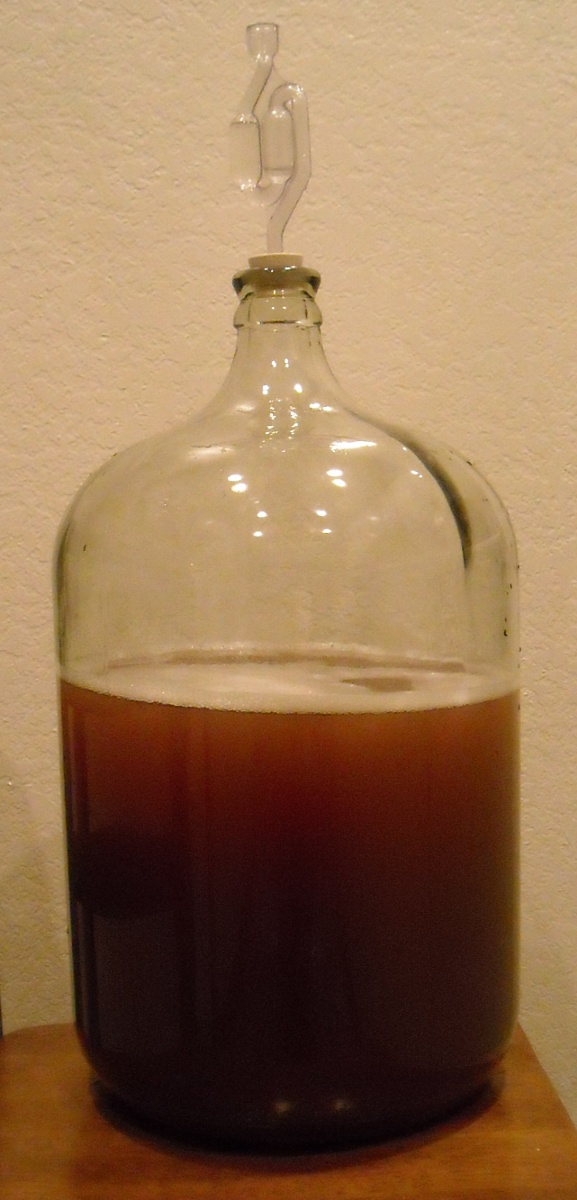
Wheat Beer Bottled and Drinkable

Ok, so it’s been a long time since the last post. The All-American Porter has been brewed and will get bottled later today. Also, the wheat beer got bottled two weeks ago–we ended up with 41 bottles, if I remember correctly. Some of these were the larger pint-sized bottles, too. I cracked the first bottle earlier this week, and it has carbonated up nicely. It’s pretty drinkable, although in hindsight the normal fruity aroma associated with the German wheat beers is not quite to my taste. A little slice of lemon really rounds out the flavor, though. Next time, I think I’ll try an American strain of yeast–these seem to lack the fruity aroma/flavors seen in many of the European strains.

Wheat Beer Update


Tonight I transferred the wheat beer (which has been fermenting for six days now) into the secondary fermenter. The beer has a nice yeasty-sour aroma, which is about what I would expect. Plus, it’s tasting pretty good. The gravity at present is 1.010, putting alcohol at right about 3 percent. Can’t wait to see what this will be like once it’s settled and matured a little!

Wheat Beer

I don’t have a clever name for this one yet. . .it’s based off of the recipe for Bert Grant’s Hefeweizen (by Yakima Brewing and Malting Co.) in the North American Clone Brews book by Scott R. Russell. I brewed it up last night (January 17), with some able assistance from my friend Todd.

Here are the basic ingredients:
1 lb. malted wheat (crushed)
8 oz. light crystal malt (40°L)
8 oz. carapils malt
2 oz. Hallertau hops pellets (3.8% alpha; 1 oz. for the bittering, 1 oz. for the aroma)
4 lbs. wheat dry malt extract
German wheat beer yeast (Wyeast 3333)

Here’s what I did:

  • I steeped the malted wheat, crystal malt, and carapils malt in 2 gallons of water for 45 minutes, at 150°F. Then, I sparged the grains with half a gallon of water at about the same temperature.
  • I added the wheat malt extract, and heated the whole thing to boiling.
  • Once the wort was boiling, I added 1 oz. of the hop pellets and boiled for 45 minutes.
  • For the final 15 minutes, I added the last ounce of hops.
  • At the end of the boil, I cooled the wort down with an ice bath in the sink, decanted the wort into my fermenter, and topped the whole thing up to about 4.5 gallons.
  • I pitched the liquid yeast, and now everythings sitting in the closet and hopefully fermenting.

The initial gravity is 1.034, which is quite a bit lower than I expected (1.045 is what the recipe gives). In the end, this will probably give me an alcohol content a little over 3 percent, assuming that it all ferments out as my previous batches have. Part of the low gravity “problem” might be that my grains were bagged too tightly, and so I didn’t get as good of utilization out of them. I don’t think this explains everything, though. Next time (assuming I like the results), I’m going to go ahead and use a full five pounds of malt extract.

The color on the finished wort is a nice straw-color – the lightest I’ve brewed to date.