Old Franconia Lager

“Farmhouse beers” are a huge and fuzzy category, in my mind including everything from saison to many kveik-based concoctions to some kellerbiers. Although a character-rich and slightly wild yeast is most common, I would also think some “rustic” lagers should also qualify. Farmhouse, like so many things in homebrewing and craft beer, is a moderately mythological concept, and one built more around feelings than strict history. I suppose that’s why it’s fun to play in the space! It can stir a different set of emotions from by-the-books or paint-by-numbers brewing; it allows creativity (and I suppose role-playing) in a way that many other styles don’t, or at least in ways that differ from other styles.

I recently ran across a supplier for Isaria 1924 malt by Weyermann (William’s Brewing). I am often interested in trying base malts outside my norm, and this was a fun opportunity to experiment. The descriptions / marketing material from Weyermann state that the malt is “made from the oldest German malting barley variety Isaria, which was officially approved for the beer production in 1924. Brewers used Isaria to brew traditional, unfiltered and flavorful traditional German Lagers.”

Colorwise, Isaria 1924 weighs in at 3.5 SRM and is thus closest to most Vienna malts (3-5 SRM, depending on supplier; the Weyermann version is 3 SRM). Relative to the Weyermann flavor wheel, Isaria 1924 reads as a subdued Vienna, with similar locations of flavor/aroma peaks, but different magnitudes (e.g., a peak at “sweet” taste but an arbitrary value of 2.5 versus 4.5).

Among the recommended styles from Weyermann, Franconian landbier was near the top. This intrigued me, because I had recently read about the “style” in the Spring 2025 issue of Craft Beer and Brewing (including recipe). Why not try something in that vein?

My version is not really based on anything in particular, other than crafting a general story–something to emphasize malt and lean into a story of a rustic beer that plausibly would originate in Franconia (which primarily overlaps with northern Bavaria). I wanted to use 100 percent Isaria 1924 malt, particularly because this was my main point of the brew session. I only had 10 pounds, which might be a bit lower on gravity than I wanted for my usual 5.25 gallon batch, so I scaled down to 4.5 gallons. Spalt Spalter hops were my hop selection, because they provide a nice earthy and spicy quality that fit well with my intended “rustic” results. Finally, I wanted to give WLP860 Munich lager dry yeast another spin; as a strain that would emphasize the malt character, and that also would be consistent with my Franconian/Bavarian theme (although Munich itself is to the south of historical Franconia–we’re going for “vibes” and not authenticity here!). During my last brew with it, I learned that a bit of patience was key–WLP860 is a slow starter, and so I shouldn’t fear if signs of fermentation are delayed.

Old Franconia Lager

  • 10 lb. Isaria 1924 malt (Weyermann)
  • 0.5 tsp. BrewTanB, added to mash
  • 1.25 oz. Spalt Spalter hop pellets (4.3% alpha), 60 minute boil
  • 0.5 tsp. BrewTanB, 10 minute boil
  • 1 Whirlfloc tablet, 5 minute boil
  • 1.75 oz. Spalt Spalter hop pellets (4.3% alpha), 5 minute boil
  • 2 pkg. Munich Lager dry yeast (White Labs WLP860)

Target Parameters

  • 60 minute infusion mash, 154°, full volume mash
  • 1.051 o.g., 1.016 f.g., 4.7% abv, 29 IBU, 6 SRM
  • Claremont tapwater, neutralized to remove bicarbonates. Roughly 40 ppm Ca, 18 ppm Mg, 102 ppm Na, 50 ppm SO4, 130 ppm Cl, RA=-31
  • 4.5 gallon batch

Procedure

  • I treated 6.75 gallons of water with a Campden tablet and 6.9 mL of 88% lactic acid, in order to drop out the bicarbonates.
  • Next, I heated the strike water to 159°, added the grains, and held at 154° with recirculation for 60 minutes. After that, I raised the mash temperature to 168°, held it there for 10 minutes, and then pulled the grains.
  • In total, I collected 6 gallons of runnings with a gravity of 1.038, for 64% mash efficiency.
  • I brought the runnings to a boil, adding hops and finings per the recipe. Because my gravity was a bit lower than intended, I boiled a bit harder to bring the gravity up. After 60 minutes, I turned off the heat and chilled the wort to 69° before transferring to the fermenter.
  • I chilled the wort down to 50° in the fermentation chamber, pitching the yeast when the beer was at 60° (night of the brew day).
  • This beer was brewed on 21 September 2025; it had a starting gravity of 1.049.
  • I fermented the beer at 50 degrees; small bubbles were visible on the surface by 22 September 2025, 24 hours after pitching. By 29 September, there was a good layer of krausen on the surface. Given the slow start the last time I used this yeast, I wanted to confirm that things were moving along. I noted an aroma of sulfur in the fermentation chamber on 30 September 2025.
  • I raised the temperature of the beer to 56° on 2 October 2025, and moved the beer to ambient on 7 October 2025.
  • Using a closed transfer, I kegged the beer on 18 October 2025. At the time, it had an amazing malt flavor!
  • Final gravity was 1.013, for 4.7% abv.

Tasting

  • Appearance
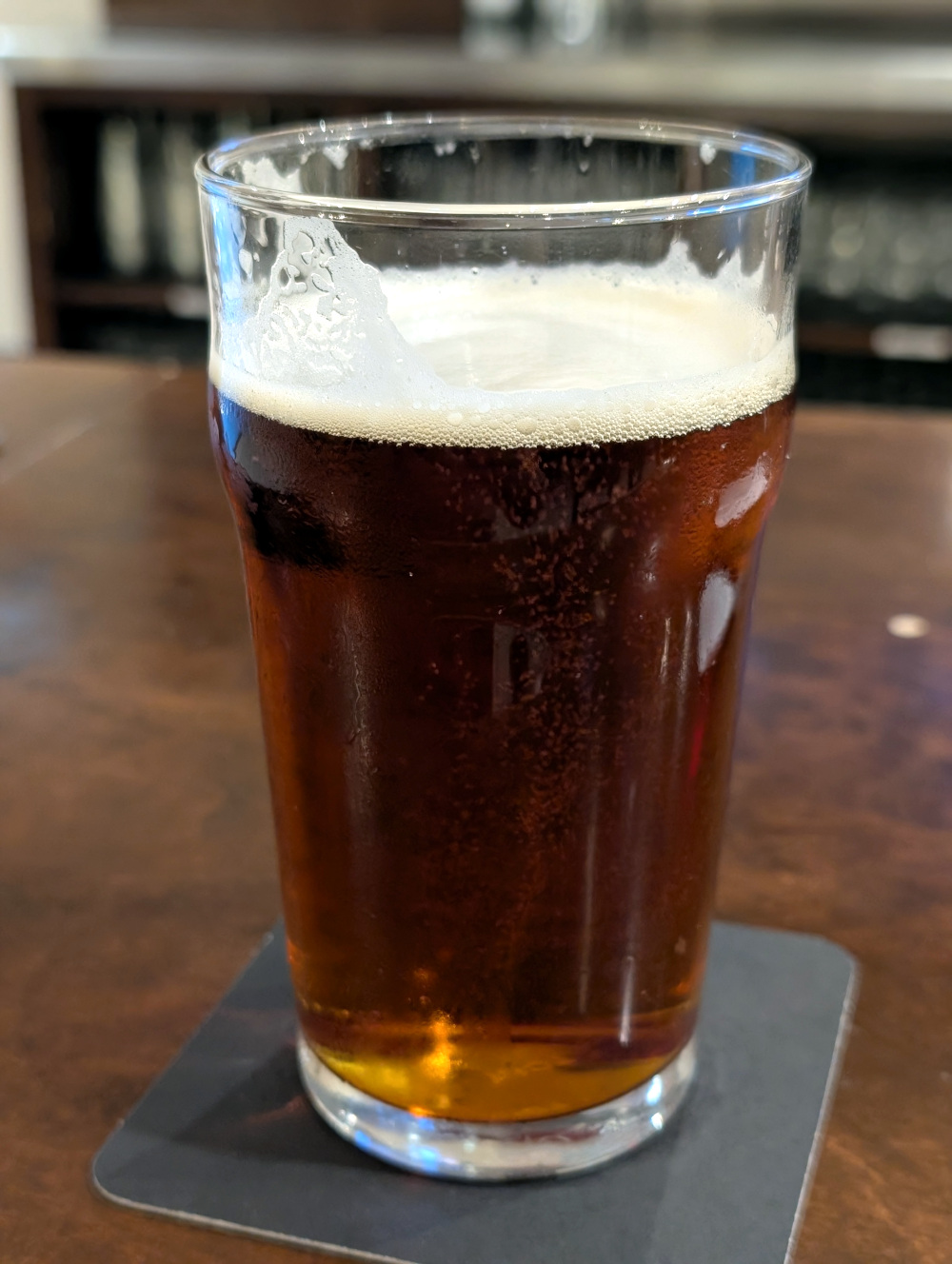
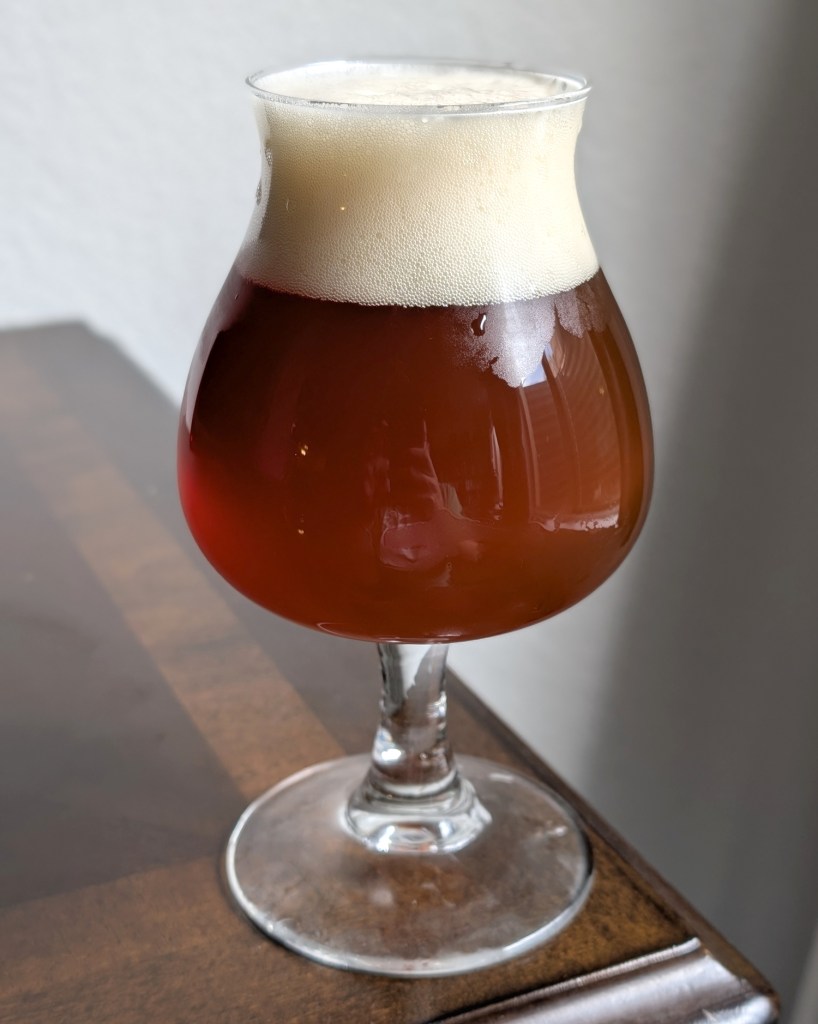
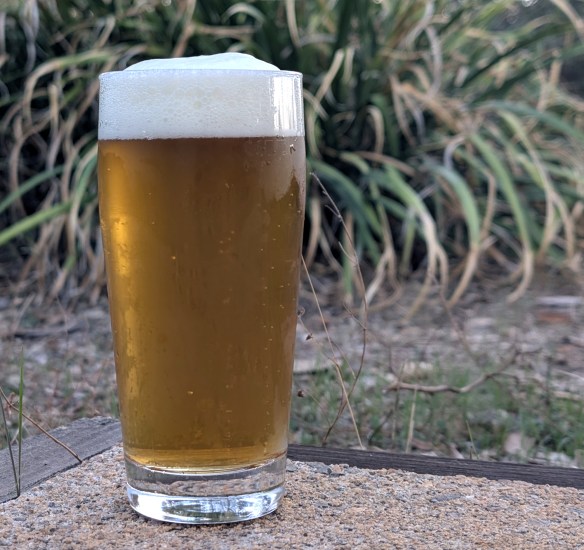
    • A deep gold beer, with a very slight haze, which pours with a thick, white, and persistent head. Beautiful!
  • Aroma
    • Medium malty-rich aroma, with moderate spicy hop character. Delicate hoppiness.
  • Flavor
    • Moderate malty rich character, against a medium level of hop bitterness. Clean yeast character.
  • Mouthfeel
    • Medium-light body, moderately high carbonation, off-dry finish. There’s may be a tiny bit of astringency.
  • Would I Brew This Again?
    • This is super nice as something a little different from the “usual” lagers. Isaria 1924 stands well as a solo malt, making an interesting and highly drinkable beer. I might dial the bitterness back a touch, or else increase the gravity slightly; the aroma is amazing, but I feel that the malt character is slightly obscured. I would also do a 90 minute mash or a decoction mash in order to improve efficiency, given the lower mash yield for this particular malt.
  • Overall
    • 8/10

Update: Around Christmas, I noted an increasingly heavy protein precipitation in this beer. I’ve never experienced something like it previously, at least in my homebrew. I didn’t have anything unusual with handling or technique, so I wonder if it’s caused by the malt. Or maybe just a fluke?

golden beer in glass with lots of white flakes of protein precipitate floating in it, like snowflakes
Let it snow?

Alstadt Altbier 2.3

My Alstadt Altbier is one of my favorite recipes, and now we’re into the sixth iteration for this fall. I inevitably have some variation, but the core philosophy of Pilsner+Munich+Vienna at the core with a ~60L crystal/caramel malt of some sort to round out the profile (and a bit of Carafa Special II for color) has been consisten. The main difference from last batch is that I used all Caramunich I instead of a 50/50 mix of Caramel Munich 60L and Caramunich II. I also switched up the yeast a bit this time, because Lallemand’s Köln strain is no longer available.

Recipe Name

  • 6.5 lb. Viking Pilsner Zero malt
  • 1.5 lb. Munich malt (BestMalz)
  • 1.5 lb. Vienna malt (Weyermann)
  • 1 lb. Caramunich I (Weyermann)
  • 2 oz. Carafa Special II (Weyermann)
  • 0.5 tsp. BrewTanB, added to mash
  • 2 oz. Spalt Spalter hop pellets (4.3% alpha), 60 minute boil
  • 0.5 tsp. BrewTanB, 10 minute boil
  • 1 Whirlfloc tablet, 5 minute boil
  • 1 oz. Spalt Spalter hop pellets (4.3% alpha), 5 minute boil
  • 1 pkg. Kaiser liquid yeast (Imperial G02)
  • 1 pkg. SafAle German Ale (Fermentis K-97)

Target Parameters

  • 60 minute infusion mash, 152°, full volume mash
  • 1.048 o.g., 1.011 f.g., 4.9% abv, 35 IBU, 13 SRM
  • Claremont tap water, adjusted with Campden tablet

Procedure

  • I made a 1L shaken-not-stirred vitality starter for the yeast (which had a package best-by date of January 2025). I used a can of starter propper with distilled water, started at 2:30 pm on brew day.
  • I heated 7.3 gallons of water to 157° and added the grains, letting it settle at 152° for 60 minutes, with recirculation. Unfortunately, I had mis-entered the strike water temperature, so I overshot the mash temperature by about 10 degrees. Once this was done, I raised the temperature to 168° for a 10 minute rest before removing the grains.
  • The mash yielded 6.5 gallons of runnings at at gravity of 1.040, for 65% mash efficiency.
  • I brought the runnings to a boil, adding hops and finings per the recipe. Once the boil was done, I chilled to around 80° and then transferred to the fermenter for an overnight chill the rest of the way.
  • I brewed the beer on 30 August 2025. Starting gravity was 1.046.
  • The starter had minimal signs of life by the afternoon of 31 August 2025, so I pitched the starter as well as a packet of K-97. I fermented at 64°.
  • The fermentation kicked off vigorously within 12 hours.
  • I kegged the beer on 11 September 2025. It had a final gravity of 1.015, for 4.1% abv.

Tasting

  • Appearance
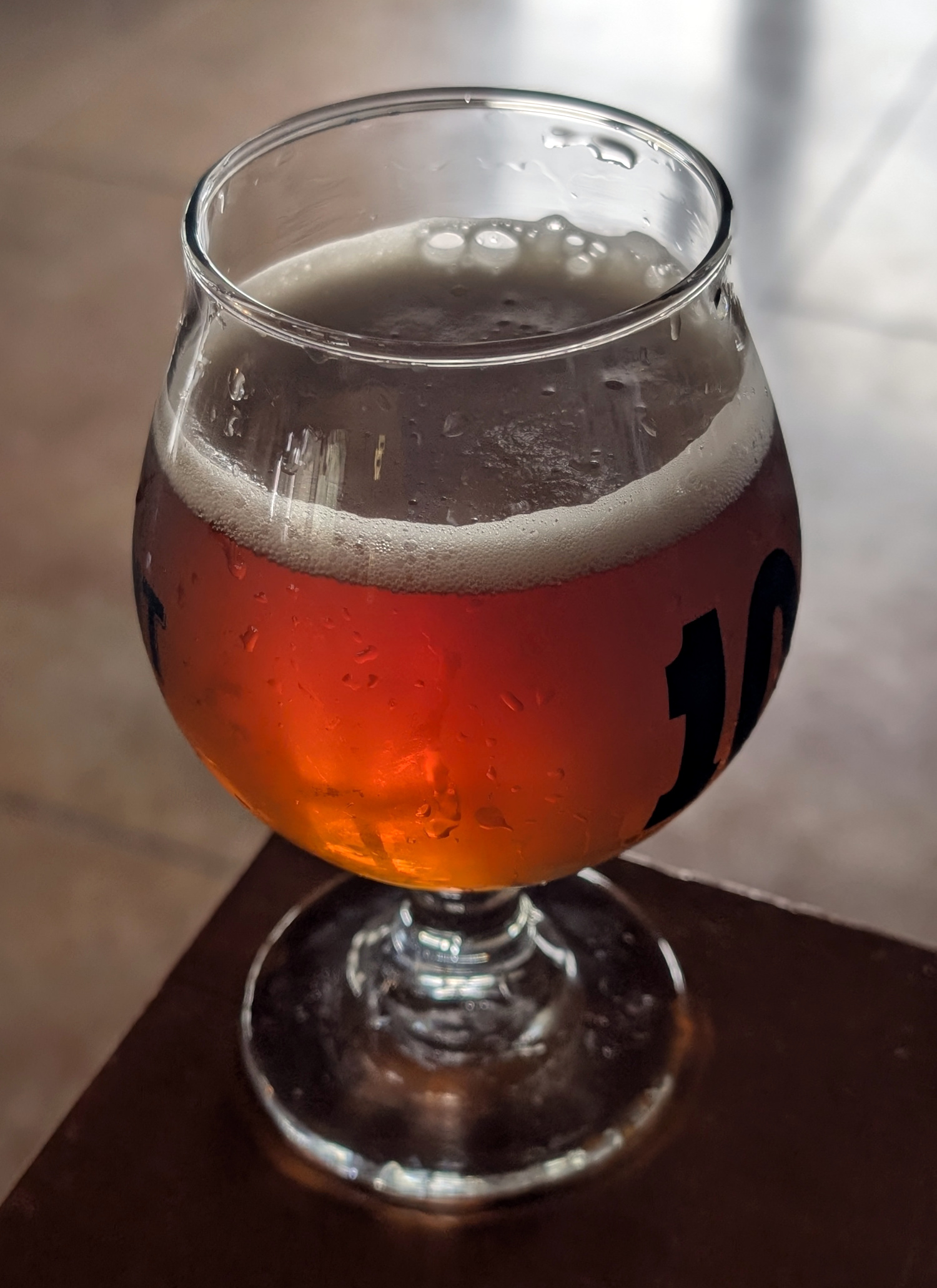
    • Pours with a creamy ivory head of reasonable persistence. The beer itself is a deep amber, and brilliantly clear.
  • Aroma
    • Light caramel and malty aroma at a moderate level, with light toffee notes; no major yeast aroma. Slight herbal hop character.
  • Flavor
    • Medium malty and light caramel flavor. Medium high bitterness. Herbal and spicy hop character, at a moderate level.
  • Mouthfeel
    • Moderately light body, medium carbonation, slightly dry finish. The body is surprisingly thin.
  • Would I Brew This Again?
    • This very is decent, but the body is a little lighter than usual, and the flavor seems thinner relative to my recollections and past notes. I might increase the mash temperature next time (but not as much as was here). This is not my best version of the beer! It’s odd that it feels so thing given the final gravity.
  • Overall
    • 6/10

Mountain Town Stout

After 17 years of serious brewing with dozens (hundreds?) of batches under my belt, I’m sometimes amazed by unexpected gaps in my brewing experience. I’ve made stouts of all varieties–oatmeal, imperial, Irish, milk, and more–but never a classic American stout! The old standards from the late 1990s and early 2000s increasingly appeal to me, because I enjoy drinking them but they are nigh impossible to find nowadays. American stout is squarely in that category. Looking through my recipe books, I was somewhat shocked by how few recipes there are for American stouts. They’re mostly the substyles cited above–oatmeal, Irish, imperial, etc. It makes me wonder if my remembrance of a golden age of American stout was exaggerated through the prism of nostalgia?

From the BYO Big Book of Clone Recipes, I found a recipe emulating the Sierra Nevada Brewing Company Stout, and it was exactly what I wanted. My biggest change was to aim for a 3 gallon batch, because I wasn’t certain if I wanted 5 gallons of such a “heavy” beer. I also made some small ingredient substitutions, using Maris Otter instead of the Munich malt in the original recipe, and hopping with Columbus and Cascade (versus Bravo, Cascade, and Yakima Goldings in the original).

Mountain Town Stout

  • 5 lb. 2-row pale malt (Rahr)
  • 1.5 lb. Maris Otter pale ale malt (Thomas Fawcett)
  • 0.5 lb. 60L caramel malt (Briess)
  • 5 oz. Carafa Special II malt (Weyermann)
  • 5 oz. roasted barley (Crisp)
  • 3 oz. 2-row black malt (Briess)
  • 3 oz. chocolate malt (Bairds)
  • 0.5 oz. Columbus hop pellets (15.6% alpha), 60 minute boil
  • 1 oz. Cascade whole hops (4.5% alpha), 10 minute boil
  • 1 Whirlfloc tablet, 5 minute boil
  • 1 oz. Cascade whole hops (4.5% alpha), 1 minute whirlpool
  • 1 pkg. American West Coast Ale yeast (Lallemand BRY-97)

Target Parameters

  • 60 minute infusion mash, 152°, full volume mash
  • 1.061 o.g., 1.013 f.g., 6.4% abv, 53 IBU, 51 SRM
  • Claremont tap water, adjusted with Campden tablet
  • 3 gallon batch

Procedure

  • I mashed in with 4.6 gallons of water, heated to 158°, and then held the mash with recirculation at 152° for 60 minutes.
  • After the full 60 minute mash, I heated the mash to 168° for a 10 minute mash-out rest. Then, I pulled the grains and brought the runnings to a boil.
  • In total, I collected 4 gallons of runnings with a gravity of 1.051, for 68% mash efficiency.
  • Once the runnings were boiling, I added hops and finings per the recipe. After a 60 minute boil, I turned off the heat, whirlpooled the Cascade hops, and began the chill.
  • Once the wort was chilled to around 80°, I transferred it to the fermenter and then chilled the rest of the way down to 60° before pitching the yeast.
  • I brewed this beer on 6 September 2025. Starting gravity was 1.063.
  • I let the beer free rise to 66° for the main bit of fermentation, pulling the fermenter to ambient on 13 September 2025.
  • I kegged the beer on 17 September 2025. Final gravity was 1.021, for 5.6% abv.

Tasting

  • Appearance
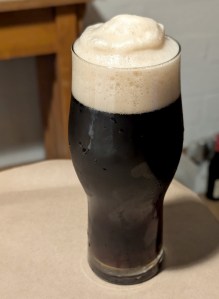
    • A deep, almost inky black beer, with a ridiculously persistent and creamy brown head.
  • Aroma
    • Notes of espresso and dark chocolate malt at a medium-high level; medium malty aroma also. Not much for hops or yeast aroma.
  • Flavor
    • High levels of rich dark coffee and chocolate at the forefront of the flavor. Bitterness is at a medium-high level, with a resiny quality. This is an intense (and flavorful) beer!
  • Mouthfeel
    • Medium rich body, medium carbonation. Rich, slightly biting finish.
  • Would I Brew This Again?
    • Absolutely! This is an intensely flavored beer; classic “American craft beer” in all senses. It is surprisingly drinkable (unlike, say, an imperial stout), but not in a casual way. I am enjoying this one!
    • As a side note, the final gravity was 1.021, versus a BeerSmith prediction of 1.013. However, the recipe book claimed 1.020. I’ve noted that BeerSmith tends to do very poorly on estimating final gravity for beers with lots of non-fermentable malt sugars (~19% of the grist in this case).
  • Overall
    • 10/10

Mosaic SMaSH Session Pale Ale

I wanted a quick-and-easy hoppy beer in the sessionable zone, so I threw together a SMaSH recipe with mostly on-hand ingredients. Maris Otter served as the base, for something a little more flavorful than average 2-row. I have a pound of Mosaic on-hand; I haven’t brewed with that variety in forever, and it’s interesting enough to stand on its own. Finally, I needed a yeast decision. This one required a quick turn-around to go on tap, so kveik was an obvious choice. My fantastic LHBS (Pacific Brewing Supplies in San Dimas) had a new brand in stock, a company called Kveik Yeastery. Looking through their products, a variety called Stalljen seemed perfect–it promised tropical fruit, mango, and pineapple, with citrus behind that. Reading a bit more about the yeast, I’m not sure if there are other commercial versions sold; if anyone knows differently, I’m happy to learn more. As a final note, this beer was set up as a “short and shoddy” style mash and boil, with 30 minutes on each.

Mosaic SMaSH Session Pale Ale

  • 10.5 lb. Maris Otter pale ale malt (Thomas Fawcett)
  • 0.5 tsp. BrewTanB (mash)
  • 1.25 oz. Mosaic hop pellets (10.7% alpha), 20 minute boil
  • 0.5 tsp. BrewTanB, 10 minute boil
  • 1 Kick Carrageenan tablet, 5 minute boil
  • 1.75 oz. Mosaic hop pellets (10.7% alpha), 10 minute whirlpool
  • 1 pkg. Stalljen kveik (Kveik Yeastery #K.22)
  • 3 oz. Mosaic hop pellets (10.7% alpha), dry hop

    Target Parameters

    • 30 minute infusion mash, 152°, full volume mash
    • 1.049 o.g., 1.012 f.g., 4.8% abv, 41 IBU, 5 SRM
    • Claremont tap water adjusted to hit 75 ppm Ca, 26 ppm Mg, 102 ppm Na, 164 ppm SO4, 130 ppm Cl, 10 ppm bicarbonate, RA=-60

    Procedure

    • Starting with 7 gallons of water, I added 7.2 mL of 88% lactic acid, 4 g of gypsum, and 2 g of epsom salts, in order to hit my water targets.
    • I heated the mash water to 157°, added the grains, and mashed at 152° with recirculation for 30 minutes. I then raised the mash to 168° for a 10 minute mash-out, before removing the grains.
    • My post-mash gravity was a bit underwhelming at 1.035 — that’s only 56% mash efficiency, well below my norm. Based on past results with the Fawcett Maris Otter, I’m thinking this is a malt that needs a full 60 minute mash at least; it certainly hasn’t overwhelmed me with its efficiency. Although I hadn’t planned a session ale, this is where I kicked things into session ale territory. I double-checked my mill gap, and all was OK there, so I can’t blame the mill.
    • I brought the runnings to a boil, but I upped the boil vigor a bit (85% power on the Foundry) and extended the boil to 60 minutes (instead of the planned 30 minutes).
    • After the boil, I added the last bit of hops and then chilled down to 93°. I transferred to the fermenter, pitched the yeast, and fermented at ambient.
    • I brewed this beer on 16 August 2025. Starting gravity was 1.043.
    • Vigorous fermentation kicked off within four hours of adding the yeast; the fermenter temperature was down to 68° by the next morning.
    • I added the dry hops on 21 August 2025, and cold crashed the beer on 24 August 2025.
    • I kegged the beer using a closed transfer on 30 August 2025. Final gravity was 1.012, for 4.1% abv.

    Tasting

    • Appearance
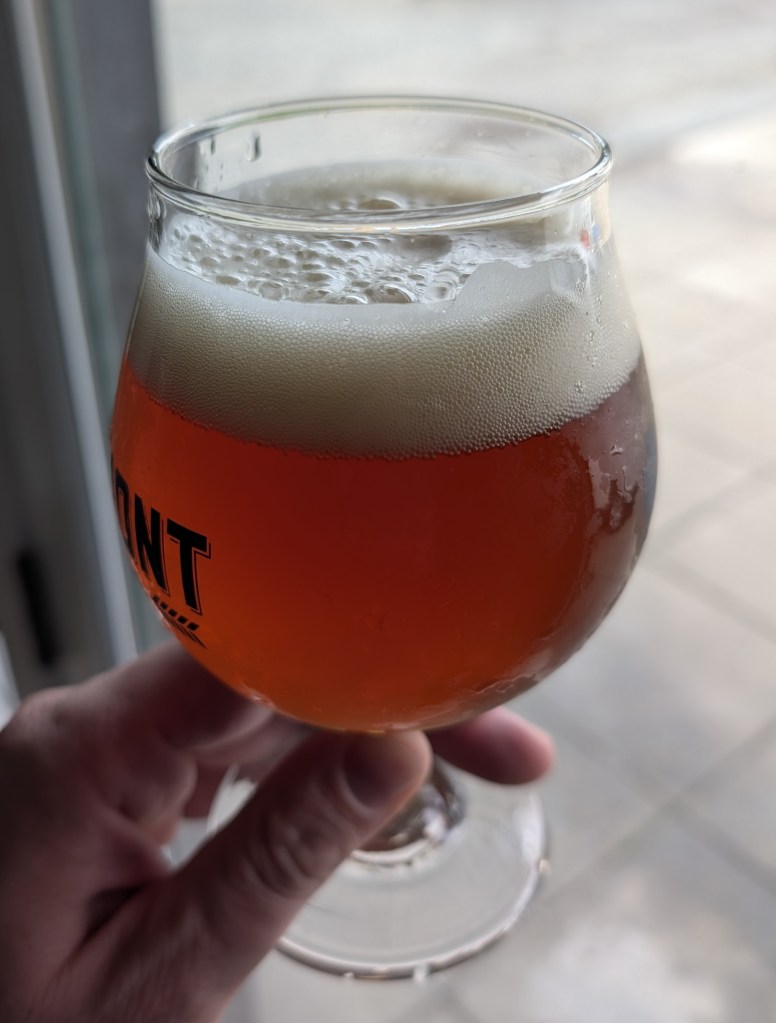
      • This is a hazy, light yellow beer that pours with a fluffy and persistent white head. The lacing is gorgeous!
    • Aroma
      • Aroma is dominated by a fresh citrus and blueberry hop character at a medium-high level. There is minimal malt or yeast character that I can pick up.
    • Flavor
      • Bitterness is at a high level, with slight astringency and hop bite. There is a medium-low level of malt flavor, with a grainy/malty-sweet character. The hops have a citrus and pine quality, with slight mango; it’s backed up by the citrusy notes presumably from the yeast.
    • Mouthfeel
      • Medium level of carbonation; light body and a dry finish with slight astringency.
    • Would I Brew This Again?
      • The core concept of this beer is great, but it definitely suffered from the low starting gravity. The astringency is annoying, but otherwise it’s a pretty decent beer. I would definitely do a version of this recipe again, with a higher gravity. Stalljen is a fantastic kveik strain; it’s unobtrusive and works well with Mosaic. I didn’t pick up the slight “twang” or tartness I get with Lutra (my other favorite strain), and I wouldn’t necessarily know this is a kveik otherwise. The persistent haze might be a negative in some recipes, but it’s so beautiful in this particular beer. Thinking ahead, I might aim for the same level of hops in a future version, with a starting gravity around 1.054. That would take a greater amount of malt as well as a longer mash.
    • Overall
      • 6/10

    Munich Helles BYO Edition

    As a delicate yet flavorful lager, Munich helles has a reputation as a style that is difficult to brew well. My previous three versions have all been pretty decent, and after a few years’ hiatus I wanted to give the style another try. A recipe from the May-June 2018 BYO magazine presented a different take from my previous batches, and was worth an attempt in order to explore my taste preferences. The main difference is that it cut out Munich malt, leaning on pilsner malt with just a touch of character malt to accent things. I modified the BYO version slightly, taking out acidulated malt and using lactic acid instead, replaced Tradition hops with Perle, and moved all late addition hops to the 5 minute mark at the end of the boil. The latter was because I wanted to emphasize aroma and not boil off the volatiles. I also reduced the calculated bitterness a touch (20 IBU vs. 17 IBU). For yeast, I had two packets of White Labs’ dry Munich Lager (WLP860); I had picked them up at White Labs last year, and this was a perfect chance to use them.

    Recipe Name

    • 9 lb. Viking Pilsner Zero malt
    • 5 oz. Carahell malt (Weyermann)
    • 3 oz. Carafoam malt (Weyermann)
    • 0.5 tsp. BrewTanB, added to mash
    • 0.65 oz. Perle hop pellets (6.3% alpha), 60 minute boil
    • 0.5 tsp. BrewTanB, 10 minute boil
    • 1 Whirlfloc tablet, 5 minute boil
    • 1 oz. Hallertauer Mittelfrueh hop pellets (2.5% alpha), 5 minute boil
    • 2 pkg. Munich Lager WLP830 dry yeast (White Labs)
    • 1 pkg. Diamond Lager dry yeast (Lallemand)
    • 1 oz. Biofine Clear, added to keg

    Target Parameters

    • Infusion mash, 45 minutes at 144°, 45 minutes at 160°, 10 minutes at 168°, full volume mash
    • 1.045 o.g., 1.008 f.g., 4.9% abv, 17 IBU, 4 SRM
    • Water built from scratch with RO water, to hit 55 ppm Ca, 61 ppm SO4, 53 ppm Cl, RA=-39

    Procedure

    • I built my water up from scratch, starting with 7.25 gallons of RO water, to which I added 3 g of calcium chloride and 3 g of gypsum. I heated this to 148°, before adding the BrewTanB, grains, and 0.2 mL of 88% lactic acid.
    • I held the mash at 144° for 45 minutes, with recirculation, before increasing the temperature to 160° and holding it there for another 45 minutes. Finally, I had a 10 minute mash-out at 168°, before pulling the grains.
    • In total, I had 6.5 gallons of runnings with a gravity of 1.039, for 71% mash efficiency.
    • I brought the runnings to a boil, adding hops and finings per the recipe. After a 60 minute boil, I turned off the heat and then chilled to 75° before transferring to the fermenter. I chilled the wort the rest of the way down to 48° before pitching the yeast.
    • I brewed the beer on 19 June 2025. Starting gravity was 1.039 – right on the numbers!
    • Fermentation was held at 50°. There was no sign of fermentation, neither krausen nor bubbles in the airlock, by 21 June 2025. So, I pitched a packet of Diamond Lager yeast just to be safe. Later reading shows this strain tends to be a slow starter and quiet fermenter, so I perhaps was a bit too hasty. Next time, I might take a sample and see if the gravity had changed. In this case, it was better to be safe than sorry.
    • I cold crashed the beer on 17 July 2025, and kegged it on 4 August 2025 using a closed transfer. At this point, the beer was pretty hazy but had an amazing flavor.
    • I added Biofine Clear on 25 August 2025.
    • Final gravity was 1.010, down from 1.045, which equates to 4.7% abv.

    Tasting

    • Appearance
      • Light yellow and brilliantly clear, with a persistent fine white head.
    • Aroma
      • Clean fermentation profile, medium-low malt with a sweet malty character. Hops very faint.
    • Flavor
      • Medium level of malty sweet flavor, with a low level of spicy hops behind that. It tastes good, but inoffensive.
    • Mouthfeel
      • Medium-light body, moderate carbonation, smooth and slightly dry finish.
    • Would I Brew This Again?
      • This beer is technically great, but it just doesn’t grab my attention in any particularly way. It’s clean, clear, and decently flavorful, but needs a touch more malt character. Versus previous recipes, I skipped Munich malt on this one, and that set things back a bit. I might try a different pilsner malt, too, but either way the malt needs a bit more of “something.”
        • Note added later: I tried this beer again, in a big mug, and it hit a bit differently. The malt character was more prominent, and it goes down easily. I’m not going to adjust my ranking based on this, other than to say that it’s a very drinkable beer, and would be a crowd pleaser, even if not the most interesting beer for me. I guess not every beer needs to be interesting!
    • Overall
      • 7/10