I last brewed this recipe awhile back, and it was high time to make it again! It’s basically the same recipe as before, just modified slightly for the efficiency of my current system and on-hand ingredients. It’s super simple, but really tasty!
2021 Orange Summer Wheat Ale
6 lb. white wheat malt (Briess)
3 lb. 2-row malt (Viking Xtra Pale)
8 oz. caramel 10L (Briess)
8 oz. rice hulls
1.5 oz. Mt. Hood hop pellets (4.6% alpha), 60 minute boil
1 tsp. Fermax yeast nutrient, 10 minute boil
1 pkg. American Hefeweizen Ale yeast (WLP 320)
Target Parameters
1.044 s.g., 1.011 f.g, 4.3% abv, 26 IBU, 4 SRM
Full volume infusion mash, 152° for 60 minutes
Claremont tap water
Procedure
I made a 1L shaken-not-stirred starter around 4 hours before pitching. It took off pretty well!
I mashed in with 7.25 gallons of water at 158°, to hit a mash temperature of 152°. I added 5 mL of 88% lactic acid to adjust the pH.
After a 60 minute mash, I removed the grains.
In total, I had 6.5 gallons of runnings with a gravity of 1.040, for 72% mash efficiency.
I brought everything to a boil, adding hops and finings per the recipe.
After 60 minutes, I chilled down to 66° and transferred to the fermenter. I pitched the yeast, and let it ferment at 66°.
I brewed the beer on 13 February 2021, with a starting gravity of 1.045.
I had 5.5 gallons in the fermenter, and fermented it at 64° to 66°, as I moved it in and out of the house and garage.
While I started the beer, I zested three Valencia oranges that I had picked, putting the zest in 3 oz. of vodka. This steeped for 3 weeks, and then I strained it to add to the keg.
I kegged the beer on 27 February 2021. It had great flavor and aroma on the base beer, even before I added the orange extract.
Final gravity was 1.010, down from 1.045. So, it had an estimated abv of 4.6%.
Tasting
Appearance
Pale gold color and hazy, with a thin white head that is moderately persistent.
Aroma
Fresh orange zest, with a faint doughy wheat character behind that. Really awesome!
Flavor
Orange juice flavor at the forefront, with a bread dough malt character behind that. Bitterness level is moderate, perhaps a little higher than works for this beer. Yeast character is very clean, with no noticeable esters.
This is a really, really nice recipe…the orange character is absolutely perfect. It’s a bit more bitter than I envisioned in the early tastings, so when I brew this again I’m going to back it down to 20 IBU. Interestingly, as it has aged a bit in the keg that overly bitter edge has been reduced. Otherwise, I wouldn’t change a thing.
Because I purchased a 55 pound sack of Maris Otter a few months ago, I have been on a bit of an English ale kick. Next stop: porters! I don’t brew this style nearly often enough, especially in its English incarnation. The particular recipe here was modified from the London Porter in Gordon Strong’s Modern Homebrew Recipes. I adjusted the base recipe slightly for the malt brands I had on-hand, and reduced the amount of brown malt slightly to account for my in-house supply. At the end of 2020, I found a bunch of 1 lb. bags of Warminster malts on sale, so loaded up on those for this recipe. I hadn’t used that brand before, and thought a good English malt would be a match for this one.
London Porter
8 lb. Maris Otter ale malt (Crisp)
1 lb. brown malt (Warminster)
1 lb. Crystal 60 malt (Warminster)
0.75 lb. Munich Light malt (Chateau)
10 oz. chocolate malt (Dingemans)
6 oz. Crystal 80 malt (Warminster)
1 oz. Fuggles hop pellets (4.7% alpha), 60 minute boil
1 oz. East Kent Goldings (EKG) hop pellets (5.0% alpha), 10 minute boil
1 Whirlfloc tablet, 5 minute boil
1 pkg. London ESB English Style Ale Yeast (Lallemand)
Target Parameters
1.051 s.g., 1.013 f.g., 5.0% abv, 23 IBU, 27 SRM
Full volume infusion mash, 153°; 60 minute boil
Claremont water, with 2 g of gypsum to get water profile with 96 Ca, 64 SO4; added Campden tablet to remove chloramines.
Procedure
I mashed in with 7.5 gallons of water at 160°, to achieve a mash temperature of 153°. After 60 minutes, I raised the heat to 168° and held it there for 15 minutes before removing the grains.
In total, I got 6.45 gallons of runnings with a gravity of 1.043, for 65% mash efficiency. I had used the small-batch adapter ring for my Foundry, because some have anecdotally said it made a difference. I didn’t notice any change, at least for this batch.
I brought the runnings to a boil, adding finings and such per the recipe.
After a 60 minute boil, I chilled and transferred to the fermenter.
Starting gravity was 1.050, with 5.5 gallons transferred into the fermenter.
I brewed this beer on 8 January 2021.
I fermented at 66° for the first two days, which was ambient in the garage. The temperature dropped a bit on the third day, so I moved it inside to ~65° on 10 January 2021.
I kegged the beer on 24 January 2021, after 16 days of fermentation. Gravity at this point was 1.025, way higher than I expected. I suspect the yeast had crashed out a bit early. I added 3 oz. of corn sugar boiled in 1 cup of water, for carbonation.
It seems that the beer kicked off fermentation in the keg again, because gravity measured 1.020 on 4 February, when I checked it again. That works out to 4.0% abv.
Tasting
Appearance
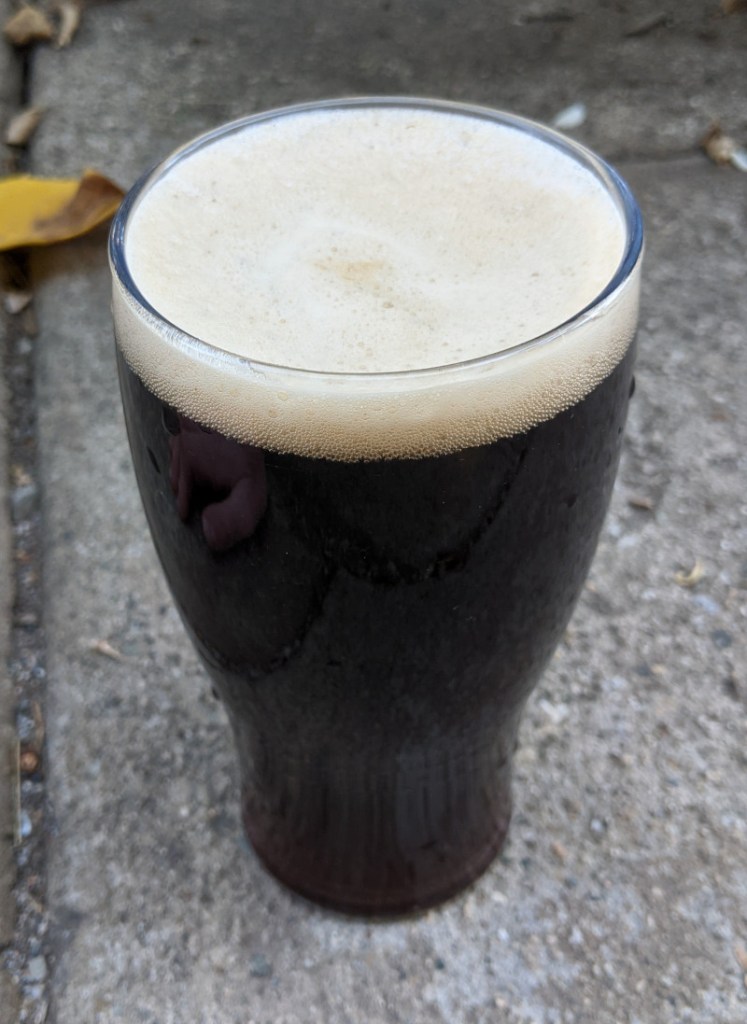
The beer pours with a thick tan head that subsides moderately quickly, with good retention. The beer itself is dark brown, with a fair bit of yeast haze. I’m pretty disappointed with the lack of clarity…I suspect this is due in part to the ESB yeast (which has given me issues previously), and a potentially stalled fermentation that kept things in suspension longer than usual.
Aroma
There is a roasty toasty malt character at the forefront–really nice. The hop character is slightly earthy, with a low level of dried stone fruit (?cherry) in the yeast character.
Flavor
The beer has a roasty, slightly nutty flavor, with a medium-high level of maltiness. The balance is tilted towards the malt, with a medium-low bitterness on the back end. The beer brings out a bit of a caramel character along with an interesting dried stone fruit character as it warms up in the glass. There is a very slight sweetness, as well as a subtle licorice character.
Mouthfeel
Medium-full body, with medium-low carbonation.
Would I Brew This Again?
This is a good enough beer, but not fully to my tastes. The malt and hop character are pretty great (I would use Warminster malts again for any English beer!), but the yeast was a complete disappointment. I am fairly shocked that it was still in suspension nearly 6 weeks after kegging and conditioning in the keg. I probably should have used a bit of gelatin earlier in the process; but that’s just not typical for my dark beers! I might make this recipe again, but would probably stick with Nottingham or something that clears up a bit more quickly.
One of my favorite local establishments is The Back Abbey, a little place in Claremont that has been a gathering spot to celebrate special occasions, and sometimes just to enjoy a nice meal (their fries are the best in the area). They also have a phenomenal selection of draft and bottled Belgian beers. When I want a treat, I’ll order a glass of Houblon Chouffe, a Belgian IPA. It has a cute gnome on the logo, and the beer is pretty good too! Because we’re not eating out much these days, I’ve been missing that beer. And the fries.
Thankfully, as a homebrewer I can fairly easily make a clone brew and enjoy my own version at home. I did a bit of looking around online, and found a clone recipe based on Houblon Chouffe that seemed pretty decent. The beer is fairly high octane, so I elected to do a 3 gallon batch rather than my usual 5 gallons. As noted below, I had to improvise a ton to hit my marks, so I dubbed this “Off the Rails Belgian IPA”. The improvisation made things a bit frantic, but also kinda fun.
The result was pretty great. It drank super easily, especially for something pushing 10% abv. The keg is drained, but here are the overall details and tasting for posterity’s sake.
Off the Rails Belgian IPA (Houblon Chouffe Clone)
10.5 lb. Viking Pilsner Malt
1.5 lb. white sugar
0.55 oz. CTZ hop pellets (15.8% alpha), 60 minute boil
0.25 oz. CTZ hop pellets (15.8% alpha), 20 minute boil
1 tsp. Fermax yeast nutrient, 10 minute boil
1 Whirlfloc tablet, 5 minute boil
0.5 oz. Saaz hop pellets (5.3% alpha), 5 minute boil
1 pkg. Belgian Ale yeast (WLP550)
1 oz. Amarillo hop pellets (7.7% alpha), dry hop in fermenter
Target Parameters
1.084 s.g., 1.009 f.g., 10.0% abv, 52 IBU, 5 SRM
Infusion mash, full volume, 144° for 30 minutes, 154° for 70 minutes, 168° mashout for 10 minutes
Claremont tap water, with Campden tablet to remove chloramine
Procedure
The night before brewing, I made a 1 liter shaken-not-stirred starter for the yeast. I also prepped the brewing water.
I mashed in with 5 gallons of water at 152° and 3.75 mL of 88% lactic acid, to target a mash temperature of 144°. It was a touch low at first (142°), so I extended the first mash rest to 30 minutes instead of 20 minutes as planned.
As the mash recirculated, I got a stuck sparge about 20 minutes in. It manifested as foaming in the mash, and a low water level outside my grain basket. Argh! I added two handfuls of rice hulls, which worked for a bit until it got stuck again. I hadn’t used the small batch adapter, so maybe that was the issue? Or perhaps it was the thickness of the mash? Either way, I had to watch things pretty carefully, and there definitely was some aeration (argh).
After 30 minutes at 144°, I raised the mash to 154° and held it there for 70 minutes, before finishing the mash cycle at 168° for 10 minutes.
I thought I had only put in 8.5 pounds of pilsner malt, but had actually put in 10.5 pounds. This led to a surprise gravity reading waaay above what I had calculated. With 1.067 after the mash and 1.080 after adding the sugar, I needed to thin things out a bit. So, I added 0.5 gallons of water to bring the gravity down to 1.072.
I boiled for 70 minutes, adding the hops as per the recipe. At the end of this, I ended up with 3 gallons, after discarding about a gallon of trub and a bit of extra wort. This brew session really went off the rails!
I brewed this beer on 12 December 2020. Starting gravity was 1.084.
I chilled the beer down to 75°, transferred to the fermenter, and chilled it to 65°. I aerated for 30 seconds with pure O2, and pitched the yeast (12 December 2020). I held the fermenter at 65° for 48 hours and then let it free-rise to 70° (starting 14 December 2020). I let it free-rise to 75° after 48 hours (starting 16 Decembe 2020). I held it at this temperature for a week, and then let it free rise to 78° (on 23 December 2020). After 24 hours, I let the beer drop to 70° (beginning 24 December 2020). I removed the beer from the fermentation chamber and brought it in to ambient (~65°) to finish fermentation, 19 days after brewing (1 January 2021). The gravity was 1.015 at this point, so I agitated the fermenter to rouse the yeast and hopefully help spur the last bit of fermentation.
I had steady bubbling in the airlock by the morning after pitching the yeast, and vigorous bubbling into a blowoff tube within 48 hours. I changed out the blowoff jar twice. The most vigorous aspect of fermentation was done by 19 December (one week after pitch), so I switched over to an airlock. The airlock had a crack, so tended to leak liquid…unfortunately, I think this means the fermentation got a little more latent oxygen than desirable.
I moved the beer to a ~64° location on 7 January 2021, adding the dry hops at this point. I cold crashed on 10 January 2021, and kegged on 15 January 2021.
Final gravity was 1.013, for 9.6% abv.
Tasting
Appearance
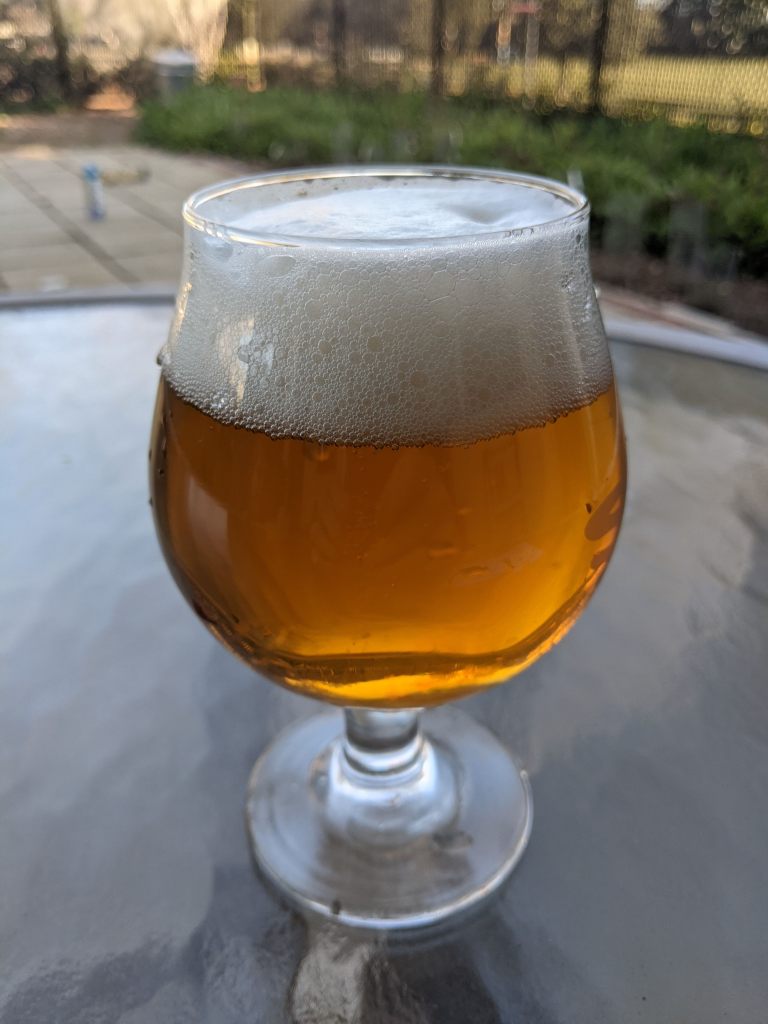
Medium gold beer, fairly clear; it has a pillowy and persistent white head.
Aroma
The aroma is wonderful! It is quite spicy, like gingerbread or spice cake, showcasing a really nice Belgian yeast aroma. The hops definitely faded a bit over time, starting out as herbal and slightly grassy, fading to a low herbal note towards the end of the keg. There is a light pear-like yeast character.
Flavor
Very clean! There is a wonderful hop/malt balance, with no boozy notes to speak of. Malt level is medium-low, with a cracker quality. Bitterness is relatively high, with an herbal and piney character, but that had faded a bit over time. There is a slight pear quality to the yeast, with spicy and peppery aspects more at the front.
Mouthfeel
Highly carbonated, medium-light body, with a medium-dry finish.
Would I brew this again?
Absolutely! I’m super pleased with the results, particularly in how well I nailed the yeast management. This fermentation schedule (gradual ramp up and gradual ramp down) seemed to do really well for WLP550, and I would absolutely use that again. I may have had some minor oxidation issues due to the mash problems as well as the airlock going dry, which resulted in a faster hop fade and slightly darker color than desired. The beer was definitely a deeper gold hue than I expected for 100% pilsner malt (with white sugar). I didn’t notice any sherry or cardboard or honey notes that I usually associate with oxidation, but I bet it would have manifested if I had let it age out a bit more. In any case, I’m super pleased with the overall result, and will give it another try someday when I want a high gravity sipper. I’ll need to reconfigure the malt and water quantities for a more carefully constrained future batch, but that should (hopefully) be trivial. I might also lower the second mash rest to 150° or so, to help dry out the beer a bit more. It finished a touch higher than desired, so I’ll mash a bit lower next time for the second step.
In the winter months, it’s nice to have something malty and tasty but not overly heavy, as an “everyday” beer. Looking through Craft Beer for the Home Brewer recipe book, I ran across a clone recipe for 90 Shilling Ale from Odell Brewing Company. Although it has a Scottish name, the ingredients are anything but! I adjusted for the malts I had on-hand, and swapped in a pound of Vienna for a pound of 2-row, because I was finishing up my 2-row malt supply before opening a new bag. I called this batch “Aspiration Ale,” because it’s aspiring to be a 90 shilling ale, but sure as heck ain’t it!
Aspiration Ale
7 lb. 6.5 oz. 2-row malt (Great Western)
1 lb. Munich light malt (Chateau)
1 lb. Vienna malt (Weyermann)
9 oz. Carafoam malt (Weyermann)
8 oz. Crystal 75 malt (Bairds)
8 oz. Caravienne malt (Weyermann)
8 oz. white wheat malt (Briess)
1 oz. Cascade whole hops (5.5% alpha), 60 minute boil
1 oz. Cascade whole hops (5.5% alpha), 10 minute boil
1 Whirlfloc tablet, 5 minute boil
1 pkg. Nottingham yeast (Danstar)
Target Parameters
1.051 s.g., 1.012 f.g., 5.2% abv, 9 SRM, 24 IBU
Infusion mash, 152°, full volume; 60 minute boil
Claremont water, with Campden tablet to remove chloramines.
Procedure
I mashed in with 7.25 gallons of water at 159°, to hit a target mash temperature of 152°. I added 3 mL of 88% lactic aid to a hit a pH of around 5.2 to 5.3. There was an amazing malt aroma to the mash; it smelled like malt and brown sugar and all sorts of goodness!
After 60 minutes, I raised the mash temperature to 168° for 10 minutes, and then removed the grain basket. In total, I got 6.4 gallons of wort with a gravity of 1.045, for 68% mash efficiency.
I boiled the runnings for 60 minutes, adding hops and finings per the recipe. At the end of the boil, I chilled the wort down to 78°, transferred it to the fermenter, and let it sit at ambient temperature in the garage to let the temperature drop a bit more.
I fermented at 62° (garage ambient), and moved it inside to 65° ambient temperature on 7 December 2020.
I moved the beer outside to 60° ambient on 22 December 2020.
I kegged the beer on 27 December 2020, with 2.4 oz. of corn sugar. Final gravity was 1.012, for 5.0% abv. I hit my predicted numbers nearly exactly for this batch!
Tasting
Appearance
Medium amber beer with a moderately persistent ivory head and slight haze.
Aroma
Malty, caramel aroma.
Flavor
Toasty and malty, with a slight caramel character. This has a pretty clean yeast profile, with a touch of pear on the backend. Medium-low hop character; not much to report for this aspect!
Mouthfeel
Medium-light body and moderate carbonation. This has a really nice “round” finish!
Would I brew this again?
This beer drinks so easily. The balance between malt and hop is perfect, and it’s great to have an amber beer that isn’t too filling! There’s no way this is a “Scottish Ale” of any sort though (at least as compared to past recipes I’ve done), but in any case it’s a great beer. My minor ding keeping me from a perfect 10 is the slight haze; otherwise the beer is fantastic!
With the end of the year, I did a rebrew of Tremonia Lager, one of my favorite recipes from the past 12 months. This round uses an identical malt bill, although I switched out the bittering hops (Sterling instead of Magnum), and used Diamond lager yeast from Lallemand instead of W34/70. The water is slightly modified too, to accommodate our seasonal water changes and reduce the magnesium load.
Tremonia Lager 1.1
9.5 lb. pilsner malt (Weyermann)
1.5 lb. Munich I malt (Weyermann)
1.5 lb. Vienna malt (Weyermann)
0.85 oz. Sterling hop pellets (7.4% alpha), 60 minute boil
0.5 oz. Mt. Hood hop pellets (4.6% alpha), 10 minute boil
1 Whirlfloc tablet, 5 minute boil
0.5 oz. Mt. Hood hop pellets (4.6% alpha), 5 minute boil
2 pkg. Diamond Lager yeast (Lallemand)
Target Parameters
1.057 o.g., 1.014 f.g., 5.6% abv, 26 IBU, 5 SRM
Infusion mash, 152° for 60 minutes, full volume
Claremont tap water adjusted with lactic acid and mineral additions, to achieve calculated water profile of 102 Ca, 45 Mg, 74 Na, 66 SO4, 89 Cl, 25 HCO3, -79 ppm RA, 20 ppm Alkalinity, 99 ppm effective hardness.
Procedure
I tested my water the night before brewing, and added 6.75 mL of 88% lactic acid to neutralize carbonates. Then, I added 2 g of gypsum and 0.5 g of calcium chloride, to achieve the target water profile listed above. Unlike my first batch of this beer, I used no Epsom salts.
I mashed in with 7.5 gallons of water at 159°, to hit a target mash temperature of 152°. After sitting for 10 minutes, I began recirculation, for a 60 minute mash rest at 152°. Then, I heated the mash to 168°, holding it here for 10 minutes.
After removing the grain basket, I had 6.6 gallons of runnings with a gravity of 1.049, for 69% mash efficiency.
I brought the kettle to a boil, adding hops and finings per the schedule. I also added 1 tsp. of BrewTan B at the end of the boil, to help maintain freshness of the beer.
I chilled the beer down to 75° or so, and then transferred to the fermenter for the final chill down to 50°. Then, I pitched the yeast.
Starting gravity was 1.055. I brewed this beer on 21 November 2020.
On 30 November 2020, I raised the temperature in the fermenter to 60°, and then cold crashed to 33° on 4 December 2020.
I kegged the beer on 10 December 2020, with a semi-closed transfer into the purged keg. It lagered for a few weeks at this temperature before going on-tap.
Tasting
Appearance
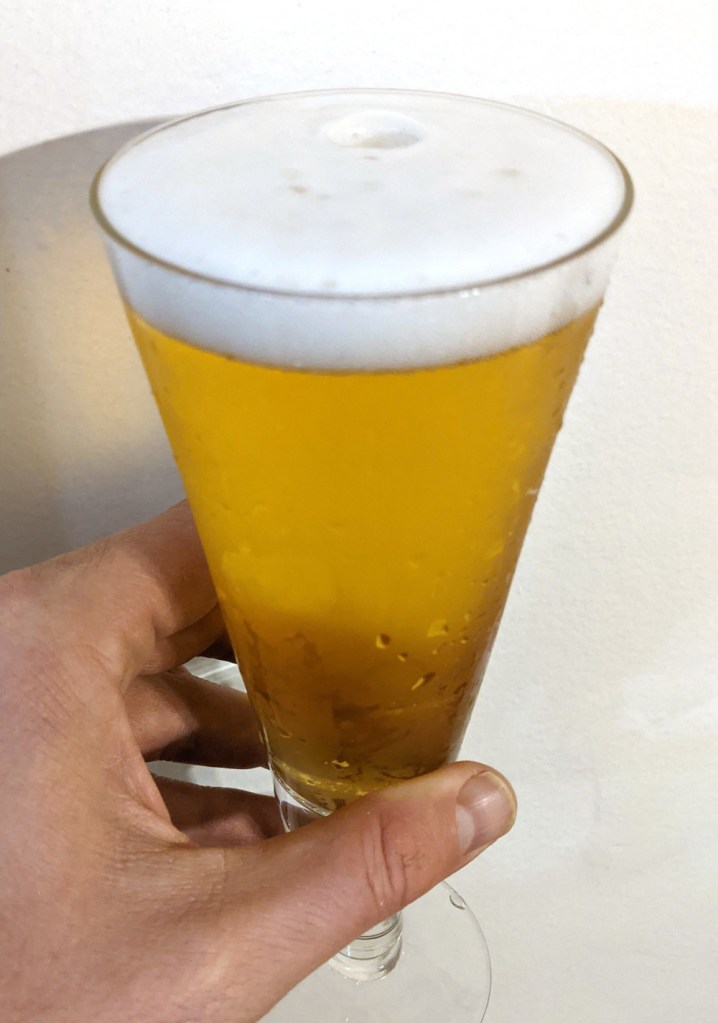
Very clear, nearly brilliant gold beer, with a persistent fine white head. Beautiful!
Aroma
Malt-forward, with a light sweet maltiness and low hop level.
Flavor
Malty, delicious, with cracker-like character. There is a firm, moderately high bitterness, but not much hop character beyond that.
Mouthfeel
Medium body, moderate carbonation, with off-dry finish and lingering bitterness.
Would I brew this again?
This is a nice beer! I like the previous version a touch better, but this one is still pretty good. The hop character was a touch better previously, and I think the mineral balance is slightly out of whack, giving a slight harshness to the bittering. I might adjust the minerals to be just a touch closer to the “old” version next time around.



 Andy's Brewing Blog