Gondwana Pale Ale 1.3

I’ve been pretty heavy on the IPAs lately, so it’s time to give my tastebuds a break with a pale ale. My go-to recipe has been Gondwana Pale Ale–it has a clean but flavorful malt profile, which permits the single hop of my choosing to shine through. I’ve brewed this recipe with minor modifications on three different occasions, so this is iteration 4.

For the current round, the malt bill is pretty much the same as before (~82% 2-row, 10% Vienna, and the remainder split between crystal 40 and Carapils). Where I previously used Citra hops, though, I substituted in Mosaic. I have not yet done a single-hop Mosaic brew, so this is a good opportunity to really explore the characteristics of that variety.

Gondwana Pale Ale 1.3

  • 8.6 lbs. 2-row malt (Great Western Malting Co.)
  • 1 lb. Vienna malt
  • 0.45 lb. 40° crystal malt
  • 0.45 lb. Carapils malt
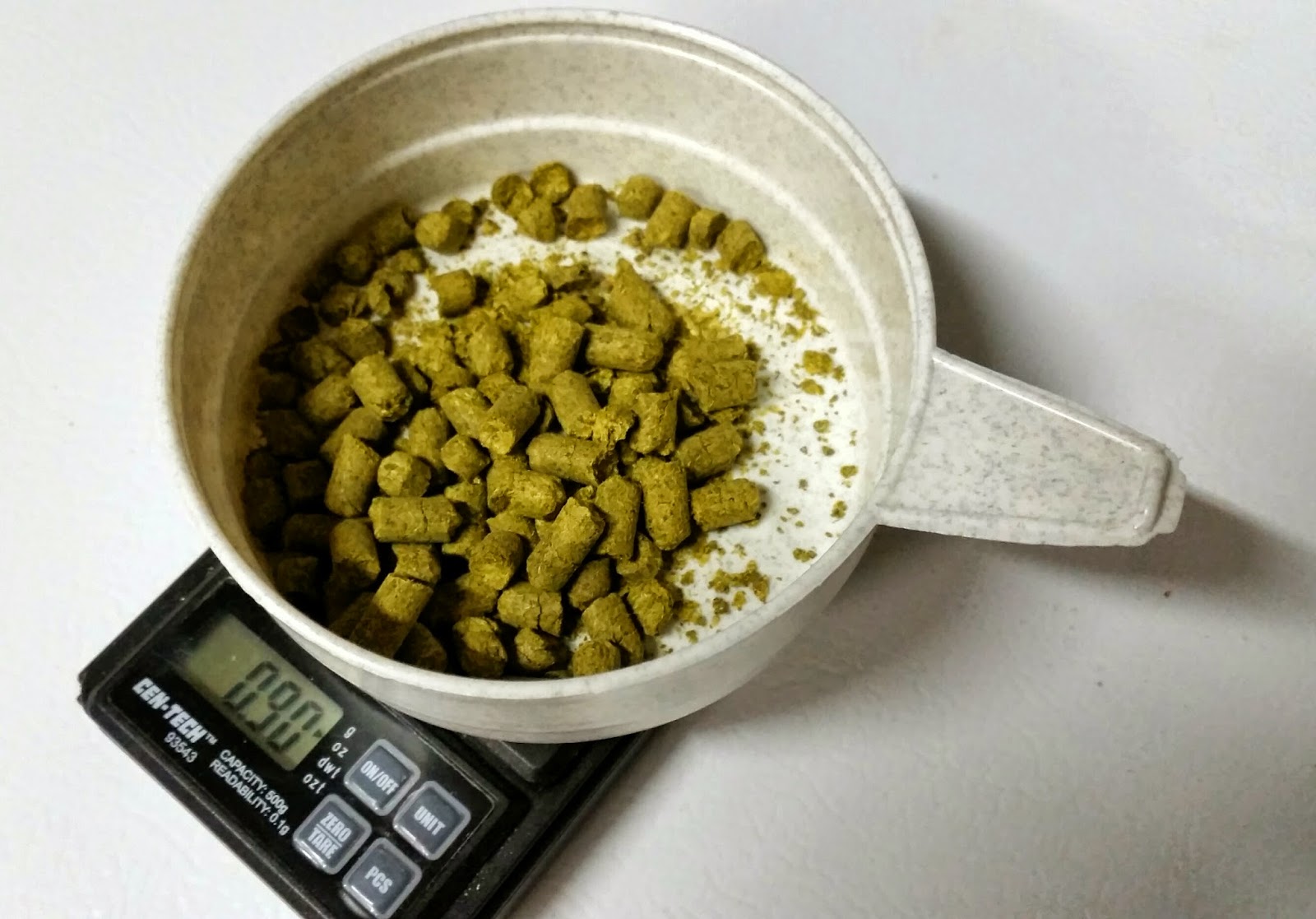
  • 1 oz. Mosaic hops pellets (11.3% alpha, 3.2% beta), 35 minute boil
  • 1 oz. Mosaic hops pellets (11.3% alpha, 3.2% beta), 2 minute boil
  • 2 oz. Mosaic hops pellets (11.3% alpha, 3.2% beta), dry hop in keg
  • 1 tsp. Irish moss (10 minute boil)
  • 1 pkg. Safale US-05 dry yeast

Procedure

  • I mashed in with 3.75 gallons of water at 163°, to hit a mash temperature of 153.3°. This was down to 152.5° after 15 minutes, and down to 149° after 40 minutes.
  • After 55 minutes of mashing, I added 1 gallon of water at 165°, to raise the mash temperature to 151.5°. I let it sit for 10 minutes, vorlaufed, and collected the first runnings.
  • Next, I added 3.7 gallons of water at 190°; this raised the mash to 174°, so added ~0.25 gallons of water in ice cubes, to bring the mash down to 165°. I let it sit for 10 minutes, vorlaufed, and collected the remainder of wort.
  • In total, I collected 7.2 gallons total, with a gravity of 1.037 gravity and 69% efficiency. This was a bit below my usually efficiency (~72%)–I suspect the more dilute mash was to blame.
  • I brought the wort to a boil, and added hops and Irish moss per the schedule.
  • After 60 minutes, I cooled the wort to 82°. Anything lower than this would have been too hard given my high groundwater temperature. I transferred the wort to the fermenter while aerating and then pitched the yeast.
  • I brewed this up on August 5. Starting gravity was 1.045. I am fermenting the beer at 64°; visible fermentation signs were in evidence after around 12 hours, and vigorous fermentation was underway after ~36 hours.
  • I’ve noted that my collected volumes have been a bit above what I predicted; I need to continue adjusting the BeerSmith settings for my mash tun volumes and dead spaces. Also, I suspect I am getting just a little sloppy with volume measurements; it’s easy to overfill my gallon measuring pitcher, which adds up after four or five pitchers’ worth.
Beer Tasting: Old Speckled Hen Clone

After a month of keg conditioning, it’s time to do a taste test of my Old Speckled Hen clone attempt!

Old Speckled Hen Clone

  • Basics
    • Starting gravity = 1.055; final gravity = 1.011; abv = 5.8%; estimated IBU = 37
  • Appearance
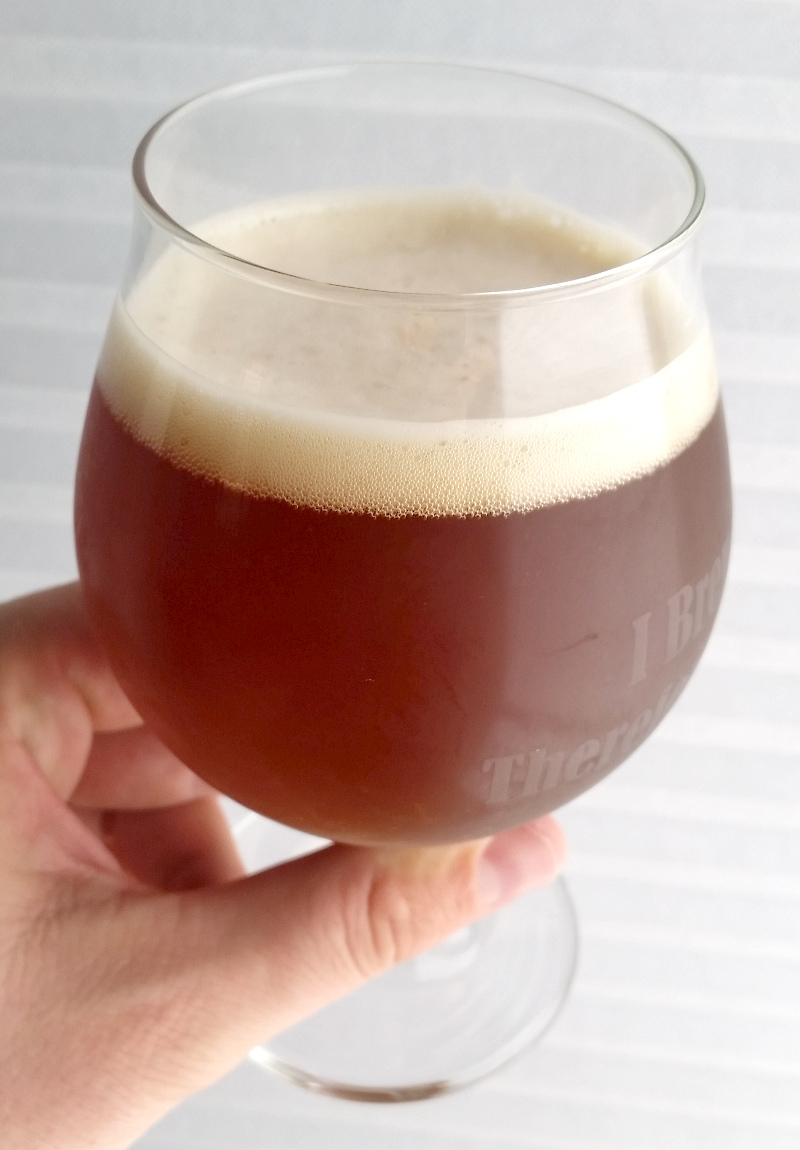
    • The beer is a rich amber color with orangish hints; a modest bit of chill haze. Head is low, creamy and ivory-colored; fairly persistent.
  • Aroma
    • Light caramel notes, with a bit of maltiness at the core.
  • Flavor
    • Lightly malty, with a lingering bitterness on the finish. Very hop-centered. Unfortunately, I think the bitterness overrides the maltiness more than I like. This becomes a better beer as it warms up a bit, though.
  • Mouthfeel
    • In the mouth, the carbonation has an almost creamy effect that is quite nice. The overall body, though, is moderately thin and a bit thinner than I prefer in this type of beer.
  • Would I brew this again?
    • In it current incarnation, probably not. The aroma is delightful, but the bitterness:body ratio is just a too high for my preference. I attribute this primarily to the fairly low mash temperature called for in the recipe, as well as use of the highly attenuative Nottingham yeast strain. If I were to do this again, I would mash higher (maybe 156°), use a different yeast strain (perhaps WLP002), and cut back the bittering addition just a touch. As it is, the current iteration just doesn’t hit the round, malty notes that the original OSH does.
  • Overall rating
    • 4/10
Note (19 July 2015): After a few more weeks in the keg, this is a much better beer. The bitterness has rounded out quite a bit, and more balanced relative to the maltiness. So, I would up it to 6/10; brew again, with modifications to the mash temperature and a longer conditioning time (probably 6 or 7 weeks).

Brewing Update: Old Speckled Hen Clone and Red Oak Ale

Red Oak Ale sample

Tonight I transferred the Old Speckled Hen Clone and the Red Oak Ale (right) out of their respective primary fermenters and into their kegs. Visible fermentation had long since ceased for both.

Old Speckled Hen Clone
This beer had been in the primary fermenter for 10 days, with a reasonably vigorous fermentation. The Nottingham dry ale yeast was a little slow to start relative to the liquid yeasts I’ve been using lately, and didn’t display signs of active fermentation until nearly 24 hours after pitching.

This beer had fermented down to 1.011, and is still a little hazy. I’m expecting that should settle out as the beer chills. The beer has a nice toffee color, and was a little more bitter than I expected. I think it is mainly because I had memories of a much more malt-forward beer; I expect this will come back to the fore as the beer conditions and the yeast continues to drop out. The distinct hops flavor is also probably due to the “spicier” English hops (where I usually have been using American hops in my other beers–I had forgotten how big the difference was!). Starting gravity was 1.055, which works out to 5.8% abv.

The kegged beer (~4.5 gallons) went directly into the keezer, where it is force carbonating under 13.5 psi at 42°.

Red Oak Ale
This beer showed vigorous fermentation within 9 hours of pitching the yeast. I agitated the beer a bit after 3 days (and once or twice more after that), following notes from yeast reviewers that the WLP041 strain tended to slow or stall out if left alone. I figured this was a good idea given the relatively high starting gravity, too (1.070).

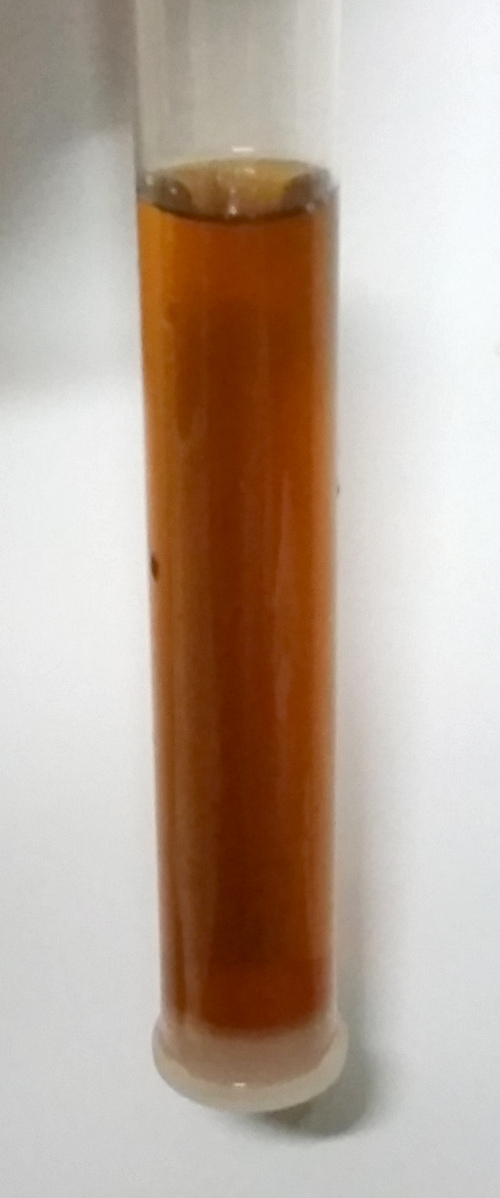
The beer had fermented down to 1.015 over the past 18 days, with a gorgeously clear burn umber color (see above picture). This works out to 7.3% abv, one of the “bigger” beers I’ve done in some time. So far, I’m pretty happy with how it is turning out.

Before sealing up the keg, I added a mesh bag with 2 oz. of Willamette hops pellets for dry hopping. They’ll stay in for ~14 days (or maybe even permanently). Tomorrow, I’ll add 2 oz. of French oak chips (medium toast), boiled in water and contained in a mesh sack. Those will stay in for just a week before being pulled. I’m leaving the keg at room temperature for at least the next week.

Old Speckled Hen Clone

Time for another new recipe. One of my favorite English beers readily available in the USA is Old Speckled Hen, an ale that falls somewhere in the English Pale Ale / Extra Special Bitter style. A quick internet search turned up this recipe at BIABrewer.info (also available on the BeerSmith recipe cloud). BIABrewer user hashie posted the recipe, so it has their name at the helm. The original recipe was developed for the brew-in-a-bag technique, so I had to modify the grain bill slightly for my own batch sparge setup.

Hashie’s Old Speckled Hen
  • 8.25 lbs. Maris Otter pale malt
  • 1 lb. 120° crystal malt
  • 0.90 oz. U.S. Northern Brewer hops pellets (9.9% alpha, 4.6% beta), 60 minute boil
  • 0.50 oz. U.K. Goldings (4.8% alpha), 15 minute boil
  • 0.5 oz. U.K. Goldings (4.8% alpha), 5 minute boil
  • 0.75 lb. Lyle’s golden syrup, 5 minute boil
  • 1 tsp. Irish moss, 10 minute boil
  • 1 pkg. Nottingham yeast (Danstar)
Procedure
  • I mashed in with 3 gallons of water at 164°, hitting 151.4° for the mash start. The mash temperature was at 148.5° after 35 minutes and 146° after 60 minutes. 
  • I added 1.3 gallons of water at 180°, which raised the mash bed to 151°. I let this sit for 10 minutes, vorlaufed, and collected 2.75 gallons of wort.
  • Next, I added 3.25 gallons of water at 185°, which raised the mash bed temperature to 168°. I let this sit for 10 minutes, vorlaufed, and collected the rest of the wort.
  • In total, I collected 6.2 gallons of wort with a gravity of 1.043. This works out to ~69% efficiency. It’s a little less than my best brews (~75%), so I wonder if that’s because I didn’t use 5.2 pH stabilizer on this batch.
  • I brought the wort to a boil and added the Northern Brewer hops.
  • After 45 minutes, I added the first dose of Goldings. After 50 minutes, I added the Irish moss. After 55 minutes, I added the second dose of Goldings and the golden syrup. The syrup has a really nice toffee note to it–I am interested to see how that will translate into the overall beer.
  • After 60 minutes, I turned off the flame and chilled the wort down to ~78°.
  • I transferred ~4.9 gallons of wort into the fermenter, with a starting gravity of 1.055.
  • After pitching the yeast, I sealed everything up and put it in the fermentation chamber. Temperature is set for 66°.

Gondwana Pale Ale 1.2

Mash on!

Ramping up for the National Homebrewers Association conference, my club is going to be serving our beers at club night! I’ve (perhaps foolishly) agreed to provide three kegs, using some of my more tried-and-true recipes. First out: Gondwana Pale Ale. I’ve made this recipe in two previous iterations, and have modified the grain and hops bill just a touch as my techniques are refined. Additionally, I’ll be using a liquid yeast starter (WLP001) instead of dried yeast (Safeale US-05).

Gondwana Pale Ale 1.2

  • 8.25 lbs. 2-row malt
  • 0.85 lbs. Vienna malt
  • 0.45 lbs. carapils malt
  • 0.45 lbs. crystal 40 malt
  • 1 oz. Citra hops (pellets, 13.2% alpha, 3.7% beta), 35 minute boil
  • 1 oz. Citra hops (pellets, 13.2% alpha, 3.7% beta), 1 minute boil
  • 2 oz. Citra hops  (pellets, 13.2% alpha, 3.7% beta), dry hop 14 days
  • 1 tsp. Irish moss (boil 10 minutes)
  • 1 pkg. California Ale Yeast (White Labs, WLP001); prepared 24 hours in advance in 1L starter

Procedure

  • I mashed in with 3.185 gallons of water at 164°, nailing 152° on the nose for a mash temperature. This had declined to 151° after 10 minutes and 150.4° after 35 minutes.
  • I added 1.18 gallons of water at 190°, which brought the temperature up to 154°. I let it sit for 10 minutes, vorlaufed, and collcted 3.25 gallons of wort.
  • I added 3.18 gallons of water at 185°, which brought the mash temperature up to 172°. This was a touch high, so I added .125 cups of ice cubes, which brought the temperature down to 165°. I let it sit for another 10 minutes, vorlaufed, and collected the rest of the wort.
  • All told, I collected 6.95 gallons of wort with a gravity of 1.037. This works out to ~72% efficiency. Because my efficiencies have been a touch low the last two batches (compared to the usual 75%+), I rechecked the gap on the rollers on my grain mill. Sure enough, they had slipped out just a touch, so I readjusted them back to 0.039.
  • I brought the wort to a boil and added the first hops charge after 25 minutes (for a 35 minute total boil).
  • I added the Irish moss after 50 minutes of boiling.
  • I added the second hops charge 1 minute before flame-out. At flame out, I removed the “old” hops, left the “new” ones in to steep, and cooled the wort. Once it was down to ~75°, I transferred the wort to the fermenter and pitched the yeast.
  • I have ~5.5 gallons of beer in the carboy, with a gravity of 1.048 (exactly where I was at for my last batch, too!). I’ll be fermenting it at 66°.
  • Within 12 hours after pitching the yeast, fermentation was well under way.
  • I brewed this beer on Saturday, April 11.