GBP70 – Bohemian Pilsner Recipe & Tasting

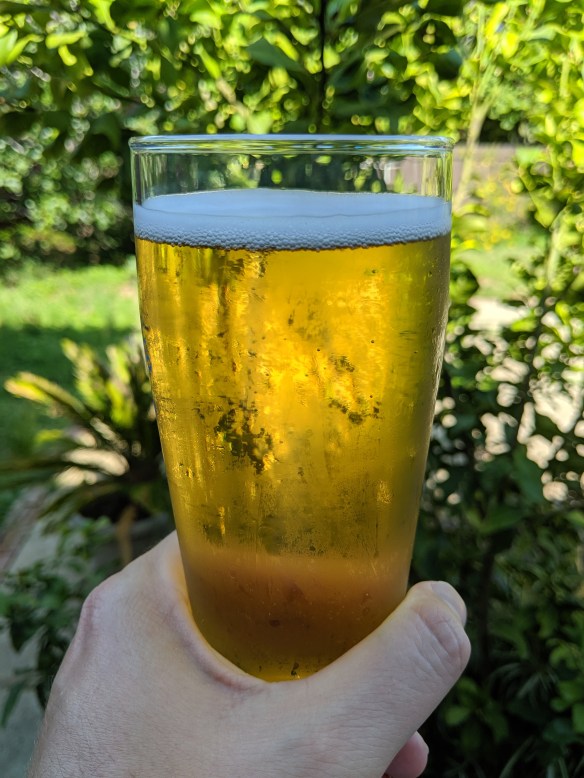
In honor of my dad’s 70th birthday (he introduced me to homebrewing, after all!), I brewed a Bohemian-style pilsner. It was pretty tasty, and sadly didn’t last long enough even for me to do a formal tasting. I made the mistake of serving it at a party, and the keg was finished before I could blink!

GBP70 (Greg’s Birthday Pilsner 70)

  • 10.5 lbs. Barke pilsner malt (Weyermann)
  • 2.3 oz. melanoidin malt (Weyermann)
  • 0.3 oz. Carafa Special III malt (Weyermann)
  • 2 oz. Saaz hop pellets (3.0% alpha), 60 minute boil
  • 0.75 oz. Saaz hop pellets (3.5% alpha), 60 minute boil
  • 1 Whirlfloc tablet, 10 minute boil
  • 1 tsp. Fermax yeast nutrient, 10 minute boil
  • 2.25 oz. Saaz hop pellets (3.5% alpha), 5 minute boil
  • 2 pkg. W34/70 Saflager Lager Yeast (Fermentis)

Target Parameters

  • 60 minute infusion mash, 150°, no sparge
  • 1.049 o.g., 1.010 f.g., 5.2% abv, 38 IBU, 5 SRM
  • Water built from RO to hit targets of 7 ppm Ca, 2 ppm Mg, 2 ppm Na, 5 ppm SO4, 5 ppm Cl, 15 ppm HCO3

Procedure

  • To 7.75 gallons of RO water, I added 0.6 g baking soda, 0.4 g CaCl, and 0.3 g gypsum.
  • I heated the mash water to ~160°, added to the mash tun, allowed to cool to 155.4°, and then added the grains along with 10 mL of 88% lactic acid.
  • I hit 150.7° on the mash temperature–not too bad! It was down to 148.7° after 45 minutes.
  • After 60 minutes, I collected 6.5 gallons of wort with a gravity of 1.041. This works out to 67% efficiency. That’s a fair bit lower than my typical efficiency (73 to 75%), but not unexpected given the no-sparge methods. I added 0.25 gallons of RO water to bring up the volume in the kettle.
  • I boiled for 60 minutes, adding hops and other ingredients per the schedule.
  • I chilled the wort to 75° in the kettle, and chilled the rest of the way down to 49° after transferring to the fermenter. I oxygenated for 60 minutes at this point, and then pitched the dry yeast directly into the wort.
  • Starting gravity was 1.046 on 12 January 2019.
  • I raised the brew temperature to 64° on 26 February 2019, and cold crashed on 28 February 2019. I kegged the beer (using a closed-transfer technique, directly into the CO2-purged keg) on 9 March 2019.
  • Final gravity was 1.010, down from 1.046. This equates to 4.9% abv.

IMG_20190327_202833General Tasting Impressions

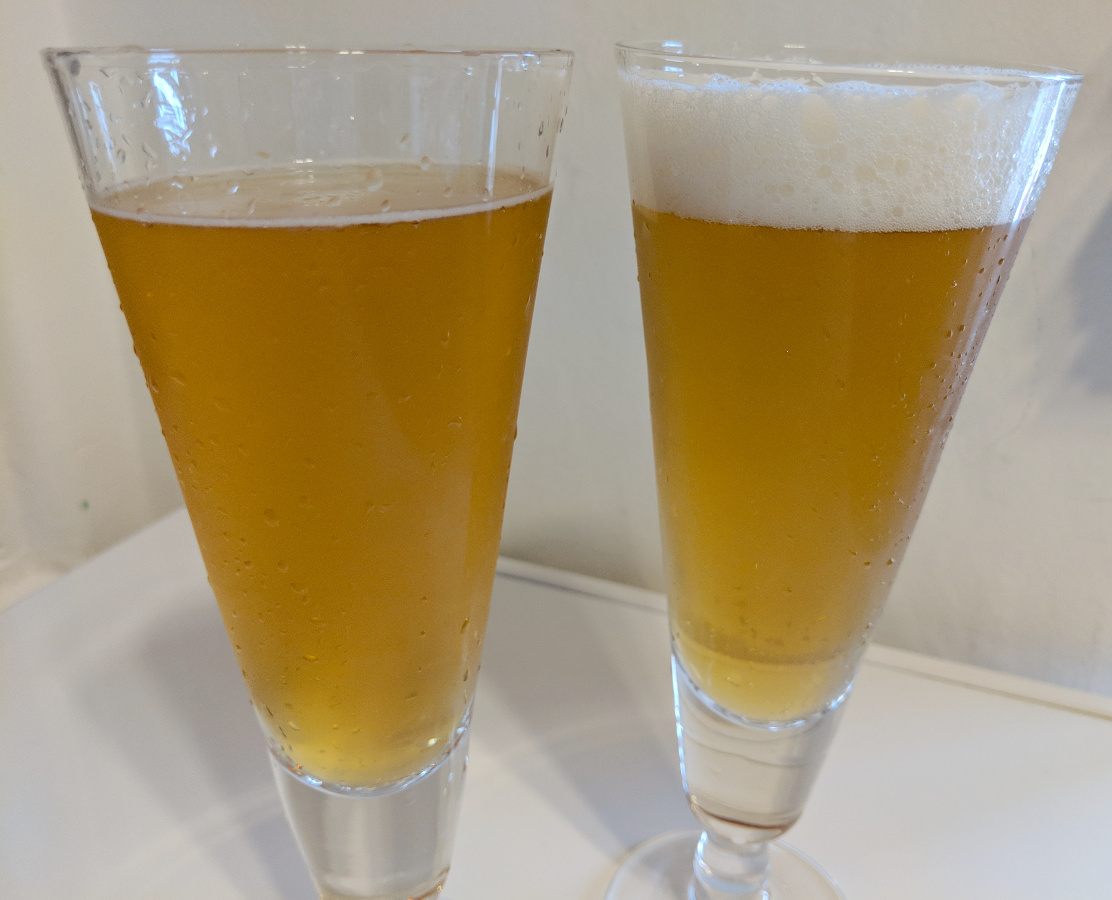
I didn’t get to do a formal tasting for this one, and it was finished before it really hit its ultimate peak, but overall I’m pretty happy with it. The malt flavor was spot-on, and I think I’ve finally iterated into a good balance of melanoidin malt within my no-decoction Bohemian pilsner recipes. The beer was pretty clear, but would have cleared to brilliant with another week or two in the keg. The head and head retention were fairly good also, but not the best I’ve ever had. Not sure why that was. I’m still chasing a perfect Saaz hop aroma in my Bohemian pilsners; it’s just a matter of finding the right hops with the right freshness. The ones I used in this batch weren’t awful, but they weren’t awfully exceptional, either. Overall, I would give this recipe 8/10, with targeted improvements to mainly chase the best possible hop flavor.

Dunkel-Osteus 2019

I really enjoyed the Munich Dunkel I brewed two years ago, and recently decided to give the recipe another go. This round was nearly identical in terms of ingredients, with the only real change being a lower mash temperature to dry out the beer a bit and reduce residual sweetness. This version is nearly perfect, and has matured nicely while on tap!

Dunkel-Osteus 2019

  • 9 lbs. Munich Dark malt (BESTMALZ)
  • 6 oz. Carafa Special II malt (Weyermann), added at vorlauf
  • 5 oz. melanoidin malt (Weyermann)
  • 1.5 oz. Hallertauer Mittelfrueh hops (4.0% alpha), 60 minute boil
  • 1 tsp. Fermax yeast nutrient, 10 minute boil
  • 1 Whirlfloc tablet, 10 minute boil
  • 2 pkg. Saflager Lager yeast (Fermentis W34/70)

Target Parameters

  • 60 minute infusion mash, 150°
  • 1.050 o.g., 1.010 f.g., 5.2% abv, 22 IBU, 23 SRM
  • Water adjusted to hit 82 ppm Ca, 7 ppm Mg, 15 ppm Na, 31 ppm SO4, 94 ppm Cl, 131 ppm HCO3, 44 ppm RA

Procedure

  • I used 5.13 gallons of Claremont tap water with 3 gallons of RO water and 5 g of calcium chloride overall, to hit my water targets.
  • I mashed in with 3.25 gallons of tap water (with Campden tablet to remove chloramines) at 161.5°, to hit a mash temperature of 150.5°.
  • For the sparge water, I mixed 2 gallons of tap water with 3 gallons of RO water and 5 g of calcium chloride.
  • After 60 minutes, I added 1.25 gallons of tap water at 185°, let the mash sit for 10 more minutes, vorlaufed, and collected the first runnings.
  • Next, I added 3.3 gallons of sparge water, let sit 10 minutes, vorlaufed, and collected the second runnings.
  • I collected 6.6 gallons of wort with a gravity of 1.040, for 73% mash efficiency.
  • I started the boil, and added the hops, Whirlfloc, and yeast nutrient per the schedule. After 60 minutes, I turned off the flame and chilled the wort down to 70°.
  • I transferred the chilled wort to my fermenter, reduced temperature to 54° in my fermentation chamber, and pitched the yeast at this point.
  • Starting gravity was 1.046, on 26 February 2019.
  • I fermented the beer at 54° for the first week, and raised the temperature to 64° on March 9, 68° on March 12, and cold crashed on March 14. I kegged the beer on 23 March.
  • Final gravity was 1.010, down from 1.046, for 4.7% abv.

Tasting

  • The Basics
    • O.G. = 1.046; f.g. = 1.010; 4.7% abv; 20 SRM; 22 estimated IBU
  •  Aroma
    • Mild chocolate aroma, with no apparent hop aroma.
  • Appearance
    • Beautifully clear, darkest amber/reddish brown color, with an off-tan persistent head
  • Flavor
    • Malty beer, with a residual breadiness on the finish; fairly moderate bitterness
  • Mouthfeel
    • Medium body, with the finish being only very slightly dry. Moderate carbonation, appropriate for style.
  • Would I brew this again?
    • Absolutely! I think I nailed the style pretty well this time around, particularly in that this version is slightly less sweet than the first one I did. I attribute this to a slightly lower mash temperature (150° vs 154°). Finishing gravity was definitely lower (1.010 vs 1.016), too. I wouldn’t mind a touch more chocolate character on this version (which the last version had), but that could be fixed by a bit more Carafa Special II. I also think I liked the Weyermann Dark Munich a bit better than the BEST version of this malt, which also might explain some of the loss in malt character character. I recall Weyermann’s Dark Munich being just a touch richer in character, so I might switch things up next time. Otherwise, this is another great recipe!
  • Overall
    • 9/10

Bierstadt Pils Clone

It’s pils time again, as I continue my exploration of European lagers. The July/August 2018 issue of BYO magazine had a tasty looking clone recipe, for Bierstadt Lagerhaus’ Slow Pour Pils. Its simplicity was beautiful–pilsner malt, acidulated malt, Hallertau Mittelfrueh hops, and lager yeast. Additionally, it gave me a chance to play around with more step mashes and decoctions.

I followed the published recipe pretty closely, adjusting just slightly on my additions to ensure that the bittering hops would still hit my target of ~33 IBU. But, I then saw a correction in a later issue that the whirlpool addition should instead be a late hop addition. I figure this probably won’t mess things up too much, giving a bit more hop aroma, although also leaving slightly more potential for haze. In any case, the official recipe is posted at the BYO website.

Because I don’t have direct-fire capabilities for my mash tun, all of the steps had to be accomplished via infusions. This took a bit of creativity, but I managed reasonably well. As another wrinkle in the process, I tried for the first time a closed-transfer technique. In the past, I found that my pilsners tended to get that honey-like taste of oxidation after 6-8 weeks, which detracted from my overall enjoyments towards the end of the keg. As noted below, my attention to technique paid off pretty well!

Bierstadt Pils Clone

  • 8 lbs. Barke pilsner malt (Weyermann)
  • 0.5 lb. acidulated malt (BEST)
  • 1 oz. Hallertauer Mittelfrueh hop pellets (4.0% alpha), first wort hop and 60 minute boil
  • 1 oz. Hallertauer Mittelfrueh hop pellets (2.7% alpha), 40 minute boil
  • 1 oz. Hallertauer Mittelfrueh hop pellets (2.7% alpha), 10 minute boil
  • 1 oz. Hallertauer Mittelfrueh hop pellets (4.0% alpha), 10 minute whirlpool
  • 2 pkg. W34/70 Saflager lager yeast
  • 1 Whirlfloc tablet, 10 minute boil

Target Parameters

  • 1.048 s.g, 1.011 f.g., 4.9% abv, 33 IBU, 3.4 SRM
  • Infusion step mash with decoction
  • Water built from 8.12 gallons of RO water, with 1.6 g CaCl, 1.25 gypsum, 1 g epsom salts in 3.25 gallons of mash water, and 2.4 g CaCl, 1.9 g gypsum, 1.5 g epsom salts in 5 gallons of sparge water, to achieve -47 RA, 59 ppm Ca, 8 ppm Mg, 89 ppm SO4, 63 ppm Cl

Procedure

  • I mashed in with 2.5 gallons of water at 150° (1.054 quarts/pound of grain), aiming for a protein rest temperature of 131°. Instead, I hit 141°, and stirred frequently to get it down to 136° by the end of the 10 minute protein rest.
  • I next added 1.5 quarts of boiling water to achieve a mash rest of 144°. After 30 minutes, the temperature was down to 140°. I then added 1.5 quarts of boiling water, to hit 152°. This was below my target of 160°, so I added another 2 quarts of boiling water, to finally hit 160°. I let it sit here for 40 minutes before proceeding to the next step. In total, I added 4.5 gallons of water for the mash.
  • Next, I pulled a thin mash of 2.75 gallons, and boiled it for 10 minutes. Next, I added it back to the mash tun, to hit 168°. I let this sit for 10 minutes, vorlaufed, and collected the first runnings.
  • Next, I added 3.25 gallons of water at 180°, let it sit for 10 minutes, vorlaufed, and collected the second runnings.
  • In total, I collected 6.75 gallons of runnings with a gravity of 1.053, for 87% mash efficiency.
  • I brought the runnings to a boil, adding hops and kettle finings per the schedule. To keep bitterness closer to my calculated numbers, I removed the boil hops before adding the whirlpool charge.
  • I chilled the wort to 85°, and then transferred it to the fermenter, where it was further chilled to 49° in my fermentation chamber. I oxygenated with 60 seconds of pure O2, and then pitched the two packets of dry yeast directly.
  • Starting gravity was 1.053, with brewing on 31 August 2018. I fermented at 50°, until 25 September 2018, when I cold crashed to 36°.
  • I did a closed transfer to the keg (under CO2 pressure) on 27 October 2018.
  • Final gravity was 1.012; down from 1.053, this works out to 5.4% abv.
Boiling the decoction

Tasting Results

  • The Basics
    • 1.053 o.g., 1.012 f.g., 5.4% abv
  • Appearance
    • Brilliantly clear, light yellow beer, with a fine, white, and persistent head
  • Aroma
    • Slight spicy hop aroma, with a pleasant and gentle maltiness behind that
  • Flavor
    • Robust hop character nicely balanced against a grainy/sweet malt profile. Really nice!
  • Mouthfeel
    • Moderately dry, with a smooth finish that tilts toward the hoppy end in a gentle yet firm way.
  • Would I brew this again?
    • Absolutely! This has matured into a wonderfully drinkable, really delightful beer. I’m pleased with how such a simple recipe can produce excellent results.
  • Overall
    • 9/10

Beer Tasting: Try Again Bohemian Pilsner

My recent version of a Bohemian pilsner has been on tap for a few weeks, and is at its peak for enjoyment. Today, I did a head-to-head with the classic flagship for the style, Pilsner Urquell.

IMG_20180707_160451

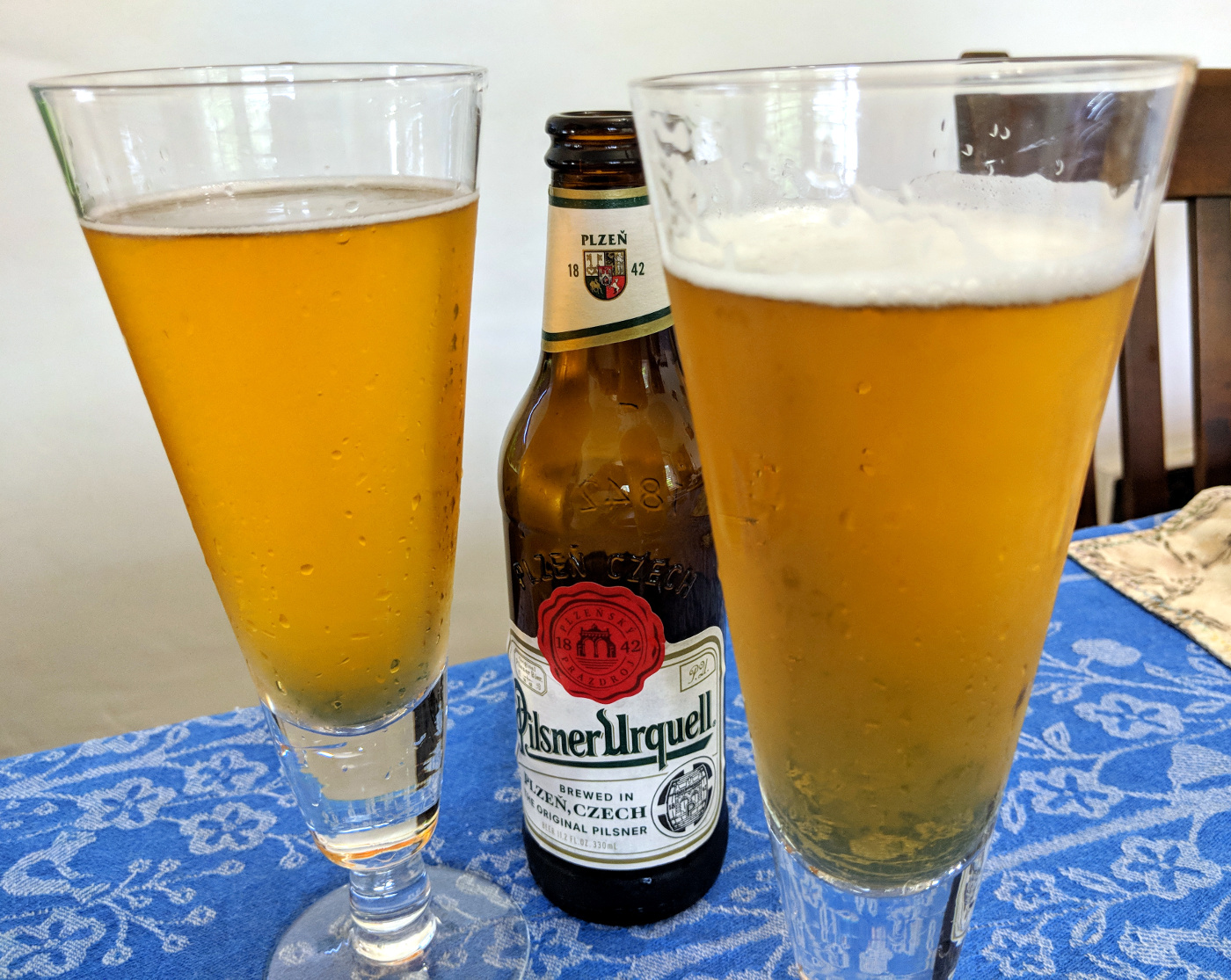
Head-to-head Bohemian pilsners! Pilsner Urquell is in the glass on the left, and my homebrew version is at right.

Try Again Bohemian Pilsner

  • The Basics
    • 1.053 s.g., 1.014 f.g., 4.2% abv, 36 IBU, 5 SRM
  • Appearance
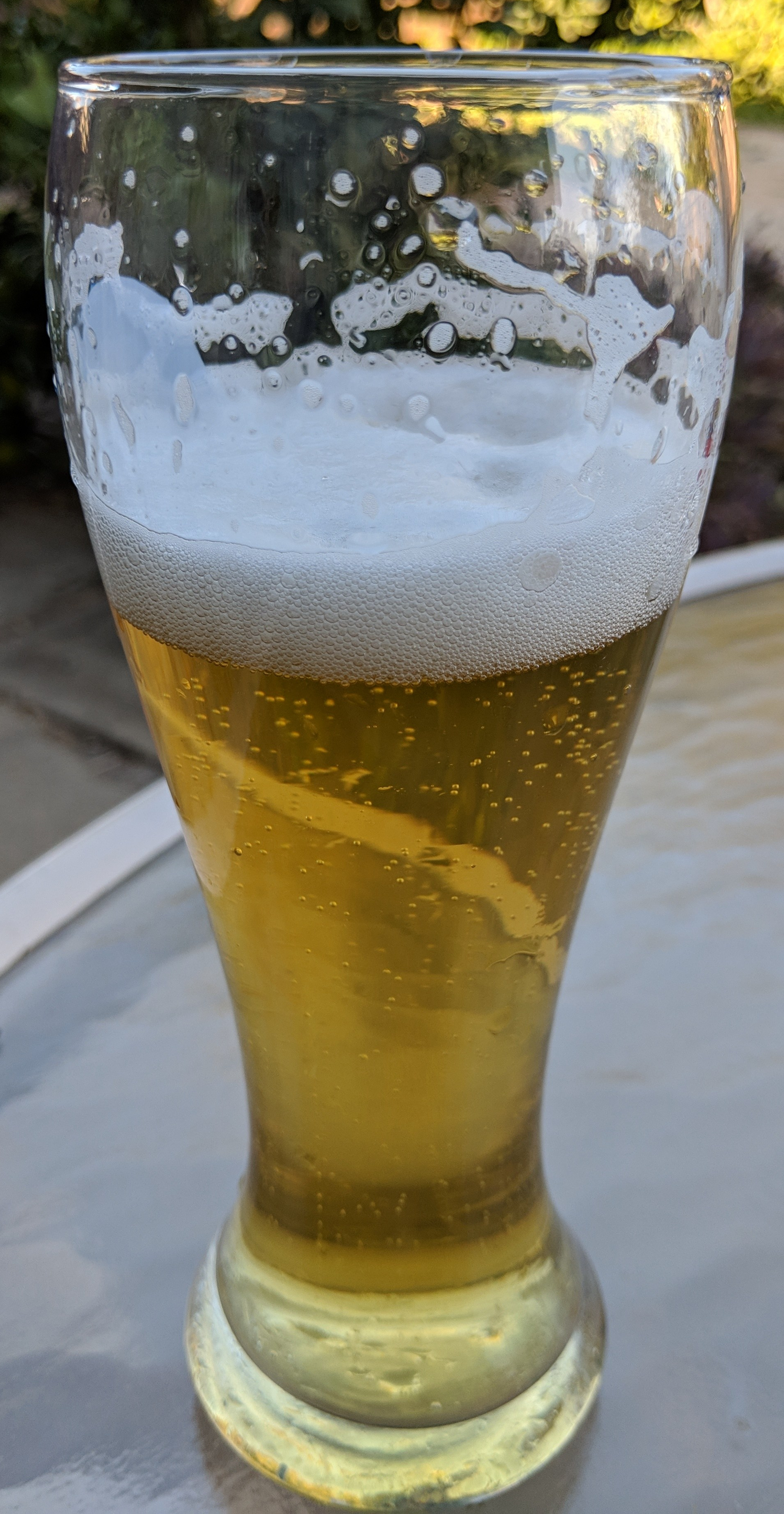
    • Pours with a fine white head with excellent persistance. The beer itself is a golden hue, nearly an exact match for Pilsner Urquell but perhaps just a notch lighter. It is very clear, but not quite brilliant (Urquell has a slight edge here). In terms of appearance, mine is equal in color, better in head (and head retention), and needs slight improvement in clarity.
  • Aroma
    • My beer tips a little bit more towards malt prominence; there is a very slight spice note from the Saaz hops, but that’s still not quite where it should be. Urquell has the hop note perfectly, so I give it a slight edge on this count.
  • Flavor
    • Bitterness levels are not quite evenly matched between Urquell and mine; Urquell comes across as a bit more bitter. Mine has a nice malt character, but this is slightly at the expense of the hops. The malt on my homebrew is rich and bready, and the bitterness stands well against that. The finish is balanced well. Relative to Urquell, it tips more towards the malt than bitterness on the finish, and I prefer the hoppier Urquell version a bit more.
  • Mouthfeel
    • My brew has a medium body and moderate carbonation. Urquell is definitely drier than my beer, with a more extended and more bitter finish. The finish on mine is smoother yet I prefer the Urquell “bite” just a touch.
  • Would I brew this again?
    • Yes, with a few minor modifications! There is lots I like about my beer, such as the appearance and malt character. I do feel like it could be a bit drier and crisper (relative to Urquell), because the hops are just a tiny bit “flabby”. My main adjustment would be to increase the hopping, and mash at a slightly lower temperature to dry out the beer a bit. I might also try halving the melanoidin contribution; I think it might be contributing some unfermentables that keep the beer from being as dry as it might be. The Barke pilsen malt that I used in this recipe has plenty of character on its own, anyhow!
  • Overall
    • 7.5/10

IMG_20180707_155837

Try Again Bohemian Pilsner

I’m craving a good Bohemian pilsner…especially that nice flavor and aroma of Saaz. My last effort was fairly disastrous, thanks to a bum batch of hops. Pro-tip: if it smells way too grassy before throwing them into the wort, throwing them into the wort won’t improve things.

In any case, I’ve got new hops, new grains, and a new recipe. I’ve cheated a bit with the grain bill, kicking in some melanoidin and Carafa III for a bit of extra malt flavor and color, respectively. For my interpretation I’ve amped up the Saaz a bit on the late-hop side, too.

Try Again Bohemian Pilsner

  • 10 lbs. Barke Pilsner malt (Weyermann)
  • 0.25 lb. Melanoidin malt (Weyermann)
  • 0.2 oz. Carafa III malt (Weyermann)
  • 2 oz. Saaz hop pellets (3.0% alpha), 60 minute boil
  • 1 oz. Saaz hop pellets (2.2% alpha), 20 minute boil
  • 2 oz. Saaz hop pellets (3.0% alpha), 10 minute boil
  • 1 oz. Saaz hop pellets (3.0% alpha), 5 minute whirlpool
  • 1 Whirlfloc tablet, 10 minute boil
  • 1 tsp. Fermax, 10 minute boil
  • 2 pkg. Bohemian lager dry yeast (Mangrove Jack’s M84)

Target Parameters

  • Infusion mash to hit target of 149°, 60 minutes, batch sparge.
  • 1.052 o.g., 1.011 f.g., 5.5% abv, 36 IBU, 5 SRM
  • Water built from RO with 0.5 g CaCl, 0.5 g epsom salts, with 6.5 mL of 88% lactic acid added to mash to adjust pH

Procedure

  • I mashed in with 3.5 gallons of water at 160°, to hit a mash temperature of 150°. The mash was down to 145° after 65 minutes. I added 1.25 gallons of water at 185°, let sit for 10 minutes, vorlaufed, and collected the first runnings. I then added 3.5 gallons of water, let sit for 10 minutes, vorlaufed, and collected the remainder of the runnings.
  • In total, I collected 6.8 gallons of runnings with a gravity of 1.046, for 83% mash efficiency!
  • I started the boil, adding hops and various finings and nutrients per the schedule above. After 60 minutes of boiling, I turned off the flame and added the final charge of hops.
  • After 5 minutes of whirlpooling, I chilled down to 75° or so. Then, I transferred the wort to the fermenter, and let it chill overnight (~10 hours), down to 48°.
  • I brewed the beer on 12 May 2018. On the morning of 13 May 2018, I oxygenated the wort for 45 seconds and pitched the yeast (rehydrated in 1 cup of boiled and cooled water).
  • Starting gravity was 1.053, nearly exactly on target.
  • After pitching, I set the temperature on the fermentation chamber to 52°, letting the beer free-rise from 48°.
  • One day after pitching (14 May 2018), no fermentation activity was yet visible, but the fermenter gave off bubbles when I agitated it gently. By the morning of 15 May 2018 (48 hours post-pitching), visible krausen was forming.
  • On 20 May (7 days after pitching the yeast), I raised the fermentation temperature to 54°.
  • On 23 May, I raised the fermentation temperature to 56°.
  • On 25 May, I raised the fermentation temperature to 58°.
  • On 27 May, I raised the fermentation temperature to 60°. At this point, the gravity was 1.014.
  • On 2 June, I cold crashed down to 33°.