Three and a half weeks after brew day, it was time to take care of the Eagle Face Oatmeal Stout. Over the holiday break, I worked on getting set up for kegging. I converted a 7 cubic foot deep freezer into a “keezer”; I’ll probably detail that in another post, but the short version is that it has a redwood collar made out of 2×4’s, with a three keg (and three faucet) capacity. This oatmeal stout is my first beer kegged in a 5 gallon keg (I’ve done some 5 L mini-kegs using the Philtap system), and was wonderfully easy to package!
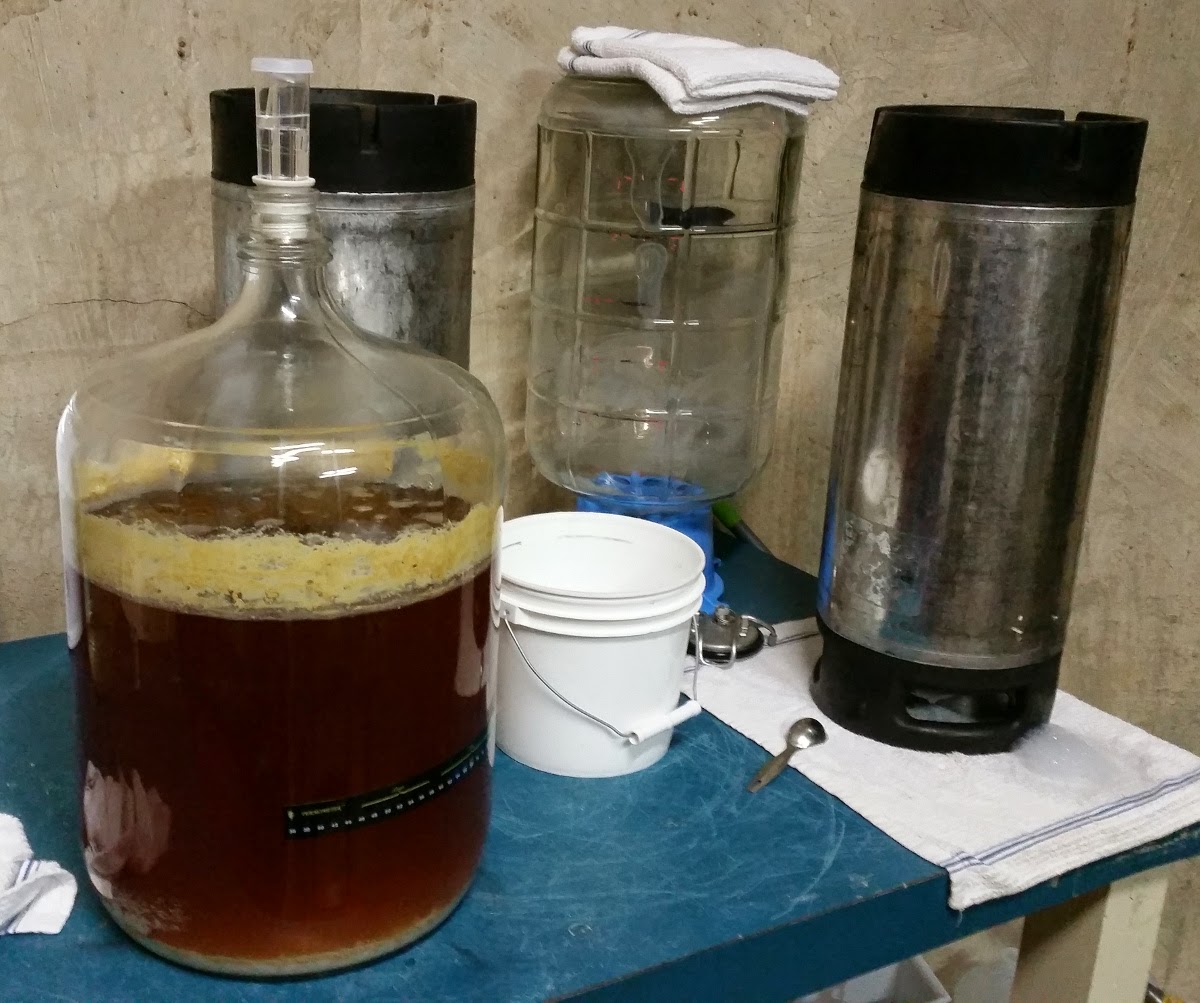
The beer was brewed on Saturday, December 13, and was happily fermenting by the next morning. On the evening of December 14, I noticed that temperature of the fermenter had risen to 74°, a few degrees over what is ideal for this strain. Part of the problem was that I had my temperature sensor for the temperature controller hanging in the air, rather than taped to the fermenter. Lesson learned, and I was able to drop the fermenter down to the mid-60s by the next morning. Not ideal, but it seems like the extra conditioning time cleared out any negative flavors.
On January 1, 2015, I pulled the fermenter from the chamber and set it on the floor. This was in the midst of a cold snap, so the whole setup was soon down to the ambient temperature of 52°. The temperature increased a little bit over the next few days, to 60° or so, but didn’t exceed that.
In terms of overall character, the English Ale Yeast (White Labs WLP002) was fast-acting and extremely flocculant. In other words, true to the strain. This was coupled with relatively low attenuation (see below), as expected.
On January 7, 2015, I kegged the beer. Final gravity was 1.022, down from 1.057. This works out to 4.6% abv and 60% apparent attenuation. The beer was slightly sweet (as expected for the yeast strain), with a nice background bitterness and just a subtle fruity aroma. If I do this recipe again, it would be interesting to try another strain to see what a drier version of the beer is like. I transferred 5 gallons (virtually all of the beer in the fermenter) into a refurbished cornie keg.
After kegging, I put the keg in the keezer, which is set for 42°. Following suggestions for force carbonation from Midwest Brewing, I set the CO2 pressure to 40 psi. I’ll do this for 24 hours, lower to 20 psi for another 24 hours, lower to ~13.5 psi, and then sample. Thus, I should be ready for at least preliminary sampling by the weekend!


 Andy's Brewing Blog