Thumbspike Saison 2.1

The Lake Arrowhead Brewfest is coming up in August, and I’ll be there with the Horse Thief Brewing Association to serve up some tasty homebrews! I’ve promised two beers–one is the second iteration of my raspberry Belgian, and the other is my wild hop saison! I recently kicked the keg on this one, and I was overall pretty pleased with it.

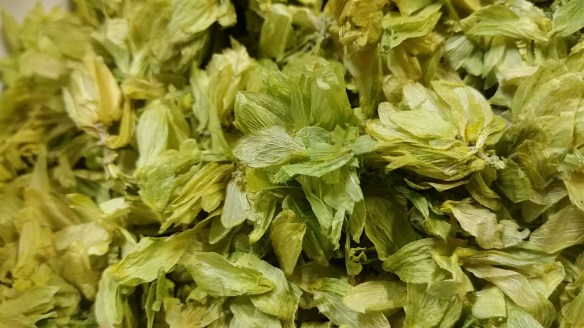
The latest version of Thumbspike Saison is virtually identical to the last, with only a few very minor changes. First, I did a mix of Bohemian and Belgian pilsner malt for the grist, because my floor-malted Bohemian pilsner malt was nearly gone. Second, I ditched the rice hulls from the grist, because the percentage of wheat was so low as to be a non-issue for sparging (and this was proven in the easy collection of the first and second runnings). Finally, I modified the hop schedule very slightly to try and increase the hop character in the brew.
20170625_205023

Thumbspike Saison 2.1

  • 5.25 lbs. Château Pilsen malt (Castle Malting)
  • 4 lbs. floor-malted Bohemian pilsner malt (Weyermann)
  • 0.75 lbs. Munich I malt (Weyermann)
  • 0.75 lbs. white wheat malt (Great Western Malting Co.)
  • 1 oz. Carafa Special II (Weyerman)
  • 1.1 oz. whole wild hops (5.8% alpha), 60 minute boil
  • 0.5 oz. whole wild hops (5.8% alpha), 10 minute boil
  • 1 oz. whole wild hops (5.8% alpha), 2 minute boil
  • 1 Whirlfloc tablet, 10 minute boil
  • 2 pkg. French Saison Ale dry yeast (Mangrove Jack’s M29)

Target Parameters

  • 1.056 o.g., 1.003 f.g., 7.0% abv, 26 IBU, 7 SRM, 5.5 gallons into the fermenter
  • 90 minute mash at 148°, batch sparge, 60 minute boil

Procedure

  • To use up my RO water and thin out the Claremont waters a bit, I added 1.5 gallons with 2.2 gallons of tap water for my mash water. I heated it up to 160°, added the water to the mash tun, and let it slide to 157°, before adding the grains. This hit a mash temperature of 148.3°, which was down to 144° after 90 minutes.
  • After 90 minutes, I added 1.2 gallons of water at 170°, let it rest for 10 minutes, vorlaufed, and collected the first runnings. I then added 3.5 gallons of water at 170°, let it sit for 10 minutes, vorlaufed, and collected the remainder of the runnings.
  • In total, I collected 6.75 gallons with a gravity of 1.048, for 80% efficiency.
  • I aimed for a 60 minute boil, adding the various hops and finings per the schedule.
  • After 60 minutes, I turned off the flame and started chilling. Once I hit 85° (which is pretty close to the limit of what I can chill with our water during the summertime!), I transferred to the primary fermenter and pitched the yeast.
  • I brewed this beer on June 25, 2017. Starting gravity was 1.055, nearly exactly hitting my target gravity.
  • I plan to ferment at ambient temperature, which is around 75°. It will probably sit for a few weeks, because I am in no particular rush to get this batch on tap.

Beer Tasting: Hell Creek Amber Ale 1.1

20170611_212509

Hell Creek Amber Ale, appropriately served in a fossil-themed glass

The keg is gone barely a week for my wild hop amber ale, so it’s better late than never in posting this review. Also, I bottled up a few of these and enjoyed sharing them with some folks at Homebrew Con (including a paleontologist or two)!

  • Aroma
    • Malt dominates the aroma, with malty-sweet toffee and light caramel character. No appreciable yeast or hop character.
  • Appearance
    • Very clear beer with a deep amber color. The head is ivory in color, and settles down to a low but persistent quality.
  • Flavor
    • Hoppiness dominates on the front end of the flavor, and persists throughout the tasting and into the finish. The hop character is fairly herbal, and the bitterness has a slight rough edge to it. The malts come across moderately, with a caramel and bready quality. There is a minerally character to this, and next time I’ll probably adjust the water a bit to lower that. 100 percent Claremont tap water apparently doesn’t work with this recipe!
  • Mouthfeel
    • Moderate body and moderate carbonation. The finish tends toward the dry and bitter side.
  • Would I brew this again?
    • This is an improvement, certainly, on the last version of this beer. I think it was a good move to ditch the special B. This is an interesting beer, because I “have” to brew it within some self-imposed constraints (only Montana/South Dakota ingredients). I would say that the beer doesn’t age entirely well, probably due to the high percentage of caramel malts, and had a bit of an oxidized note towards the end of the keg. For the next iteration of this recipe (assuming there is a next, of course!), I’ll probably switch up the grain bill and see what other amber ale recipes are out there. The caramel is just a touch heavy in this for my tastes. As noted above, I’ll also play with the water a bit.
  • Overall
    • 6.5/10

Lemondrop Wheat Ale

Summer means wheat beers! My intention with this batch is to have something light and refreshing that won’t take too long to turn around, either. I also wanted to experiment with Lemondrop hops, and this seemed like the perfect style in which to do so.

In terms of recipe design, the grist (52% pilsner malt, 46% white wheat malt) is fairly standard. I vacillated on whether or not to include flaked wheat as a way to increase body and prolong haze in the keg, but in the end neither factor is terribly important to me on this batch. The other decision I had to make was whether or not to dope the beer with some homemade lemon extract. My first version of the recipe had this, but after discussion with some other homebrewers at the AHA forum, I decided not to use it. My main purpose with this batch is to explore the hops, and I don’t want those to be overwhelmed by citrus extract. Depending on how this turns out, I may add some extract towards the end of the keg, but we’ll see. Discussion on the forum also led me to use pilsner rather than 2-row, for a slightly lighter malt profile against the hops.

When testing the hops before I threw them into the kettle, I noted that they had some citrus (not nearly as prominent as I expected, given the name and the hype) along with a hay note (not necessarily grassy in the way I often think of grassy–it was dried hay, not freshly cut lawn). My suspicion based on these findings is that I’ll likely use the extract before the keg is finished!

Lemondrop Wheat Ale

  • 4.5 lbs. floor-malted Bohemian pilsner malt (Weyermann)
  • 4 lbs. white wheat malt (Great Western)
  • 2.7 oz. rice hulls
  • 0.3 oz. Warrior hop pellets (15.5% alpha), 60 minute boil
  • 0.5 tsp. Fermax, 10 minute boil
  • 1 oz. Lemondrop hop pellets (6.2% alpha), 15 minute steep/whirlpool
  • 1 oz. Lemondrop hop pellets (6.2% alpha), dry hop in keg
  • 1 pkg. American Hefeweizen Ale yeast, WLP320 (White Labs)

Target Parameters

  • Infusion mash to hit target of 152°. Batch sparge.
  • Claremont tap water with RO and salt additions to hit targets of 82 Ca, 8 Mg, 9 Na, 89 SO4, 73 Cl, 78 HCO3, 64 ppm alkalinity, 1 ppm RA.
  • 1.045 o.g., 1.012 f.g., 4.4% abv, 20 IBU, 4 SRM, 5 gallons into fermenter

Procedure

  • The day before brewing, I made a 1L starter for my yeast and set it going on the stir plate.
  • I mashed in with 3 gallons of Claremont tap water treated with a quarter of a Campden tablet. The water had a target temperature of 162.2°, which hit my target mash temperature of 152°.
  • For my sparge water, I added 3 g gypsum, 1.2 g epsom salt, and 4 g calcium chloride to 5 gallons of RO water. Added with the strike water, I should hit my target.
  • The mash was down to 148 or 149° after 60 minutes. I added 1.6 gallons of water at 160 degrees, to raise the mash temperature to 152°. Then, I let the mash rest for 10 minutes, vorlaufed, and collected the first runnings.
  • I added 3.4 gallons of sparge water at 183°, to raise the mash temperature to 164. I let this sit for 10 minutes, vorlaufed, and collected the remainder of the runnings.
  • In total, I collected 6.75 gallons of runnings with a gravity of 1.038, for 78% efficiency.
  • I brought the wort to a boil and added the hops and other items per the schedule.
  • After a 60 minute boil, I turned off the flame, added the last hop charge in a mesh bag, and let it sit for a few minutes before cooling. I started cooling, which brought the wort down to 165°. I paused the cooling, let it sit for another 10 minutes, and continued chilling down to 75°.
  • I transferred the wort to the fermenter and pitched the yeast.
  • I brewed this beer on 9 June 2017. Starting gravity was 1.047, just a bit more than predicted (0.02 above target). I’m fermenting this at 66°.

Gondwana Pale Ale 1.5

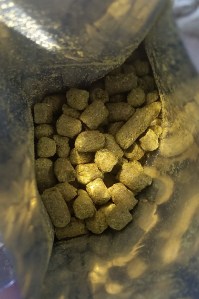
african_queenMy local homebrew shop happened to have a pound of African Queen hop pellets during my most recent visit…for those not in the know, this is a variety grown in South Africa, and one of the few that is available (for now) in the United States. Due to some recent hop farm purchases, future South African hop availability is likely to be even tighter than before, so I had to jump at this chance to brew with this variety.
These hops are touted as being on the flavor/aroma end of things, so I wanted a good pale ale recipe that would highlight this. My classic Gondwana Pale Ale seemed like just the ticket! I subbed in a little Vienna malt for the 2-row to help bolster the maltiness. Otherwise, there is very little changed here from my most recent iteration, just the hops.

Gondwana Pale Ale 1.5

  • 6.5 lbs. 2-row malt (Rahr Malting Co.)
  • 3 lbs. Vienna malt (Great Western Malting Co.)
  • 0.5 lb. crystal 40 malt (Great Western Malting Co.)
  • 7 oz. Carafoam malt (Weyermann Malting)
  • 0.35 oz. Warrior hop pellets (15.8% alpha), 60 minute boil
  • 2 oz. African Queen hop pellets (14.5% alpha), 5 minute boil
  • 2 oz. African Queen hop pellets (14.5% alpha), dry hop in keg
  • 1 Whirlfloc tablet, 10 minute boil
  • 1 pkg. California Ale yeast (WLP001)

Target Parameters

  • Infusion mash to hit target of 152°. Batch sparge.
  • Claremont tap water.
  • 1.053 o.g., 1.011 f.g., 5.4% abv, 41 IBU, 6 SRM, 5 gallons into fermenter

Procedure

  • A few days in advance, I made a yeast starter, cold-crashing it and setting aside some for a future batch.
  • On brew day, I mashed in with 3.5 gallons of water at 163°, to hit a 152° mash temperature. The temp had dropped to ~150° after 30 minutes.
  • After 60 minutes, I added 1.25 gallons of water at 185°, let sit for 10 minutes, vorlaufed, and collected the first runnings.
  • Next, I added 3.5 gallons of water at 185°, let sit for 10 minutes, vorlaufed, and collected the remainder of the wort.
  • In total, I collected 6.6 gallons of wort with a gravity of 1.045, for 78% efficiency.
  • I started the boil and added everything per the schedule.
  • After 60 minutes, I chilled the wort down to 70 degrees, and pitched the yeast. I’ll be fermenting at 66°.
  • Starting gravity was 1.053 (right on target!). I brewed this beer on 27 May 2017.
  • Final gravity on 7 June 2017 was 1.012, which equates to 5.4% abv. I added the hops to the keg in a mesh bag, and began carbonation and dry-hopping at room temperature.

Wild Times Pale Ale

I recently acquired a pound of wild hops from the Seattle area of Washington state, courtesy of a generous friend who found them on his property. The plus side of wild hops is that they have a definite “cool” factor. The negative side is that wild hops are indeed wild (or naturalized, if they are “feral” versions of cultivated hops)–you have no real published guidelines to constrain expectations for aroma, flavor, and bittering properties. It’s all lab analysis and careful sensory evaluation. In other words–a grand opportunity for a motivated homebrewer.

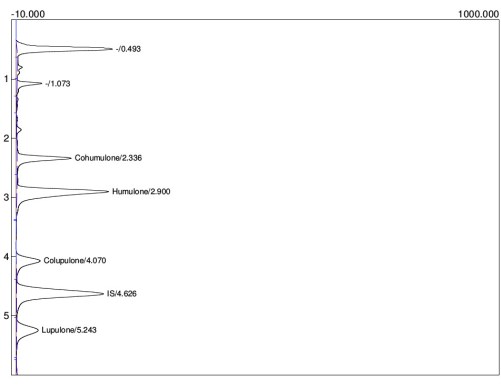
My first order of business was to figure out the chemistry of these things, particularly alpha acids. Because I had a good quantity of the hops, I didn’t mind sending them off for analysis. My go-to place has been BrewLaboratory; they are relatively inexpensive, fast, and supportive of homebrewers. They use HPLC (High Performance Liquid Chromatography), and their turn-around time has been less than 2 or 3 days from receipt of the sample.

I was pleasantly surprised by the alpha acid values–5.8%! Beta acids clocked in at 3.2% and cohumulone at 30%.

2016-washington-state-wild-hops

HPLC Profile for Washington State Wild Hops

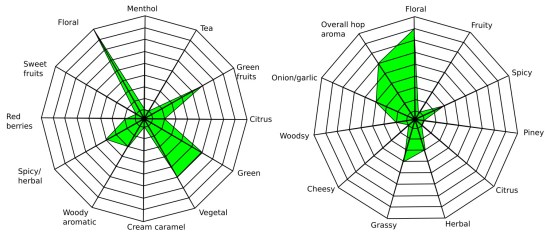
The analysis nicely covered the basic chemistry, but what about the more complex aromas and flavors? When rubbing the hops between my palms, I noted a dominant, very perfume-like aroma! Behind that is a bit of vegetal/allium aroma. To help formalize my thinking on the matter, I roughed out the hop profile using spider diagrams. There are two slightly different formats that I found in my research, included below. Each breaks out the aroma descriptors slightly differently–for instance, one specifically has an “onion/garlic” category, whereas in the other that is lumped in with “vegetal”.

Wild Hop Spider Diagrams

Wild Hop Spider Diagrams, Showing Level of Intensity of Different Aroma Components

With nearly a pound of thoroughly analyzed wild hops in hand, I wanted to put together a nice and simple batch of beer to highlight their flavor and aroma. After consulting with some friends, I settled on an American pale ale. The goal was for something that was clean and not overly malty, to let the hops shine. Because I didn’t want to commit to five gallons of beer for the first round on these hops, I settled on a 3 gallon batch, which will fit into a 2.5 gallon keg that I have on-hand.

The weather is turning cool, and I didn’t want to deal with the thermal loss of brew-in-a-bag. So, I also elected to do a full-volume, no-sparge mash in my mash tun.

Wild Times Pale Ale

  • 5.5 lbs. California Select 2-row malt (Great Western Malting Co.)
  • 0.5 lb. 10°L caramel malt (Briess)
  • 0.25 oz. Galena hop pellets (13.8% alpha), 60 minute boil
  • 1.5 oz. Washington wild hops (5.8% alpha, 3.2% beta), 10 minute boil
  • 1.5 oz. Washington wild hops (5.8% alpha, 3.2% beta), 1 minute boil
  • 1 oz. Washington wild hops (5.8% alpha, 3.2% beta), 5 minute whirlpool
  • 0.5 tablet WhirlFloc, 10 minute boil
  • 1 pkg. Safale American dry yeast (US-05)
  • 1.5 oz. Washington wild hops (5.8% alpha, 3.2% beta), 10 day dry-hop

Target Parameters

  • 152° mash, no sparge, 60 minutes
  • 1.051 o.g., 1.011 f.g., 5.2% abv, 43 IBU, 4 SRM, 3 gallons into the fermenter

Procedure

  • I mashed in with 5.3 gallons of water at 168.8°, to hit a mash temperature of 152.4°. The mash was down to 149.5° after 25 minutes and down to 147° after 50 minutes.
  • After 60 minutes, I drained the mash tun. I collected 4.5 gallons of wort at a gravity of 1.036, for 74% efficiency. Not too bad!
  • I started the boil, and added the hops per the recipe specifications.
  • After 60 minutes, I turned off the flame, added the whirlpool hops, and chilled the beer down to 76°.
  • I transferred the beer to the fermenter while aerating, and pitched the yeast. I’ll be fermenting this at 68°.
  • Starting gravity was 1.046, a bit less than expected. However, I am not surprised because I kept a gentle touch on the flame to avoid overboiling with the smaller volume of wort.
  • I brewed this beer on 21 November 2016.