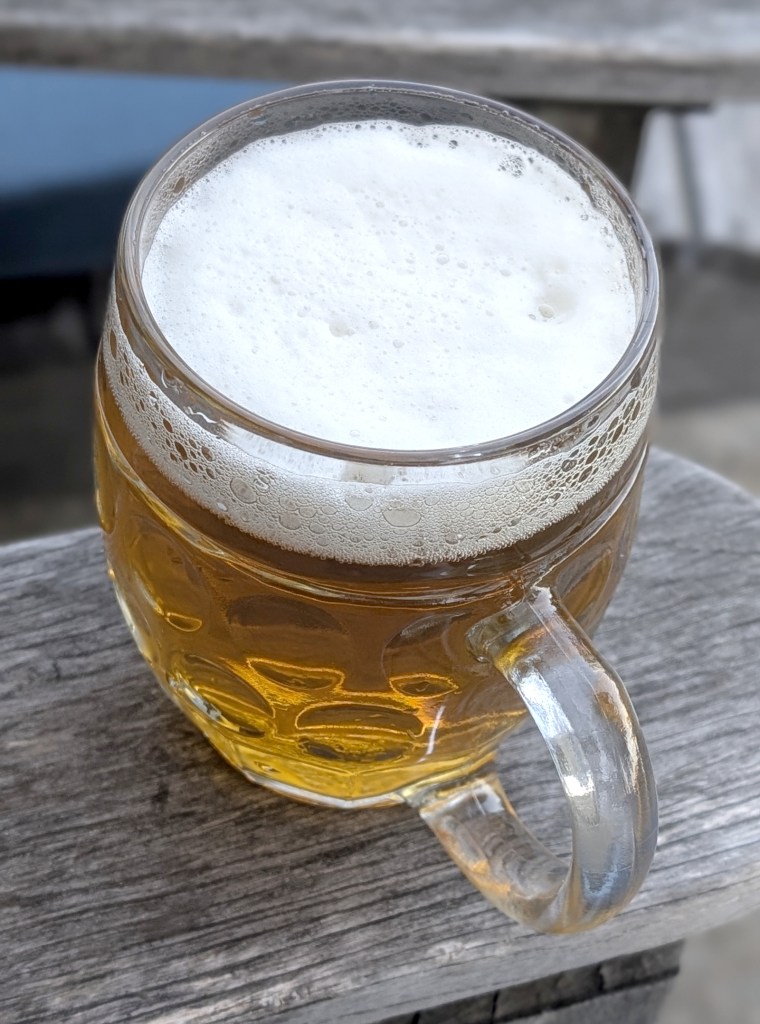
I like to keep my process simple for most batches, but sometimes it’s fun to go a little bit over the top. Adding a new ingredient, perhaps a decoction step, maybe another fiddly process, and so on, can keep things interesting and help me stretch my brewing toolkit. Most often, this is in pursuit of lager perfection. The Fall 2026 issue of Craft Beer & Brewing highlighted a recipe for Cohesion Brewing’s 8° lager–it was dead simple in the ingredients (single malt, only two varieties of hops), but the process (decoction, recommended spunding, etc.) were going to be something else altogether. Having been to Cohesion and sampled their (amazing) beers, I thought it was absolutely worth a try. The low abv on this one, due to the 8° starting gravity, and its purportedly robust flavor was another mark in the recipe’s favor.
Cohesion uses a Colorado Craft malthouse, Troubadour, for their recipes; although European-style lagers tend to lean in to a “European malt only” philosophy (at least in homebrewing circles), I trust Cohesion’s results. Their beer is simply excellent, and that is worth something. So, I special ordered Super Pevec Foundation malt (from Colorado Craft Malt–they carry virtually the full line of Troubadour malts), as well as WLP802. The only ingredient from the recipe that I couldn’t source at a homebrew scale was Agnus hops, which were the bittering charge in the published recipe. I swapped in Magnum, which I figured would be fine because it’s a small amount (only 0.3 oz. in a 5 gallon batch) at the front end of a 90 minute boil.
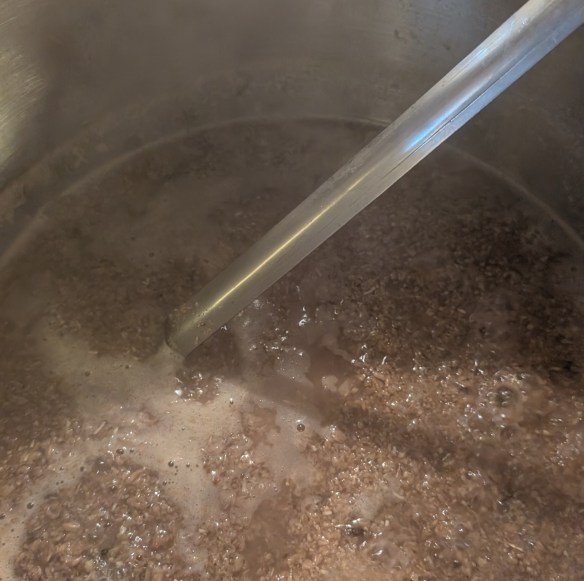
I followed the technique from the article as closely as I could; it called for spunding during the second half of fermentation, which involved purchasing a spunding valve. I’ve been thinking about acquiring one of these for awhile, so I pulled the trigger. The single decoction was not my usual technique, but something I’ve done a few times; in many ways, that was the easiest part of the extended process! Between extra mash steps totalling nearly 2 hours, a 90 minute boil, 20 minute whirlpool, and a chill down to 47°, this was going to be a long brew day. Thankfully, the results were worth it!
Cohesion 8°
- 6.5 lb. Super Pevec Foundation malt (Troubadour)
- 0.5 tsp. BrewTanB, added to mash
- 0.3 oz. Magnum hop pellets (12.0% alpha), 90 minute boil
- 1 oz. Saaz hop pellets (2.4% alpha), 30 minute boil
- 0.5 tsp. BrewTanB, 10 minute boil
- 1 Whirlfloc tablet, 5 minute boil
- 1 oz. Saaz hop pellets (2.4% alpha), 20 minute whirlpool at 194°
- 2 pkg. Czech Budejovice lager WLP802 (White Labs)
Target Parameters
- Decoction mash, with initial infusion and 20 minute rest at 122°, 30 minutes at 145°, 20 minute decoction, 20 minutes at 165°, full volume mash
- 1.032 o.g., 1.008 f.g., 3.2% abv, 28 IBU, 4 SRM
- Water built from RO, to hit target of 47 ppm Ca, 20 ppm SO4, 68 ppm Cl
- 5.25 gallon batch
Procedure
- I built the water from RO, starting with 7.4 gallons of water to which I added 3 g calcium chloride and 1 g gypsum. Next, I heated the water to 124°, and added the grains (along with BrewTanB) to hit a 20 minute rest at 122° (with recirculation). Next, I raised the mash temperature to 145°, and rested it there for 30 minutes.
- I pulled about 10 quarts of thick mash to a separate pot, and brought it to a boil for 20 minutes, with frequent stirring (especially in the early stages).
- After adding the decoction back to the main mash, this raised the mash temperature to around 165°. I held it here for 20 minutes, before removing the grains and bringing the kettle to a boil.
- I collected 6.8 gallons of runnings with a gravity of 1.026, for 74% mash efficiency.
- Once the kettle was at a boil, I added the Magnum hops, boiling for 60 minutes before adding the first charge of Saaz. With 10 minutes to go, I added BrewTanB, and with 5 minutes to go I added Whirlfloc.
- After the full 90 minute boil, I turned off the heat and chilled to 194° before adding the final Saaz addition. I held here, recirculated for 5 minutes, and then let steep and settle for an additional 15 minutes (without recirculation).
- I chilled down to 78° (as low as the groundwater would allow), and transferred the wort to the fermenter, with minimal splashing.
- Approximately 5 gallons of wort went into the fermenter, with a gravity of 1.032.
- In the fermentation chamber, I chilled the wort to 47°, which took around 5 hours. I pitched the yeast (two packets, directly into the fermenter) and then added 30 seconds of pure oxygen with a carbonation stone. I put a piece of foil over the opening where the airlock would normally fit, to allow an initial open fermentation.
- I set the fermentation chamber for 50°, and held it here for most of the fermentation.
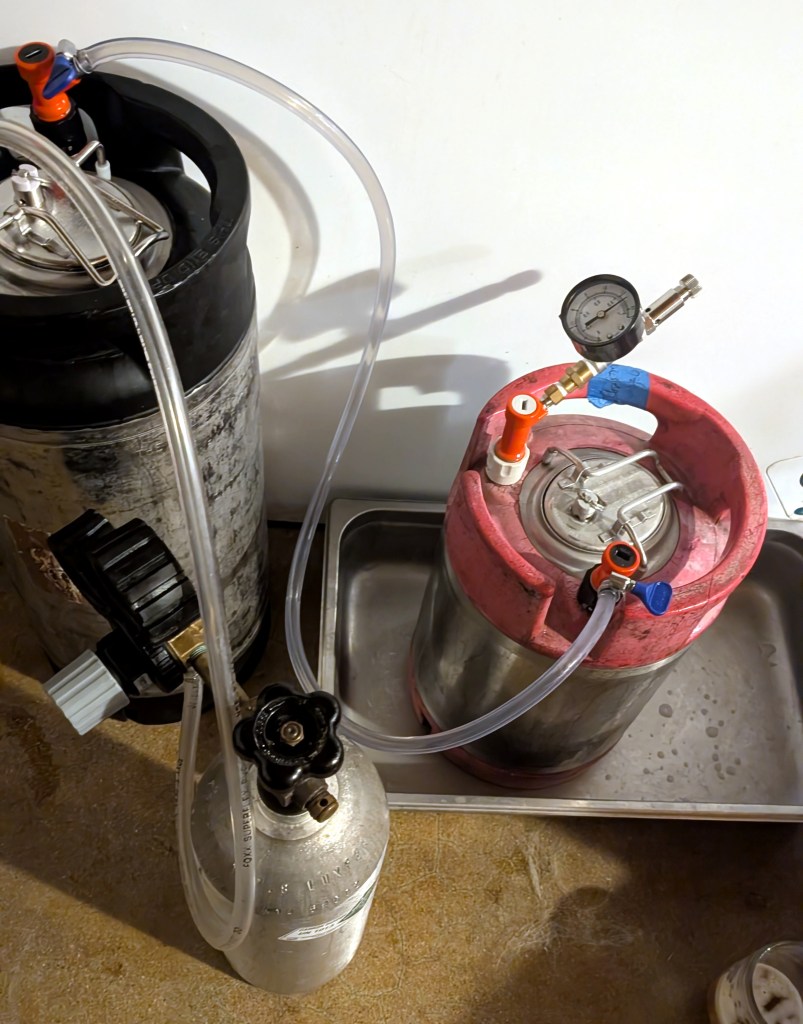
- The beer was brewed on 6 September 2026. No krausen was visible on 8 or 9 September, and a low krausen was visible on 12 September 2026. At this point, the beer showed 7.2 Brix on the refractometer, corrected (for fermenting wort corrections) to 1.026 (6.6 Plato). The recipe called for transfer to a pressurized fermenting vessel at this point (around 5 days into fermentation), so I used a semi-closed transfer to move it over to a keg. I put the spunding valve on and set it at 16 psi.
- By the next morning (13 September 2026), the pressure was down to around 5 PSI. I adjusted the valve, and it ended up stable at around 14 PSI for the next stretch.
- The beer was down to 5 Brix on 17 September 2026 (1.012 s.g.); I wasn’t sure if this would be the end, so I ran a forced diacetyl test. I heated a sample to ~170° for 15 minutes, and a buttery aroma was detected.
- Due to some other fermentation chamber needs, I brought the fermenting keg out to ambient for ~12 hours on 19 September 2026. I was bringing another lager down to fermentation temperature, and didn’t want to cold shock the yeast. I left the keg out overnight, and then put it into a 52° fermentation chamber on the morning of 20 September 2026.
- I ran another forced diacetyl test on 30 September 2026, and the beer passed. At this point, I reduced pressure to 13.5 PSI at 52°, and let it stabilize there.
- I cold crashed the beer to 33° on 3 October 2026.
- The final gravity, measured on 7 October 2026, was 1.008 (4.4 Brix, which I corrected using the appropriate conversions).
- In initial tastes, it was clear that this is an amazing beer. From my notes at the time: “Virtually perfect malt flavor, balance on everything is superb. It might be one of the very best things I’ve ever made. Well worth the effort.” Remarkably, I hit the target gravities perfectly at both start and finish. WOW!
- The beer was brilliantly clear by 26 October 2026.
- Because the beer had been sitting on the last bit of fermentation yeast, I was mildly concerned about some off flavors developing. So, I used a closed transfer to move the beer over to a 2.5 gallon keg on 30 October 2026 (between kettle trub and a hefty number of servings already, this was pretty much all that was left). I used the spunding valve to regulate pressure during the transfer. Interestingly, there was way less yeast on the bottom of the keg than I had expected. Maybe I was worried about nothing? Maybe not–after all of that effort, I didn’t want to chance things.
Tasting
- Appearance
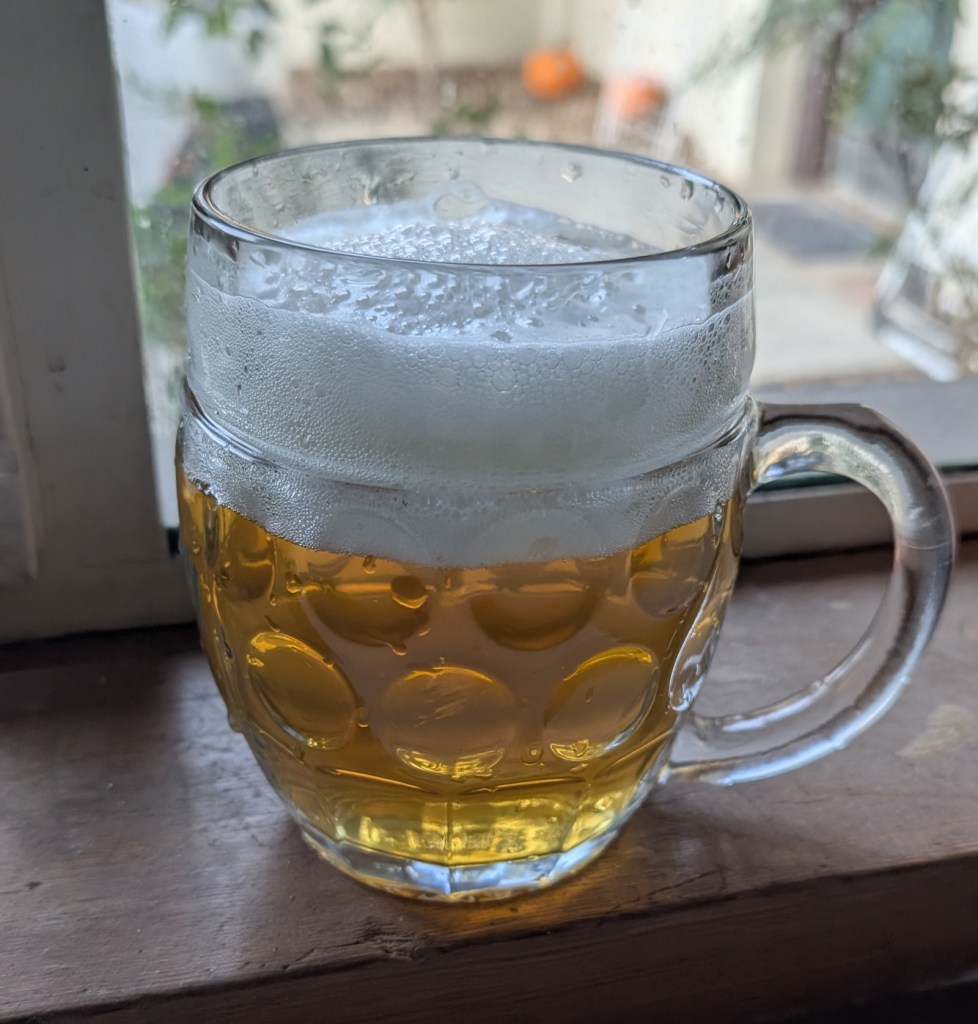
- Although the calculated color in BeerSmith was 3.7 SRM, in the glass it’s a bit closer to 5 SRM–a deep gold color, with brilliant clarity. The beer pours with a persistent white head (but not as nice as on the fancy taps at Cohesion!). It is so gorgeous.
- Aroma
- Bready, medium-high malt aroma, and a medium-low herbal hop aroma. Perfect!
- Flavor
- Medium-low bready flavor, with a bit of caramel on the back end. Medium-high bitterness, with an herbal quality. The malt/hop characters play well together. I love how I squeezed so much complexity from just a single malt variety! High quality malt plus careful technique paid off.
- Mouthfeel
- Medium light body, medium-low carbonation. Smooth finish with a pleasant bitterness.
- Would I Brew This Again?
- This recipe was a ton of work, but so worth it. I love how I captured so much character with basic ingredients of high quality, amped up by a close attention to process. I can’t go this over the top with every batch (I just don’t have time or energy), but I enjoyed every aspect of this batch.
- Overall
- 10/10