Beer Tasting: Citra Blonde Ale

Time to taste the Citra Blonde Ale! It has been in the keg for about two and a half weeks, and turns out to be an incredible beer.

  • The Basics
    • Original gravity = 1.049; final gravity = 1.015; abv = 4.5%; estimated IBU = 19
  • Appearance
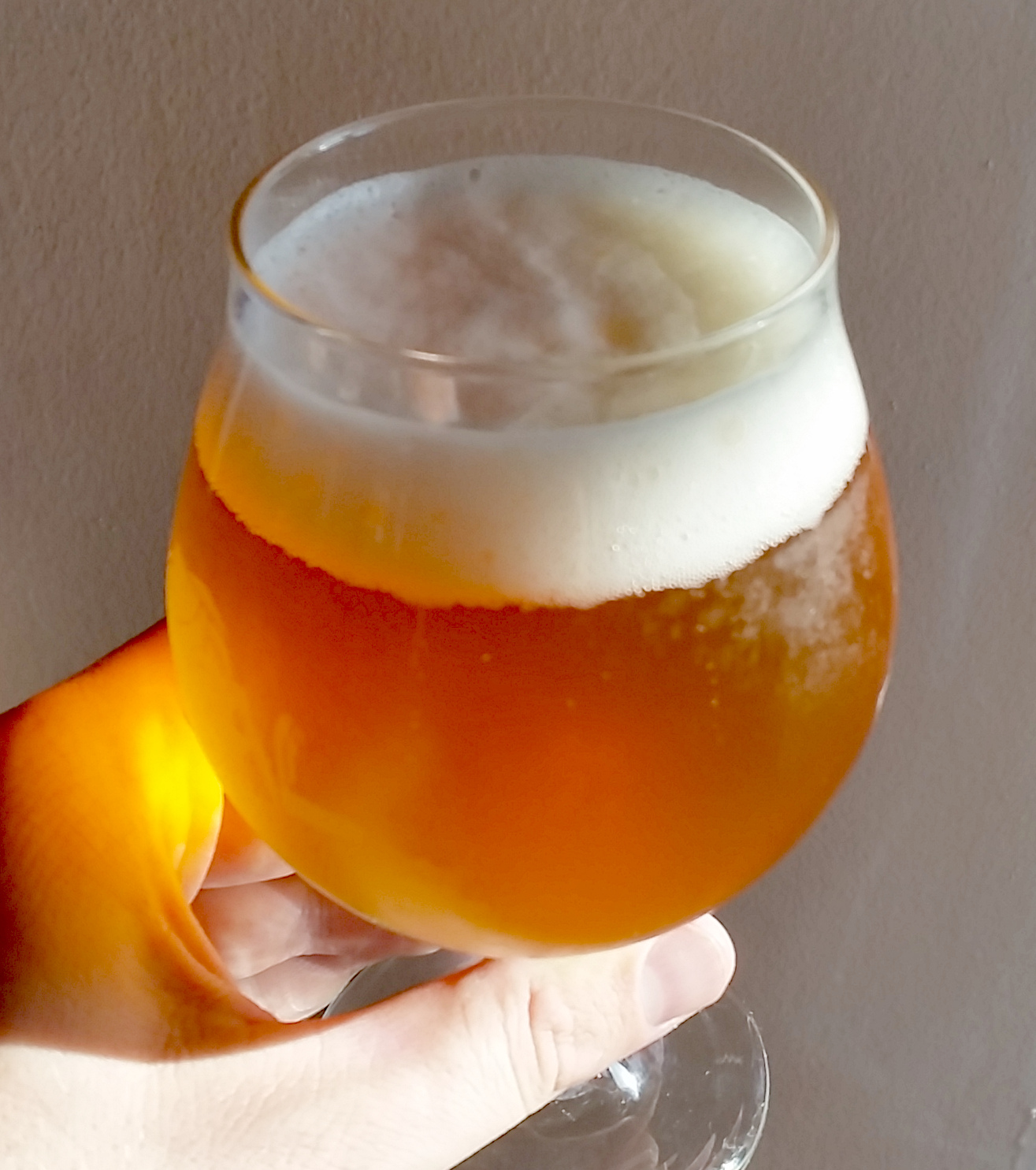
    • Clear with just a very faint haze. The head is white, medium-fine, of moderate size, and persistent.
  • Aroma
    • Very lightly malty, with a refreshing hint of citrus.
  • Flavor
    • “Juicy” is the best descriptor; that flavor is robust but not overwhelming. The hops are definitely in the foreground, and I can pick out light citrus. It’s really interesting how “juicy” this beer is – I can’t say I’ve ever picked up on this before in my beers, but it’s definitely there. It’s almost like a bit of watermelon was squeezed into the beer. The hops are noticeable more for the flavoring and aroma than bitterness.
  • Mouthfeel
    • Moderate body and carbonation, as is appropriate for this style.
  • Would I brew this again?
    • Absolutely! This is an incredibly tasty beer, which really nails a unique set of flavors and aromas. I love pretty much everything about it! The special techniques–including no-sparge–as well as the Citra hops added up to something quite nice. It’s interesting how different it is as a blonde ale from my other favored recipe, the Summer Blonde Ale.
  • Overall Rating
    • 10 / 10

Packrat Porter

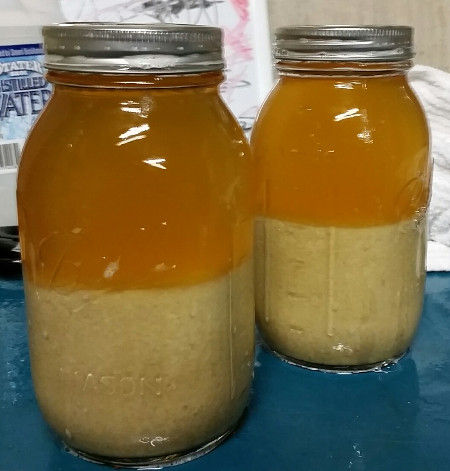
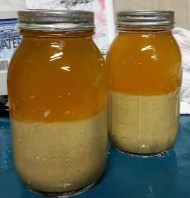
Yeast sludge settling out

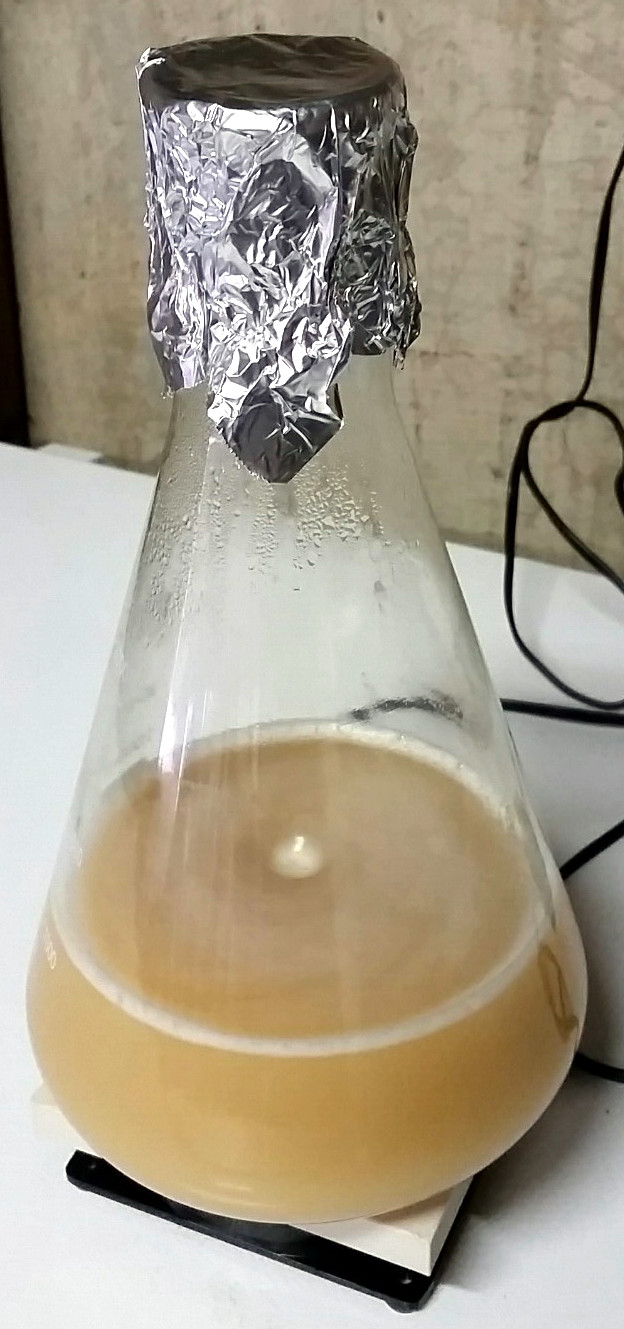
I’m always interested in expanding my skills and homemade brewing equipment, and it seemed like an opportune time to take a big step forward. I’ve been curious about washing and reusing yeast for some time, but just haven’t made the effort to enact the process. So, when I kegged my Seven Seas Session IPA, I saved the sludge from the bottom of the primary fermenter. I added a bit of boiled and cooled water, and then decanted the slurry into two quart mason jars. Each jar was about 2/3 full (a little too full, in retrospect), and I then topped each up with more cooled and boiled water. I let them sit for awhile, and then decanted the liquid as well as the top layer of sludge into another quart jar. This, too, was topped up with water and then placed in the fridge for a week. Last night, in preparation for today’s batch, I prepared a 1L yeast starter and added the yeast from the bottom of the jar. This stirred overnight and into the afternoon, at which point I was ready to pitch the yeast. The starter looks and smells quite healthy, so I’m optimistic about this little experiment. Next time, I may instead overbuild a primary yeast culture and save that, instead of reusing yeast from a previous batch.

I also decided to try adding the dark grains and crystal malts during the vorlauf, following a technique suggested by Gordon Strong in his recent homebrew recipes book. This was a little tricky when it came time to calculate the various water volumes required, and I missed the target by a little bit (I had done the calculations without the various crystal malts, and I also presume the oats soaked up a bit of extra water). I improvised by washing the grains at the end with a final pulse of water, and that brought me right to my volume and gravity target. Lesson learned!

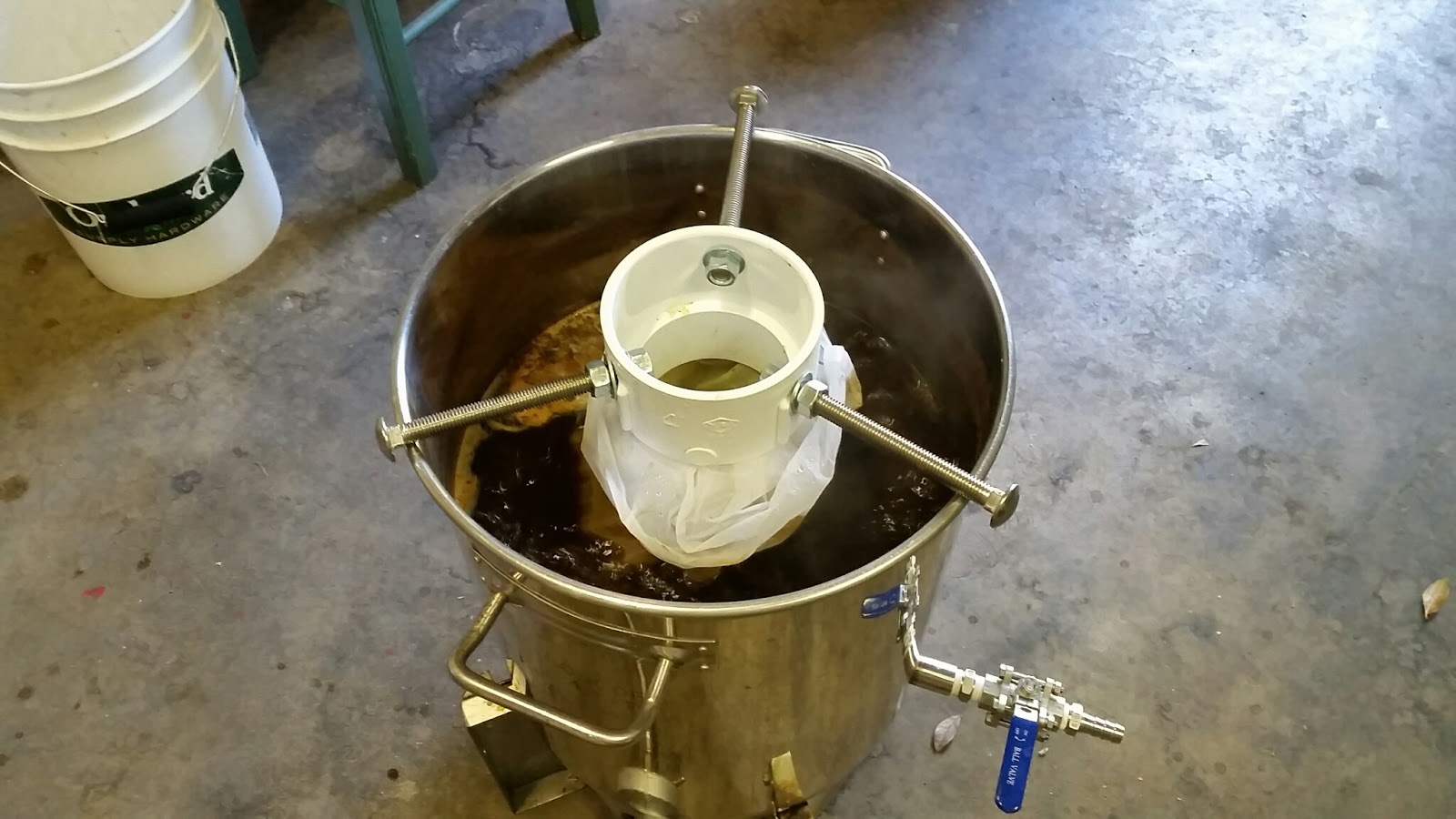
The final major addition to today’s brew process was the construction of a hop spider. I essentially followed directions from BYO magazine, but instead used a food-grade straining bag instead of a paint-straining bag. It worked quite well during the boil, and will definitely be easier than wrangling multiple bags during more hoppy brews.
Today’s brew was an American(ish) porter, named in honor of a resident of our quarry this summer. It was also appropriately named as the dumping ground for a whole bunch of leftover ingredients and free samples, as well as my first attempt at yeast washing. I am under no illusions that some of the smaller grain additions will have a detectable effect, but I can’t stand the idea of throwing out those little packets, either! Given my experience with the last porter I brewed, which was a touch thin, I beefed up the recipe with a pound of flaked oats.
Packrat Porter
  • 8.55 pounds 2-row malt (Great Westerning Malting Co.)
  • 1 lb. flaked oats
  • 1.4 oz. Borlander Munich Malt (Briess)
  • 1.4 oz. Victory malt (Briess)
  • 1 lb. chocolate malt, added at vorlauf
  • 0.75 lb. 60° caramel Munich malt (Briess), added at vorlauf
  • 0.37 lb. 40° crystal malt, added at vorlauf
  • 1.4 oz. 60° caramel malt (Briess), added at vorlauf
  • 1 oz. Newport hops (10.7% alpha), 60 minute boil
  • 1L starter of English ale yeast, WLP002 (reused)
  • 1 tbs. 5.2 pH stabilizer (in mash)
  • 1 tablet Whirlfloc (10 minute boil)
Procedure
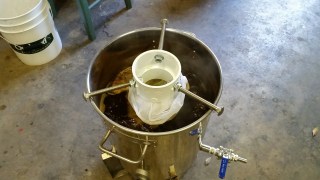
Hop spider in action
  • I mashed in with 3.1 gallons of water at 168°, which stabilized to around 155°. The mash had dropped to 152° after 60 minutes.
  • After 60 minutes, I added the dark and crystal grains, as well as 1.27 gallons of water at 185°. I let this sit for 15 minutes, vorlaufed, and collected 3.15 gallons of wort. Then, I added 3.65 gallons of water at 180°, which raised the mash bed to 164°. I let this sit, vorlaufed, and collected the remainder of the wort. This totaled 6.1 gallons at a gravity of 1.046. This was a little under my target on both counts, so I added 0.75 gallons of water at 120°. I drained this for the final collection.
  • All told, I collected 6.75 gallons of wort with a gravity of 1.048. This works out to 75% efficiency.
  • Once the wort came to a boil, I added the hops and boiled for 60 minutes. With 10 minutes to go, I added the Whirlfloc.
  • At flame-out, I chilled the wort down to about 80 degrees and then transferred it to the carboy. I placed it in the fermentation chamber and cooled it for an hour or so, and then pitched the yeast.
  • Starting gravity was 1.056, which should result in a final abv of around 5.1%. The unfermented wort has a nice dark color and a good taste. I plan to ferment this for 2 weeks at 68°.

Seven Seas Session IPA Update

After 5 days in the primary fermenter, the Seven Seas Session IPA appeared to have finished up fermenting. So, I raised the temperature from 65°to 70°, to help things clean up a bit. After a total of eight days in the primary fermenter, I kegged the beer and added the dry hops (August 30, 2015). The yield was a full five gallons. Final gravity was 1.018, down from 1.052, which works out to 4.3% abv. The beer has a great flavor, with a definite hops character. Both the level of bitterness (higher than my last session IPA) as well as the body (more full than the last version) are greatly improved. I plan to let this dry-hop at room temperature for at least a week before carbonating and cold-conditioning.

As an experiment for my upcoming brew (titled “Packrat Porter”), I’m washing and reusing my yeast. More on that in the next post!

Seven Seas Session IPA

My first real attempt at a session IPA was adequate, but needed some work. So, I’ve tuned up the malt and hop bill a bit in order to bolster the brew all around. The result: Seven Seas Session IPA. The name is a bad pun on the hops variety, Falconer’s Flight 7C’s.

Seven Seas Session IPA

  • 7.5 lbs. 2-row malt (Great Western Malting Co.)
  • 1.25 lbs. 10° Munich malt
  • 1 lb. white wheat malt
  • 0.5 lb. crystal 60° malt
  • 0.5 lb. crystal 15° malt
  • 1 tbs. 5.2 pH stabilizer
  • 1 oz. Falconer’s Flight 7C’s Blend hops pellets (10.3% alpha, 4.9% beta), 15 minute boil
  • 2 oz. Falconer’s Flight 7C’s Blend hops pellets (10.3% alpha, 4.9% beta), 10 minute boil
  • 1 oz. Falconer’s Flight 7C’s Blend hops pellets (10.3% alpha, 4.9% beta), 5 minute boil
  • 1 Whirlfloc tablet (10 minute boil)
  • 1 pkg. English Ale Yeast (WLP002), prepared in 1 liter starter, 12 hours in advance
  • 2 oz. Falconer’s Flight 7C’s Blend hops pellets (10.3% alpha, 4.9% beta), 14 day dry hop
Procedure
  • I mashed in with 16.75 quarts of water at 170°, to hit a mash temperature of 159.7° at the start. After 10 minutes, the mash was at 159.5°, 157.6° after 45 minutes, and 154.5° after 60 minutes.
  • I added 0.8 gallons of water at 210°, which raised the mash temperature to 160°. I let it sit for 10 minutes, vorlaufed, and collected 3.25 gallons of wort. Then, I added 3.8 gallons of water at 185°, which raised the mash temperature to 168°. This was then vorlaufed after 10 minutes at the remainder of the wort was collected.
  • All together, I collected 6.75 gallons of wort at a gravity of 1.043. This works out to 74% efficiency.
  • I brought the wort to a boil, and added the first ounce of hops at 45 minutes, two more ounces at 50 minutes (along with a Whirlfloc tablet), and the final ounce of hops at 55 minutes.
  • After 60 minutes of boiling, I turned off the flame and chilled the wort as much as I could. Given the high temperatures (and the warm-ish tap water), I was only able to chill down to about 90°. I transferred the wort into the fermenter, and then set it to chill in the fermentation chamber. Once I reached 70° (after about 3 hours), I pitched the yeast. I started fermentation at 68°, and will drop the temperature to 65° once visible fermentation was under way (persumably within a few hours).
  • In the end, I had 5.25 gallons of wort at a gravity of 1.052. I plan to ferment for at least 10 days before dry hopping.

Citra Blonde Ale Kegged

After 11 days in the primary, I kegged the Citra Blonde Ale tonight (August 19, 2015). Final gravity was 1.015, down from 1.049, which works out to 4.5% abv. The beer is definitely a touch more malty than my usual blonde ale recipe. Because the wheat beer is just about out and I hate the thought of an empty tap, I’m speed-carbonating this batch (40 psi at 36° for 24 hours, then down to 25 psi for 24 hours, and then adjust down to serving pressure).