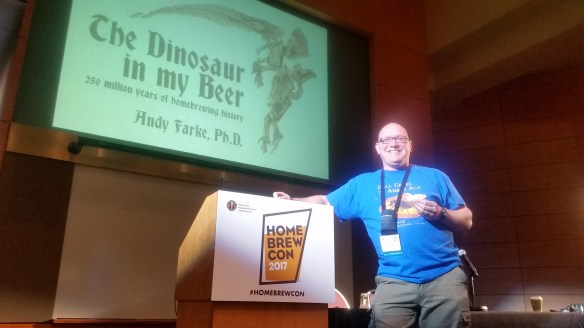
This was the big day! I started off the morning with my seminar, “The Dinosaur in Your Homebrew.” For being at 9 am on the morning after club night, I had a fairly decent crowd–around 50 to 75 people. Martin Brungard introduced me, augmented by a special guest appearance from T. rex. (quite a surprise!) Then, I rolled into the content of the talk. Overall, I felt like it went pretty well. There are a few things I would tweak (I forget to mention some of the technical updates on names for formations contributing to the Burton aquifer), but I am always my own worst critic! I was pleased to see a few “big names” in the audience, and equally pleased to chat with a few folks afterwards on topics related to my presentation.
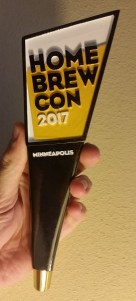
The speaker gift was pretty cool–a custom tap handle with the conference logo! The construction is nice and solid, and it will have an honored place in my tap room. Overall, my experience as a speaker was pretty positive, and I would absolutely do it again. AHA had good communication prior to the event, and made sure to have one or two people from the organization at my talk to touch base before and after the event. I particularly should acknowledge Dave Carpenter for encouraging me to submit a proposal…I did it somewhat on a whim and just before the deadline, without really any expectation of it flying, so this was a nice bonus experience!
 Later that morning, I hit Annie Johnson’s seminar on Czech pilsners. She had lots of great content, and is a tremendously engaging and entertaining speaker. It was cool to see how “casual” the big breweries are about things like sanitation (at least for their “reference batches”), and it was a good reminder that excellent results can come from even what we homebrewers might consider appallingly primitive technique. It was also nice treat to sample some of her homebrewed Czech pilsner…it’s not often I get to try beer from well-known elite homebrewers!
I grabbed some food at the convention center, and then headed over to the scheduled online forum meetup. This was probably the only real aspect of the conference I found a bit disappointing. There wasn’t really any signage for particular forums, and so I wandered around and met one or two people, but there was never really a big group of folks like I’ve usually seen at similar events elsewhere. Ah well! Hopefully this will get changed in future years (I mentioned it in my conference feedback survey).
One of my fellow members of the Horse Thief Brewers Association (Steve J.) had an entry in the final round for the National Homebrew Competition, so I joined him at the award ceremony. I have to say I was dreading it slightly–there were a lot of awards to go through, and I was expecting an unending slog of announcements and marches to the stage. What a pleasant surprise! They kept things moving smoothly and efficiently, while still allowing each winner who was present to have their moment in the spotlight. The whole thing was finished in barely an hour–not bad at all! Although my fellow club member didn’t win, I did know the winner for the Double IPA category (Randy Sauter of Rapid City, South Dakota). It was pretty darned cool to hear his name announced, and to congratulate him afterwards. I was lucky enough to be able to sample the beer, and it was truly gold medal worthy!
The “Knockout Party” was immediately afterward, with ample homebrew available (including all of the extra bottles left over from the competition). I was interested to taste these…and surprised as to how many showed signs of aging or other flaws. This is a strong argument for rebrewing and/or careful handling prior to the competition! One fellow I met via Twitter was kind enough to share some fun sours from his collection; yet another connection I wouldn’t have made without social media.
Overall, this was a fun and educational conference. I enjoyed meeting lots of other homebrewers, learning some new techniques and tricks, and having the opportunity to present on some topics important to me. Another Homebrew Con is definitely in the cards for the future!