I make a small keg of something special for Thanksgiving every year, usually a beer that’s a bit bigger, maltier, or hoppier than what I normally have on tap. When asked for requests, my friend Justin thought a rebrew of my Stygimoloch Bock (first made in 2019) would be just the ticket. It’s a malt bomb of a beer, as befitting the dunkles bock style, and a great recipe.
Typically, I’ve used a variety of German and American malts for this beer, usually Weyermann (with a bit of Briess as needed). Given my recent success with Troubadour products, I thought it would be fun to do a special craft malt edition for the 2026 Stygi Bock. Because Troubadour’s lineup is pretty broad, I was able to find 1:1 substitutions for all of the grains. Munich II became Blue Serenade, Munich I was now Ballad, CaraMunich was substituted with Mod Sixto, and melanoidin was replaced by Mod Nektar. I normally have a bit of Carafa Special III for color adjustment, but this recipe didn’t need it. Blue Serenade is around 13 SRM (versus 8.5 SRM for Munich II), so that set things a bit right into my target zone without the need for color adjustment. I used a combo of Diamond Lager and S-189, because my packets were a little past expired. As a bigger beer, it also needs a touch more yeast than my usual lager, so I used four packages (two of each).
Stygimoloch Bock 2026: Craft Malt Edition
- 9 lb. Blue Serenade Foundation Malt (Troubadour)
- 5 lb. Ballad Malt (Troubadour)
- 8 oz. Mod Sixto Malt (Troubadour)
- 4 oz. Mod Nektar Malt (Troubadour)
- 0.5 tsp. BrewTanB, added to mash
- 1.15 oz. Perle hop pellets (6.3% alpha), 60 minute boil
- 0.5 tsp. BrewTanB, 10 minute boil
- 1 Whirlfloc tablet, 5 minute boil
- 2 pkg. Diamond Lager yeast (Lallemand)
- 2 pkg. SafLager German Lager yeast (Fermentis)
Target Parameters
- 60 minute infusion mash, 152°, full volume mash
- 1.069 o.g., 1.013 f.g., 7.5% abv, 23 IBU, 17 SRM
- Claremont tap water, neutralized with lactic acid to remove bicarbonates
- 5.25 gallon batch
Procedure
- I collected 29 liters (7.65 gallons) of tap water, and added 5.4 mL of 88% lactic acid to drop out the carbonates. Next, I heated the water to 158°, before adding the grains and holding at 152°, with recirculation, for 60 minutes.
- I raised the mash to 168° for 10 minutes, and then pulled the grains.
- In total, I collected 6.5 gallons of runnings with a gravity of 1.053, for 61% mash efficiency. This is lower than usual–I suspect I probably should have done a longer mash and lower temperature to maximize efficiency (or perhaps a decoction).
- To bring up the starting gravity, I boiled for 90 minutes total–30 minutes before adding the first charge of hops. Everything else was added per the recipe.
- After the boil, I turned off the heat and chilled to 79° before whirlpooling and holding 30 minutes prior to the transfer.
- 20 liters of wort remained after the chill, with a starting gravity of 1.064. I moved the beer to the fermenter, chilled overnight to 47°, pitched the yeast, and then sealed up the fermenter.
- I’m fermenting the beer at 52 degrees. I brewed the beer on 19 September 2026, and pitched the yeast on 20 September 2026.
- I kegged the beer on 11 October 2026. For serving, I filled one keg with 2.5 gallons of beer and added 2.6 oz. of corn sugar to naturally carbonate at room temperature. The other keg ended up with around 1.5 gallons, which I force carbonated.
- The final gravity for the beer was 1.020, for 5.8% abv.
Tasting
- Appearance
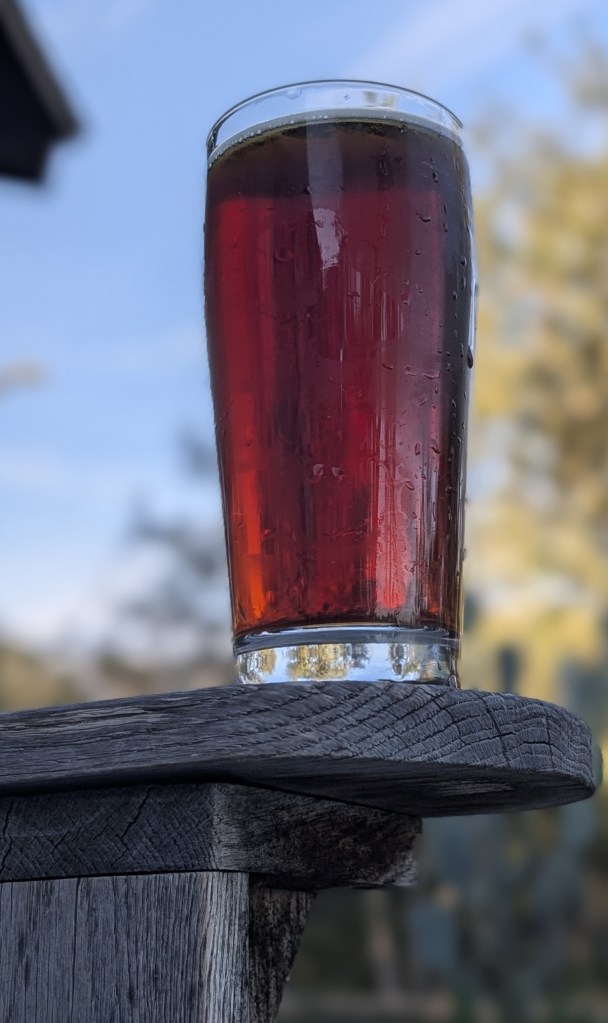
- Brilliantly clear deep amber beer, pouring with an ivory head that persists as a ring around the margin of the glass.
- Aroma
- Rich bread crust maltiness, with a bit of some dark fruit. No yeast aroma, no hop aroma.
- Flavor
- The beer has a richly bready and bread crust character at a high level, and a bit of dried fruit at a low level, in the malt. The medium level of clean bitterness from the hops keeps things from being too cloying although it’s just on the edge of too sweet. Clean yeast character.
- Mouthfeel
- Medium body, moderate carbonation, smooth and only slightly dry finish.
- Would I Brew This Again?
- I quite like this interpretation of the beer! The malt character is phenomenal and complexly interesting. The dried fruit aspect is a nice little aspect that works well. If I use these malts again (and I definitely would!), I should probably do a lower, longer mash next time, to get better attenuation and efficiency. The slight perception of underattenuation is the only thing standing between this beer and perfection. All that said, I’m looking forward to serving this beer at Thanksgiving.
- Overall
- 8/10