Kitchen Sink Pale Ale

To ring in 2020, I did some “kitchen sink” brews to finish out some of my grain and hop stash. One of these was a mixed English/American pale ale, brewed using Brulosophy’s “Short and Shoddy” technique–essentially, using a 30 minute full-volume mash and 30 minute boil to reduce the brew time. It was a quick-turnaround, and has been a pretty good (even if not perfect) batch.

Kitchen Sink Pale Ale

  • 10.25 Maris Otter malt (Crisp)
  • 0.5 lb. Caramel Munich 60°L malt (Briess)
  • 0.25 lb. Caramel 20°L malt (Briess)
  • 0.80 oz. Warrior hop pellets (15.8% alpha), 30 minute boil
  • 1 Whirlfloc tablet, 5 minute boil
  • 2 oz. Cascade whole hops (est. 5.5% alpha), 5 minute boil
  • 1 pkg. Safale American Ale yeast (US-05)
  • 2.25 oz. East Kent Goldings hop pellets, 4 day dry hop in fermenter

Target Parameters

  • 30 minute full volume infusion mash, 154°
  • 1.050 o.g., 1.012 f.g., 5.0% abv, 39 IBU, 9 SRM
  • Claremont tap water, with 1 tsp. of gypsum added to boil

Procedure

  • I mashed in with 7.75 gallons of water at 160°, and hit my target temperature of 154° pretty closely. I added a scant 1 tbs. of 88% lactic acid to the mash, to bring the pH down to acceptable levels.
  • After 30 minutes, I vorlaufed and collected the runnings. I ended up with 6.6 gallons of runnings at a gravity of 1.049, for 77% mash efficiency. That’s a bit better than I usually expect for this kind of mash, more typically around 70 to 72%.
  • I added the gypsum to the kettle, brought everything to a boil, and added hops as required by the recipe. After 30 minutes, I turned off the heat and chilled down to 72°.
  • I transferred to my fermenter, noting a fair bit of trub loss due to the whole hops. I’ll want to remember to adjust accordingly for future recipes that use lots of whole hops!
  • Starting gravity was 1.050, right where I wanted it.
  • I started the fermentation on 2 January 2020, fermenting at ambient temperatures of around 56° to 60°. On January 6, ambient was down to 58°, so I moved the beer into the fermentation chamber and set the temperature for 66°.
  • On 12 January 2020, I added the dry hops.
  • On 13 January 2020, I cold crashed the beer.
  • I kegged on 16 January 2020, using a partial closed transfer into a CO2-purged keg.
  • Final gravity was 1.010, for 5.3% abv.

Tasting
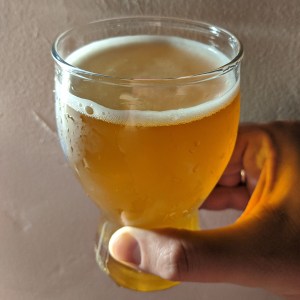
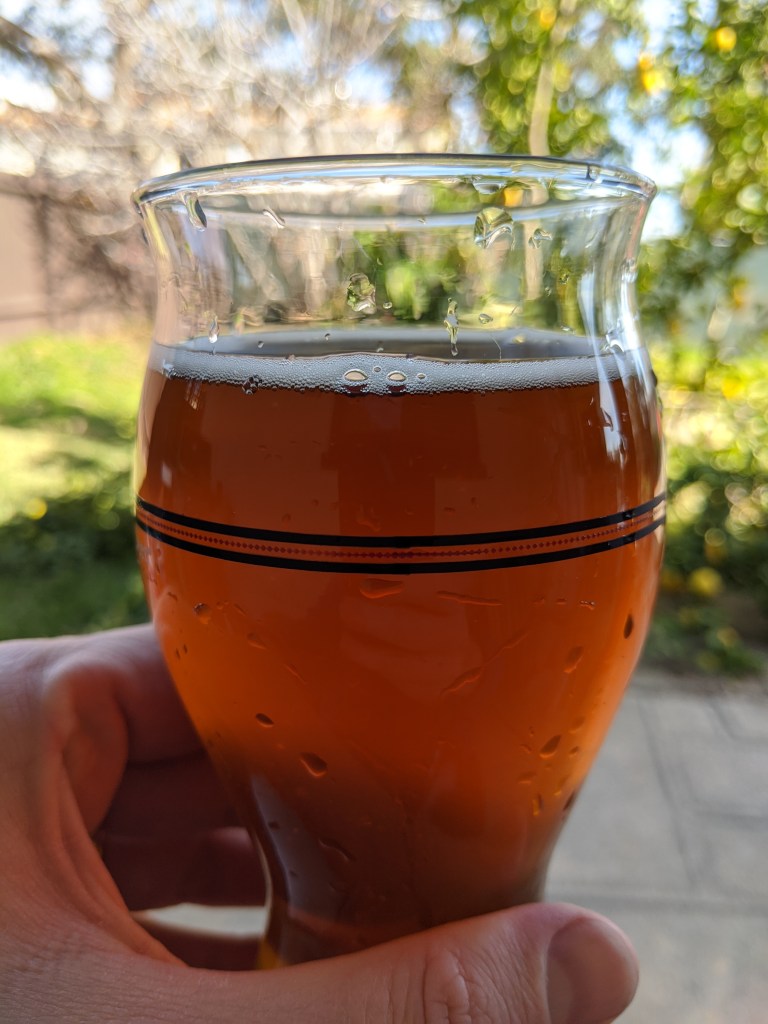
Gold colored beer in glass
  • Appearance
    • Gold, slight haze, with persistent off-white head.
  • Aroma
    • Slightly spicy hop aroma, with light caramel aroma alongside that.
  • Flavor
    • Moderately bitter, with hop qualities in the realm of slightly woody and herbal. The malt character is somewhat bready, with a bit of caramel (likely from the CaraMunich).
  • Mouthfeel
    • Medium-light body, only slightly dry; really nice on this count, actually! Moderate carbonation.
  • Would I Brew This Again?
    • This is a pretty decent beer, and is quite drinkable, but there’s nothing that really jumps out at me. As a pale ale, it’s very much in the realm of qualities that I like–not overly bitter, some malt character, some interesting hops in there too. But, there’s nothing that wows me, either. So, I can say this was a good way to use up some ingredients, but nothing to put on the “must brew” list. On the plus side, the short-and-shoddy technique worked just fine on this batch!
  • Overall
    • 7.5/10

What’s Brewing? January 2020 Edition

Awhile back, I changed my blogging habits to condense each batch into a single post, rather than split across multiple updates. Some of this was to save time, and some of this was to make it easier to find the full story on a particular batch later on. I’ve (personally) liked this switch overall, but feel that it also can lead to a drought in posting.

So, I’m introducing a new, occasional series–“What’s Brewing?” These will be quick, informal posts to highlight planned batches, currently fermenting batches, and other bits that don’t quite warrant a full write-up.

What’s Brewing? January 2020 Edition

Over the holidays, I brewed up a storm! I’ve been doing a ton of lagers, and hope to have enough backlog that I can let some of them condition for a good stretch of time.

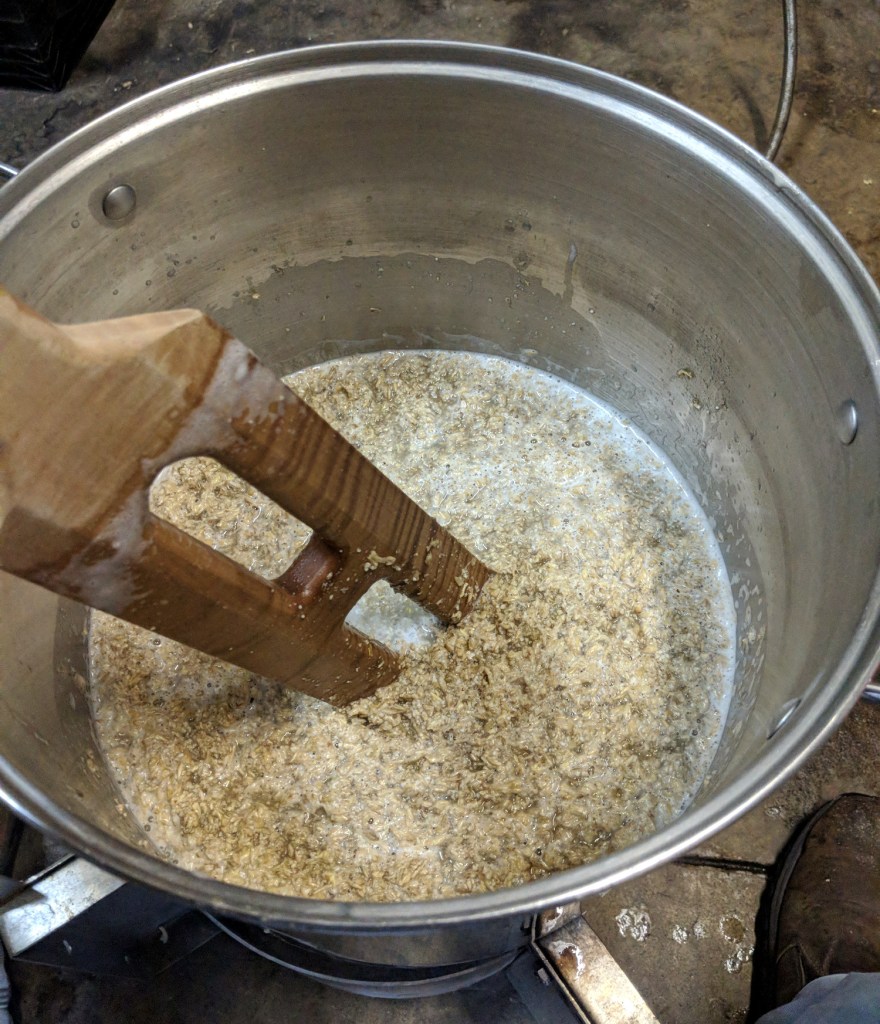
Decoction mashing for my German-style pils

December kicked off with a festbier, which is now lagering in the keg. I brewed it as a fairly traditional version of the style. I followed that up with a German pils, but made with American pilsner malt (from Great Western) and Crystal hops. This one got the double decoction treatment, as I work on perfecting that technique. Finally, I did a rebrew of my Red Rye Lager, an American-style amber lager made with California common yeast (in this case, Imperial Yeasts Cablecar version). The nice thing on the latter is that it’s cool enough that I can just ferment it at ambient, without having to tie up fermentation chamber space!

With so many lagers in production, I was a bit worried about taps sitting vacant while I waited for beers to ferment and condition. So, I kicked off 2020 with two quick-and-dirty kitchen sink brews. One was an English-style porter, the other an American(ish) pale ale. I took some shortcuts with ingredients, using up odds-and-ends that were on hand. I also adopted the “Short & Shoddy” format of Brulosophy, with abbreviated, 30 minute full-volume mashes and 30 minute boils. Those batches should be ready to keg in a few days.

Over the break, I did a full cleaning of my keezer lines. On tap, I currently have my ESB, the smoked Scottish ale, and a cider. The Scottish ale has cleared up and conditioned beautifully, and has been absolutely enjoyable. My cider was made with Treetop brand Honeycrisp apple juice from the shelf and Mangrove Jack cider yeast. It’s dry, hazy, and perfect for winter evenings. Both the Scottish ale and cider are in 2.5 gallon kegs, and will probably get kicked pretty soon. I’m aiming to have the Short & Shoddy porter and pale ale ready to go in their place.

Farke’s ESB 1.1

Early in 2019, I made an English bitter that turned out exceptionally. Hoping to capitalize on that success, I did a second iteration at the end of November. The overall recipe is pretty similar, although the base malt brand was Crisp instead of Bairds. Also, I dropped the crystal 90 and used just crystal 80. Finally, I fermented a very slight touch warmer, at 67° instead of 66°.

The beer, a few days after adding gelatin

Farke’s ESB 1.1

  • 8.5 lb. Maris Otter malt (Crisp)
  • 0.75 lb. 80°L 6-row caramel malt (Briess)
  • 0.25 lb. 80°L caramel malt (Briess)
  • 1 oz. East Kent Goldings hop pellets (6.0% alpha), 60 minute boil
  • 1 Whirlfloc tablet, 10 minute boil
  • 1 oz. East Kent Goldings hop pellets (6.0% alpha), 5 minute boil
  • 1 pkg. London ESB English Style Ale Yeast

Target Parameters

  • 60 minute full volume infusion mash, 152°
  • 1.043 o.g., 1.012 f.g., 4.2% abv, 28 IBU, 11 SRM
  • Claremont tap water

Procedure

  • I mashed in with 7.5 gallons of water at 168°, to hit a mash temperature of 153°.
  • After 1 hour, I vorlaufed and collected the runnings.
  • In total, I collected 6.5 gallons of wort at 1.040 s.g., for 73% mash efficiency. This was a bit better than expected for a full-volume mash, so I adjusted the boil accordingly to try and hit my target starting gravity.
  • I boiled for 60 minutes, adding hops and whirlfloc as scheduled. Then, I chilled down to ~75°, pitched the yeast, and put it in the fermentation chamber. The temperature was set at 67°.
  • Starting gravity was 1.045, with the batch brewed on 25 November 2019.
  • I kegged the beer on 23 December 2019. Final gravity was 1.008, a bit lower than I expected. This works out to 82% attenuation and 5.0% abv.
  • This yeast is described as poorly flocculent–and it was. For the first week or so, the beer poured as a hazy, yeasty mess. It wasn’t terribly pleasant to drink, although it got a bit better as the yeast started to settle somewhat. On January 3, I decided to speed things along and add gelatin, with 1 tsp. in 1 cup of water. Within two days, the beer was pouring (and tasting) much better. It wasn’t perfectly brilliant, but it was much clearer.

Tasting

  • Appearance
    • Light amber color, somewhat hazy, with thin off-white head.
  • Aroma
    • Slight caramel aroma, bready, with light fruity ester. Not much for noticeable hop aroma.
  • Flavor
    • Light caramel and toffee notes on the flavor, with modest (but not over-the-top) bitterness.
  • Mouthfeel
    • Off-dry, light bodied, moderate carbonation.
  • Would I brew this again?
    • Although I really liked this recipe last time I brewed it, I am less of a fan this time around. I’m not sure why it ended up so dry (1.008 final gravity); maybe the mash temperature dropped too quickly, maybe it’s the brand of malt, or maybe I got some contamination that took off on fermenting the sugars? I don’t really taste any off flavors, but the beer is indeed a bit drier than I might like. I think the overall malt character is pretty good, and the ester character is a bit more where I want it on this batch. However, the ESB yeast is a horrible flocculator. I noticed this last time I brewed it, too, and it’s a bit on the ridiculous side, especially for a beer that I think should be drunk more fresh than not. For any future use, I would definitely cold crash and throw in gelatin right at the start, or else try a different yeast strain. I do think the overall package would be better, too, with going back to the original malt bill.
  • Overall
    • 5/10

Brew Year’s Resolutions 2020

I missed doing this last year, but might as well try again for 2020.

  • Patience.
    • I often bring my lagers on-line before they are as conditioned as well as they could be. That means that the keg is okay when I start, pretty good for the middle part, and might reach fantastic only during the last third. This is often a planning issue, and sometimes a space issue. For 2020, I will try to better plan my brew cycles so that I can hold off on tapping lager kegs until they are better conditioned. A month (minimum) of lagering would be great…and if I can get to 6 or 8 weeks, even better!
  • Practice.
    • I want to rebrew a few recipes, such as my Raspberry Belgian and my Alta California Lager. I never did my oatmeal stout last year, and will try that, too.
    • 2020 will be a year to explore the world of North American “noble hops”, for purposes of pilsners and such: Crystal, Liberty, Mt. Hood, Sterling, Vanguard, and U.S. versions of Hallertau and Tettnang. In the last week of 2019, I made a German-style pils with Crystal and a red rye lager with Mt. Hood, so I’ve got a head start!
  • Prose.
    • I want to do something, either large or small, for beer communication this year. Maybe pitch a new article. Maybe just submit a small note. 2019 was fairly dormant on this front, so I want to do better in 2020. I enjoy talking and writing about beer, and would like to do more.
  • Prost!
    • I want to keep brewing fun! This means sharing more beer with friends (both at my home and by sending growlers out into the world), taking some quiet moments to truly savor a beer, and experimenting with new recipes and new-to-me styles. Small-batch (3 gallon) brews have been a good strategy in the past, and I might keep that up as a way to continue experimentation on styles and recipes of uncertain drinkability. No resolution should get in the way of my enjoyment of beer, and I’m usually pretty good at holding to this. On to 2020!

Homebrew Highlights of the 2010’s

As we turn over not just one but two digits in the calendar year, from 2019 to 2020, it makes me reflect on how I’ve grown as a brewer. So, what happened in the ten years of 2010 through 2019?

Beer bottles
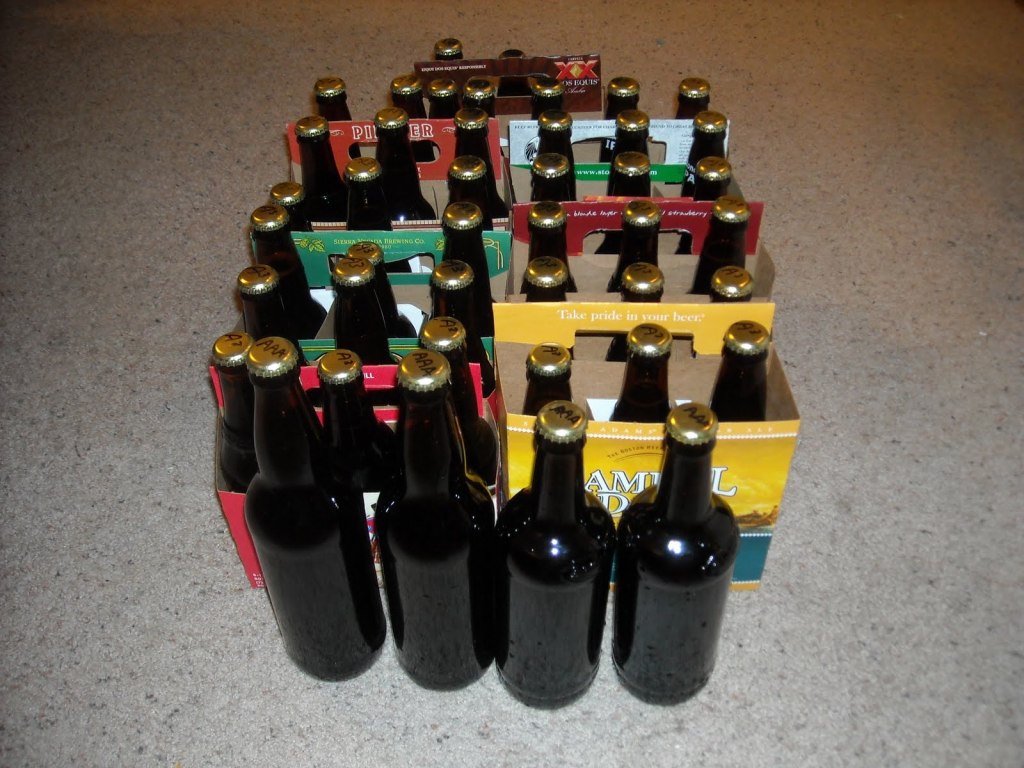
An early batch, all bottled up and ready to condition in my closet.
  • Process
    • At the start of 2010, I was doing extract-only, partial volume boils in a 5 gallon pot on my stove. I had no fermentation temperature control, so was limited to brewing during the cooler months of the year, and bottled exclusively. Some of this was due to space (I was living in a one-bedroom apartment), some of it was money (I hadn’t yet bought the full assortment of equipment), and some of it was skill–I hadn’t yet practiced that much!
    • As we close out 2019, I’m doing all-grain, batch-sparge, full volume brew days. I’m using two temperature-controlled fermentation chambers, and then kegging my beers to serve via a three-faucet keezer. 2014 was the biggest year for this, as we moved into a new place that had much more space to set up a brewery.
  • Ingredients
    • In 2010, I was brewing with a limited supply of ingredients from a very small brew shop supplemented by mail order. The world of ingredients was quite a bit narrower then, and things like Citra and Mosaic and craft malting weren’t even in my vocabulary. Because I was only brewing with extract, I was heavily reliant upon a narrow selection of extract products.
    • In 2019, the world of ingredients is scarcely recognizable. Some of this is due to my process changes, as I get to know new malts. Much of this is due to a new array of suppliers and products. We have a truly excellent, well-stocked local homebrew shop very close by (Pacific Brewing Supplies of San Dimas), so I can easily get 95% of what I might ever need via them. There are so many new hops and yeasts and yeast suppliers and malting companies that I can’t even pretend to keep up. It’s awesome!
Wild hops — part of an experimental saison I brewed a few times.
  • Style
    • In 2010, I was brewing a variety of fairly “traditional” ales–brown ales, pale ales, wheat beers, etc. I was severely limited by space and temperature control!
    • In 2019, I’ve tried brewing everything from kettle sours to obscure European wheat ales to light lagers. The world feels wide open, and I’ve embraced lagers in a way I never imagined possible.
  • Community
    • In 2010, I was brewing totally solo, perhaps having friends over from time to time. I didn’t have much to challenge me (beyond myself), and it was hard to get honest feedback from trained palates.
    • In 2019, I am active in a local homebrew club, and know a fair number of brewers outside that circle. This has added considerably to my enjoyment of the hobby, helped me meet new people, and has also opened up new ways to challenge myself and get helpful feedback. I love club contests that push me to try new styles, and I like getting comments from a friendly yet critical crew of tasters. In the bigger sense of community, I’ve had opportunities to contribute to Zymurgy magazine and present at HomebrewCon. I never would have imagined this being a possibility back in 2010!
  • Commercial
    • In 2010, homebrew comprised only a small percentage of my beer consumption. I made four or five batches annually, and as a result had to make up the rest with commercial purchases. The commercial landscape for local craft beers was quite narrow at the time–we only had two or three breweries within a reasonable drive, and the reasonable drive didn’t exactly encourage sampling much (unless I had a driver!).
    • In 2019, there are so many local breweries that I can’t possibly sample them all. Access to Lyft helps a lot, but between money (it’s expensive to go to breweries constantly), liver (I drink less than I used to, and breweries just ain’t doing much less than 5% abv), and time (we’ve got two kids now), I don’t get out as much as I might. I would say 95% of my beer consumption now is my own homebrew. I brew enough that I can usually keep plenty on tap, and I can also brew lower alcohol beers and styles that don’t get as much attention in local craft breweries. It’s virtually impossible to find a quality German-style lager locally (and imports are incredibly hit or miss), so I gotta make ’em myself!
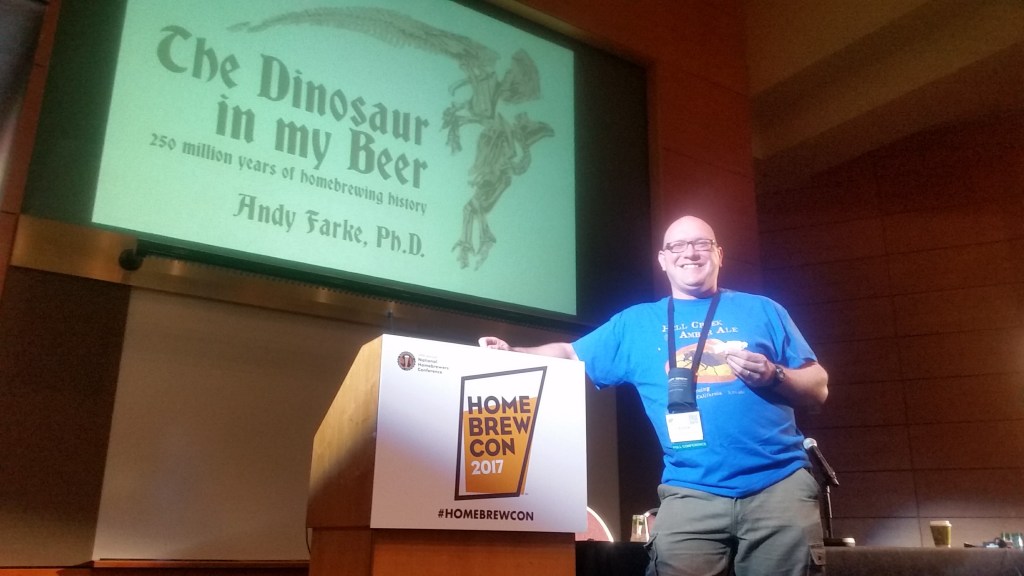
Getting ready for my presentation at the 2017 HomebrewCon
  • Recipe Highlights
    • If I had to pick one recipe to represent each year, what would it be?
      • 2010
        • Premium Oatmeal Stout — the brew session was a bit of a scramble, but it was (in my recollection) a pretty nice beer.
      • 2011
        • Vanilla Voay Porter — another one of my early dark beers. These styles tended to be more enjoyable, because they tended to cover up the sins of the learning process more than a lighter beer could.
      • 2012
      • 2013
        • Citation Porter — I didn’t brew much this year (new kid and all), so Citation Porter gets mentioned more by default than anything.
      • 2014
      • 2015
        • Pannotia White IPA — you just don’t see this style on the market, which is unfortunate. I find it far more interesting and drinkable than your average haze-bomb. It’s got plenty of fruit and citrus character, but also still tastes like a beer.
      • 2016
      • 2017
        • Raspberry Belgian — a sour beer, and one that is really hard to keep on hand because it goes so quickly. I need to play with this recipe more in the future…
      • 2018
        • Jamaica Wit — another Belgian, bringing together a Californian twist with hibiscus flowers.
      • 2019
Cheers to the 2010s, and on to the 2020s!