Red Rye Lager 1.1

Back in late 2017, I came up with one of my best from-scratch recipes: Red Rye Lager. It’s been over two years since that batch, so I decided to give it another go. This fills a nice niche of a malty, moderate body, good-for-winter lager. It’s basically the same recipe, just with some modifications for malt brands and hop types. Following my 2020 goal of trying more American hop varieties, I went with Mt. Hood for the hops instead of Hallertauer and Magnum. Also, I used crystal 120 instead of The end result is pretty nice, as before!

Red Rye Lager 1.1

  • 6.75 lb. Superior Pilsen Malt (Great Western Malting)
  • 3 lb. BEST Munich malt (BESTMALZ)
  • 1 lb. Viking rye malt
  • 0.5 lb. Carared malt (Weyermann)
  • 6 oz. Caramel 120°L malt (Briess)
  • 2 oz. Carafa Special III malt (Weyermann)
  • 2 oz. rice hulls
  • 1 oz. Mt. Hood hop pellets (4.6% alpha), 60 minute boil
  • 1 tsp. Fermax yeast nutrient, 10 minute boil
  • 1 Whirlfloc tablet, 5 minute boil
  • 2 oz. Mt. Hood hop pellets (4.6% alpha), 5 minute boil
  • 1 pkg. Cablecar yeast (Imperial yeast #L05)

Target Parameters

  • Infusion mash to hit target of 154°, 60 minutes, batch sparge
  • 1.053 o.g., 1.015 f.g., 5.0% abv, 21 IBU, 14 SRM
  • Water adjusted to hit target of 52 Ca, 10 Mg, 11 Na, 43 SO4, 53 Cl, 109 HCO3, RA 46 ppm.

Procedure

  • I mashed in with 4.5 gallons of RO water, with 2 g epsom salt and 3 g CaCl added and 5 mL of 88% lactic acid, in order to hit a 152° mash temperature for 60 minutes.
  • I used tap water for the sparge, starting with 1 gallon at 185°. I let it sit for 10 minutes, vorlaufed, and collected the first runnings. Then I added 3.75 gallons at 185°, let sit for 10 minutes, vorlaufed, and collected the second runnings.
  • In total, I collected 7.5 gallons of runnings with a gravity of 1.042, for 73% mash efficiency.
  • I brought the runnings to a boil, adding hops and other items per the recipe. After 60 minutes, I chilled to 75°, whirlpooled, and let the wort sit for around 40 minutes.
  • I transferred to the fermenter, added the yeast directly from the package, and let the beer ferment at ambient (56°).
  • I brewed the beer on 29 December 2019. Starting gravity was 1.055.
  • I kegged the beer on 31 January 2020. Final gravity was 1.010, for 5.9% abv.
Tasting

  • Appearance
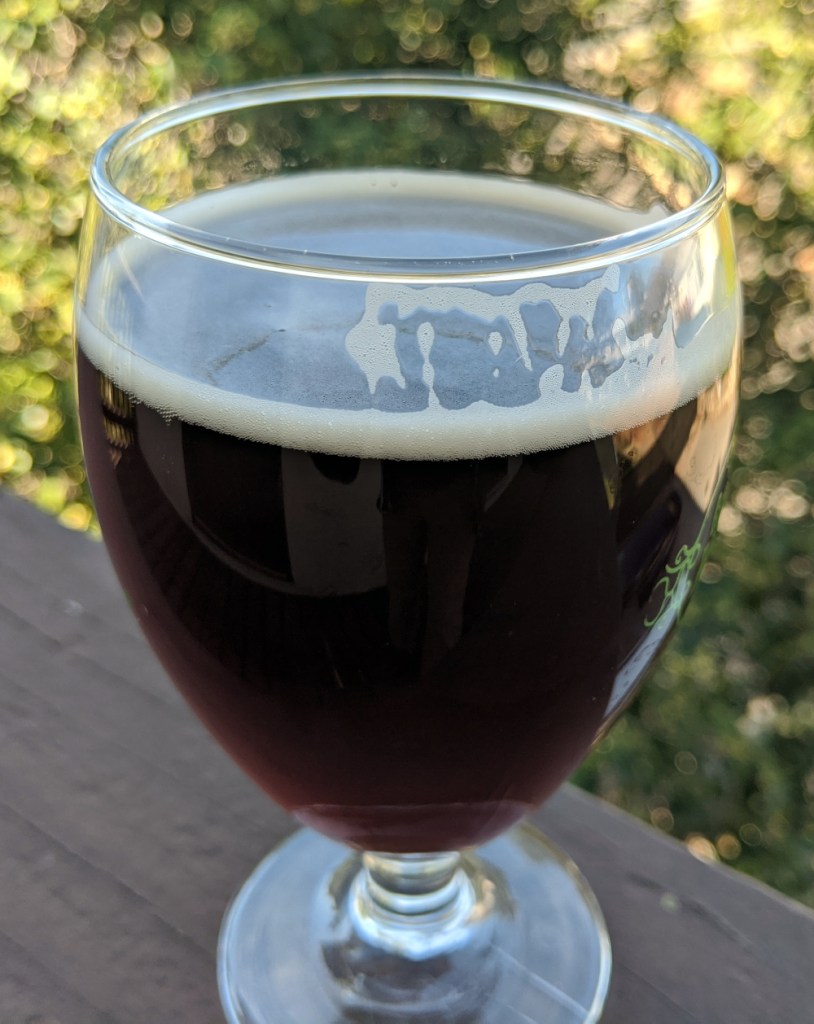
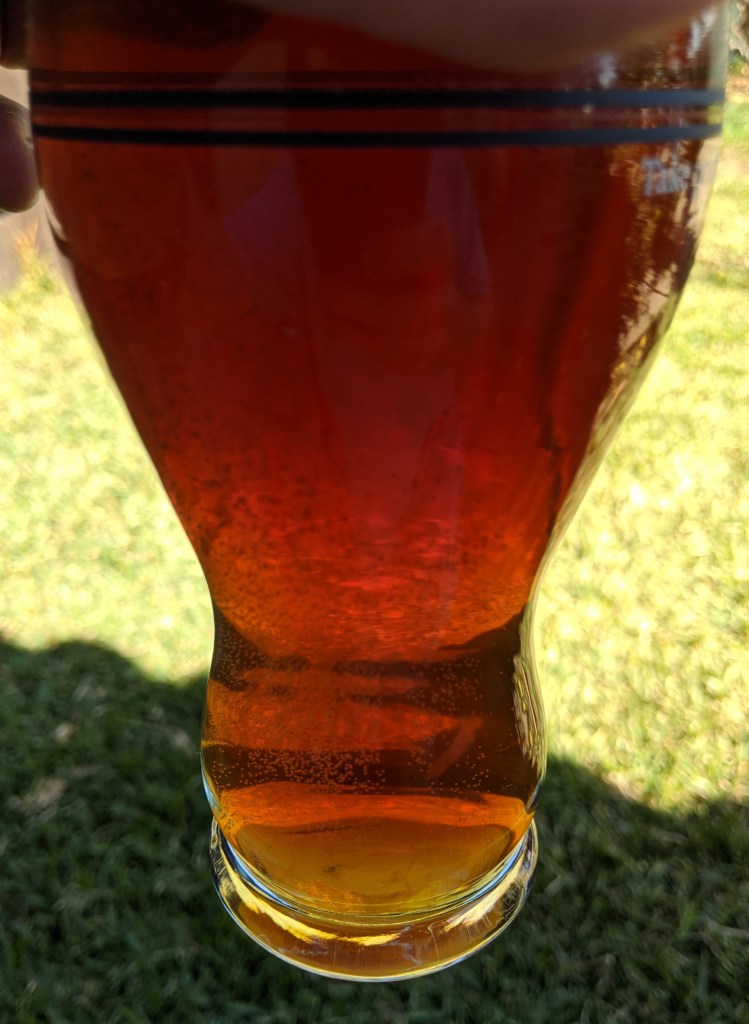
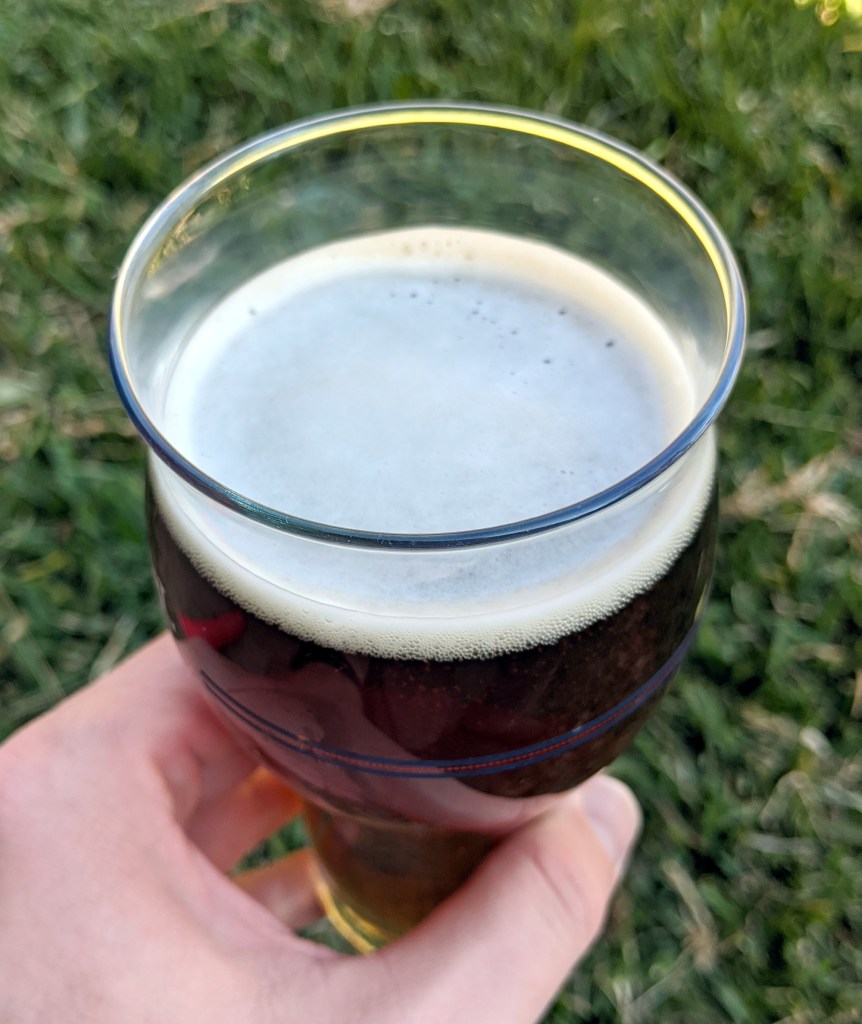
    • Reddish amber and clear, with a creamy, persistent ivory head. It’s a beautiful beer!
  • Aroma
    • Caramel and rye spice aroma; very clean yeast profile. Not much for hop aroma.
  • Flavor
    • Malt-forward, with a nice (but not overwhelming) rye character and a caramel note with that. The bitterness comes through on the back end; it’s firm, not over the top, and keeps the malt from being too cloying. It’s maybe a touch sweeter than I might like, but that’s only a very minor degree.
  • Body
    • Medium body, not as light as I would expect for the lowish finishing gravity. That said, the body is perfect for this beer. Moderate carbonation, with an off-dry finish.
  • Would I brew this again?
    • Yep! This is a winner of a recipe, even in the second iteration. It’s definitely among my favorite beers. Both this and the past iteration (version 1.0) are quite solid. I might ditch the crystal 120 to dial back the sweetness slightly, but that’s a fairly minor tweak.
  • Overall
    • 9.5/10

Crystal Pils

One of my current brewing goals is to try out American noble-type hops, to see how they stack up against German varieties. I theoretically should be able to get American varieties that are fresher and slightly cheaper than their German counterparts, although freshness is my main concern in the quantities I use.

For this batch, I’m making a German-style pils, with American malt and American hops. Crystal is my focus for this batch–it is often described as a substitute for Hallertauer Mittlefrueh, which made this American variety a logical choice.

Otherwise, the batch is a pretty straightforward pilsner. I upped the effort a bit with a double decoction, to improve mash efficiency as well as flavor. I also experimented with boiling the water prior to brewing to precipitate out carbonates. Finally, I made an additional water treatment of gypsum and calcium chloride. Our tap water here is a bit low in sulfate, and I also thought a bit more calcium and chloride wouldn’t hurt. I have had perpetual issues with minor haze, so it seemed worth a try. Similarly, I think that decoction may be helpful. This is all bad experimental science of course, because I’m changing way too many variable at once, but in any case I was feeling adventurous.

Crystal Pils

  • 9.5 lb. Superior Pilsen Malt (Great Western Malting)
  • 1 oz. Crystal hop pellets (3.0% alpha), 60 minute boil
  • 1 oz. Crystal hop pellets (4.5% alpha), 60 minute boil
  • 1 tsp. Fermax yeast nutrient, 10 minute boil
  • 1 Whirlfloc tablet, 5 minute boil
  • 2 oz. Crystal hop pellets (4.5% alpha), 5 minute boil
  • 1 pkg. German lager yeast (WLP830), prepared in starter

Target Parameters

  • Double decoction, with 60 minute rest at 145°, 20 minute rest at 158°
  • 1.048 o.g., 1.006 f.g., 5.5% abv, 32 IBU, 3 SRM
  • Claremont tap water, boiled and cooled prior to brewing, with 2 g gypsum and 3 g CaCl added.

Procedure

  • Two days prior to brewing, I brought the tap water to a rolling boil and let it cool, in an attempt to precipitate out carbonate. I carefully decanted the water prior to brewing. I added 2 g of gypsum and 3 g of CaCl to increase the overall calcium and sulfate levels.
  • Also two days in advance, I made a 1.75L starter, let it run, and cold crashed for 12 hours prior to pitching.
  • I mashed in with 4 gallons of water at 156°, to hit 145°. I added 6.25 mL of 88% lactic acid to the mash, to adjust mash pH. Because I didn’t know the exact chemistry of my water, I did a few test scenarios and found that this amount would keep me in the acceptable pH range for most possible water chemistries.
  • After 30 minutes of mash rest, I decocted 6 quarts of thick mash, raised the temperature to 160°, and let it sit for 10 minutes. I boiled for 15 minutes, and added it back to the main mash, to hit 152°. This was a bit below my intended target of 158°, so for next time I’ll want to decoct a larger volume–perhaps twice what I needed?
  • After 20 minutes, I decocted two gallons of thick mash, boiled for 10 minutes, and added it back to the main mash. This hit a temperature of 166°, so I stirred and added 1 gallon of water at 160°. This brought the mash down to 162°.
  • I let the mash sit for 10 minutes, vorlaufed, and collecte the first runnings. I added the remaining 3.6 gallons of water, and collected second runnings.
  • In total, I collected 7.1 gallons of water with a gravity of 1.040, for 81% mash efficiency.
  • I brought the kettle to a boil, boiling for 60 minutes and adding hops, nutrients, and finings per the schedule.
  • I chilled down to 85° and let the kettle sit for 4 hours. Trub settled out nicely–a long rest might be a good procedure for future beers where I care about clarity.
  • I transferred to the fermenter, chilled to 48°, oxygenated, pitched the yeast, and let the fermenter free rise to 52°.
  • I brewed the beer on 26 December 2019, and fermented at 52° for the first 11 days. The yeast threw off a ton of sulfur in the first few days of fermentation.
  • On January 6 (11 days post-brew), ambient temperature in my garage was 58°, so I moved the fermenter out of the fermentation chamber. Temperatures in the garage were between 55° and 62° for the next three weeks.
  • After 20 days at ambient, I kegged the beer on 26 January 2020. I transferred the beer semi-closed transfer into a CO2-purged keg. I conditioned at 33° for awhile, before moving it on-tap.
  • Final gravity was 1.010, down from 1.045, for 4.6% abv.

Tasting

  • Appearance
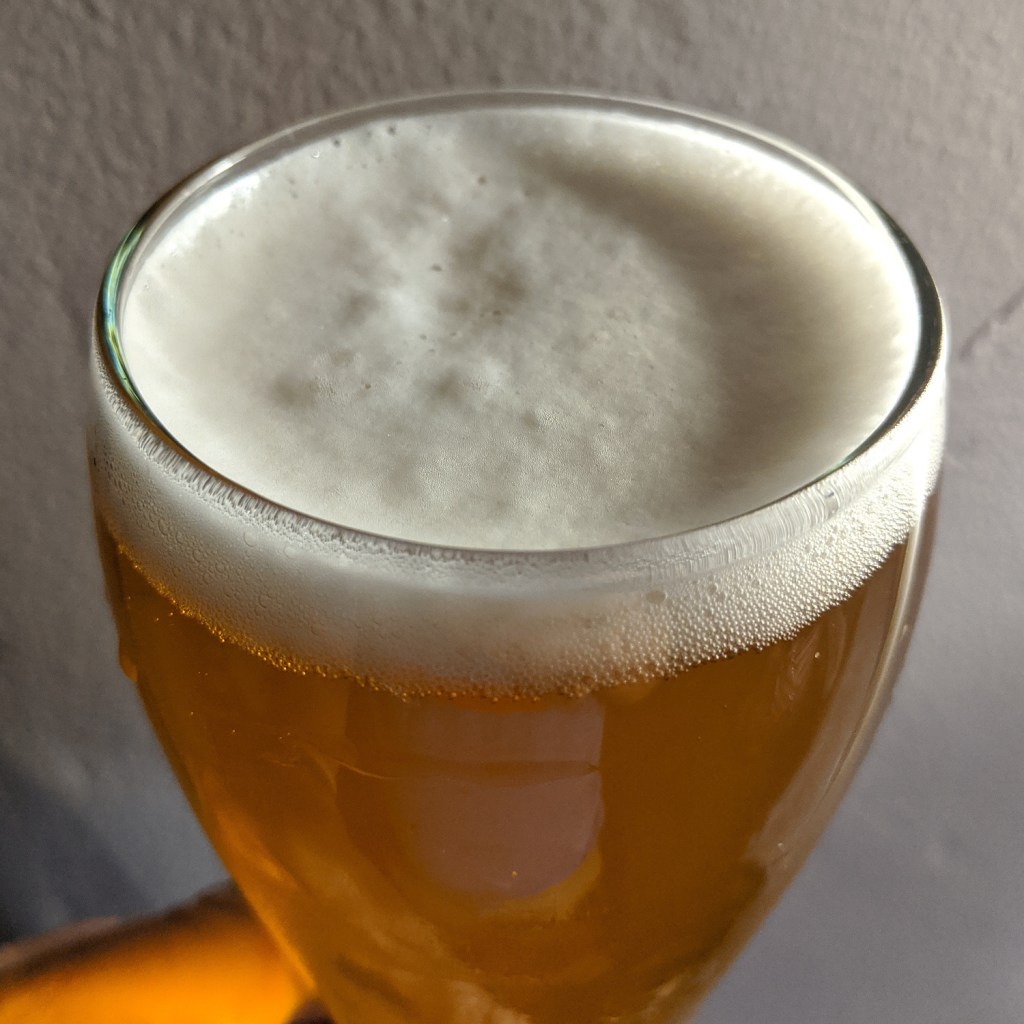
    • Light yellow, clear (but not quite brilliant), with persistent, fine white head. Gorgeous! It’s a shame it’s not brilliant, but that would probably just take a bit more time and patience.
  • Aroma
    • Slightly spicy hop aroma, with a lightly sweet malt note. Very nicely balanced between the two.
  • Flavor
    • Slightly sweet, grainy malt character. Firm but not overpowering bitterness.
  • Mouthfeel
    • Moderately dry, smooth finish with a residual bitterness that pleasantly lingers. Moderate carbonation; a bit reduced because I have to do an extended pour thanks to the massive head!
  • Would I brew this again?
    • Yes! This is a delightful beer, which is a darned good approximation of the German pils style using American ingredients. I would be a bit happier if it was brilliant rather than just “vey clear,” but that’s about the only ding on this otherwise great brew. It seems that a decoction didn’t make much difference for clarity here. Even so, the thing I love about pilsners is that they are simplicity in recipe with maximum enjoyability in flavor!
  • Overall
    • 9.5/10

What’s Brewing? February 2020 Edition

stainless steel fermenter in fermentation chamber
The new fermenter, bubbling away with a Czech dark lager

Excitement at the brewery! I just got my first stainless steel fermenter, thanks to a clearance deal at my local homebrew shop*. The fermenter is nothing fancy, but the price was right and I have been meaning to start transitioning away from glass carboys in the name of safety and easier sanitation.

Since last report, I have had three brewing sessions, for a kölsch, a Czech dark lager, and an American IPA.

Kölsch is my homebrewing club’s March contest beer. I vacillated a bit on recipe design, but settled for a version without wheat, which supposedly better matches “typical” kölsch in Cologne. Pilsner malt makes up 2/3 of the grist, and kölsch malt (from Schill malting) makes up the remainder. I elected to run with American hops, swapping in Liberty instead of German varieties. It seems to be moving along pretty well, and I will keg it in a week or two before lagering until the contest.

The Czech dark lager is the inaugural batch for my new stainless steel fermenter. I’ve never brewed this style before, but wanted to try it as a dark lager option for the taps.

Finally, the American IPA is taken from a recipe in Homebrew Recipe Bible. It used some hop varieties I haven’t brewed with much (particularly Ahtanum, along with CTZ and Chinook), and some familiar favorites (Cascade, Amarillo, Centennial, and Simcoe). Although I’m fairly comfortable formulating an American IPA recipe, I think it’s good to sample some external recipes on occasion, to see what flavor combinations others like. It keeps me out of a rut!

In the lagering chamber, I have the German pils and red rye lager. I had a near disaster with that a few days back, when I shifted some things around and didn’t notice that the probe on my temperature controller had fallen out of the chamber. The result was an overnight freeze of the kegs! Luckily, the damage seems to be minimal, and I thawed them out over a day or two. One interesting phenomenon–as the beers thawed, they stratified heavily, forming a sort of eisbock. Unfortunately, it meant I had to agitate the kegs a bit to remix the beer, setting back a week of quiet lagering. Hopefully the haze will continue to settle before I serve. When I tasted the beers following thawing (and after agitation), I didn’t notice any major flavor damage. I normally tape the temperature probe in place on a fermenter (to make sure the fermenter temperature is accurately measured), but leave it loose when lagering in the keg. I learned a valuable lesson–find some way to secure the temperature probe inside my lagering chambers!

Right now, I have a festbier, a session porter, and a pale ale on tap. It fits my tap philosophy well, of having something lighter, something darker, and something hoppier on tap at all times.


*If you’re in the San Dimas area, Pacific Brewing Supplies is an awesome, family-run (and family-friendly) business. They have a broad, well-stocked inventory, and the owners are super knowledgeable.

Kitchen Sink Porter

Continuing in my “kitchen sink” series of beers, I brewed a porter recently; it was really a session porter in the end, which has been nice for easy quaffing during the winter months.

Kitchen Sink Porter

  • 7 lbs. Maris Otter malt (Crisp)
  • 1 lb. Munich II malt (Weyermann)
  • 0.75 lb. caramel 60°L malt (Briess)
  • 0.5 lb. pale chocolate malt (Crisp)
  • 5 oz. caramel 120°L malt (Briess)
  • 2 oz. chocolate malt (Bairds)
  • 1 oz. roasted barley (Bairds)
  • 2 oz. Bobek hop pellets (4.5% alpha), first wort hop and 30 minute boil
  • 1 Whirlfloc tablet, 10 minute boil
  • 1 pkg. Windsor dry yeast (Lallemand)

Target Parameters

  • 30 minute full volume infusion mash, 155°
  • 1.044 o.g., 1.012 f.g., 4.3% abv, 26 IBU, 23 SRM
  • Claremont tap water

Procedure

  • I mashed in with 7.5 gallons of water at 159.5°, to hit a 154° mash temperature.
  • After 30 minutes, I vorlaufed and collected 6.3 gallons of runnings with a gravity of 1.039, for 68% efficiency.
  • I brought everything to a boil, boiling for 30 minutes and adding hops and finings as required.
  • After a 30 minute boil, I turned off the heat and chilled down to 70°, before pitching the yeast.
  • I brewed this beer on 3 January 2019. It had a starting gravity of 1.043.
  • The beer was fermented at ambient temperature of around 60°. I pitched the yeast immediately after transfer into the fermentation vesel, and fermentation took off pretty quickly.
  • On January 6, ambient was down to around 58°, so I moved the fermener into the fermentation chamber, where I applied some heat and set the temperature for 66°.
  • I cold crashed the beer on 13 January 2020.
  • I kegged the beer on 15 January 2020. Final gravity was 1.015, for 3.6% abv.

Tasting

  • Appearance
    • Medium brown color, mostly clear (slight haze), with persistent tan head.
  • Aroma
    • Chocolaty, clean aroma. I’m not picking up much of the bread and biscuit aroma that a good English porter should have.
  • Flavor
    • Roasty, chocolate flavor, with a distinct (but not harsh) bitterness that persists on the tongue. As the beer warms up, some of the biscuity malt notes start to come through.
  • Mouthfeel
    • This is a little thinner than I would like; it needs some extra body, I think. Moderate carbonation, smooth and off-dry finish.
  • Would I brew this again?
    • There’s a fair bit happening in dark malt flavor, but the mouthfeel department needs some serious augmentation. I also feel like the lighter character malts (e.g., crystal malts) could be expanded a bit more, because the dark malts really take over. It’s not unpleasant, just a bit one-dimensional. This is a pretty drinkable beer–and the low abv certainly helps with that–but not a recipe I’m likely to do again. For a future iteration of this type of beer, I would definitely mash at a much higher temperature (maybe 158°?) and perhaps add in some biscuit malt and/or more crystal 120.
  • Overall
    • 5.5/10

Holiday Festbier

I have always stereotyped lagers–especially those that are lighter in color–as beers best suited for warm weather. Lawnmower beer. That kind of thing. As my palate has expanded, though, I’ve decided that lighter lagers aren’t just for the summer. A festbier–with its slightly more complex flavor profile–seems like a good option for cooler months. And who says it’s just for Oktoberfest?

My recipe was inspired by a festbier recipe I saw on Brulosophy, with pilsner and Vienna malts carrying the bulk of the grist alongside a splash of Munich malt. In the end, it worked out pretty well!

Holiday Festbier

  • 6 lb. Vienna malt (Weyermann)
  • 5.5 lb. Superior pilsen malt (Great Western)
  • 0.75 lb. Munich Malt (Best; 7.6 SRM)
  • 0.35 oz. Magnum hops (13.2% alpha), 60 minute boil
  • 2 oz. Saaz whole hops (3.0% alpha), 10 minute boil
  • 1 Whirlfloc tablet, 10 minute boil
  • 1 tsp. Fermax yeast nutrient, 10 minute boil
  • 2 pkg. Saflager lager yeast (W34/70)

Target Parameters

  • 60 minute infusion mash, 149°, batch sparge.
  • 1.056 o.g., 1.011 f.g., 5.9% abv, 21 IBU, 5 SRM
  • Water built from RO, for target of 35 Ca, 3 Mg, 29 Na, 41 SO4, 40 Cl, 77 HCO3, 37 RA

Procedure

  • I built up 4.25 gallons of mash water by adding 1.7 g baking soda, 1.3 g CaCl, 0.8 g gypsum, and 0.5 g epsom salts. I aimed for a mash-in temperature of 160.5°, to hit 149.1° for the mash. Immediately after mashing in the grains, I added 9.5 mL of 88% lactic acid, to adjust the pH appropriately.
  • I built up the sparge water with 4.6 gallons of RO water supplemented with 1.9 g baking soda, 1.5 g CaCl, 0.9 g gypsum, and 0.6 g epsom salts.
  • I started the batch sparge with 1 gallon of water at 180°, let it sit for 10 minutes, vorlaufed, and collected first runnings. I then added the remainder of the sparge water, vorlaufed, and collected the rest of the runnings.
  • In total, I collected 7 gallons of runnings with a gravity of 1.045, for 70% efficiency.
  • I brought the kettle to a boil, adding hops and finings per the recipe. After 60 minutes, I turned off the flame and chilled down to 75° or so. After transferring to the fermenter, I chilled down to 50° in the fermentation chamber before oxygenating the wort and pitching the yeast.
  • I brewed this beer on 7 December 2019. Starting gravity was 1.053, a touch below my target (1.056), but not too awfully low.
  • I started fermentation at 52°, and raised it to 56° after two weeks (21 December 2019). I raised the beer to 60° on 23 December 2019, before crashing to 33° on 26 December 2019.
  • I kegged the beer on 28 December 2019, by semi-closed transfer into a CO2 purged keg. Final gravity was 1.009, which works out to 5.9% abv.
  • After kegging, I lagered the beer at 33°. From the start, flavor was really nice. When I sampled the beer on 12 January 2020, after two weeks of lagering, flavor was still amazing, but the beer was still fairly hazy. By February 6, the beer had only a slight haze, and could be rated as relatively clear (but not yet bright). I expect it should be up to snuff within a week or two.

Tasting

  • Appearance
    • Gold, nearly clear (only a slight haze at the time of this tasting), with a nice and persistent white head.
  • Aroma
    • Malt, malt, malt. Aroma is a slightly sweet malty quality, and I don’t pick up much for hops.
  • Flavor
    • Smooth maltiness, with the malt character being a combination of pure maltiness and a bit of breadiness. (I’m using various forms of “malt” in my descriptions, but that’s really the best descriptor for this beer!) Hop level is moderate and has a beautiful smoothness, with the balance of the beer definitely tilted towards malt.
  • Mouthfeel
    • This beer is sooooo drinkable! Medium body, moderate carbonation, just a pure thing of beauty.
  • Would I brew this again?
    • Absolutely! This is a wonderful recipe. My only mild knock-down is for the slight haze in the beer, but if I were to lager this for months as a proper festbier I think it would be fine. The malt character and hopping level are perfect. On top of all of this, it really nails the high drinkability that a good festbier should have.
  • Overall
    • 9/10