
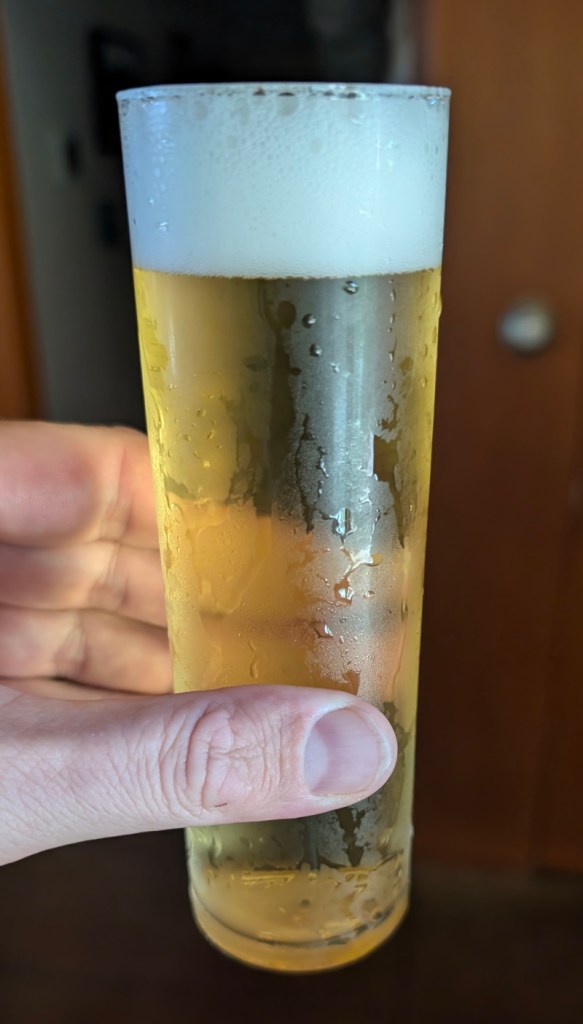
Kölsch is an accessible style, but its delicate qualities make it a challenge to brew well. Like a light lager, there isn’t much hop or malt character to hide behind, and the yeast character has a narrow separation between “subtle and pleasant” vs. “rotten fruit bomb.” Over several years, I had perfected a house recipe, but changes in ingredient availability restarted my quest.
This new recipe is, unsurprisingly, broadly similar to my old one. While searching the AHA’s recipe archives, I found an NHC-winning kölsch from 2023 (note: an AHA membership is required to view the original recipe), formulated by Metts Potter. It has a simple base of pilsner malt with a hint of Vienna (similar to my original, except I had light Munich instead of Vienna), with a light dose of Hallertauer Mittelfrueh. The original recipe used Wyeast 2565, but White Labs is easier to get so I used a close equivalent, the classic WLP029. I also had mixed pilsner malt types, to use up the last little bit of one sack of Briess. Because I had already done a kölsch semi-recently and didn’t want to get too tired of the style, I opted for a small, 3-gallon, batch.
Iceberg! Kölsch
- 4.75 lb. Synergy Select Pilsen malt (Briess)
- 0.75 lb. pilsen malt (Briess)
- 10 oz. Vienna malt (Weyermann)
- 0.25 tsp. BrewTanB, added to mash
- 0.85 oz. Hallertauer Mittelfrueh hop pellets (2.5% alpha), 60 minute boil
- 0.85 oz. Hallertauer Mittelfrueh hop pellets (2.5% alpha), 15 minute boil
- 0.25 tsp. BrewTanB, 10 minute boil
- 0.5 Whirlfloc tablet
- 1.5 g. WLN1000 yeast nutrient, 5 minute boil
- 1 pkg. German Ale/Kölsch yeast WLP029 (White Labs)
- 1 oz. Biofine Clear, added to keg
Target Parameters
- Hochkurz mash, with 5 minute rest at 144°, 45 minute rest at 148°, 10 minute rest at 153°, 45 minute rest at 163°, 15 minute mash-out at 170°, full volume mash
- 1.047 o.g., 1.012 f.g., 4.7% abv, 20 IBU, 4 SRM
- Water built from scratch, to hit 48 ppm Ca, 44 ppm SO4, 54 ppm Cl
- 3 gallon batch
Procedure
- Starting with 4.7 gallons of RO water, I added 1.4 g of calcium chloride and 1.3 g of gypsum, to hit my water profile target. I heated the strike water to 149° before adding the BrewTanB, grains, and 10 mL of 10% phosphoric acid.
- I held the mash at 144° for 5 minutes, before raising to 148° for 45 minutes, then to 153° for 10 minutes, 163° for 45 minutes, and finally 170° for 15 minutes. All of this was done while recirculating.
- After the mash, I removed the grains and brought the runnings to a boil. In total, I collected 4.36 gallons of runnings with a gravity of 1.040, for 75% mash efficiency. This high efficiency probably is a result of the extended mash time.
- Once the kettle was at a boil, I added the hops and finings per the recipe. After the full 60 minute boil, I turned off the heat, chilled to 75°, and then transferred the wort to the fermenter. Within the fermentation chamber, I chilled the batch to 64° before pitching the yeast.
- I brewed this beer on 31 May 2026; starting gravity was 1.048.
- I fermented the beer at 66°, and kegged on 30 June 2026 via a closed transfer. The beer had a very nice flavor and aroma; bitterness seems a bit lighter than in Snowdrop Kölsch, which isn’t surprising given the stats.
- Final gravity was 1.010, for 5.0% abv.
- I had a first taste of the conditioned beer on 17 August 2026; it was really nice! There was a very slight but persistent haze, so I added Biofine Clear on 19 August 2026, when I moved the beer into my kegerator. The beer was (finally!) brilliantly clear on 24 August 2026.
Tasting
- Appearance
- Light yellow, brilliantly clear beer; pours with a low but somewhat persistent white head.
- Aroma
- Medium-low pear-like yeast character. Medium-low spicy hop character. Low grainy malt character.
- Flavor
- Grainy malt at a medium-low level; medium-low level of clean bitterness with a slightly spicy quality. Light pear fruitiness in the yeast, at a low level.
- Mouthfeel
- Medium-light body, medium level of carbonation, slightly lingering bitterness on an off-dry finish.
- Would I Brew This Again?
- This is a fantastic kölsch, especially so once it was fully conditioned and dropped clear. Every element is beautifully balanced, creating an eminently drinkable beer that is perfect for a hot day. This seems like a worthy successor to Snowdrop Kölsch, as a house kölsch recipe.
- Overall
- 10/10
 Andy's Brewing Blog
That 75% mash efficiency from the extended Hochkurz schedule is a nice payoff for the extra time. I’ve found WLP029’s pear ester walks exactly the narrow line you describe, so it’s good to hear this batch stayed on the “subtle and pleasant” side. Interesting call adding Biofine in the keg after conditioning; glad it dropped brilliantly clear in the end. I’ve been recording my brew days and cutting the timelapses with a tool called MakeAIVideo, which makes it easy to rewatch mash steps like these. Cheers!
LikeLike