
This summer was incredibly hectic–both in expected and unexpected ways–and thus it was hard to fit in as much brewing as I would like. One of my precious brewdays was set aside for a session IPA…and because things were topsy-turvy, I decided to run with kveik.
The recipe itself isn’t based on anything in particular, beyond past experience. I wanted a beer that was flavorful in hops, highly crushable, and not too over-the-top in alcohol. Thanks to my regular HOPBOX deliveries, I had no shortage of IPA-worthy hops.
I built the recipe with a base of Golden Promise malt, and a touch of light crystal malt to keep things from being too dry or too thin. As I often do with my session beers, I mashed high. Instead of a massive whirlpool addition, I tilted the hops towards the final five minutes of the boil, and loaded in a few ounces of dry hops in the keg. Citra, Mosaic, and Eclipse were a natural combination. I hadn’t brewed with Eclipse before, but the description suggested it would meld well with the other two. As for yeast, Voss Kveik seemed like a good fit. I’ve brewed with it a few times before, and the citrus notes hopefully wouldn’t clash. Plus, I liked the idea of a yeast that I didn’t have to baby too much during summer weather.
Citrosaic Session Ale
- 10 lb. Golden Promise Finest Pale Ale malt (Simpsons)
- 0.25 lb. Cara 20 (Dingemans)
- 0.25 lb. Carahell (Weyermann)
- 1 oz. Citra hop pellets (12.8% alpha), 30 minute boil
- 1 Whirlfloc tablet, 5 minute boil
- 1 oz. Citra hop pellets (13.6% alpha), 5 minute boil
- 1 oz. Eclipse hop pellets (16.8% alpha), 5 minute boil
- 1 oz. Mosaic hop pellets (11.6% alpha), 5 minute boil
- Voss kveik (Lallemand), 1 pkg. dry yeast
- 1 oz. Citra hop pellets (13.6% alpha), dry hop in keg
- 1 oz. Eclipse hop pellets (16.8% alpha), dry hop in keg
- 1 oz. Mosaic hop pellets (11.6% alpha), dry hop in keg
Target Parameters
- 1.046 s.g., 1.013 s.g., 4.4% abv, 66 IBU, 5 SRM
- Claremont tap water, no adjustments
- Full-volume mash, no sparge, at 156°
Procedure
- I mashed in with 7 gallons of water at 162°, to hit a mash temperature of 156°. I held it here with recirculation for 10 minutes. I added ~7 mL of 88% lactic acid at the start of the mash, to adjust pH.
- After 60 minutes, I raised the mash temperature to 168°, held it here for 10 minutes, and then removed the grains.
- In total, I collected 6.1 gallons of runnings with a gravity of 1.043, for 69% mash efficiency.
- I brought the mash to a boil, adding hops and finings per the recipe. After 60 minutes, I turned off the heat and chilled down to around 90°.
- I brewed this beer on 11 July 2022. Starting gravity was 1.048.
- I transferred the wort to my fermenter, pitched the yest, and let things roll at ambient temperature. Everything was rocking within 6 hours, and had slowed down within 18 hours.
- Although I planned to keg this within a week or so, life got in the way (thanks, COVID), and it wasn’t until 13 August 2022 that I managed to get things transferred. I was a bit worried about flavor damage or oxidation, but it didn’t seem too awful.
- I added the hops in a bag, at the time of kegging. Final gravity was 1.022, for 3.4% abv.
Tasting
- Appearance
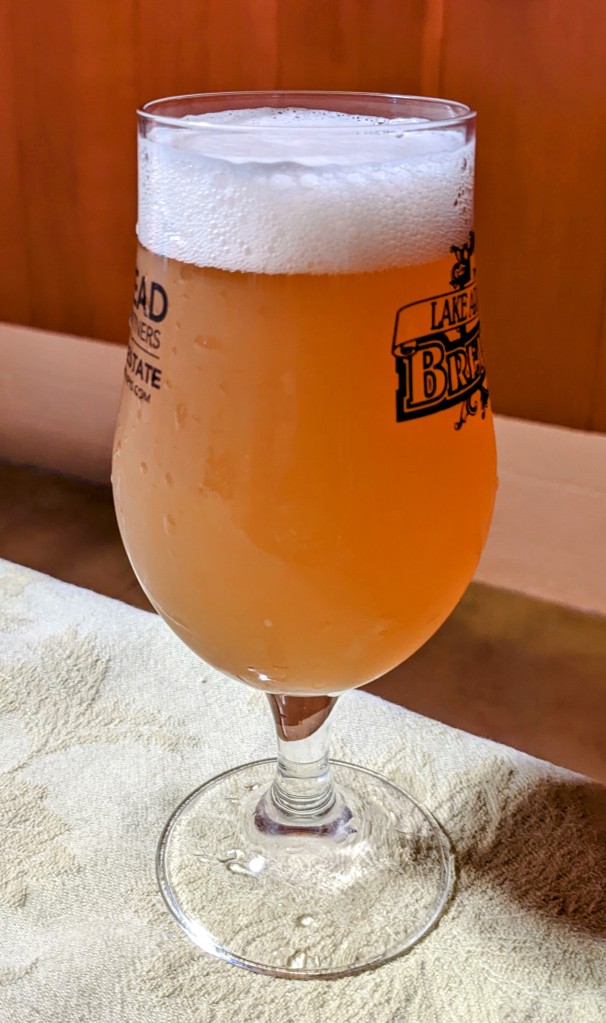
- Medium-gold, fairly hazy, pours with a creamy and persistent white head.
- Aroma
- Fresh tangerine is prominent in the hop aroma, with a bit of passion fruit and other tropical notes; there is a touch of dankness as the beer warms up. And of course I get the class blueberry. Fermentation aroma is clean.
- Flavor
- Very bitter, with a slight hop “bite” and citrus pithiness. The very prominent hop flavor includes orange/tangerine, grapefruit, and a bit of blueberry. It tastes quite “juicy”! Malt is clean, with a slight hint of light caramel sweetness and graininess.
- Mouthfeel
- Medium dry, with a dry finish. Moderate carbonation.
- Would I Brew This Again?
- Yes! This is just a nice summer IPA, in the tropical/citrus tradition. I don’t want these flavors all the time, but I really liked this particular recipe. The kveik meshes well with the hops, and has a surprisingly clean profile. It just stays out of the way. I wouldn’t mind if the clarity was better (hence my lower rating), but in the end this is a highly crushable IPA, exactly what I wanted.
- Overall
- 8/10

 Andy's Brewing Blog