Pilsnerpeton

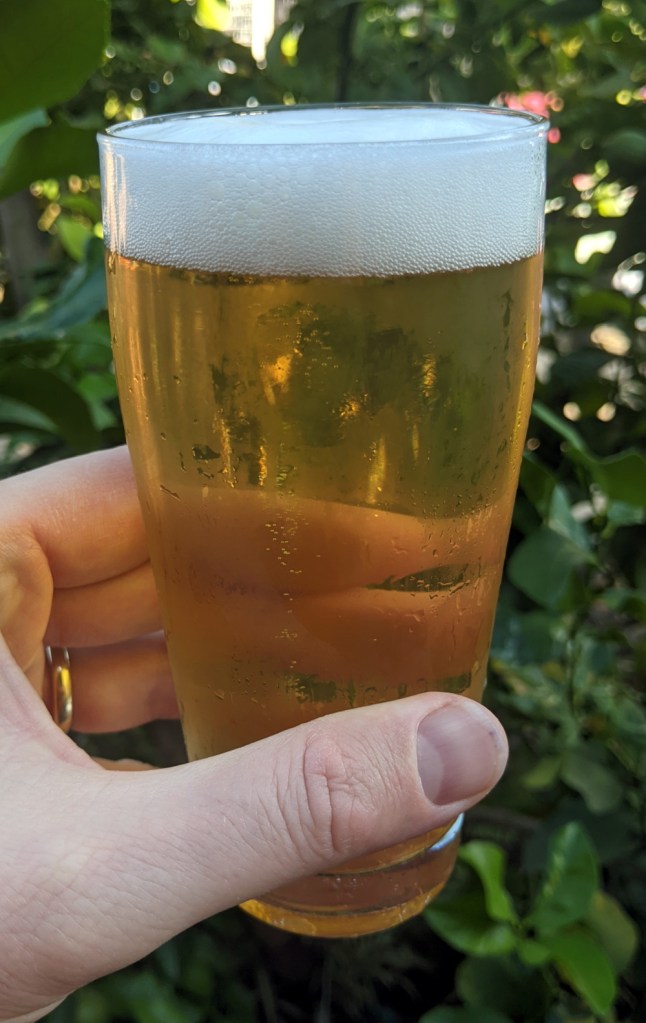
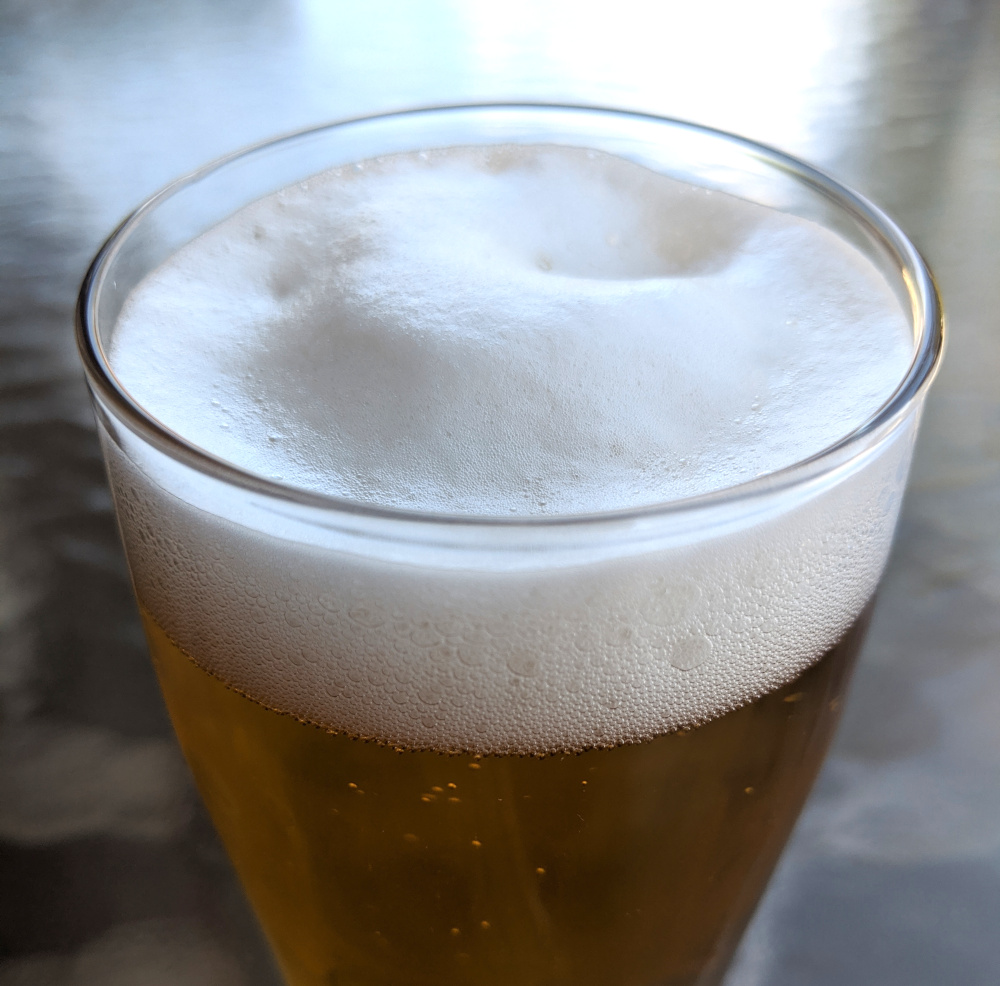
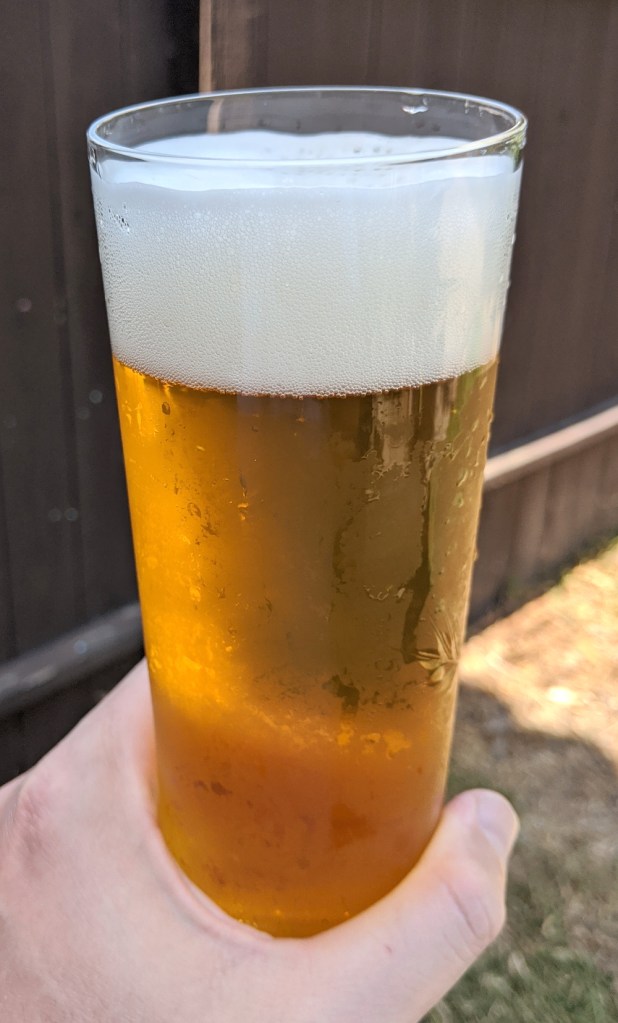
I’m slowly and steadily improving my German pils game, and feel like this one is a winner! It’s a super basic recipe, but my philosophy has always been that the best pilsners are accentuated by skill and quality ingredients, rather than endless ingredient lists.

The name is a cheeky reference to a naming convention in zoology, with many amphibians, reptiles, and relatives getting an “-erpeton” suffix. It translates literally as “reptile” or “creeping thing.” Acquaintance Brad McFeeters cheekily noted that Pilsnerpeton would be a great name for a lagerpetid (dinosaur cousin), and I thought it would also be a euphonious name for a beer! I might keep it as the name for my house German pils recipe from here on out…

Pilsnerpeton

  • 10 lb. Viking Pilsner Zero malt
  • 0.4 oz. Perle hop pellets (7.1% alpha), 60 minute boil
  • 0.15 oz. Sterling hop pellets (7.4% alpha), 60 minute boil
  • 1.0 oz. Perle hop pellets (7.1% alpha), 10 minute boil
  • 0.25 oz. Mt. Hood hop pellets (4.6% alpha), 10 minute boil
  • 1 tsp. Fermax yeast nutrient, 10 minute boil
  • 1 WhirlFloc tablet, 5 minute boil
  • 1 pkg. Global liquid yeast (Imperial #L13)

Target Parameters

  • 1.046 s.g., 1.006 f.g., 5.2% abv, 4 SRM, 26 IBU
  • Full volume step mash, with 30 minute rest at 142°, 40 minute rest at 156°, and 10 minute mash-out at 168°
  • Claremont tap water, treated with Campden tablet.

Procedure

  • Around 12 hours in advance of pitching, I made a 1.5L SNS (shaken-not-stirred) starter with 150 g of light DME.
  • I heated 7.25 gallons of water to 147°, and mashed in the grains. I added 5 mL of 88% lactic acid to adjust pH.
  • I held the mash at 142° for 30 minutes, and then raised it to 156°, which took approximately 9 minutes. After 40 minutes at 156°, I raised the temperature to 168°, which took around 10 minutes. I held it at this temperature for 10 minutes, before removing the grains and bringing the kettle to a boil.
  • The gravity out of the mash was 1.039, with 6.4 gallons collected. This equates to 67% mash efficiency.
  • Once the kettle was boiling, I added hops and kettle finings per the recipe.
  • After a 60 minute boil, I turned off the heat and chilled down to 88° while recirculating. At this point, I stopped recirculation and let the wort settle for 30 minutes.
  • Then, I transferred the wort to the fermenter, discarding around 1 gallons of trub. This was probably a bit more than I needed to get rid of, and would aim for ~0.5 gallons next time.
  • In the fermenter, I chilled the wort down to 49°, over a 3 hour period. I oxygenated the wort for 40 seconds, and then pitched the yeast.
  • I brewed the beer on 28 December 2020. Starting gravity was 1.044.
  • I started fermentation at 48°, with a free rise to 50° after pitching. I raised the beer to 54° on 1 January 2021, 56° on 5 January, and 60° on 9 January. I cold crashed down to 34° on 16 January 2021.
  • I kegged the beer on 30 January 2021, after two weeks of cold crashing.
  • Final gravity was 1.013, down from 1.044, for 4.1% abv. The final gravity was a bit higher than predicted by BeerSmith, but I think that’s because the software doesn’t do well with calculating wort fermentability from step mashes.

Tasting
  • Appearance
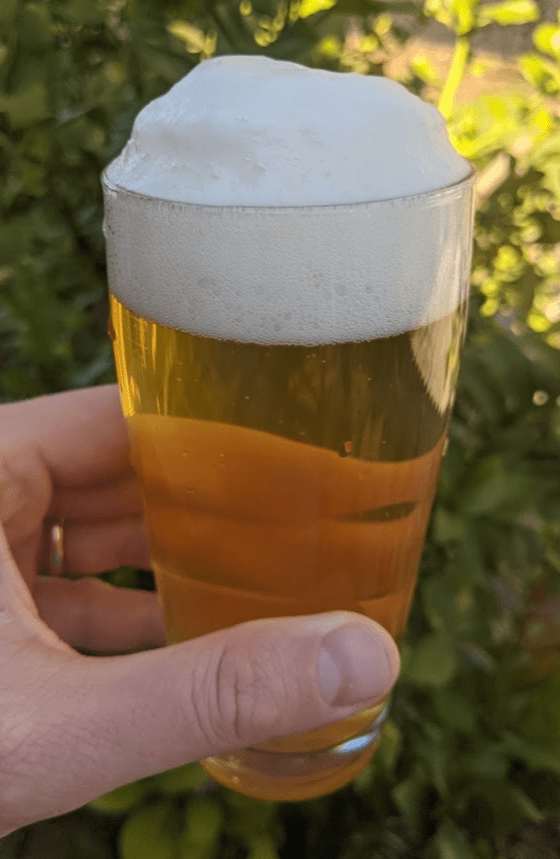
    • Very clear light gold beer, just shy of brilliant, with a beautifully creamy, tall, and persistent white head. It has wonderful lacing down the side of the glass as you drink it.
  • Aroma
    • Malty sweet and cracker notes in a moderate malt aroma. There is a low level of “spicy” hop character. I might like a little more hop aroma, but that’s a minor fault.
  • Flavor
    • Clean, malty-sweet character, with moderate level of very smooth bitterness. The hop flavor is herbal/spicy, with a clean finish. The bitterness lingers pleasantly.
  • Mouthfeel
    • Medium-light body, moderate carbonation, very smooth finish.
  • Would I brew this again?
    • Yes! The malt/hop balance are perfect for my taste, so I think ~25 IBU in a lower-gravity pils is a sweet spot for my preference. Clean fermentation character and clean malt make this taste so good! I might try some hop adjustments for the late hopping to improve aroma, but that is the only real fault in this beer.
  • Overall
    • 9/10

Dog Days Pilsner

As the summer reached its peak of heat near the end of August, pilsners were always on my mind. There’s nothing more refreshing than sitting out on the patio at the end of an afternoon, with a Willi Becher of freshly poured pilsner. I find that a good pilsner with some character can also work as a fall beer…basically, a classic German pils is the year-round beer in my world!

So, during the Dog Days of Summer, I crafted this Dog Days Pilsner recipe. I kept the malt bill super simple, with pilsner malt and a touch of CaraPils to round out the mouthfeel. Although I often go for a SMaSH-type strategy for hopping, this time I wanted to build up some layers of hop character. Finally, I wanted a little more yeast character, so went with the White Labs’ Oktoberfest/Marzen recipe, instead of my usual W34/70. Those strategies paid off nicely in the end!

Dog Days Pilsner

  • 9.5 lb. Pilsner malt (Weyermann)
  • 6 oz. Carapils malt (Weyermann)
  • 4 oz. acidulated malt (BestMalz)
  • 1 oz. Sterling hop pellets (7.4% alpha), 60 minute boil
  • 1 oz. Saaz hop pellets (5.3% alpha), 20 minute boil
  • 0.55 oz. Hallertauer Mittelfrueh hop pellets (3.2% alpha), 5 minute boil
  • 1 tsp. Fermax yeast nutrient, 10 minute boil
  • 1 WhirlFloc tablet, 5 minute boil
  • 1 pkg. Octoberfest/Marzen lager yeast (WLP 820), in 1.75L vitality starter

Target Parameters

  • 1.046 s.g., 1.015 f.g., 4.1% abv, 3 SRM, 37 IBU
  • Infusion mash, 155°, batch sparge; 60 minute boil
  • Claremont water, adjusted with lactic acid and gypsum to achieve 66 ppm Ca, 30 ppm Mg, 81 ppm Na, 107 ppm SO4, 90 ppm Cl, est. 30 ppm HCO3; alkalinity 25 ppm, effective hardness 65 ppm, RA -40 ppm

Procedure

  • The morning of my brew day, I spooled up a 1.75L vitality starter for the yeast, and ran it on my stir plate.
  • To prepare my water, I added 9 mL 88% lactic acid to 8.25 gallons of tap water along with a Campden tablet, and then 4g gypsum. This was done to knock out the carbonates and approximate a target of 66 ppm Ca, 30 ppm Mg, 81 ppm Na, 107 ppm SO4, 90 ppm Cl, est. 30 ppm HCO3; alkalinity 25 ppm, effective hardness 65 ppm, RA -40 ppm.
  • I mashed in with 3.5 gallons of water at 162°. Mash temp was a bit low at 151.5°, so I added 3 quarts of water at 178°, to hit 155.5°. I added 0.75 mL of 88% lactic acid to the mash, to lower pH to an estimated target of ~5.45.
  • After 60 minutes, I added 0.75 gallons of water at 185°, let it sit for 10 minutes, vorlaufed and then collected the first runnings. I added the remainder of the sparge water, and collected second runnings.
  • In total, I collected 6.8 gallons of runnings at 1.043, for ~77% efficiency.
  • I brought the runnings to a boil, adding hops and kettle finings per the schedule. After a 60 minute boil, I turned off the heat and chilled down to 85° with my cooling coil. I transferred to the fermenter and cooled the rest of the way (~52°) in the fermentation chamber. This final chill took around six hours.
  • I gave the wort a 30 second blast of pure oxygen, and then pitched the yeast.
  • I brewed the beer on 15 August 2020, and started fermentation at 54°.
  • I raised the temperature to 56° on 31 August, 58° on 2 September, and then 60° on 4 September. I held it at 60° for 12 hours, and then started the downward trend. It was at 57° on 5 September, 50° on 6 September, 45° on 7 September, 40° on 8 September, and 35° on 9 September. The final step was down to 32° on 10 September, and I held it there until kegging on 26 September 2020.
  • The final gravity was 1.011, down from 1.049, for 5.0% abv.

Tasting

  • Appearance
    • Clear, just shy of brilliant. Light gold color, with a fine and persistent white head.
  • Aroma
    • Moderate level of malt aroma comes through, with a grainy sweet character. The hops come across amazingly, with a moderately prominent floral quality.
  • Flavor
    • Moderate grainy-sweet malt character–just gorgeous! The bitterness is moderately high, with a clean and slightly herbal character.
  • Mouthfeel
    • Moderately light body, with a crisp and slightly dry finish and moderate carbonation.
  • Would I brew this again?
    • This is a really nice pilsner. The aroma and malt character are perfect. I can’t think of much I would change with this one, other than letting it lager a touch more before it goes on tap. In the last part of the keg that I’m on right now, it’s looking really nice!
    • My typical German pils recipes are on the upper end of bitterness for the style (37 IBU here, versus 40 max in the BJCP guidelines). At some point, I should probably play around with recipes at the lower end of the IBU spectrum…
  • Overall
    • 9.5 / 10 (slight ding for initial clarity)

Summer Helles

I’ve been trying to get out ahead of my lagering schedule, by having a few lagers in the pipeline at a time. A minor, but consistent, flaw in my lagers has been that they have a slight haze when first put on tap. I primarily suspect that’s because I just don’t give them enough lagering time. Typically, they might be only 4 or 5 weeks post-brewing, with perhaps only two weeks at most of cold conditioning (<35°) prior to tapping. That’s just not enough time. I’m also not (usually) inclined to rush things with gelatin, because it’s another potential point of oxidation on what are often fairly delicate beers. If I’m going to all the work of making a lager, I want it to taste just as great at the start of the keg as at the finish of the keg!

So, this summer I’ve been working to build up a backlog of beer to allow a bit more time for full conditioning. It’s not always successful–“Mow the Damn Lawn, Farke” was on tap only two weeks after kegging–but I’ve certainly gotten better.

For a recent lager brew, I decided to chase after the elusive Munich helles style. They have notoriously delicate malt character, and are seemingly the cause of endless jousting on brewing forums (particularly when the low oxygen brewers get involved). I made my first attempt three years back, and it was alright, but nothing to write home about. The malt character needed some work.

For this round, my base recipe followed Gordon Strong’s helles in Modern Homebrew Recipes, with some modifications for ingredients on-hand as well as process. I did a shorter step mash schedule, skipping the 131° rest in the original recipe and going straight to 148° for the first rest. I also used W34/70 instead of a bock yeast, with a repitch of the yeast cake from my Tremonia Lager. I didn’t have Belgian aromatic malt on hand, so I used Carahell instead. Also, I used Hallertauer Mittelfrueh hop pellets instead of US Vanguard, a rare case as of late in which I am using the German variety instead of American hop equivalents!

Summer Helles

  • 8.75 lb. Pilsner malt (Weyermann)
  • 1 lb. Munich light malt (Chateau)
  • 0.25 lb. Carahell malt (Weyermann)
  • 2 oz. Carapils malt (Briess)
  • 1.55 oz. Hallertauer Mittelfrueh hop pellets (3.2% alpha), 60 minute boil
  • 1 tsp. Fermax yeast nutrient, 10 minute boil
  • 1 Whirlfloc tablet, 5 minute boil
  • Saflager W34/70, repitch of yeast from previous batch

Target Parameters

  • 1.046 o.g., 1.008 f.g., 17 IBU, 4 SRM, 5.0% abv
  • Full-volume infusion step mash, 40 minute rest at 148°, 15 minute rest at 158°, 15 minute rest at 168°
  • Claremont tap water, alkalinity neutralized by 88% lactic acid

Procedure

  • For my 4 gallons of initial strike water, I added 3.6 mL of 88% lactic acid to neutralize alkalinity, along with a Campden tablet.
  • I mashed in at 155°, to hit a 147.8° mash temperature. I added 2.5 mL of 88% lactic acid to adjust pH. The mash was down to 145° after 25 minutes.
  • 45 minutes after the initial infusion, I added 6.25 quarts of near-boiling water to raise the mash temperature to 157°. The water was added over a 5 minute period. After 15 minutes, the temperature was down to 154° or so.
  • At this point (~60 minutes into the mash), I added the rest of my hot water (~3 gallons) to hit a final mash rest of 167°.
  • After 10 minutes, I vorlaufed and collected the full volume of runnings in the kettle. I got 7.1 gallons at a gravity of 1.041, for 77% mash efficiency.
  • I brought the kettle to a boil, adding hops and finings per the schedule.
  • After a 90 minute boil, I turned off the heat and chilled down to ~75°, before transferring to the fermenter.
  • I let the fermenter chill the rest of the way down to 50°, and gave it a 30 second burst of pure oxygen before pitching the yeast.
  • I brewed the beer on 24 June 2020, with a starting gravity of 1.047.
  • The first week of fermentation was at 50°, and I let the fermenter free-rise to 54° on July 1. I let it further rise to 58° (July 3) and 60° (July 4), before chilling to 55° (July 5), 50° (July 6), and then 45° and 40° over an 8 hour period (July 7). I chilled further to 35° (July 8) and 33° (July 9), and let it lager on the yeast at that temperature until kegging.
  • I kegged the beer on July 24, using a closed transfer followed by force carbonation. The beer was pretty clear, but not perfectly clear at this point.
  • Final gravity was 1.008, down from 1.047, for 5.2% abv.

Tasting

  • Appearance
    • Pours with a beautiful, full white head, that is quite persistent. Pale gold in color and very clear, but just a touch off of brilliant. It’s a gorgeous beer!
  • Aroma
    • Malty and ever-so-slightly sweet, with a touch of hop spice.
  • Flavor
    • Full maltiness, with a really pleasant and rounded character. A clean but firm bitterness; I would say the bitterness tilts towards medium/medium-low, with a slight spice character. The bitterness could be notched back very slightly, but not by much.
  • Mouthfeel
    • Moderate carbonation, with a smooth and slightly dry finish.
  • Would I brew this again?
    • Yes! This is a really enjoyable recipe, and I feel like it nails the malt character quite well. It’s a much better version of a Munich helles than my last one, and it definitely benefited from a longer lagering time than I often get. I might edge the bitterness back a tiny bit. Also, I will probably play around with malt brands and hop varieties in future version, but the proportions and balance are pretty much right where I want them. This is a refreshing late summer lager!
  • Overall
    • 9/10

Tremonia Lager

Despite their sometimes bland reputation, pale lagers have a surprising breadth of variation. One type I’ve not yet explored is the Dortmunder Export, lumped into the German Helles Exportbier category under the BJCP 2015 guidelines. As described there, it’s a style that packs a fair bit of malt character (especially for a pale lager) and noticeable but not overwhelming hopping, against a relatively mineralized water profile. The latter aspect was particularly appealing for me, given the nature of our local tap water. Let’s just say I’m not going to be making a Bohemian pilsner straight out of the water faucet, but with a bit of tweaking I can get right into the appropriate water zone for a Dortmunder Export.

I did a fair bit of research for this brew, checking out the recipes available already (including this nice article) and trying to approximate something of my own. Compared with other lagers, there are surprisingly few example recipes. My first recipe draft was about 90% pilsner malt and 10% Vienna. After posting this to the Homebrewers Association Forum, common feedback was that some Munich would also be in character and even desirable. So, I adjusted the recipe to include approximately 70% pilsner, 15% Vienna, and 15% light Munich malt. In practice, my percentages were slightly off of this just because I was using up some of my malt stock (for instance, I had 2 ounces of extra Vienna malt, and it seemed silly to leave that behind). I also had a blend of two pilsner malts, because I used up one bag and opened another. Finally, I chose Magnum as the backbone for my bittering, with Mt. Hood as the flavor/aroma addition.

For this recipe, I decided to use my new Lamott water testing kit and some chemistry to adjust my tap water prior to the mash. My goal was to use acid to neutralize much of the carbonate load, and then adjust from there. Excluding the carbonate, my water is actually pretty good most of the time, and can be built up for many styles. It just takes some time and careful adjustment.

The name for this references a supposed archaic Latin name for the city of Dortmund. It sounded cool, so it stuck.

Tremonia Lager

  • 4 lb. 5 oz. Superior Pilsen Malt (Great Western)
  • 4 lb. Pilsner Malt (Weyermann)
  • 1 lb. 10 oz. Vienna Malt (Great Western)
  • 1 lb. 8 oz. Munich I Malt (Weyermann)
  • 0.5 oz. Magnum hop pellets (13.2% alpha), 60 minute boil
  • 0.5 oz. Mt. Hood hop pellets (4.6% alpha), 10 minute boil
  • 0.5 oz. Mt. Hood hop pellets (4.6% alpha), 5 minute boil
  • 1 tsp. Fermax yeast nutrient, 10 minute boil
  • 1 Whirlfloc tablet, 5 minute boil
  • 2 pkg. Saflager W34/70 dry yeast

Target Parameters

  • 1.052 o.g., 1.012 f.g., 5.3% abv, 27 IBU, 5 SRM
  • Infusion mash, 152° for 60 minutes, batch sparge
  • Claremont tap water adjusted with lactic acid and mineral additions, to achieve calculated water profile of 64 Ca, 8 Mg, 26 Na, 97 SO4, 91 Cl, 24 HCO3. RA=-31 ppm, alkalinity=20 ppm, effective hardness 51 ppm.

Procedure

  • The night before brewing, I started the water adjustment process. With 9 gallons of Claremont tap water, I added 7.5 mL of 88% lactic acid to bring down the alkalinity. I stirred the hot tap water sporadically over a 4 hour period, to let the CO2 get kicked out. This amount of lactic acid should be well below the flavor threshold. I tested the water chemistry after this, and confirmed that much of the bicarbonate was dropped out. To this water, I then added 2 g gypsum, 2 g epsom salt, and 0.8 g calcium chloride, along with half a Campden tablet (for chloramine removal), to hit the water properties listed above.
  • I mashed in with 4 gallons of water at 163°, to hit a mash temperature of 152.5°. I added 2.5 mL of 88% lactic acid to drop the pH slightly. The mash had dropped to 149.5° after 25 minutes.
  • After 60 minutes, I added 1.3 gallons of water at ~185°, let it sit for 10 minutes, vorlaufed, and collected first runnings.
  • Next, I added 3.75 gallons of water at ~185°, let it sit for 10 minutes, vorlaufed, and collected the remainder of the runnings.
  • In total, I collected 7.5 gallons of runnings with a gravity of 1.044, for 78% efficiency. I’m happy with that!
  • I boiled the wort for 60 minutes, adding hops and finings per the recipe above.
  • Once the boil was done, I chilled down to 52°, and sprinkled the dry yeast directly into the wort. I did not oxygenate this batch, beyond simple aeration when going into the kettle.
  • I brewed the beer on 16 May 2020, reaching a starting gravity of 1.050. Final gravity was 1.013, for 4.9% abv.
  • I kegged the beer into a CO2-purged keg on 6 June 2020. After a few days of carbonation at 33°, I added 0.75 tsp. of gelatin dissolved and pasteurized in 1/2 cup of water on 12 June 2020, in order to speed up the clarification processs. I noticed nice clarity within 48 hours, and nearly brilliant clarity within a week. Thank you, gelatin! I realize I risked adding some oxygen at this point, but want to see if there are any noticeable effects as I finish the keg.

Tasting

  • Appearance
    • It has the color of burnished gold and is wonderfully clear, with a persistent and creamy white head that leaves slight lacing on the side of the glass.
  • Aroma
    • Moderate bready and slightly sweet malt aroma, with a hint of hop spice against that; very clean yeast character
  • Flavor
    • Moderately bitter, with a grainy/bready malt character that finishes with just a hint of malty sweetness and lingering bitterness; really nice!
  • Mouthfeel
    • Medium body, medium carbonation, very slightly dry on the finish but not overly so
  • Would I brew this again?
    • Absolutely! I really love this recipe, and love this style as a result. It’s a nice notch up from pilsner in terms of maltiness, without getting too heavy or too high in alcohol. I find the beer to drink really easily, too…maybe too easily. I see this as a recipe that I can play around with hop varieties and malt brands, but I really see no reason to make any substantial adjustments. The Pilsner/Vienna/Munich balance is pretty much spot-on!
  • Overall
    • 10/10

Crystal Pils

One of my current brewing goals is to try out American noble-type hops, to see how they stack up against German varieties. I theoretically should be able to get American varieties that are fresher and slightly cheaper than their German counterparts, although freshness is my main concern in the quantities I use.

For this batch, I’m making a German-style pils, with American malt and American hops. Crystal is my focus for this batch–it is often described as a substitute for Hallertauer Mittlefrueh, which made this American variety a logical choice.

Otherwise, the batch is a pretty straightforward pilsner. I upped the effort a bit with a double decoction, to improve mash efficiency as well as flavor. I also experimented with boiling the water prior to brewing to precipitate out carbonates. Finally, I made an additional water treatment of gypsum and calcium chloride. Our tap water here is a bit low in sulfate, and I also thought a bit more calcium and chloride wouldn’t hurt. I have had perpetual issues with minor haze, so it seemed worth a try. Similarly, I think that decoction may be helpful. This is all bad experimental science of course, because I’m changing way too many variable at once, but in any case I was feeling adventurous.

Crystal Pils

  • 9.5 lb. Superior Pilsen Malt (Great Western Malting)
  • 1 oz. Crystal hop pellets (3.0% alpha), 60 minute boil
  • 1 oz. Crystal hop pellets (4.5% alpha), 60 minute boil
  • 1 tsp. Fermax yeast nutrient, 10 minute boil
  • 1 Whirlfloc tablet, 5 minute boil
  • 2 oz. Crystal hop pellets (4.5% alpha), 5 minute boil
  • 1 pkg. German lager yeast (WLP830), prepared in starter

Target Parameters

  • Double decoction, with 60 minute rest at 145°, 20 minute rest at 158°
  • 1.048 o.g., 1.006 f.g., 5.5% abv, 32 IBU, 3 SRM
  • Claremont tap water, boiled and cooled prior to brewing, with 2 g gypsum and 3 g CaCl added.

Procedure

  • Two days prior to brewing, I brought the tap water to a rolling boil and let it cool, in an attempt to precipitate out carbonate. I carefully decanted the water prior to brewing. I added 2 g of gypsum and 3 g of CaCl to increase the overall calcium and sulfate levels.
  • Also two days in advance, I made a 1.75L starter, let it run, and cold crashed for 12 hours prior to pitching.
  • I mashed in with 4 gallons of water at 156°, to hit 145°. I added 6.25 mL of 88% lactic acid to the mash, to adjust mash pH. Because I didn’t know the exact chemistry of my water, I did a few test scenarios and found that this amount would keep me in the acceptable pH range for most possible water chemistries.
  • After 30 minutes of mash rest, I decocted 6 quarts of thick mash, raised the temperature to 160°, and let it sit for 10 minutes. I boiled for 15 minutes, and added it back to the main mash, to hit 152°. This was a bit below my intended target of 158°, so for next time I’ll want to decoct a larger volume–perhaps twice what I needed?
  • After 20 minutes, I decocted two gallons of thick mash, boiled for 10 minutes, and added it back to the main mash. This hit a temperature of 166°, so I stirred and added 1 gallon of water at 160°. This brought the mash down to 162°.
  • I let the mash sit for 10 minutes, vorlaufed, and collecte the first runnings. I added the remaining 3.6 gallons of water, and collected second runnings.
  • In total, I collected 7.1 gallons of water with a gravity of 1.040, for 81% mash efficiency.
  • I brought the kettle to a boil, boiling for 60 minutes and adding hops, nutrients, and finings per the schedule.
  • I chilled down to 85° and let the kettle sit for 4 hours. Trub settled out nicely–a long rest might be a good procedure for future beers where I care about clarity.
  • I transferred to the fermenter, chilled to 48°, oxygenated, pitched the yeast, and let the fermenter free rise to 52°.
  • I brewed the beer on 26 December 2019, and fermented at 52° for the first 11 days. The yeast threw off a ton of sulfur in the first few days of fermentation.
  • On January 6 (11 days post-brew), ambient temperature in my garage was 58°, so I moved the fermenter out of the fermentation chamber. Temperatures in the garage were between 55° and 62° for the next three weeks.
  • After 20 days at ambient, I kegged the beer on 26 January 2020. I transferred the beer semi-closed transfer into a CO2-purged keg. I conditioned at 33° for awhile, before moving it on-tap.
  • Final gravity was 1.010, down from 1.045, for 4.6% abv.

Tasting

  • Appearance
    • Light yellow, clear (but not quite brilliant), with persistent, fine white head. Gorgeous! It’s a shame it’s not brilliant, but that would probably just take a bit more time and patience.
  • Aroma
    • Slightly spicy hop aroma, with a lightly sweet malt note. Very nicely balanced between the two.
  • Flavor
    • Slightly sweet, grainy malt character. Firm but not overpowering bitterness.
  • Mouthfeel
    • Moderately dry, smooth finish with a residual bitterness that pleasantly lingers. Moderate carbonation; a bit reduced because I have to do an extended pour thanks to the massive head!
  • Would I brew this again?
    • Yes! This is a delightful beer, which is a darned good approximation of the German pils style using American ingredients. I would be a bit happier if it was brilliant rather than just “vey clear,” but that’s about the only ding on this otherwise great brew. It seems that a decoction didn’t make much difference for clarity here. Even so, the thing I love about pilsners is that they are simplicity in recipe with maximum enjoyability in flavor!
  • Overall
    • 9.5/10