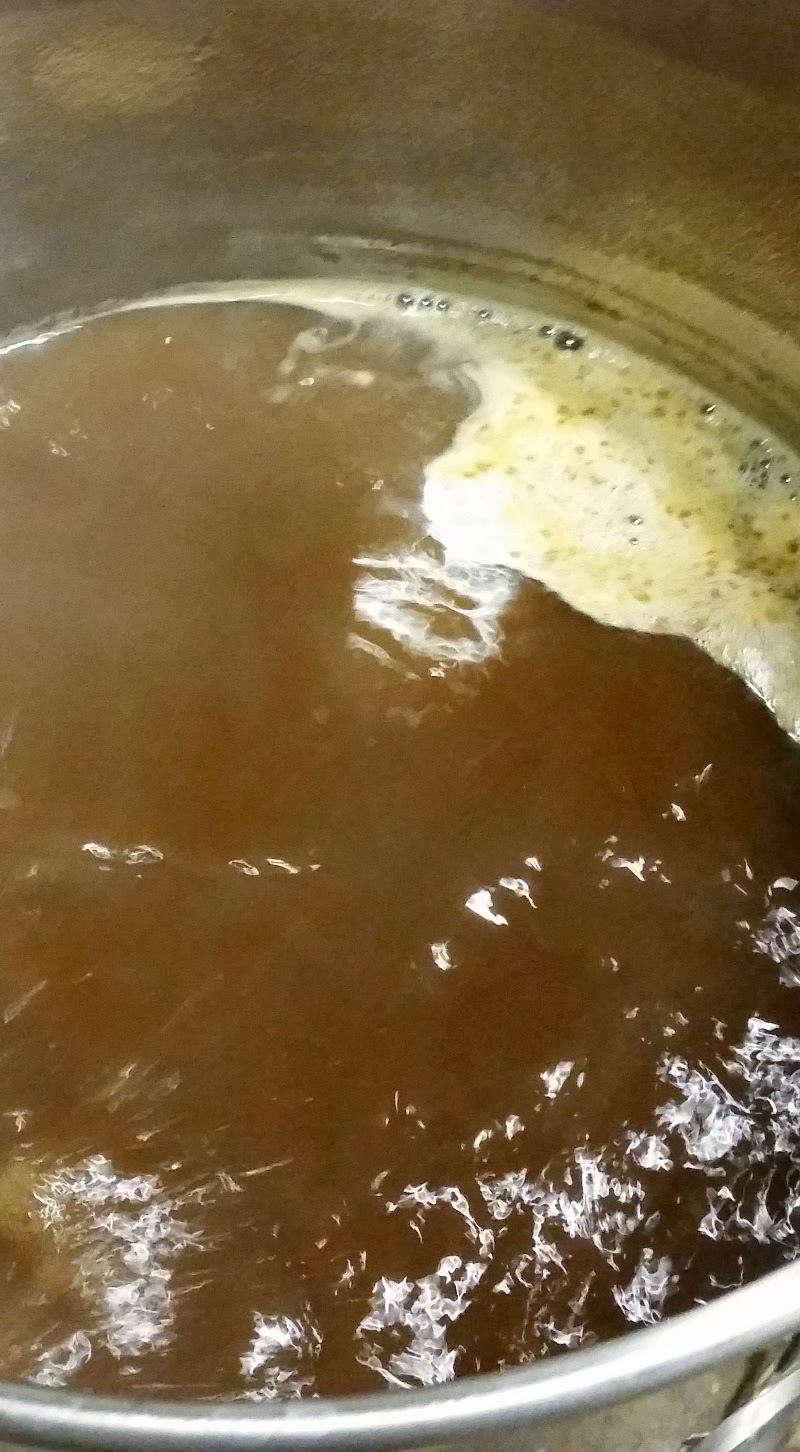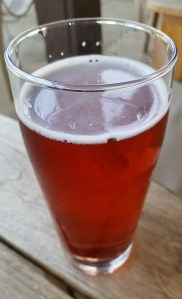
Raspberry Belgian

Our brew club is focusing on fruit beers for the April meeting, so I wanted to have something ready to go. Thumbing through the recently published Brew Your Own book, I saw a tasty-looking recipe for a clone of Funkwerks Raspberry Provincial.

One interesting thing about the BYO recipe is that it uses acidulated malt rather than kettle souring to achieve the sourness. I vacillated on which approach I would take, but in the end went for acidulated malt for simplicity.

I modified the recipe slightly for the hop bill, and also scaled it down from 5 gallons to 3 gallons. I figured I didn’t really want 5 gallons of a raspberry beer, tasty though it might be. I also will be using a home-made puree from frozen raspberries, rather than canned raspberry puree. The cans are huge, more than twice the volume I need for this recipe, and a bit expensive, so it didn’t make sense to waste the money buying a whole ton of extra raspberry. Per recommendations on the fruit puree company website, I upped the quantity of fruit by 12 percent a bit to account for all of the stuff that doesn’t make it into a typical puree can (seeds, etc.). The final modification was to go with a full-volume mash, to save a bit of time.

Raspberry Belgian

  • 2.5 lb. floor-malted Bohemian pilsner malt (Weyermann)
  • 1.25 lb. white wheat malt (Great Western Malting Co.)
  • 0.75 lb. acidulated malt (Weyermann), added to last 20 minutes of mash
  • 0.3 lb. flaked oats
  • 0.3 lb. flaked wheat
  • 0.25 lb. Carapils malt
  • 0.16 lb. rice hulls
  • 0.12 oz. Warrior hops (15.8% alpha), 60 minute boil
  • 0.20 oz. Willamette hops (5.1% alpha), 15 minute boil
  • 1 pkg. Belgian Wit Ale yeast (WLP400, White Labs), prepared in 0.5L starter
  • 17 oz. raspberry puree, added after 4 days of fermentation

Target Parameters

  • 155° mash, 60 minutes
  • 1.043 o.g., 1.011 f.g., 4.1% abv, 15 IBU, 3 SRM, 3 gallons into the fermenter

Procedure

  • I added 5.25 gallons of water at 170°, and let it cool down until it hit a temperature of 159.5°. Then, I mashed in with my grains (except for the acidulated malt) and hit a temperature of 155.4°.
  • After 40 minutes, the mash temperature was down to 150.4°. At this piont, I added the acidulated malt.
  • At the end of the 60 minute mash, the temperature was down to 148.7°. I vorlaufed and collected 4.2 gallons of wort with a gravity of 1.030. This equated to 64% efficiency. That is a fair bit below my normal efficiency in the upper 70s, but I figure that was probably due to the full volume mash, no sparge technique, as well as the high number of adjuncts.
  • I added hops per the schedule, over the course of a 60 minute boil.
  • After 60 minutes, I chilled to 70°, transferred to the fermenter while aerating, and pitched the yeast.
  • Starting gravity was 1.039, a bit below target. I think I’m okay with that, given how new this brew is to my experience. I find it interesting that, at least in a casual tasting, the flavor isn’t that prominently sour or tart. I wonder how that will come through in the finished beer?
  • I brewed this on 10 March 2017, and will be fermenting at 71°. On March 14, I will add the raspberry puree.

Red Oak Ale

Most of my beers recently have been fairly down-the-middle, aiming-for-a-particular-style kinds of brews. Most have turned out quite well, but I’m really feeling the need to do something a little wild and crazy. To heck with BJCP guidelines; let’s brew something interesting!

So, I searched around a bit, searching inspiration from various recipes and beer kits. Then, my eyes landed on the Fire in the Hole Ale kit from More Beer. It had everything…ample hops, ingredients I hadn’t used, a different yeast strain, and even some oak chips for good measure. I modified the ingredient list a bit for what was on hand in the brew store and in my hops stash, and came up with Red Oak Ale. It’s a bit of a kitchen sink beer–gotta get rid of those spare hops in odd quantities after all–but at the least it will be something different.

Red Oak Ale

  • 11 lbs. 2-row malt (Great Western Malting)
  • 1 lbs. 80° crystal malt
  • 1 lb. flaked wheat
  • 0.5 lb. Munich malt
  • 0.5 lb. rye malt
  • 0.15 lb. Carafa II malt
  • 1.15 oz. Magnum hops pellets (12.5% alpha), boil 60 minutes
  • 1 oz. Northern Brewer hops pellets (7.8% alpha), add at flame-out
  • 1 oz. Willamette hops pellets (5.2% alpha), add at flame-out
  • 0.59 oz. El Dorado hops pellets (12.6% alpha), add at flame-out
  • 0.41 oz. Magnum hops pellets (12.5% alpha), add at flame-out
  • 1 tsp. Irish moss, boil for 10 minutes
  • 2 pkg. Pacific Ale liquid yeast (WLP041), in 1.5 L starter prepared 24 hours in advance
  • 2 oz. Willamette hops pellets (5.5% alpha), 14 days dry hop
  • 2 oz. French oak chips, 7 days in secondary
Procedure
  • Because the yeast were ~2 months past prime, I used two vials and made a 1.5L starter (4 oz. DME to 1.5 L water). The starter was a little slow to krausen, but within ~16 hours it was satisfactorily foaming on the stir plate.
  • I mashed in with 4.5 gallons of water at 169°. This hit a mash temperature of 157°, which was down to 155.5° after 15 minutes and 153° after 40 minutes.
  • I added .36 gallons of water at 200°, let it sit for 10 minutes, vorlaufed, and collected 2.8 gallons of wort.
  • I added 3.15 gallons of water at 180°; the mash bed rose to 168°. After 10 minutes, I vorlaufed and collected the remainder of the wort.
  • All told, I collected 6.25 gallons of wort at 1.059 s.g. This works out to ~72% efficiency. A little lower than normal; I wonder if this is because I skipped the pH 5.2 stabilizer? Or maybe because it’s a fairly high gravity recipe with a lot of flaked ingredients?
  • Once reaching a boil, I added the Magnum hops bittering addition.
  • After 50 minutes, I added the Irish moss.
  • Over 60 minutes, I boiled the wort down to 5.5 gallons; at flame-out, I added the aroma hops. These are partly randomly chosen to accentuate earthy aromas, and partly chosen to use up spare stock.
  • I cooled the wort down to ~76°, and transferred to my fermenter while aerating with the Venturi pump. I pitched the yeast, and sealed everything up. I’ll be fermenting at 66°.
  • Starting gravity was 1.070, with ~4.75 gallons into the fermenter.
  • I plan to ferment for ~10 days, transfer to the keg, and dry-hop for 14 days. For the last 7 days, I’ll add the oak chips (boiled in water to sterilize them). Then, carbonation!
  • I brewed the beer on the evening of 15 May 2015. Within 8 hours, the beer had krausened nicely and was fermenting along at a good clip. I expect I’ll agitate it a bit in a few days (as some have recommended for WLP041) to help fermentation along.
A note on refractometer calibration
  • I’ve been noting that the specific gravity scale on my refractometer is not terribly reliable, at least relative to my hydrometer. For instance, the refractometer read 1.065 when the hydrometer read 1.070, and for another batch 1.049 and 1.052, respectively. I had initially assumed a 0.02 difference, but the relationship is not strictly 1:1. So, I gathered up readings from a few batches, and came up with this equation:
    • h=1.1037604457r-0.105597493
      • Where h = hydrometer reading and r = refractometer reading
  • I plan to investigate this a little more thoroughly to come up with a quick-and-easy conversion.