
My previous American Pale Ale was enjoyable for multiple reasons, and I was keen to brew another one in the same flavor space. Specifically, I love the “traditional” Americna craft versions of APA, with their citrus/pine hops and decent malt complexity.
Conveniently, the July/August 2023 issue of BYO featured a style profile on American Pale Ale by Gordon Strong, with a focus on more traditional versions of the style. I usually have good luck with Strong’s recipes, so decided to give this one a go. It had a more complex malt bill than I normally use, which seemed like an interesting experiment.
My version follows the spirit of Strong’s fairly closely, although I increased the pale malt and pilsner malt quantities very slightly in order to account for my system efficiency. I also went with Centennial and Columbus hops instead of the more complex original version (Cascade+Amarillo+Centennial), to use up some of my hops on-hand. Finally, I like the “cleaner” profile of American ale yeasts, so I used those instead of the suggested English yeasts.
American Pale Ale 2023
- 5.25 lb. Lamonta Pale American malt
- 4.25 lb. Viking Pilsner Zero malt
- 1 lb. Munich I malt (Weyermann)
- 0.5 lb. caramel malt 60L (Briess)
- 0.5 oz. Centennial hop pellets (8.1% alpha), 60 minute boil
- 0.5 tsp. BrewTanB, 10 minute boil
- 1 Whirlfloc tablet, 5 minute boil
- 0.5 oz. Centennial hop pellets (8.1% alpha), 5 minute boil
- 2 oz. Columbus LUPOMAX hop pellets (20.5% alpha), 15 minute whirlpool
- 1 pkg. American West Coast Ale (Lallemand BRY-97)
Target Parameters
- 1.050 s.g., 1.011 f.g., 5.1% abv, 38 IBU, 8 SRM
- Full volume mash, 152° for 60 minutes, 168° mash-out for 10 minutes
- Claremont tap water adjusted to hit target water parameters of 83 ppm Ca, 6 ppm Mg, 84 ppm Na, 108 ppm SO4, 120 ppm Cl, 20 ppm HCO3, RA=-46 ppm
Procedure
- I collected 7.5 gallons of tap water and added 6.25 mL of 88% lactic acid in order to neutralize the carbonates. Then, I heated the water to 156° before adding the crushed grains and 1.5 mL of 88% lactic acid for pH adjustment.
- I set the mash temperature to 152° for 60 minutes with recirculation, and then raised the temperature to 168° for 10 minutes. Finally, I removed the grains.
- In total, I collected 6.75 gallons of runnings with a gravity of 1.041, for 68% mash efficiency.
- While I brought the kettle to a boil, I added 4 g of gypsum to hit my water target.
- I added hops and finings per the schedule, boiling for a total of 60 minutes.
- Once I turned off the heat, I added the LUPOMAX Columbus hop pellets and recirculated for 15 minutes.
- Next, I chilled the wort to 85° before transferring to the fermenter for the final chill to 66°. This took around 5 hours. Finally, I pitched the yeast.
- Starting gravity was 1.049. I brewed the beer on 16 July 2023.
- Fermentation was vigorous, with the yeast overflowing into the airlock.
- I kegged the beer on 12 August 2023. Final gravity was 1.010, for 5.1% abv.
- The beer had dropped very clear by 24 August 2024.
Tasting
- Appearance
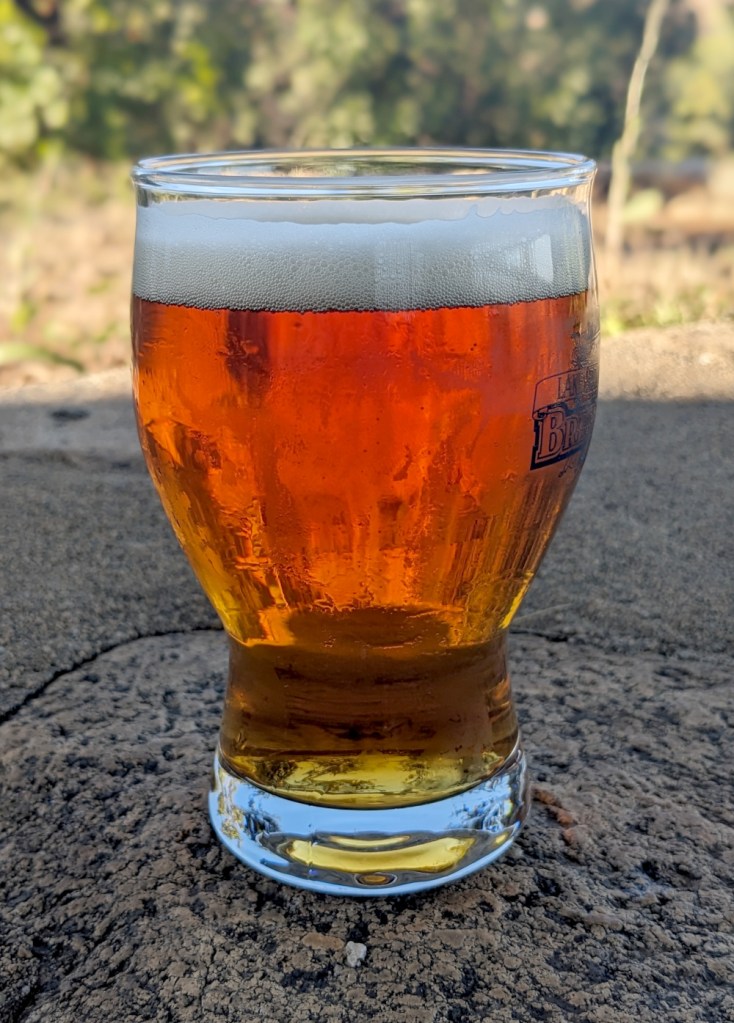
- Very clear and deep gold beer, which pours with a creamy and incredibly persistent ivory head. Just gorgeous!
- Aroma
- Bready malt and a touch of caramel, with piney hop notes. No significant yeast character.
- Flavor
- Moderately high bitterness, with extended bitter finish. The bitterness tends towards piney resin and citrus pith. The malt level is secondary; slightly bready and smooth.
- Mouthfeel
- Medium body, medium-low carbonation, slightly dry finish. Overall, this beer has a nice “round” palate.
- Would I Brew This Again?
- YES! This is a wonderful, classic American pale ale, of the sort you just can’t find anymore. Everything merges perfectly. The hop combo is awesome, and hits my sweet spot.
- Overall
- 10/10

 Andy's Brewing Blog