Mahajanga IPA

Although my tastes tilt towards lower alcohol (<5.5% abv) beers, I like something a bit stronger as a treat now and then. I’ve previously enjoyed Avery Brewing Brewing Company’s Maharaja, a 10% abv double (triple?) IPA, and found a clone recipe in Craft Beer for the Homebrewer. I modified the hops in my version, with Chinook in place of Columbus and Centennial on the boil. On the dry hop end of things, I was much closer to the original recipe.

The name is a play on Avery’s brew, honoring a city in northwestern Madagascar where I spent a bit of time during my fieldwork in that country.

Mahajanga IPA

  • 10.5 pounds 2-row malt (Great Western)
  • 7 oz. biscuit malt (Dingemans)
  • 6 oz. crystal 120 (Great Western)
  • 1 oz. Chinook whole hops (13.1% alpha), 60 minute boil
  • 1 oz. Chinook whole hops (13.1% alpha), 30 minute boil
  • 1 lb. pilsen light dry malt extract, 10 minute boil
  • 1 Whirlfloc tablet, 5 minute boil
  • 1 tsp. Fermax yeast nutrient, 5 minute boil
  • 2 oz. Centennial hop pellets (8.1% alpha), 10 minute whirlpool
  • 1 pkg. Safale American Ale yeast (US-05)
  • 1 oz. Centennial hop pellets (8.1% alpha), dry hop in keg
  • 1 oz. Chinook whole hops (13.1% alpha), dry hop in keg
  • 1 oz. Simcoe hop pellets (13.6% alpha), dry hop in keg

Target Parameters

  • 1.088 o.g., 1.013 f.g., 10% abv, 113 IBU, 13 SRM
  • Claremont tap water, with 2 g of gypsum added at end of boil
  • Full volume mash, 90 minutes at 147°, mash out to 168°, ferment at 65°

Procedure

  • I mashed in full volume with ~5 gallons of water at 156°, to hit a mash temperature of 147°. I added ~4 mL of 88% lactic acid to adjust the mash pH.
  • After a 90 minute mash, I brought it up to 168° and held for 10 minutes before removing the grains.
  • I hit around 57% mash efficiency, with ~1.058 gravity for 4 gallons of runnings. This is pretty low, so I knew I would have to add a pound of DME.
  • I brought the runnings to a boil, adding hops, DME, and kettle finings per the recipe.
  • I added 2 g of gypsum at the end of the boil.
  • Approximately 3.4 gallons of wort went into the fermenter. I gave this 30 seconds of pure O2, and then pitched the yeast. It fermented at ambient (~64°).
  • I brewed the beer on 25 November 2020, and it had a starting gravity of 1.077.
  • I kegged the beer on 19 December 2020, adding the dry hops at that time. Final gravity was 1.014, for 8.5% abv. I’m thrilled that the beer attenuated fairly well!
  • I removed the dry hops on 27 December 2020, to avoid overhopping or harshness.

Tasting

  • Appearance
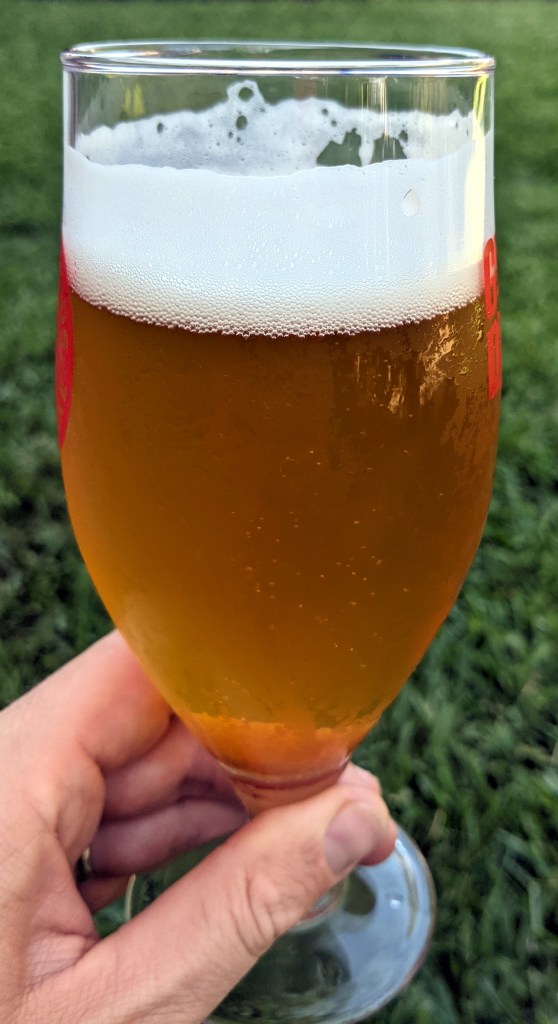
    • The beer has an orangish, burnished gold color; it’s slightly hazy, but not overly so. It pours with a persistent ivory head with really nice lacing.
  • Aroma
    • Slight caramel malt quality, and a prominent hop character of citrus rind and pine resin. There is no yeast character or hot alcohol character, which is awesome!
  • Flavor
    • The beer is quite bitter, with a grapefruit rind and pine resin character to the bitterness. The malt flavor is somewhat grainy, and relatively moderate compared to the hops. Yeast character is very clean. This is a hop-forward beer!
  • Mouthfeel
    • Medium-light body, with an off-dry finish and moderate carbonation.
  • Would I brew this again?
    • Overall, this is a great recipe that just requires some hop adjustment. The hop character is a bit one-dimensional, with the Chinook dominating everything else. If I rebrew this, I’ll go closer to the original recipe, and ditch Chinook for all but a small dry hop addition. The malt character is about perfect, with enough body to stand up to the hops. The yeast management was perfect on this one–it attenuated well, and the yeast character was clean rather than boozy or fusel-ridden.
  • Overall
    • 6/10

See See IPA

Classic American IPA time, again! The recipe is a modest modification of my Wildfire IPA from a few months back. The malts are fairly different (crystal 40 and biscuit, instead of crystal 30), and I used light Munich instead of dark Munich malt. The hopping schedule is also adjusted, to use the clean bitterness of Magnum and all of the flavor/aroma happening in the whirlpool and dry hop. So, I suppose it’s not really a complete rebrew, but a new recipe strongly inspired by the past recipe.

The name references the C-C dry hopping, with Cascade and Chinook whole cones right in the keg. And that, in turn, is a (bad) pun on “See See Rider,” a song that originated over 100 years ago and is known to many of us because of Elvis Presley.

See See IPA

  • 12 lb. 2-row brewer’s malt (Great Western)
  • 1 lb. Munich light malt (Chateau)
  • 0.5 lb. crystal 40 malt (Great Western)
  • 0.25 lb. biscuit malt (Dingemans)
  • 1.4 oz. Magnum hop pellets (13.2% alpha), 45 minute boil
  • 1 tsp. Fermax, 10 minute boil
  • 1 Whirlfloc tablet, 5 minute boil
  • 1 oz. Cascade whole hops (5.5% alpha), 15 minute whirlpool
  • 0.5 oz. Chinook whole hops (13.1% alpha), 15 minute whirlpool
  • 0.4 oz. Centennial hop pellets (9.3% alpha), 15 minute whirlpool
  • 1 pkg. American West Coast Ale yeast (Lallemand BRY-97)
  • 1.5 oz. Chinook whole hops (13.1% alpha), dry hop in keg
  • 1 oz. Cascade whole hops (5.5% alpha), dry hop in keg

Target Parameters

  • 1.057 s.g., 1.011 f.g., 6.1% abv, 7 SRM, 67 IBU
  • Infusion mash, 150°, full volume; 60 minute boil
  • Claremont water, with Campden tablet to remove chloramines.

Procedure

  • I heated 7.5 gallons of mash water to 157°, and added the grains to hit a target mash temperature of 150° for 60 minutes. I added 10 mL of 88% lactic acid to adjust pH.
  • After a 60 minute mash with recirculation, I ramped the temperature up to 168° over 10 minutes, and held it there for 10 minutes more. Next, I removed the grains and started heating to the boil.
  • I had approximately 6.5 gallons of runnings with a gravity of 1.050, for 64% mash efficiency.
  • I boiled for 60 minutes, adding hops and finings per the recipe.
  • After 60 minutes, I added the whirlpool hops and recirculated for 15 minutes, before continuing to chill.
  • I transferred the wort to the fermenter, and let it chill down to 68° in the fermentation chamber, before pitching the yeast.
  • I brewed this beer on 14 November 2020. Starting gravity was 1.055.
  • I kegged the beer on 1 December 2020, adding whole dry hops directly to the keg. I have the hop screen adapter for my Clear Beer Draft System, and thought I’d give it a try.
  • Final gravity was 1.012, for 5.7% abv. This batch came pretty close to hitting targets!

Tasting

  • Appearance
    • Deep gold and fairly clear, with just a smidge of haze at the time of this writing. It has cleared up surprisingly wel! The beer pours with a persistent but modest off-white head.
  • Aroma
    • There are definitely Chinook hops in this! Hop aroma is at the forefront, with a heavy spicy, herbal, and slightly dank character. I don’t pick up much for citrus notes, although I could be convinced there is grapefruit as part of it. There is a hint of caramel malt character, but that’s very much in the background. No yeast character is evident.
  • Flavor
    • Flavor is dominated by the hops, with the herbal and dank character mentioned above. Bitterness is moderately high, but not over the top; it’s about perfect for my tastes! The malt character is nicely supportive, and I like the malty, bready character alongside the trace of caramel. As with aroma, the yeast stays in the background, where it belongs!
  • Mouthfeel
    • Medium body, with a finish that is only slightly on the dry side. Carbonation is also on the moderate side, as is appropriate for the style.
  • Would I brew this again?
    • This general recipe is a great base for a classic northwestern IPA that highlights “old school” American hops. It’s pretty similar to its Wildfire IPA predecessor, and I think this overall recipe is likely to stay in my semi-regular rotation. Although it’s a bit out of vogue these days, the 2-row plus Munich base malt combo really hits the spot for me, and I think the crystal malt adds important character. My main complaint on this batch is that the Chinook hops are just a touch heavy. Their flavor plays well with everything else, but I prefer the more citrusy varieties like Cascade in my American IPAs.
  • Overall
    • 7/10

Wildfire IPA

I love IPAs, but I’m also a bit burnt out on brewing them. Often if I want this style, I’ll just buy a four- or six-pack, and that will satisfy my temporary craving. There are tons of really good (and many great) IPAs out there, but they start to blend together after awhile. The contemporary Citra/Mosaic/etc. versions are tasty, but honestly there’s not always a lot of difference from one to the next. I like the taste of many hazies at first, but get tired after half a glass. The theme in many contemporary IPAs is tropical fruit notes…which can be fun, but gets monotonous after awhile. Can you tell that I’m bored?

More and more, my flavor preferences come back to the “old school” IPAs. Pine, low-key citrus, and herbal notes are all something I crave. It’s hard to find these in many of the newer (and dominant) commercial IPAs! Even the local breweries that have otherwise excellent IPAs aren’t filling this flavor-space anymore. I can’t blame them, if this IPA variant doesn’t sell well. As a homebrewer, though, I can more easily tailor my beer to personal tastes!

I recently received a copy of the Homebrew Recipe Bible, which is a nicely written and expansive tome of recipes. Their recipe for Wildfire IPA immediately appealed to me. It had a hefty blend of old school and newish-hops, while also dodging Citra and Mosaic tropes. I made some small modifications for ingredients on-hand, but otherwise it’s as-written.

Wildfire IPA

  • 12.75 lbs. 2-row malt (Great Western)
  • 1.25 lbs. Dark Munich malt (Viking), 11 SRM
  • 0.75 Crystal 30 malt (Great Western)
  • 0.6 oz. Chinook hop pellets (13.0% alpha), 60 minute boil
  • 0.6 oz. Columbus/Tomahawk/Zeus (CTZ) hop pellets (15.5% alpha), 60 minute boil
  • 0.6 oz. Centennial hop pellets (9.3% alpha), 10 minute boil
  • 1 tsp. Fermax, 10 minute boil
  • 1 Whirlfloc tablet, 5 minute boil
  • 0.5 oz. Simcoe hop pellets (13.6% alpha), 5 minute boil
  • 1 oz. Amarillo hop pellets (7.7% alpha), 10 minute whirlpool
  • 1 oz. Cascade whole hops (~5.5% alpha), 10 minute whirlpool
  • 2 pkg. US-05 American ale dry yeast
  • 1 oz. Ahtanum hop pellets (6.0% alpha), dry hop in keg
  • 0.5 oz. Cascade Cryo-Hops (12.5% alpha), dry hop in keg

Target Parameters

  • Infusion mash to hit target of 150°, 60 minutes, batch sparge
  • 1.066 o.g., 1.013 f.g., 7.0% abv, 68 IBU, 7 SRM
  • Claremont tap water, with 1/2 tsp (~2 g) of gypsum added to boil kettle

Procedure

  • I mashed in with 5 gallons of water at 161.8°, to hit a mash temperature of 149.8°. I added 8 mL of 88% lactic acid to the mash, to adjust the pH.
  • After 60 minutes, I added 0.5 gallons of water at 185°, let sit for 10 minutes, vorlaufed, and collected the first runnings.
  • Next, I added 3.6 gallons of water at 185°, let it sit for 10 minutes, vorlaufed, and collected the second runnings.
  • In total, I collected 7.10 gallons of runnings with a gravity of 1.053, for 70% mash efficiency.
  • In the kettle, I added the 1/2 tsp. of gypsum and brought the mixture to a boil, adding hops per the recipe. After 60 minutes, I added the whirlpool hops and let it sit for 10 minutes before chilling.
  • As I transferred the wort to the fermenter, I noticed a lot of trub. This is due to the heavy hop load. Like, a lot of trub. For future recipes, I’ll need to adjust my kettle leavings (~1 gallon) to ensure I have a full 5 gallon batch.
  • I fermented the beer at 66°, following my brew day on 9 February 2020.
  • I kegged the beer on 29 February 2020. Starting gravity was 1.053, and went down to 1.008, for 7.7% abv. At the time of kegging, I added the dry hops in a weighted mesh sack.

Tasting

  • Appearance
    • Deep gold color and hazy but not cloudy, with a persistent and creamy white head.
  • Aroma
    • Pine, citrus pith, slight dankness
  • Flavor
    • Hop forward (as it should be), with a wonderful piney and bitter citrus character. Malt has a slight caramel, bready quality (likely from the Munich malt).
  • Mouthfeel
    • Moderately light body, off-dry, moderate carbonation.
  • Would I brew this again?
    • Yes! This is a very solid “traditional” West Coast IPA recipe, like something that would have been popular in the early 2000’s. I can’t think of much to change with this one…the only minor “ding” would be the slight haziness, but I’m pretty willing to tolerate that. Overall, it’s exactly the beer I wanted.
  • Overall
    • 9/10

Warrior’s IPA

IMG_20190216_213732

Transferring the wort into the fermenter

Today’s American IPAs are awesome–I love hops like Mosaic and Citra, to the point where I have been starting to hit fruity hop fatigue. The antidote? Make a beer with the most piney, resiny, harshest old school hops I could find.

Warrior’s IPA

  • 12 lb. 2-row malt (Rahr)
  • 1.5 lb. rye malt (Viking)
  • 0.5 lb. crystal 60 malt
  • 4.4 oz. crystal 80 malt
  • 4 oz. rice hulls
  • 1 oz. Warrior hop pellets (15.8% alpha), 60 minute boil
  • 1 Whirlfloc tablet, 10 minute boil
  • 2 oz. East Kent Goldings hop pellets (6.0% alpha), 5 minute boil
  • 1.5 oz. Cascade whole hops (~3.5% alpha), 5 minute whirlpool
  • 2 pkg. Safeale American Ale yeast (US-05)
  • 3 oz. Columbus hop pellets (14.0% alpha), dry hop in keg

Target Parameters

  • 60 minute infusion mash, 154°, no sparge
  • 1.065 o.g., 1.016 f.g., 6.5% abv, 61 IBU, 9 SRM
  • Claremont tap water, augmented with 1 tsp. gypsum

Procedure

  • I mashed in with 7.75 gallons of water at 162°, to hit a mash temperature of 151.7°. After 60 minutes, I vorlaufed and collected 5.75 gallons of runnings with a gravity of 1.055. This equated to a fairly miserable measured mash efficiency of 60%. (After this, I re-aligned my mill, in case that was the problem–I also figure the percentage of rye might be partly to blame, too).
  • I brought the runnings to a boil, adding hops and finings per the recipe. After 60 minutes, I turned off the heat, added the whirlpool hops, let sit for 5 minutes, and then chilled.
  • I transferred the beer to the fermenter, and fermented at 66°.
  • I brewed the beer on 16 February 2019, and kegged on 9 March 2019.
  • Starting gravity was 1.065, and final gravity was 1.011, for 7.2% abv.

Overall Impressions

I served this beer for a party, and it kicked before I could really get a good tasting. I didn’t even get a good picture! It was really popular with the hopheads, definitely delivering on the hop flavors and aromas that I wanted–rich, resiny, and piney. I felt like it needed a bit more time to mature, because the malt flavors weren’t quite there yet. Another few weeks might have helped. Oh well…I guess that means I have to brew this again!

The Ones That Got Away…

For a variety of reasons, I haven’t been able to blog about every single batch I brewed in 2018. Many of the ones that didn’t make the cut were repeat brewings of successful recipes. Because I’m not likely to get all of them with full blog posts at this stage, I’m giving myself semi-amnesty by listing them with brief comments.

  • Cerveza de Jamaica 1.1
    • This was a rebrew of the first version, which I really liked. Version 1.1 was modified very slightly to add a little more hibiscus and a little more orange peel, and the result was an incredibly tasty beer!
  • Double IPA / Hoppy Blonde Ale
    • This was an experiment with parti-gyle techniques, co-brewed with a friend. The double IPA ended up at around 7.8% abv, and was fairly tasty. The blonde ale rounded out at 4.6% abv, and was also pretty nice. The experiment was a lot of work on brew day, but a fun attempt.
  • Raspberry Belgian 2018
    • I rebrewed a house favorite recipe for a beer festival, and thus didn’t really get to taste the final result (sadly). Everything on the process was tasty, though, so I’ll be doing this one again too.
  • Bavarica Session IPA
    • This one was pretty disastrous! The flavors clashed horribly (never again will I use Munich malt in a session IPA), and I dumped most of the batch.
  • Grab Bag IPA
    • Basically to use up a bunch of ingredients. Nothing memorable here, although it was pretty drinkable.
  • Grapefruit Wheat Ale
    • I don’t have many notes on this, other than that I used Amoretti grapefruit craft puree for some of the flavoring.