Laurasia IPA Updates

On February 16, I transferred the Laurasia IPA over to the secondary fermenter. At that time, the gravity was 1.029; the taste was clean, a faint fruity aroma before CO2 outgases, and a very mellow hoppiness. I was surprised at the relatively high gravity and the apparently slow fermentation–perhaps due to underoxygenation? Or maybe due to the yeast strain?

I sampled the beer again on February 25, to find the gravity at 1.020. This calculates out to 6.5% abv. In a few days, I will add the Simcoe hops for a few days of dry-hopping.

Rainy Day IPA 1.2

One of my very favorite recipes so far has been the “Rainy Day IPA” – brewed back in 2010 and 2011.  I modified things a little based on what my local brew shop had (Centennial instead of Cascade, and White Labs rather than Wyeast), but otherwise it’s basically the same as before.

Ingredients for Rainy Day IPA 1.2

  • 10 oz. 20° crystal malt
  • 1 lb. 60° crystal malt
  • 3 lbs. golden light dry malt extract
  • 3 lbs. sparkling amber dry malt extract
  • 2 oz. Centennial hops pellets (11.4% alpha acid; 4.1% beta acid) for bittering
  • 1 oz. Centennial hops pellets (11.4% alpha acid; 4.1% beta acid) for aroma
  • 1.1 oz. Cascade hops pellets for dry hopping
  • 1 oz. Centennial hops pellets for dry hopping
  • 1 tsp. Irish moss
  • White Labs California Ale Yeast WLP001

Steps

  • Steep crystal malt in 3 gallons of water at 158° for 60 minutes. Sparge with 0.625 gallons at roughly the same temperature, for a total pre-boil volume of 3.625 gallons.
  • Heat mixture to boiling, turn off heat. Add dry malt extract. Heat to boiling, add bittering hops.
  • Boil for 45 minutes, add Irish moss.
  • Boil for an additional 12 minutes, add aroma hops.
  • Boil for an additional 3 minutes, for a total of 60 minutes.
  • Cool using cooling coil. Top up to ~4.75 gallons using cold tap water, and pitch yeast at 70° F.
  • Starting gravity was 1.060 at 70° F.

Based on calculations in BeerSmith, the starting gravity was spot-on. The recipe has an estimated bitterness of 63 IBUs, color of 8.5 SRM, and estimated final abv of 5.3%.

As in previous versions of this beer, I plan to dry-hop after transferring to the secondary fermenter in one week. More updates will be posted as appropriate.

Rainy Day IPA 1.1 Update

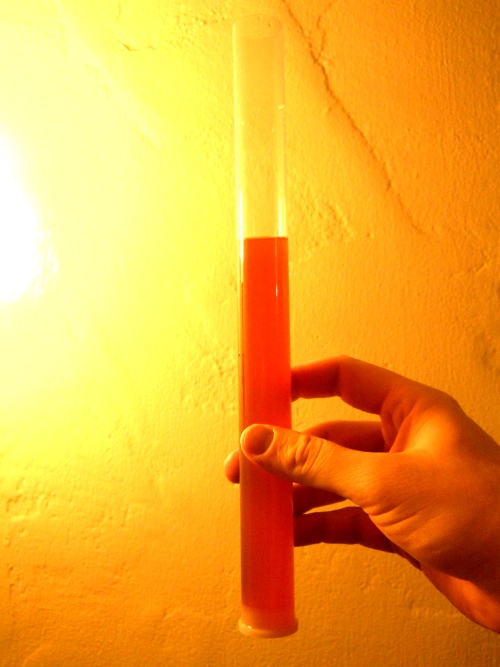
Tonight (7 January 2011, six days after brew day) I transferred my latest batch of the Rainy Day IPA to the secondary fermenter, a 6-gallon glass carboy. Right now, the s.g. reads at 1.018 (down from 1.060 at the beginning, for 5.5% alcohol by volume). Once the transfer was complete, I added 2 oz. of Cascade hops pellets (5.4% alpha acid) in a nylon mesh bag, for dry hopping.

The hops pellets were left over from last year (I bought them in March 2010), and were kept triple-bagged in the freezer. I’ve read that some deterioration is natural after opening (these were opened last year, as it was a 6 oz. bag), but that pellets are pretty hardy in the long-term because the interior is protected from oxygen.

In another minor technique change, I decanted the beer from the primary into the secondary fermenter through a hose attached to the spigot at the bottom of the primary, rather than through siphoning. I had been a little hesitant to try this, because I was worried about getting too much of the trub and other nastiness off of the bottom. But, it doesn’t seem like any more than normal got carried along (especially when I tipped the bucket back a bit for the initial part of the siphoning). I’ll definitely be trying this again, as it was much easier.

The beer is reasonably bitter, but not quite as much so as I remember from last time. The color and flavor is nice otherwise, so it will be interesting to see how the dry hopping augments the taste and aroma.
Rainy Day IPA 1.1

The Rainy Day IPA that I brewed last March turned out to be one of the best beers I’ve made yet. It had everything that a good IPA should have – clarity, lots of IBUs, and a good hoppy aroma. The use of pelletized hops for the dry hopping phase seemed to be the key to getting good hop aroma retention after bottling. Perhaps the increased surface area is behind this? In that case, I wonder if finely chopping up whole hops would have the same effect.

At any rate, I decided to make another batch of this, with just a few minor tweaks (primarily related to the ingredients I had on hand). Except as outlined below, everything is the same as before. So, I’ll only list the changes.

Differences From the Last Batch

  • More by accident than anything, I ended up steeping the grains at a slightly higher temperature (~170°) for the steeping phase.
  • I used 3 oz. of whole Cascade hops for the bittering (instead of a combo of whole hops and pellets added at various points during the boiling), boiled for the entire 60 minutes.
  • I added 1 tsp. of Irish moss at the 45 minute mark (done before, but not explicitly noted on the recipe).
  • I added 1 oz. of whole Sterling hops 57 minutes into the boil, and boiled these for 3 minutes, for aroma (instead of 1 oz. of Cascade pellets for 5 minutes).
  • After cooling with the cooling coil and topping up to 4.5 gallons, the starting gravity was 1.060 (on 1 January 2011). This contrasts with a starting gravity of 1.056 for the last batch.
  • I pitched the yeast, and it has been fermenting at 68°-72° degrees for the past few days.

I can’t wait to see how it will turn out, and if I can replicate the good points of the last batch. I plan to dry-hop it once again with some Cascade pellets left over from last year. They probably won’t be as fresh, but I do want to use them up.