Re-Envisioning the American Homebrewers Association

logo for the American Homebrewers Association

The big news of late was that the American Homebrewers Association is being spun off from the Brewers Association as a stand-alone non-profit! I view this as nearly entirely a net good; the BA has increasingly treated the AHA as an unwanted guest during the past few years, and I don’t think the combination was making much sense anymore. The AHA had a reduced voice in BA governance, Homebrew Con was vastly scaled back (and cancelled for this year), AHA membership numbers were down from their peak, and there is a general sense that the hobby is ebbing versus the heady days of the early 2010’s. The vibe I got from the forums, likely at least in part from the aforementioned decisions, was that the AHA wasn’t able to provide a level of engagement or service that made it a compelling need for homebrew hobbyists.

There was some initial discussion at the AHA forum and a bit on Reddit, but overall this news has had surprisingly minimal chatter in the spaces I normally frequent. Exceptions include an optimistic blog post from Beervana, and an overview from Stan Hieronymus on Appellation Beer’s Monday links (including some important context and history that I haven’t seen much mentioned in the various AHA hagiographies). The AHA also posted some Q&A’s, which provide additional information.

AHA has asked for members to comment on what we’re hoping for in the newly independent organization, as well as a suggested vision statement. I have submitted my thoughts there, but in the meanwhile I also wanted to post them here in case they are useful for others.

Please provide comments to consider on the future planning of the AHA.”
pint glass of amber beer
Photo by Pixabay on Pexels.com
  • AHA will need to decide its target membership — is it just for the USA? USA+Canada+Mexico? Worldwide? AHA can’t be everything to everyone, which on the one hand will be a disappointment for some, but on the other hand is necessary for organizational focus.
  • On the topic of target membership, who is that? There is sometimes an implicit assumption that brewers are homeowners who work as engineers, and that’s not helpful. I really like the way that AHA has made things like 1 gallon stovetop batches more visible lately; let’s keep that energy going! (but don’t forget those making the 5 gallon batches)
  • Similarly, what sort of fermentations does AHA support? Beer is the obvious core. Does mead stay as a part of this? They seem to be linked at least at an organizational level. Does it make sense going forward? My gut on this is “yes,” but I think it’s a question that needs to be asked! Are the legal frameworks for mead different from those for beer? I would argue against distilling becoming a core of the organization — it’s a very different process, community, and legal framework — and wine also doesn’t make much sense.
  • I would love to see AHA target issues that matter to homebrewers. A big one in my book is that competitions like the NHC require many entrants to ship their entries in a semi-clandestine manner that contravenes shipping company policies! The NHC website itself states, “Shipments brought directly through UPS or FedEx may get denied, as shipping alcohol is against policy. Indicate ‘glassware’ or ‘samples’ if asked to provide such information.” Similar instructions are given for customs guidance for international entries. Maybe I’m too much of a rules follower, but this is inviting future disaster, and I don’t think the NHC should feel great about asking its entrants to lie, especially in a public forum. I’ll just be blunt and say that this is a stupid thing for a non-profit to do.
  • With the disconnect between AHA and BA, I foresee a need for AHA to step up and advocate for homebrewers in brewery spaces–especially holding club meetings or organizing general events. Although laws vary from locality to locality, a “toolkit” for homebrewers or homebrewing clubs who want to meet up and share homebrew at public spaces would be very helpful. I think it could also be a potential collaboration between AHA and BA to communicate to the commercial industry about this ongoing desire from hobbyists.
  • What is the future of Zymurgy? Personally, I like having a physical magazine; I spend too much time with electronic devices as it is, and I enjoy sitting with a homebrew and reading it cover-to-cover. I also recognize that print media is a mixed bag at best these days, not everyone shares my love of printed publications, and even the membership may be split on this. That said, I think any decisions should include both current membership (which I expect skews conservative in wanting a printed publication) and potential membership (which may or may not share those views).
  • Who owns Zymurgy? That is, where does the copyright for the back issues reside? There is a ton of great content in there, and I am hoping it won’t be locked up by BA. If this hasn’t been outlined yet, it needs to be done ASAP — don’t hope for a future resolution. What other IP will matter?
  • Consider apps carefully. If well designed, they are useful; but do we need another app for homebrewers? They are expensive to build and maintain, so I would somewhat argue against them.
  • The recipe archive at the AHA website and in Zymurgy is valuable. I’ve seen a lot of people say, “But there are so many recipes online! I don’t need that archive.” So many of the recipes online are awful. I trust the recipes that the AHA produces, because they have at least minimal vetting.
  • How does AHA confront the currently changing relationship of society with alcohol? I think it will continue to evolve and ebb and flow, but I do think we need to meet all potential hobbyists where they are.
  • Community is important. I really love the AHA forum, and find it (for my needs) to be the kind of community I want overall. That said, I really would like to see the AHA help with informal meetups. Not everyone is a club member, or wants to be a club member, or can be a club member, and not everyone has capacity to attend a national conference. But, many folks (me included) would welcome a chance to meet up, swap brews, and hang out with fellow homebrewers. Years ago, AHA used to sponsor rally days. Could something like that return?
  • What will membership guidelines / rules be? Most member-based organizations will have some kind of code of conduct / member expectations / etc. I don’t feel great about “litmus tests” for members, but I think we’ll want a process for removing someone who is acting counter to the aims of AHA or who grossly violates the norms of a healthy organization.
  • Members need to feel like we have voices. This hasn’t happened with the BA in recent years. I recognize that there are many potentially competing interests, but yet another survey isn’t necessarily going to be what we need. There should, eventually, be a clear process for volunteering and participating in governance of the AHA. It can’t just be those with the cash to pay to attend HomebrewCon (or its equivalent) every year; that’s only partially representative of the membership.
  • Speaking of fundraising, I suspect there is going to be heavy lifting to change the philanthropic nature of our homebrewing community. We are conditioned to “doing it for charity” at brew fests and such, but haven’t yet been primed to think of the AHA as one of those charitable options. Fortunately or unfortunately, many (most?) will think that the buck stops with their annual membership dues. We’re going to have to change that thinking. AHA will need to make a compelling case for why members should donate above and beyond their annual dues. Part of that is making initiatives that all members feel they might benefit from. That does not mean there shouldn’t be more focused initiatives (I support those!), but we need to have options. Don’t forget unrestricted donations, either! It doesn’t have to be an immediate donation — estate gifts are equally important. For that matter, make estate planning an option for members!
  • What other hobbyist groups are important to link up with? If we have similar needs or potentially at least small overlaps in audience, that could be mutually beneficial. Can we learn something from other hobbyist organizations? Have they noted trends or opportunities that might parallel needs for the AHA?
  • Speaking from a position of ignorance, what is the plan for after the BA? At least initial statements have said that connections for GABF, etc., will remain. What happens when BA says “no more” on that? (perhaps they have promised otherwise, but let’s be realistic here; if it’s not in writing, it’s going away) Would that scenario have a major impact? Or minor impact? Are there members who sign up just for GABF early access, and who would disappear if that disappeared?
  • For those who have followed things, there is a general distrust and dissatisfaction with the BA. I suspect that is part of why AHA is going independent. BUT…we probably want to have some form of working relationship, at some level. What will that look like?
glass of pale yellow beer in front of dark green plants
Photo by Michelle Riach on Pexels.com

Suggested Vision Statement for the AHA

  • “Relax, Don’t Worry, Have a Homebrew.” (only partly kidding)
  • “The American Homebrewers Association will create a community of home brewers of beer and beer enthusiasts, promoting the fun of the hobby, building opportunities for sharing knowledge and camaraderie, and advocating for homebrewers of all locations, backgrounds, and brewing approaches.”
Day 3 of Homebrew Con

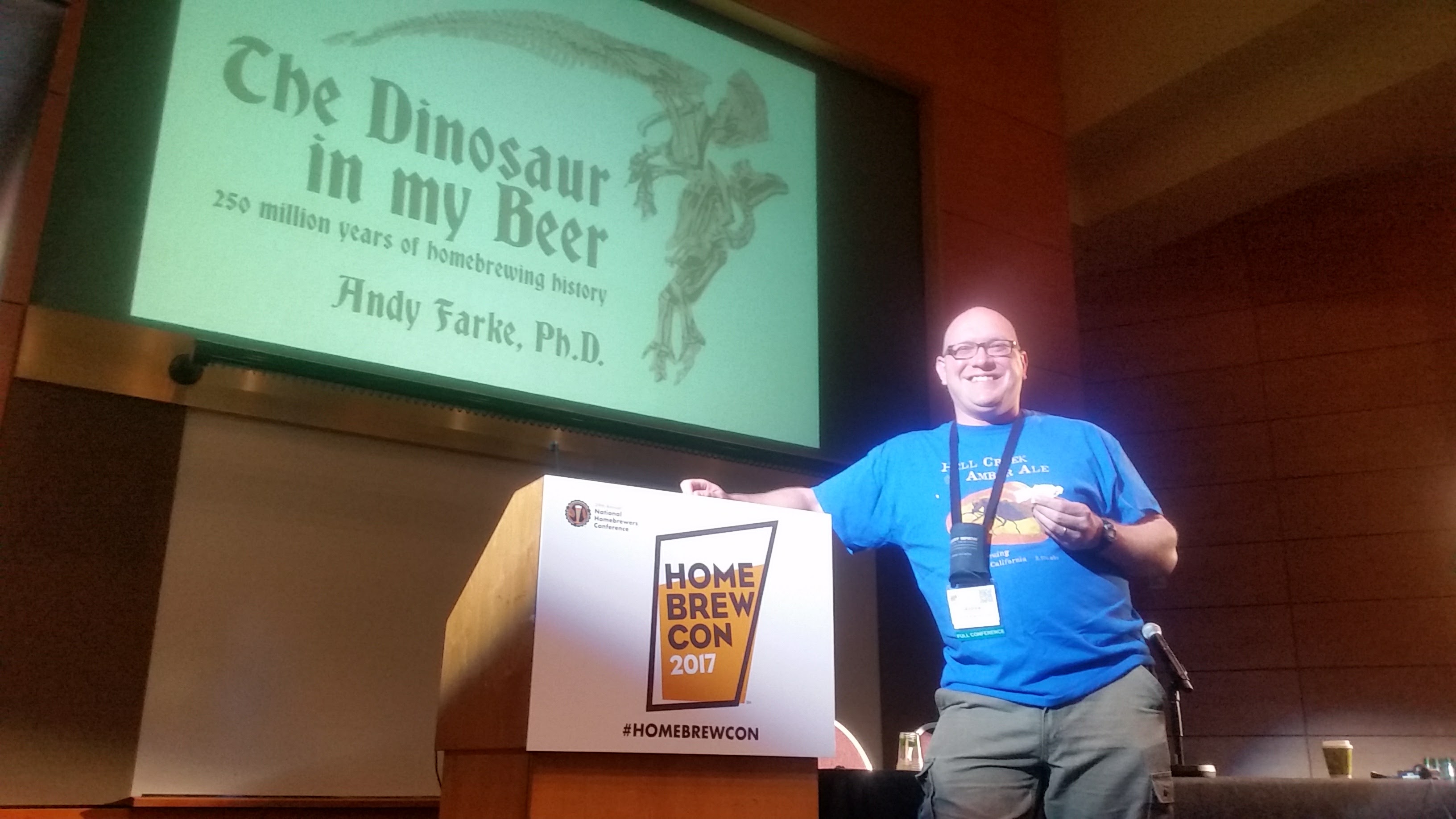
This was the big day! I started off the morning with my seminar, “The Dinosaur in Your Homebrew.” For being at 9 am on the morning after club night, I had a fairly decent crowd–around 50 to 75 people. Martin Brungard introduced me, augmented by a special guest appearance from T. rex. (quite a surprise!) Then, I rolled into the content of the talk. Overall, I felt like it went pretty well. There are a few things I would tweak (I forget to mention some of the technical updates on names for formations contributing to the Burton aquifer), but I am always my own worst critic! I was pleased to see a few “big names” in the audience, and equally pleased to chat with a few folks afterwards on topics related to my presentation.

20170617_084933

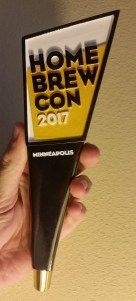
The speaker gift was pretty cool–a custom tap handle with the conference logo! The construction is nice and solid, and it will have an honored place in my tap room. Overall, my experience as a speaker was pretty positive, and I would absolutely do it again. AHA had good communication prior to the event, and made sure to have one or two people from the organization at my talk to touch base before and after the event. I particularly should acknowledge Dave Carpenter for encouraging me to submit a proposal…I did it somewhat on a whim and just before the deadline, without really any expectation of it flying, so this was a nice bonus experience!

20170617_182454Later that morning, I hit Annie Johnson’s seminar on Czech pilsners. She had lots of great content, and is a tremendously engaging and entertaining speaker. It was cool to see how “casual” the big breweries are about things like sanitation (at least for their “reference batches”), and it was a good reminder that excellent results can come from even what we homebrewers might consider appallingly primitive technique. It was also nice treat to sample some of her homebrewed Czech pilsner…it’s not often I get to try beer from well-known elite homebrewers!
I grabbed some food at the convention center, and then headed over to the scheduled online forum meetup. This was probably the only real aspect of the conference I found a bit disappointing. There wasn’t really any signage for particular forums, and so I wandered around and met one or two people, but there was never really a big group of folks like I’ve usually seen at similar events elsewhere. Ah well! Hopefully this will get changed in future years (I mentioned it in my conference feedback survey).

One of my fellow members of the Horse Thief Brewers Association (Steve J.) had an entry in the final round for the National Homebrew Competition, so I joined him at the award ceremony. I have to say I was dreading it slightly–there were a lot of awards to go through, and I was expecting an unending slog of announcements and marches to the stage. What a pleasant surprise! They kept things moving smoothly and efficiently, while still allowing each winner who was present to have their moment in the spotlight. The whole thing was finished in barely an hour–not bad at all! Although my fellow club member didn’t win, I did know the winner for the Double IPA category (Randy Sauter of Rapid City, South Dakota). It was pretty darned cool to hear his name announced, and to congratulate him afterwards. I was lucky enough to be able to sample the beer, and it was truly gold medal worthy!

The “Knockout Party” was immediately afterward, with ample homebrew available (including all of the extra bottles left over from the competition). I was interested to taste these…and surprised as to how many showed signs of aging or other flaws. This is a strong argument for rebrewing and/or careful handling prior to the competition! One fellow I met via Twitter was kind enough to share some fun sours from his collection; yet another connection I wouldn’t have made without social media.

Overall, this was a fun and educational conference. I enjoyed meeting lots of other homebrewers, learning some new techniques and tricks, and having the opportunity to present on some topics important to me. Another Homebrew Con is definitely in the cards for the future!

Day 2 of Homebrew Con

I intended to write up something after Club Night, but got back late and wanted to practice my talk one last time, so this is only getting written two days late!

In any case, Day 2 of Homebrew Con piled on some more informative seminars and product demos as well as more tasty beer.

The seminar highlight for me was on oxidation, presented by Robert Hall and Andy Mitchell. They even had samples of fresh and oxidized Fat Tire to compare, which was a really nice demo. They had tips on how to expand your oxidation vocabulary (it’s not just old cardboard or sherry; it also can manifest as honey or applesauce, among others), which was pretty useful. For those who want to experience oxidation directly, a simple demo is to take two bottles of a commercial beer (lighter beer, such as light lager or amber ale preferable), and then uncap one and leave it open for a few seconds before recapping. Leave the uncapped one at room temperature for a few days, and then compare! You should be able to pick up oxidation notes fairly easily. Finally, Andy presented some really cool data on oxidation in home bottling. He works at Fat Tire, and so has access to some sweet dissolved oxygen measuring equipment. He filled bottles from the tap using a hose without CO2 purge (like filling a growler) and a beer gun with CO2 purge, and compared their DO levels to those coming off the commercial bottle line. Surprisingly (to me), the “home-filled” bottles (even those using a tap hose!) often (but not always) had less dissolved oxygen than those from the commercial beer line! Capping on foam is probably critical. The bottle-line beers had more consistent DO levels, though, whereas the “home-filled” ones had a more variable spread of data points. Lots to think about!

20170616_120634

Briess Malt Steeping Demo

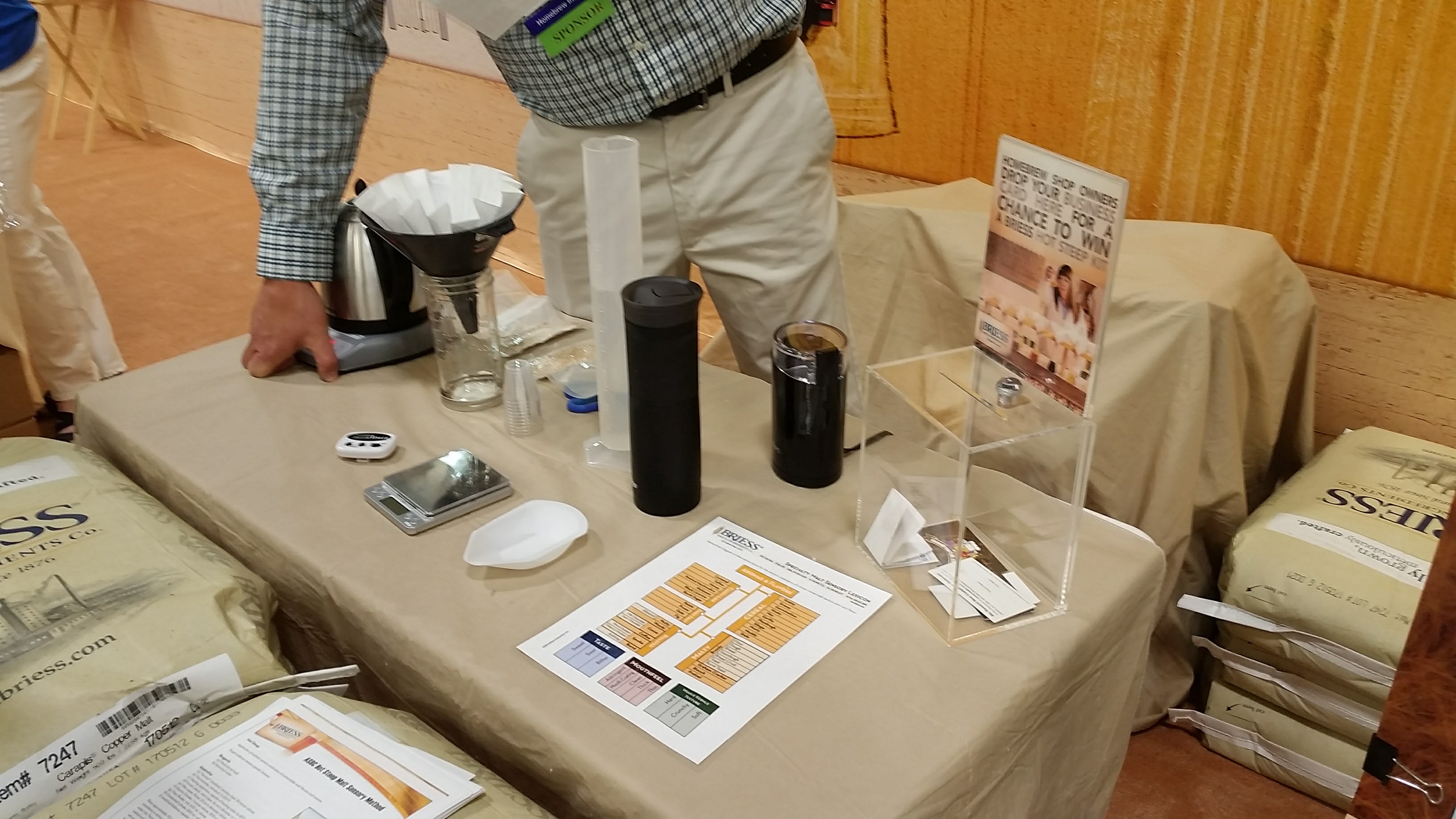
I also saw a nice demo of the ASBC hot steep malt sensory method at the Briess booth (see picture above). I had read about this recently, and it seems like a nice way to quickly, cheaply, and easily compare malt flavor and aroma in a homebrewing environment. A PDF of their handout is available here.

In the social club, one of the local homebrewers (from the Primary Fermenters club) had a really tasty lemongrass ginger wit–it was wonderfully balanced in flavor and quite refreshing! It ranked among the more interesting and enjoyable homebrews I sampled at the conference.

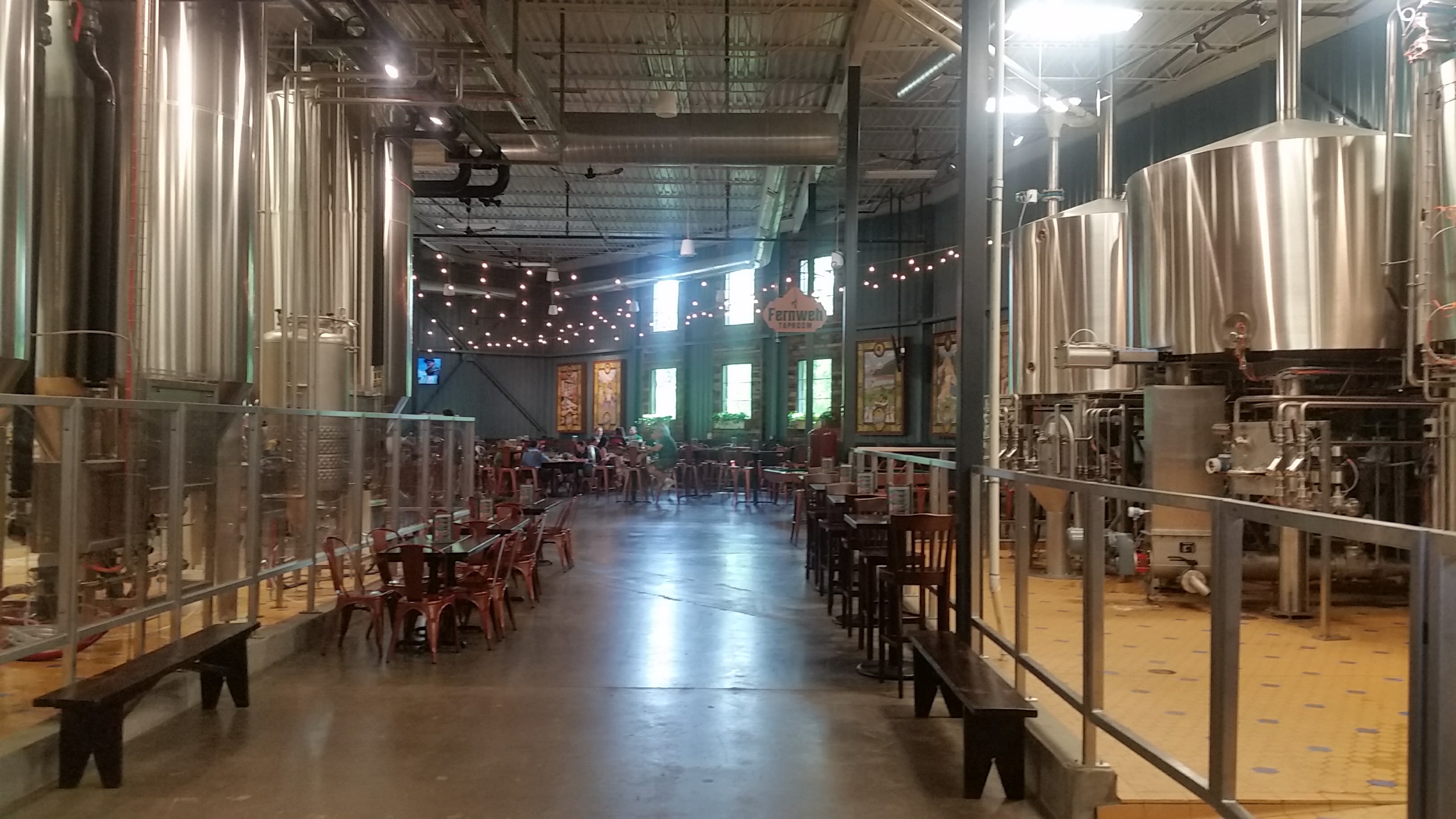
For lunch, a few of us made our way out to the Utepils Brewery. It’s a really pretty space, with gorgeous tilework below the fermenters, and even more gorgeous beer on tap. I had another glass of their delightful Czech pilsner, as well as their weizen. A food truck had pasties in several delicious varieties, which complimented the beers nicely.

20170616_135032

Inside the Utepils brewery and tap room

The day culminated with the world-famous Club Night! Numerous local and regional clubs had their best stuff on tap, with some really fun themes. I enjoyed a Big Lebowski-themed booth, as well as the Game of Thrones booth–featuring taps run through an ice wall! This being the Upper Midwest, many excellent meads were available.

Back to the room, and one more run-through of my talk to close out the day…

Tomorrow I’ll post a summary of the conferences final day!

Quick Takes from Day 1 of Homebrew Con 2017

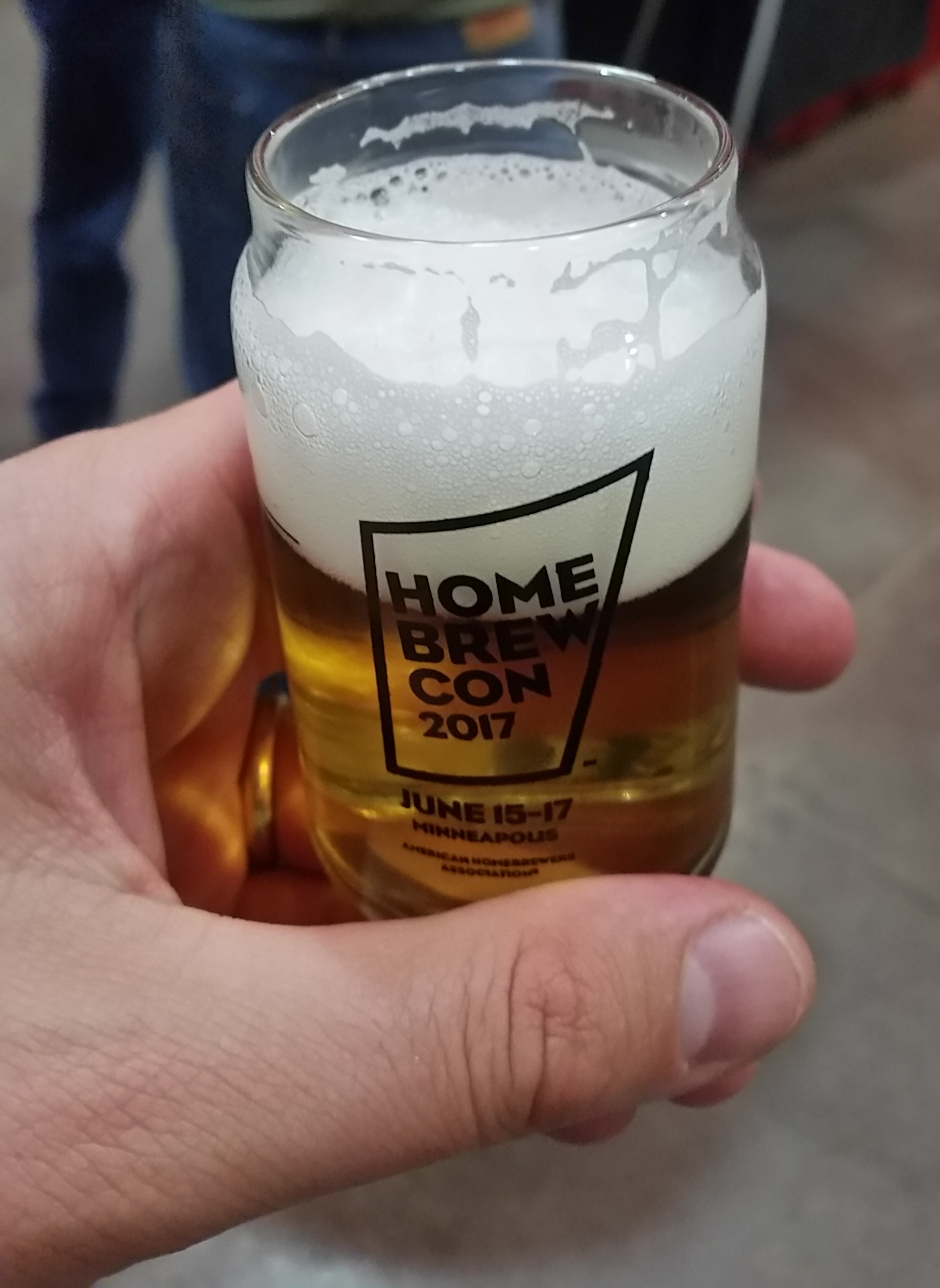
I’m here in the Twin Cities! I’ve got my swag bag, got my conference beers, and got my taster glass. I sat through three seminars, wandered the exhibit hall, and enjoyed the kick-off night.

Highlights of the day…

  • The best presentation/seminar of the day was from Axel Jany of Weyermann Malting…he talked about some of their specialty malts, and gave a very interesting and entertaining presentation on some of the recent developments from Weyermann. The talk nicely addressed philosophies behind recipe development, as well as providing some good technical info on their malts. As a bonus, I managed to snag a (free) 10 lb. bag of their new Barke Pilsner Malt, made from a “rare” barley variety. This will definitely be going into a future beer!
  • I got to sing along with Denny Conn (and a gazillion other homebrewers) as Denny played the ukelele. Fun!
  • Lots of free stuff–including some experimental hops from Yakima’s 2014 crop. They’re a bit old, I suppose, but look to be nicely packed and good candidates for a future pale ale.
  • Omar Ansari of Surly Brewing gave a fun keynote on his history with brewing.
  • There were a ton of great beers at the kickoff event tonight. I of course enjoyed sampling beers from Funkwerks (including the original Raspberry Provincial, which I had only sampled in my own cloned form–following my session, I realized that I gotta up the acid in this, and thus go with a dedicated kettle sour rather than trying to use acid malt as in the clone recipe).
  • Bald Man Brewing had a great logo that looked kinda like me (bald men unite!)…and some interesting beers!
  • For me, the absolute highlight of beers this evening were those from Utepils. They had an altbier and kolsch that were absolutely on point. And their Bohemian pilsner…divine! I will be dreaming about this beer. The malt, hops, water, and yeast combined into perhaps the most perfect example of this beer that I have ever sampled in my life!

20170615_220013

The Bohemian Pilsner from Utepils…wow, what a beer!

Homebrew Con Seminar: The Dinosaur in My Beer!

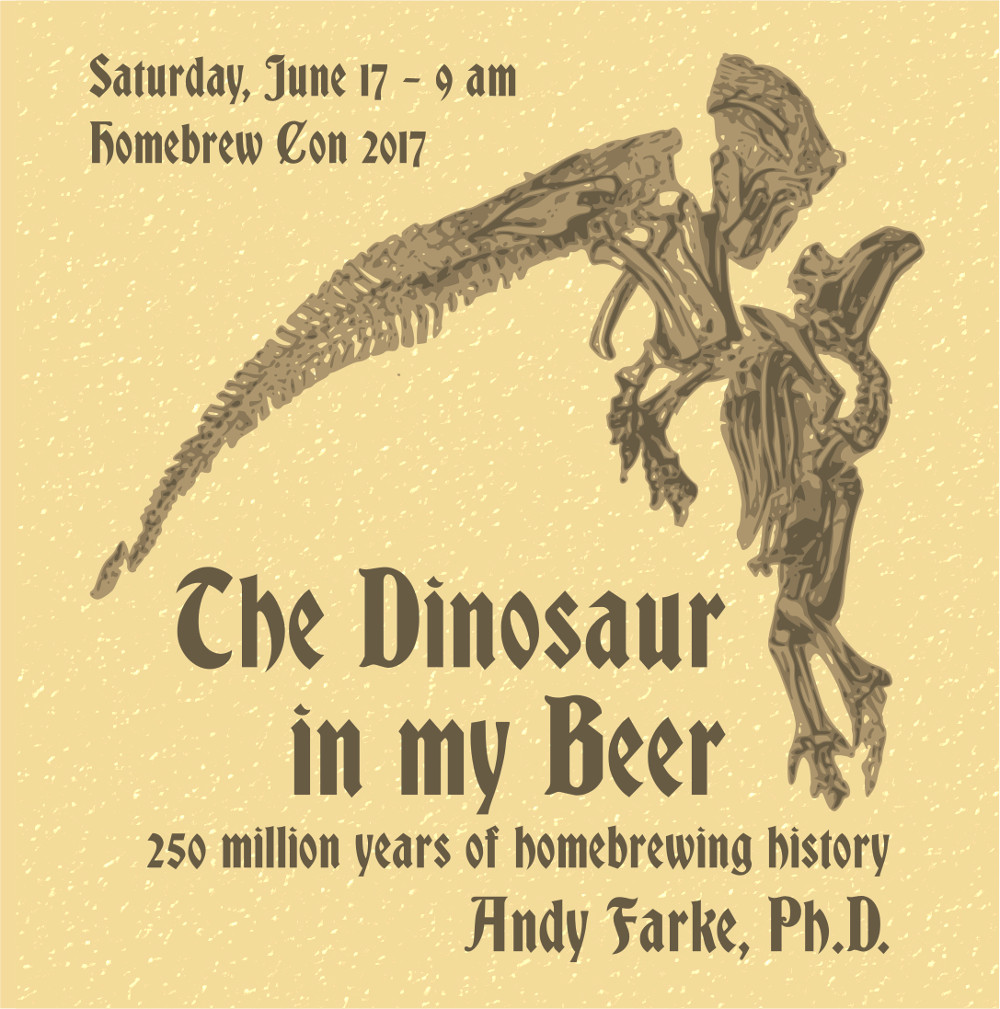
blog_imageI’m excited to be on the schedule for Homebrew Con (aka National Homebrewers Conference) in Minneapolis next month! If you’re at the event, come see my seminar: The Dinosaur in My Beer: 250 Million Years of Homebrewing History.

Of course, most beer enthusiasts are familiar with the overall arc of brewing lore (and some of you could probably recite it in your sleep). Things got rolling in the ancient Middle East around the same time that cereal grains were domesticated, hops made it into the equation during the Middle Ages, and craft breweries got their game going during the late 20th century. This is all interesting–and indeed, numerous books and articles have been published on the topic. Yet, virtually every treatment of brewing that I’ve read neglects the much deeper history of all of our brewing ingredients. We wouldn’t have Burton water without events that happened during the dawn of the age of the dinosaurs. We wouldn’t have hops without an evolutionary innovation in plants more than 120 million years ago. And oddly enough, the production of barley malt led to the discovery of many important fossils.

My seminar (around 45 minutes long, with time for questions) ties together threads that stretch deep into our planet’s history. You’ll gain a better appreciation for just how densely beer and beer ingredients are interwoven with the evolution of life–beer ain’t just a cultural phenomenon! I’ve given versions of this talk at Claremont Craft Ales as well as the Arizona Museum of Natural History, but the Homebrew Con version will have lots of new content, plenty of cool images, and interesting anecdotes. I guarantee that you’ll learn something you didn’t know before!

My seminar starts at 9 am on Saturday, June 17, in Auditorium 1. And even if you can’t make the seminar, I’d love to chat about beer, brewing, and paleontology. Hope to see you in Minnesota!

And for an extra bonus…I’m bringing a replica of the skull from Aquilops americanus, the little dinosaur that inspired Eagle Face Oatmeal Stout, as seen in a recent issue of Zymurgy magazine. If you’ve ever wanted to get your selfie with a dinosaur, now is your chance!

[Image info: The dinosaur skeleton in the logo is modified from a 19th century rendering of Iguanodon by Gustave Lavalette. Also of note: the fossil was found in a part of Belgium that is purportedly home territory for saisons! This fact inspired one of my first attempts at the style.]