Refractometer Calibration

This is more of a sticky note for myself than anything…I did a bunch of calculations and regressions based on my brewery setup and my refractometer, and established the following equation to convert from the specific gravity reading on my refractometer to a close approximation of specific gravity from my hydrometer:

h=1.070743072r-0.070823104
where h is the hydrometer reading (s.g.) and r is the refractometer reading (s.g.)

This equation seems to do a very good job of matching my previous values.

Note: I estimated a Brix correction factor of 1.0645 for my system.

Red Oak Ale

Most of my beers recently have been fairly down-the-middle, aiming-for-a-particular-style kinds of brews. Most have turned out quite well, but I’m really feeling the need to do something a little wild and crazy. To heck with BJCP guidelines; let’s brew something interesting!

So, I searched around a bit, searching inspiration from various recipes and beer kits. Then, my eyes landed on the Fire in the Hole Ale kit from More Beer. It had everything…ample hops, ingredients I hadn’t used, a different yeast strain, and even some oak chips for good measure. I modified the ingredient list a bit for what was on hand in the brew store and in my hops stash, and came up with Red Oak Ale. It’s a bit of a kitchen sink beer–gotta get rid of those spare hops in odd quantities after all–but at the least it will be something different.

Red Oak Ale

  • 11 lbs. 2-row malt (Great Western Malting)
  • 1 lbs. 80° crystal malt
  • 1 lb. flaked wheat
  • 0.5 lb. Munich malt
  • 0.5 lb. rye malt
  • 0.15 lb. Carafa II malt
  • 1.15 oz. Magnum hops pellets (12.5% alpha), boil 60 minutes
  • 1 oz. Northern Brewer hops pellets (7.8% alpha), add at flame-out
  • 1 oz. Willamette hops pellets (5.2% alpha), add at flame-out
  • 0.59 oz. El Dorado hops pellets (12.6% alpha), add at flame-out
  • 0.41 oz. Magnum hops pellets (12.5% alpha), add at flame-out
  • 1 tsp. Irish moss, boil for 10 minutes
  • 2 pkg. Pacific Ale liquid yeast (WLP041), in 1.5 L starter prepared 24 hours in advance
  • 2 oz. Willamette hops pellets (5.5% alpha), 14 days dry hop
  • 2 oz. French oak chips, 7 days in secondary
Procedure
  • Because the yeast were ~2 months past prime, I used two vials and made a 1.5L starter (4 oz. DME to 1.5 L water). The starter was a little slow to krausen, but within ~16 hours it was satisfactorily foaming on the stir plate.
  • I mashed in with 4.5 gallons of water at 169°. This hit a mash temperature of 157°, which was down to 155.5° after 15 minutes and 153° after 40 minutes.
  • I added .36 gallons of water at 200°, let it sit for 10 minutes, vorlaufed, and collected 2.8 gallons of wort.
  • I added 3.15 gallons of water at 180°; the mash bed rose to 168°. After 10 minutes, I vorlaufed and collected the remainder of the wort.
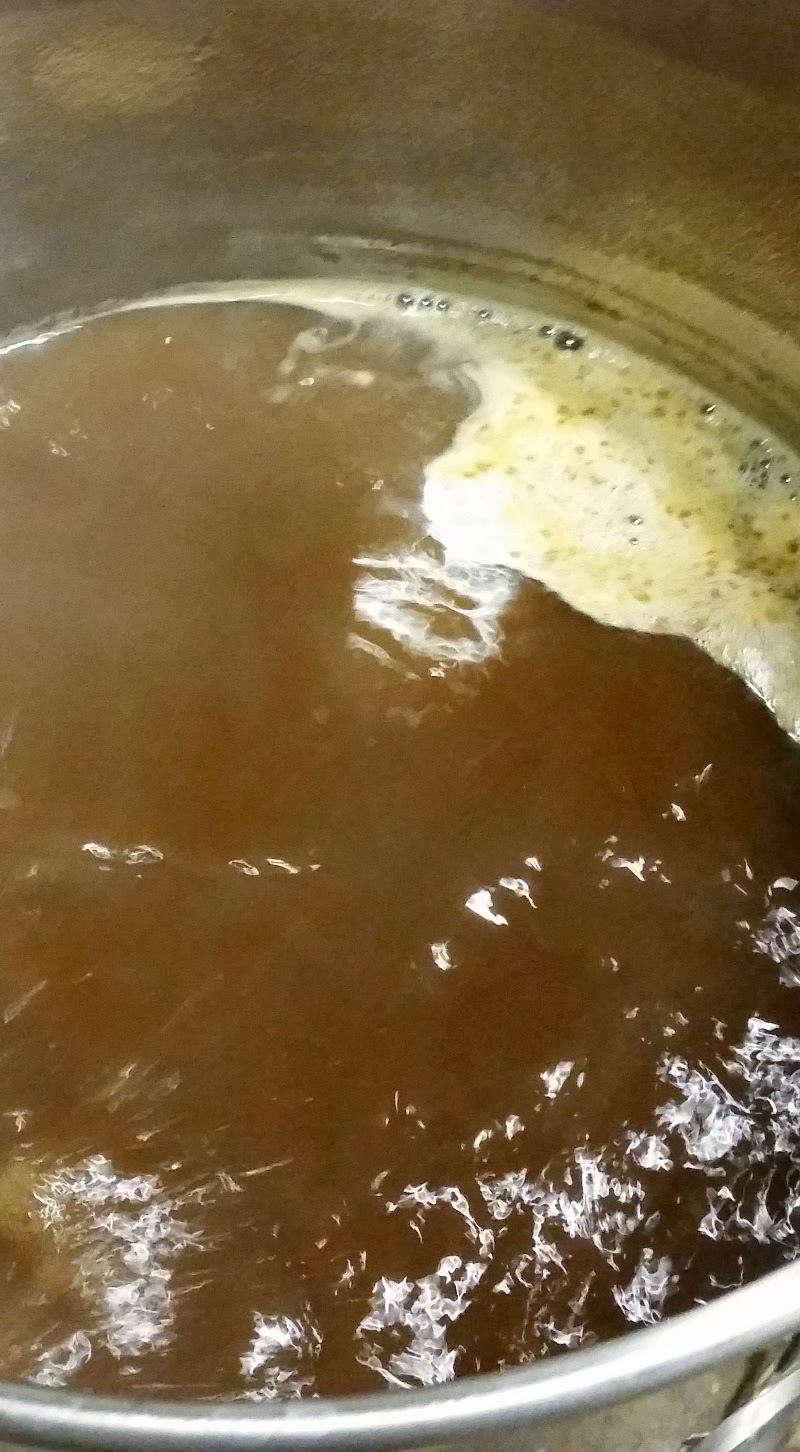
  • All told, I collected 6.25 gallons of wort at 1.059 s.g. This works out to ~72% efficiency. A little lower than normal; I wonder if this is because I skipped the pH 5.2 stabilizer? Or maybe because it’s a fairly high gravity recipe with a lot of flaked ingredients?
  • Once reaching a boil, I added the Magnum hops bittering addition.
  • After 50 minutes, I added the Irish moss.
  • Over 60 minutes, I boiled the wort down to 5.5 gallons; at flame-out, I added the aroma hops. These are partly randomly chosen to accentuate earthy aromas, and partly chosen to use up spare stock.
  • I cooled the wort down to ~76°, and transferred to my fermenter while aerating with the Venturi pump. I pitched the yeast, and sealed everything up. I’ll be fermenting at 66°.
  • Starting gravity was 1.070, with ~4.75 gallons into the fermenter.
  • I plan to ferment for ~10 days, transfer to the keg, and dry-hop for 14 days. For the last 7 days, I’ll add the oak chips (boiled in water to sterilize them). Then, carbonation!
  • I brewed the beer on the evening of 15 May 2015. Within 8 hours, the beer had krausened nicely and was fermenting along at a good clip. I expect I’ll agitate it a bit in a few days (as some have recommended for WLP041) to help fermentation along.
A note on refractometer calibration
  • I’ve been noting that the specific gravity scale on my refractometer is not terribly reliable, at least relative to my hydrometer. For instance, the refractometer read 1.065 when the hydrometer read 1.070, and for another batch 1.049 and 1.052, respectively. I had initially assumed a 0.02 difference, but the relationship is not strictly 1:1. So, I gathered up readings from a few batches, and came up with this equation:
    • h=1.1037604457r-0.105597493
      • Where h = hydrometer reading and r = refractometer reading
  • I plan to investigate this a little more thoroughly to come up with a quick-and-easy conversion. 

Summer Blonde Ale 1.1

Thanks to a few recent gatherings at which I have served my homebrew, my three kegs all kicked this past week. That means…more brewing! My Pannotia White IPA just came online this weekend (and wow is it tasty!), but I’ve got two taps to fill as soon as possible. So, I’m fulfilling this “obligation” first with a blonde ale and second with a “wild and crazy brew” (more on that one in a subsequent post).

For tonight’s brew, I elected to rebrew a blonde ale that I did last summer. That one turned out pretty nicely, and the warm summer months are approaching, so on we go again! I made a few minor modifications, partly to account for the efficiency of my equipment but also to use up some hops I had on-hand. Also, I switched yeast strains from US-05 to WLP001.

Summer Blonde Ale 1.1

  • 9 lbs. 2-row malt (Great Western Malting Co.)
  • 8 oz. 15° crystal malt
  • 1.10 oz. Willamette hops pellets (5.2% alpha, 3.7% beta), 60 minute boil
  • 1 tsp. Irish moss (10 minute boil)
  • 1 pkg. California Ale Yeast (WLP001, prepared in 1L starter)
Procedure
  • I mashed in with 3.1 gallons of water at 160°. The temperature stabilized at 151°, was down to 148° after 35 minutes, and was down to 147° after 55 minutes.
  • After 60 minutes, I added 1.25 gallons of water at 160° to the mash, let the mash sit for 10 minutes, vorlaufed, and collected 3.3 gallons of wort.
  • Then, I added 3.1 gallons of water at 185°, which raised the mash bed to 168°. I let it sit for 10 minutes and vorlaufed.
  • All told, I collected 6.6 gallons of wort with a gravity of 1.039. This works out to 74% mash efficiency.
  • Once the wort came to a boil, I added the hops and boiled the mixture for 60 minutes. 10 minutes prior to flame-out, I added the Irish moss.
  • After removing the kettle from the heat, I chilled the wort down to 70° and transferred all to the fermenter (aerating with the Venturi pump). I pitched the starter (which I had put together five days previous; cold-crashed for two days, and decanted spent wort leaving all but ~0.5 L yeast slurry).
  • My starting gravity is 1.047, with 5 gallons of wort into the fermenter. I’ll be fermenting at 65°.

Beer Tasting: Lab Bench Pale Ale

My Lab Bench Pale Ale has turned into a pretty nice brew; I did a formal tasting at the end of April (as well as a run-through with my homebrew club). Results are below.

  • The Basics
    • Starting gravity = 1.047; final gravity = 1.010; abv = 4.8%. Estimated IBU = 38
  • Aroma
    • Crisp and hoppy, as expected for a dry-hopped beer. A touch citrusy.
  • Appearance
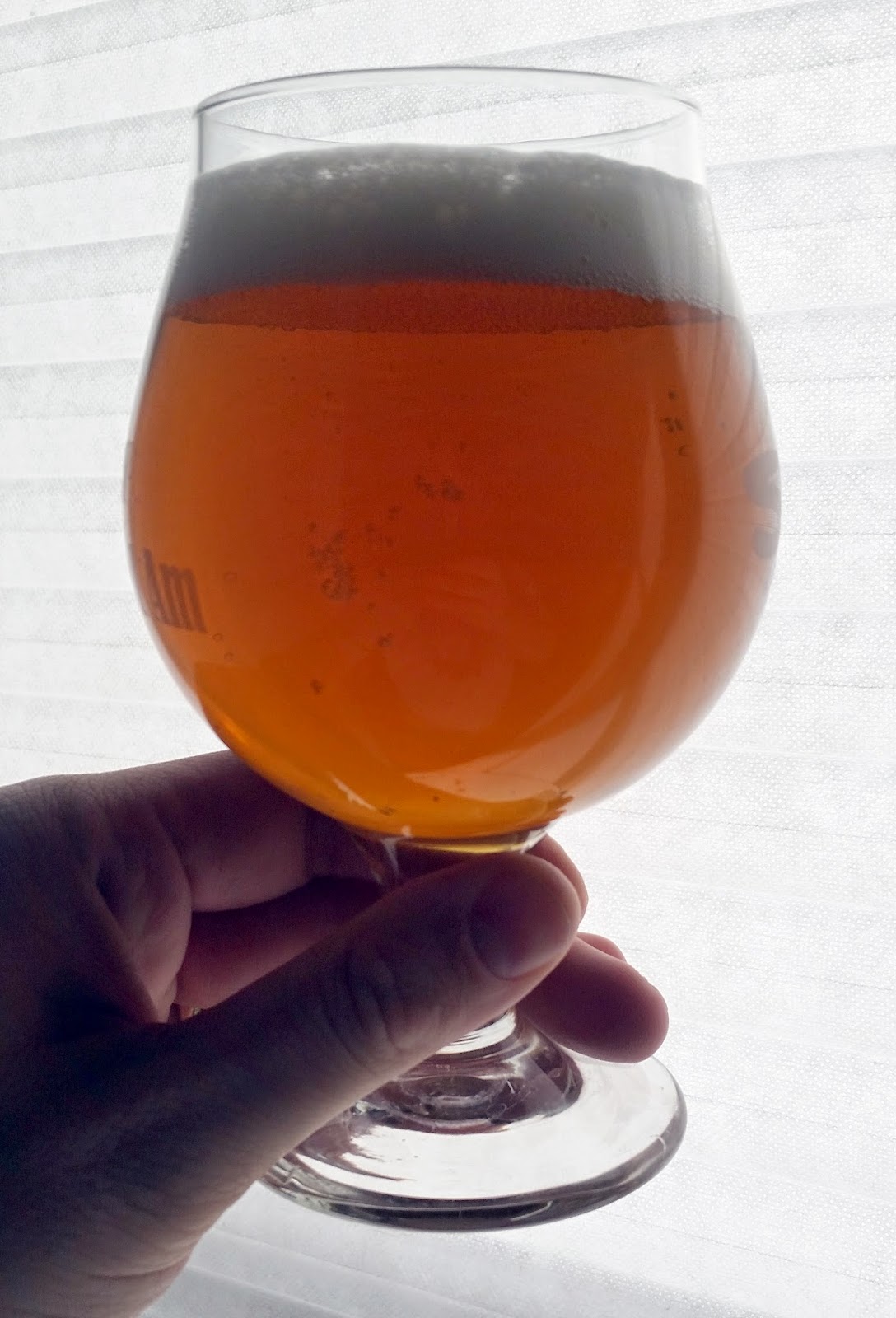
    • Clear, rich golden hue; off-white head with fine bubbles and excellent persistance.
  • Flavor
    • Hop-forward, only a hint of maltiness. Smooth bitterness on the finish.
  • Mouthfeel
    • A touch thin (but not overly so); excellent carbonation for the style
  • Would I brew this again?
    • I think so, but with a little modification. My mash temperature seems to have been about right, but perhaps a little carapils would help with body. I am pretty pleased with how the first wort hopping seems to have created a smooth bitterness for the beer. The aroma is also just about perfect!
  • Overall rating
    • 7.5/10

Beer Tasting: Live Long & Porter

In mid-April, roughly two months after brewing, I did a formal tasting of Live Long & Porter.

  • The Basics
    • Starting gravity = 1.050; final gravity =  1.016; abv = 4.5%; estimated IBU = 30
  • Aroma
    • Coffee and a hint of chocolate. Nice.
  • Appearance
    • Creamy, tan-colored head, very persistent. Dark brown beer with good clarity.
  • Flavor
    • Chocolate, coffee; some maltiness behind it. Finish a little more bitter than perhaps I like.
  • Mouthfeel
    • Carbonation is good, but body is pretty weak.
  • Would I brew this again?
    • Probably not in this form; it’s a good enough beer (and the aroma absolutely nails what I love in a porter), but the body is too thin, which really detracts from the overall beer. For the next iteration, I would probably add a bit more carapils and crystal malt, as well as perhaps some flaked oats.
  • Overall rating: 
    • 5.5/10