Fake Tire Amber Ale 1.1

My first batch of Fake Tire Amber Ale is amazing. In my (non-humble) opinion, it’s probably one of the best recipes I’ve done yet. A genuinely biscuit-ish flavor (just like Fat Tire!), clear appearance, and nice head combine deliciously. The downside of this is that I have finished most of the batch. Watching my dwindling supply, I decided to take action and brew up another batch today. I made some small changes, largely on account of what was available for ingredients.

Changes from first batch
Nothing major – instead of whole hops, I used hops pellets. This presumably has the effect of upping the hops utilization a little bit, but according to BeerSmith it’s not a major amount. 21.9 IBU’s versus 24.1 IBU’s for the whole and pellet hops, respectively. Given the margin of error in IBU measurements for hops, as well as the margin of error inherent to home brewing, I decided not to mess with the recipe.

The only other major variation was that I topped up to just a hair under 5 gallons, with a starting gravity of 1.050. I presume the larger amount of water was needed to get close to last time’s gravity (1.051) because I decanted a little more of my wort into the brewing bucket than I did previously.

In any case, I will be curious to see how this one turns out!

Socks-Off IPA

This IPA is so-named because it will “knock your socks off”, between the hops and the potential alcohol content. My wonderful spouse got me a “home-brewed” IPA kit from our local small brew store (i.e., one thrown together by the owner) for Christmas, so I decided to brew it up tonight, with a few minor modifications for what ingredients I had on hand and wanted to use up.

Socks-Off IPA

  • 0.66 lbs. Munich malt
  • 3.75 lbs. Pale Malt, Maris Otter
  • 3.3 lbs. Briess Amber Liquid Malt Extract
  • 3.3 lbs. Briess Golden Light Liquid Malt Extract
  • 3.3 lbs. Briess Bavarian Wheat Liquid Malt Extract
  • 3 oz. Cascade hops (whole)
  • 1 oz. Hallertauer hops (whole)
  • 1 oz. Sterling hops (whole)
  • 1 oz. Saaz hops (whole)
  • 1 tsp. Irish moss
  • 2 oz. Northern Brewer hops (pellets)
  • 1 package London Ale III yeast (Wyeast Labs #1318)

Steps

  • I heated 3 gallons of tap water to 154° F, and steeped the grains for one hour (between 154° and 156° F). Then, I sparged the grains with one gallon of water at roughly 160° F, to bring the total volume to 4 gallons (or just a little over).
  • After bringing the mixture to a boil, I turned off the heat and added the liquid malt extracts. Then, I heated the kettle back to a boil (again) and added the whole Cascade, Hallertauer, and Sterling hops.
  • After 45 minutes, I added 1 tsp. of Irish moss.
  • After 55 minutes, I added the Saaz hops.
  • After 60 minutes, I removed all of the hops and chilled the wort. Once it had gotten down to an appropriate temperature, I added the wort to my fermenter. The volume at this point was 3.5 gallons, so I topped up with cold tap water to roughly 5.25 gallons.
  • The temperature of the wort was 76° F. I pitched the yeast, sealed the lid, and let the yeast do its thing.
  • Starting gravity was 1.072 – right at the upper of end of the American IPA style. BeerSmith estimates the bitterness at 59.3 IBU, color at 11.7 SRM, and ABV at 7.1%. 
  • In a week or so, I’ll move the mixture over to my secondary fermenter, and add the Northern Brewer pellets for dry-hopping.

In other news, I’ve started using the BeerSmith software to formulate my recipes. The excellent reputation of the program is quite deserved – it’s flexible and friendly to extract brewers as well as all-grain brewers.

Amber Ale, Vanilla Porter, and Irish Stout Updates

A few updates condensed into one post. . .

Vanilla Voay Porter
This experimental brew (recipe, update, and update) was bottled on Saturday, December 10. This gave the vanilla extract/pods around two weeks in the secondary fermenter – the chopped and scraped pods floated on the surface, and many of the tiny seeds were everywhere in the fermenter.

Final gravity was 1.016, from a starting gravity of 1.056, giving 5.25% alcohol by volume. Final yield was just over 5 gallons of beer(!), with 30 12-oz. bottles, 12 1-pt. bottles, and 4 22-oz. bottles.

Four days after bottling, I was impatient and opened one of the small bottles. Carbonation was still very slight, but the flavor and aroma were delicious. A faint vanilla scent, but a rich vanilla flavor (not overpowering though, thankfully). I’m very excited to see how this is going to mature over the next few weeks!

Fake Tire Amber Ale
One week after brewing, I transferred my Fat Tire clone into the secondary fermenter. The aroma was very estery, with a strong banana component. I might have been a little worried, except the yeast strain is known to do this. The gravity was around 1.014 at this point, and hadn’t changed at all when I racked the beer into the bottling bucket today (December 17, 19 days after brewing). This gives 5% alcohol by volume, a little less than the 5.2% of real Fat Tire.

From this batch, I got 20 12-oz. bottles, 14 1-pt. bottles, and 1 22-oz. bottle. Next time I might try scaling the recipe up a bit.

When preparing to bottle, I’m very impressed by the absolute clarity of the beer. This bodes well for the final product (which I’ll probably test in a week’s time – Christmas Eve!).

Coopers Irish Stout
The Irish stout I made a few weeks ago has matured into a wonderfully drinkable brew. The head is a nice caramel-color, and isn’t overwhelming, but certainly sticks around the edges of the glass after pouring. The flavor has a hint of malt and is dominated by the roasted grains, and has a nice dry finish (as expected for the style). As I noted at the time of bottling, it’s not a very exciting beer (middle of the road flavor – good but no really unusual highlights), but it’s certainly a solid one.

This kit was cheap, fast, easy, and tasty – perfect for the beginning or end of the brew season when I just want to crank something out! I’ll admit that it’s not quite as much fun as doing everything from scratch, but then again that’s also a welcome break sometimes. I expect I’ll probably do this kit (or a similar one) again!

Irish stout, in the glass

Fake Tire Amber Ale

I’ve always liked Fat Tire (from New Belgium Brewing), and have previously found clone recipes to be a good way to experiment with various styles and flavors. Thus, tonight’s brew was modeled after two different Fat Tire recipes I found kicking around the Internet. These are followed reasonably closely, except for the hops – I used what I had on hand, so this will almost certainly modify the resultant into something Fat Tire-ish rather than a spot-on Fat Tire (if such a thing is genuinely possible). Thus, I’m calling this batch. . .

Fake Tire

  • 5 pounds plain extra-light DME
  • 0.5 lb Munich light malt
  • 0.5 lb Carapils malt
  • 0.5 lb biscuit malt
  • 0.5 lb crystal malt (20° Lovibond)
  • 0.5 lb crystal malt (40° Lovibond)
  • 1.0 oz chocolate malt
  • 1.0 oz. Cascade hops (60 minutes boil)
  • 1.0 oz. Mt. Hood hops (5 minutes boil)
  • 1 tsp. Irish moss (15 minutes boil)
  • Wyeast 1272 (American Ale II)

Steps

  • I heated 3.5 gallons of tap water to 154° F (usually hovering around 156° to 158°), and steeped the grains for 45 minutes. Then, I sparged the grains with 0.5 gallons of tap water at 154°.
  • After bringing the mixture to a boil, I turned off the heat and added the malt. I brought it back to a boil, and threw in the Cascade hops.
  • After boiling for 45 minutes, I added 1 tsp. of Spanish moss.
  • After boiling for another 10 minutes (for 55 minutes total boil), I added the Mt. Hood hops.
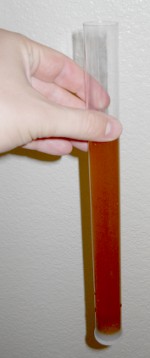
  • After 5 more minutes (60 minutes total of boiling), I cooled the wort with my chiller, added cold tap water to a total of 4.5 gallons, and pitched the yeast. Pitching temperature was 74° F, and starting gravity was measured at 1.052. The wort is a nice amber color (as befits an amber ale).

As I refined the recipe, I played around with some calculators for IBU and starting gravity. I got an estimated boil gravity (4 gallon boil) of 1.077; with a top-up to 5 gallons, this gives an estimated IBU of 20.7 and estimated starting gravity of 1.061. My actual starting gravity was a little lower, at 1.052. Part of this discrepancy could be the sludge I left in the bottom of the brew pot, and the other could just be errors in the brew calculator.

New Belgium officially gives an “OG” of 12.6 and an “FG” of 2.2 for Fat Tire, which I think is on the Brix scale (even if not stated). This translates to 1.051 and 1.009. Thus, my original gravity is quite close! We’ll see if this comparability is maintained through fermentation. (as a side-note, they measure 18.5 IBU and 5.2% ABV, too)

I’ve never fermented with American Ale II before, so I’m curious to see how it works out. Judging by the Wyeast website, this should be a nice little strain.

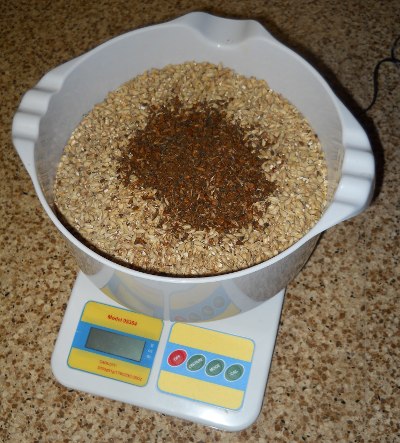
The grains, waiting to steep

Coopers Irish Stout – An Experiment

Last weekend I was at my local home brew store, getting the stuff together for tomorrow’s brewing session (a Fat Tire-ish amber ale). Looking up on one shelf, I saw these cans of hopped extract kits. $21 on the price tag. Intrigued by the low cost, I asked the shop owner if it was worth trying. He told me that many home brewers look down their noses at these kits (I suppose because it’s considered cheating), but that they actually can turn out some great beer. Quick, easy, cheap. . .worth a try! So, I bought a kit and took it home.

I selected a Coopers Irish Stout kit, which included a can of hopped malt and a packet of yeast. The package recommended adding some additional malt and dextrose – I had dry malt already, but not the latter, so I skipped dextrose. Instead, I used one pound of light and one pound of amber dry malt extract.

The directions recommended dissolving the can’s contents and the dry malt in 2 liters of boiling water. In order to achieve an additional level of sanitation, I boiled the dry malt first (in about 3 liters of water). Once that had gone for a few minutes, I turned off the heat and stirred in the liquid hopped malt. Several websites I saw said not to boil this final mixture, in order to maximize flavor. That makes sense, because the malt in the can should already be sterile, and I didn’t want to drive off any latent aroma.

At any rate, I dumped the hot mixture in my primary fermenter, and topped it up with cold tap water to about 5.25 gallons (enough to get the overall temperature down appropriately for the yeast). Original gravity was 1.044. I pitched the dry yeast directly into the fermenter (per the package directions), sealed it up, and hoped for the best.

The fermentation was clearly moving along after 24 hours, and after 48 hours it was so vigorous as to be spilling out the top of my airlock. I let it go for seven days, until the gravity had dropped to 1.018. Then, I transferred the beer into my bottling bucket (with 2/3 cup corn sugar added for priming), and bottled. The overall yield was 10 18 oz. bottles and 36 12 oz. bottles – not too shabby! Given the o.g. and f.g., I can expect about 3.4% alcohol by volume.

The uncarbonated beer has a clean flavor, but I must say it isn’t that complex or interesting otherwise. Then again, what can you expect for around $25 worth of materials? A big plus was the speed of initial brewing – it was only about 90 minutes of work to get from can to sealed primary fermenter (this includes cleaning all of the equipment!). Once carbonated, I anticipate this Irish Stout being a rather drinkable session brew – perfect for the upcoming winter months!