Our feijoa (pineapple guava) tree had a slack year in 2024-2025 (probably due to dry conditions), so I wasn’t able to gather any fruit. But, the tree produced fairly well towards the end of 2025, so it was the perfect time for a rebrew of my old favorite sour beer. The feijoa fruits weren’t quite as large this year, and were perhaps a bit riper when I picked them, so the overall quality is different from the first batch. That said, it still turned out as a great beer (even if a bit of extra work)!
Everything is pretty much the same this year as the previous version; there is a mix of pilsner malts, because I was getting to the end of my Pilsner Zero supply. With a smaller harvest of fruit, I opted for a 2.5 gallon instead of a 3 gallon recipe.
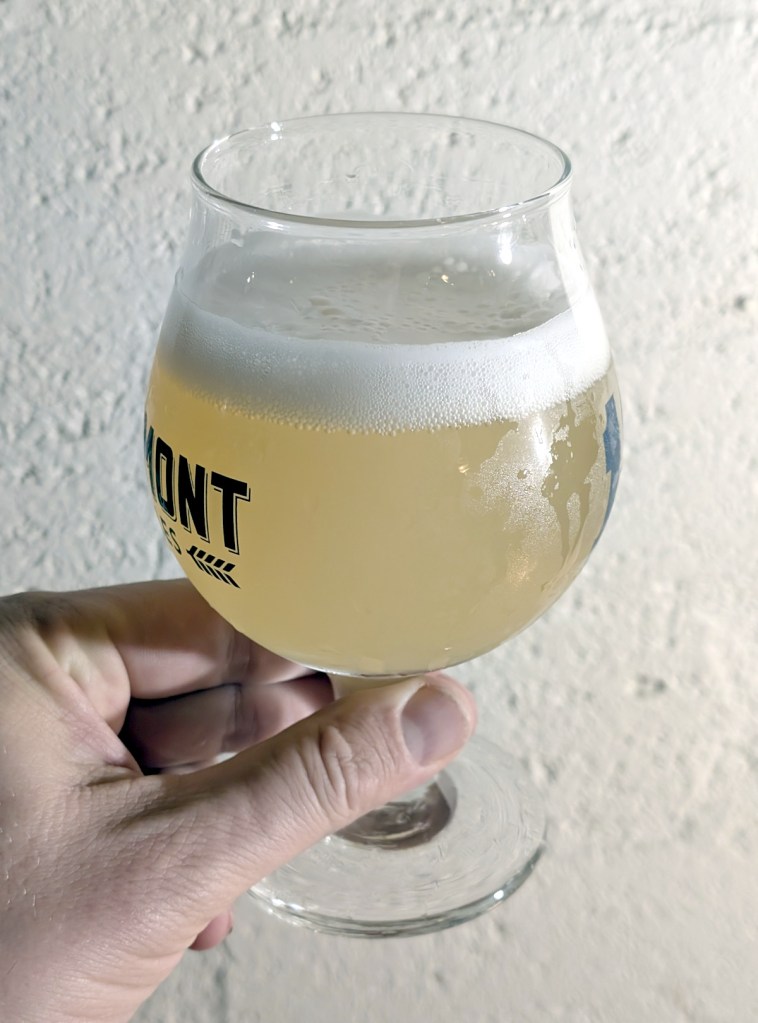
Rated “PG” (for Pineapple Guava) 2026
- 1 lb. 12 oz red wheat malt (Briess)
- 14 oz. Pilsner Zero malt (Viking)
- 8 oz. Synergy Select Pilsen Malt (Briess)
- 2 oz. rice hulls (added to mash)
- 0.25 tsp. BrewTanB, added to mash
- 0.25 tsp. BrewTanB, 10 minute boil
- 1 oz. Saaz whole hops (South Dakota; est. 3.5% alpha), 5 minute boil
- 0.5 tsp. yeast nutrient (WLN1000), 5 minute boil
- 1 pkg. Wildbrew Philly Sour (Lallemand)
- 2 lb. feijoa (pineapple guava) puree, added at end of fermentation
Target Parameters
- 60 minute infusion mash, 152°, full volume mash
- 1.031 o.g., 1.006 f.g., 3.2% abv, 5 IBU, 3 SRM
- Claremont tap water, neutralized, to hit 120 ppm Ca, 7 ppm Mg, 89 ppm Na, 50 ppm SO4, 120 ppm Cl, 10 ppm bicarbonate, -81 RA
- 2.5 gallon batch
Procedure
- Starting with 3.75 gallons of tap water, I added a quarter of a Campden tablet to drop the chloramines, and then 2.65 mL of 88% lactic acid, to neutralize the bicarbonates.
- I heated the water to 155°, before adding the grains, and holding at 152° for 60 minutes, with recirculation.
- After the main mash, I raised the mash temperature to 168° and held it there for 10 minutes.
- Once the mash was done, I pulled the grains. I had 3.4 gallons of runnings with a gravity of 1.025, for 72% mash efficiency.
- I brought the runnings to a boil, and boiled for 60 minutes, adding hops and other ingredients per the recipe.
- After the 60 minute boil, I chilled to 84°, transferred to the fermenter, pitched the yeast, and fermented at ambient. I wrapped a towel around the temperature to maintain temperature.
- I brewed the beer on 18 February 2026; starting gravity was 1.033.
- The beer was down to 70° by the morning of 19 February 2026, with active bubbling in the airlock. I put my fermentation heater next to the fermenter and wrapped the fermenter in a towel in order to keep the temperature up.
- The fermenter was around 76° when I checked it on 22 February 2026.
- I added the fruit puree on 22 February 2026. I had picked the feijoa at the end of December, skinned it, and then froze the pulp. After thawing, I pureed the pulp with an immersion blender, heated the puree it to between 160° and 165°, and then let it sit for 30 seconds. I added the pasteurized puree to the fermenter at this point, which raised the temperature to 86°. There was a gentle krausen on top when I opened the fermenter.
- The fermenter sat at ambient, until I kegged the beer on 7 March 2026. I used 1.5 oz of corn sugar dissolved in water to start carbonation (and reduce oxygen).
- Final gravity was 1.009, down from 1.033; this works out to 3.1% abv, pretty close to my initially estimated target.
- After a few weeks, I moved the keg to the fermentation chamber and topped up the CO2 with forced carbonation.
Tasting
- Appearance
- Very hazy and straw-colored beer, with a surprisingly persistent white head (likely helped by the high level of carbonation).
- Aroma
- Highly tart, acidic aroma, with a medium level of tropical fruit; very ripe, almost like papaya, especially on the initial pour; as the beer warms, I pick up more guava, and a bit of apricot and pineapple.
- Flavor
- Very clean sour profile, with a lactic acid character; a light bread dough malt flavor. As the beer warms, a medium-low level of tropical fruit comes through, with well ripened pineapple as the dominant flavor. Minimal bitterness.
- Mouthfeel
- Highly carbonated, crisp, light-bodied beer; a wonderful effervescent character.
- Would I Brew This Again?
- This is a super amazing beer, made even more special by the fact that I picked the fruit in my yard. It is just about the perfect fruited sour; the aroma is a little more “ripe” than the previous version. The flavor is not as fruit-forward (hence the 9/10), but still nice. The Philly Sour strain works well for these kinds of beers; I’m definitely sold on it! Comparing with the previous version, the color is a little lighter; maybe that’s something about the fruit?
- Overall
- 9/10
 Andy's Brewing Blog