
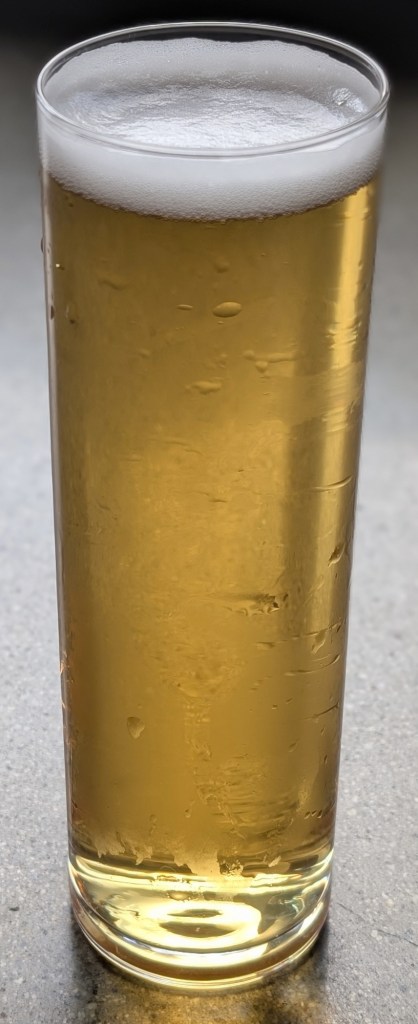
This kölsch recipe is one of my favorites, and I have brewed it annually since 2023. The recipe is pretty dialed in, except for the fact that on this brew I misread it and added a half pound of Munich II when assembling my grain bill. Oops! I anticipated it would up the maltiness a bit in a way that’s outside the norm for this beer (and style), which was indeed the case.
My supply of Edelweiss hop blend (business closed) and Köln Kölsch-style yeast (discontinued by manufacturer) is dwindling. I need to start thinking about my next iteration of the recipe. The hops are manageable, but it still is a bummer that I don’t yet know of a good dry yeast alternative! K-97 takes waaaay too long to clear and has a vinous character I don’t quite care for in some cases.
Snowdrop Kölsch
- 9.5 lb. pilsner malt (Rahr)
- 0.5 lb. Munich I malt (Weyermann)
- 0.5 lb. Munich II malt (Weyermann)
- 0.5 tsp. BrewTanB (mash)
- 1 oz. Edelweiss hop pellets (5.8% alpha), 45 minute boil
- 0.5 tsp. BrewTanB, 10 minute boil
- 1 Whirlfloc tablet, 5 minute boil
- 2 oz. Edelweiss hop pellets (5.8% alpha), 5 minute boil
- 1 pkg. Köln Kölsch-style yeast (Lallemand)
- 1 oz. Biofine Clear (added to keg)
Target Parameters
- 1.048 s.g., 1.011 f.g., 25 IBU, 4 SRM, 4.9% abv
- Full volume mash, 60 minute mash at 152°, 10 minute mash-out at 168°
- RO water with added minerals to hit target of 50 ppm Ca, 5 ppm Mg, 6 ppm Na, 54 ppm SO4, 72 ppm Cl, 0 ppm HCO3, -38 ppm RA
Procedure
- Starting with 7.25 gallons of RO water, I added 0.4 g of sea salt, 1.4 g of epsom salt, 1.7 g of gypsum, and 3.6 g of calcium chloride, in order to reach my target water parameters.
- I heated the strike water to 158° before adding the BrewTanB, grains, and 1 tbs. of 10% phosphoric acid (for pH adjustment).
- I held the mash at 152° (with recirculation) for 60 minutes, and then heated the mash to 168° for a 10 minute mash-out, before pulling the grains.
- In total, I collected 6.6 gallons of runnings with a gravity of 1.041, for 68% mash efficiency.
- I brought the runnings to a boil, adding hops and finings per the recipe. After 60 minutes, I chilled the wort to 66° and transferred to the fermenter. I pitched the yeast during the transfer.
- During fermentation, I held the temperature at 62°.
- I brewed this beer on 17 February 2025. Starting gravity was 1.049.
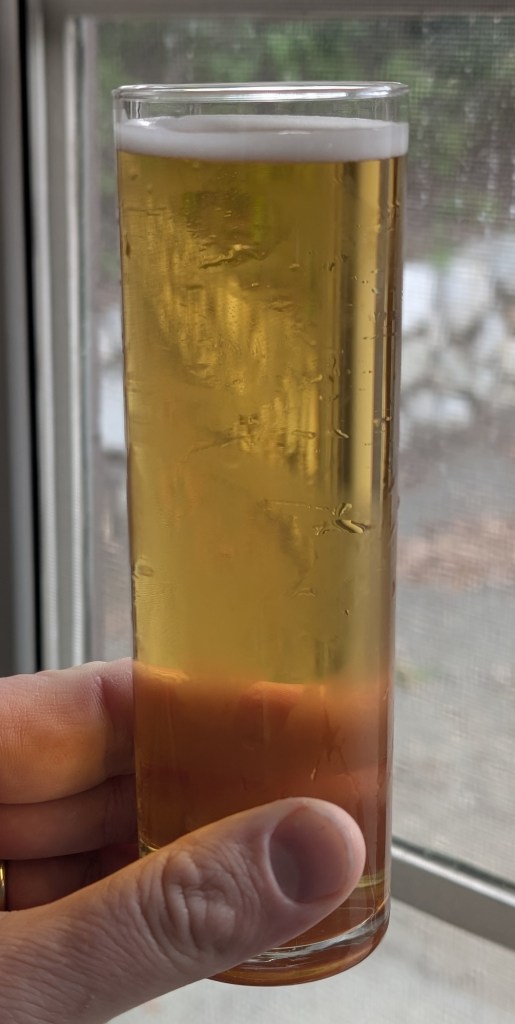
- I kegged the beer on 9 March 2025, using a closed transfer. It was pretty hazy at this point in the sample glass and will likely take awhile to drop clear.
- Final gravity was 1.011, for 5.0% abv.
- I added BioFine Clear on 24 March 2025, and put the beer on tap on 26 March 2025. It was brilliantly clear by this point! I had overshot the carbonation a bit, so it took some time to work things down. I used the pressure release valve on the keg and also served without the gas line connected, which over the course of a few days got it closer to “pouring without a massive dose of foam.”
Tasting
- Appearance
- Pours with a low yet very persistent white head. The beer itself is brilliantly clear and light yellow. This is probably the best looking kölsch I have ever made! The Biofine Clear definitely came through.
- Aroma
- Lightly fruity yeast character with a red apple quality. Low hop and malt character; slightly floral hops.
- Flavor
- Moderate level of maltiness and medium bitterness. Slightly fruity yeast character. The malt flavor is not quite as grainy as I personally would like in a kölsch–it’s more of a down-the-middle malty quality–but still nice. It’s a very drinkable beer!
- Mouthfeel
- Medium-light body, medium-high carbonation, smooth finish, crisp.
- Would I Brew This Again?
- This is a great recipe! The malt flavor is not quite as delicate as I would prefer (hence the 9/10 instead of 10/10), but that’s my fault for messing up the grist. I overcarbonated the beer just a little too, but that will amp down over time.
- Overall
- 9/10
 Andy's Brewing Blog