
I’m feeling experimental, and I’m feeling summer-y, and I need some good homebrew to sip on the porch on a warm Saturday afternoon. I discovered agua de Jamaica (a hibiscus tea often just sold as Jamaica) when I moved to California, and finally made my own last summer. This hibiscus-based tea is tart, tasty, and refreshing…which is a perfect accompaniment for a witbier! [For those who aren’t familiar, it’s pronounced roughly as “huh-MY-kuh”, not “juh-MAY-kuh”.]
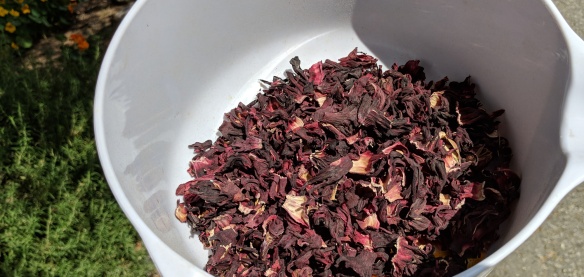
My base recipe is a pretty standard witbier, with a grist of 50% pilsner malt and 50% flaked wheat. I’m using WLP400 as the yeast, and a small dose of Hallertauer Mittelfrueh for the bittering hops. Because I want to highlight the hibiscus flavor and avoid any clash with coriander, I’m just using some fresh navel orange peel for steeping. I decided to add the dried hibiscus flowers at flameout, basically the same as if I were making tea. I kept hopping levels towards the lower end of the witbier style, because I expect that the flameout additions may add some bitterness.
Cerveza de Jamaica
- 5 lbs. pilsen malt (Briess)
- 5 lbs. flaked wheat
- 4 oz. rice hulls
- 0.75 oz. Hallertauer Mittelfrueh hop pellets (4.0% alpha), 60 minute boil
- 1 tsp. Fermax yeast nutrient, 10 minute boil
- Peel of two medium navel oranges, 10 minute steep after flameout
- 3 oz. dried hibiscus flowers, 10 minute steep after flameout
- 1 pkg. Belgian Wit Ale yeast (WLP400), prepared in 1L vitality starter
Target Parameters
- Infusion mash to hit target of 152°, 60 minutes, batch sparge.
- 1.050 o.g., 1.011 f.g., 5.1% abv, 11 IBU, 3 SRM
- Water built from RO to hit target of 48 ppm Ca, 85 ppm Cl, -34 ppm RA.
 Procedure
- I built my mash water with 3.5 gallons of reverse osmosis water and 6 g of CaCl. I mashed in at 164°, adding 7.5 mL of 88% lactic acid, and hit a mash temperature of 150°.
- After a 60 minute mash, I added 1.5 gallons of RO water at 185°, let sit for 10 minutes, vorlaufed, and collected the first runnings. I then added 3.5 gallons of water at 185°, let it wait for 10 minutes, vorlaufed, and collected the second runnings.
- In total, I collected 6.8 gallons of runnings, with a gravity of 1.039, for 73% efficiency. I’ve learned that adding an extra half gallon of sparge or mash water is important for these beers that have lots of flaked grains, both to keep up volume under the extra absorption and to ensure I get better efficiency.
- I boiled for 60 minutes, adding the various ingredients per the schedule.
- At flame-out, I added the fresh orange peel and dried hibiscus, and let them steep for 10 minutes. They stayed in while I chilled the wort, to extend the flavor extraction.
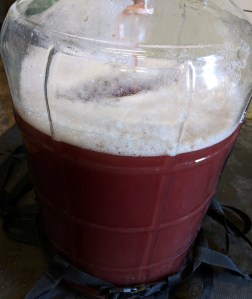
- The wort is really awesome in appearance and flavor; it has a deep purple hue, a slightly tart flavor, and an aroma that mixes all of the additions in a tasty way. I can’t wait to try this after fermentation!
- While mashing, I made a 1L vitality starter for the yeast. It ran on the stir plate for about 3 hours, and it showed signs of fermentation by then. After I pitched the yeast, solid signs of fermentation were visible within 18 hours.
- I brewed this on 28 April 2018, and starting gravity was 1.048. Initial fermentation is happening at 68°; I’ll let it free-rise after 3 or 4 days.
 Andy's Brewing Blog