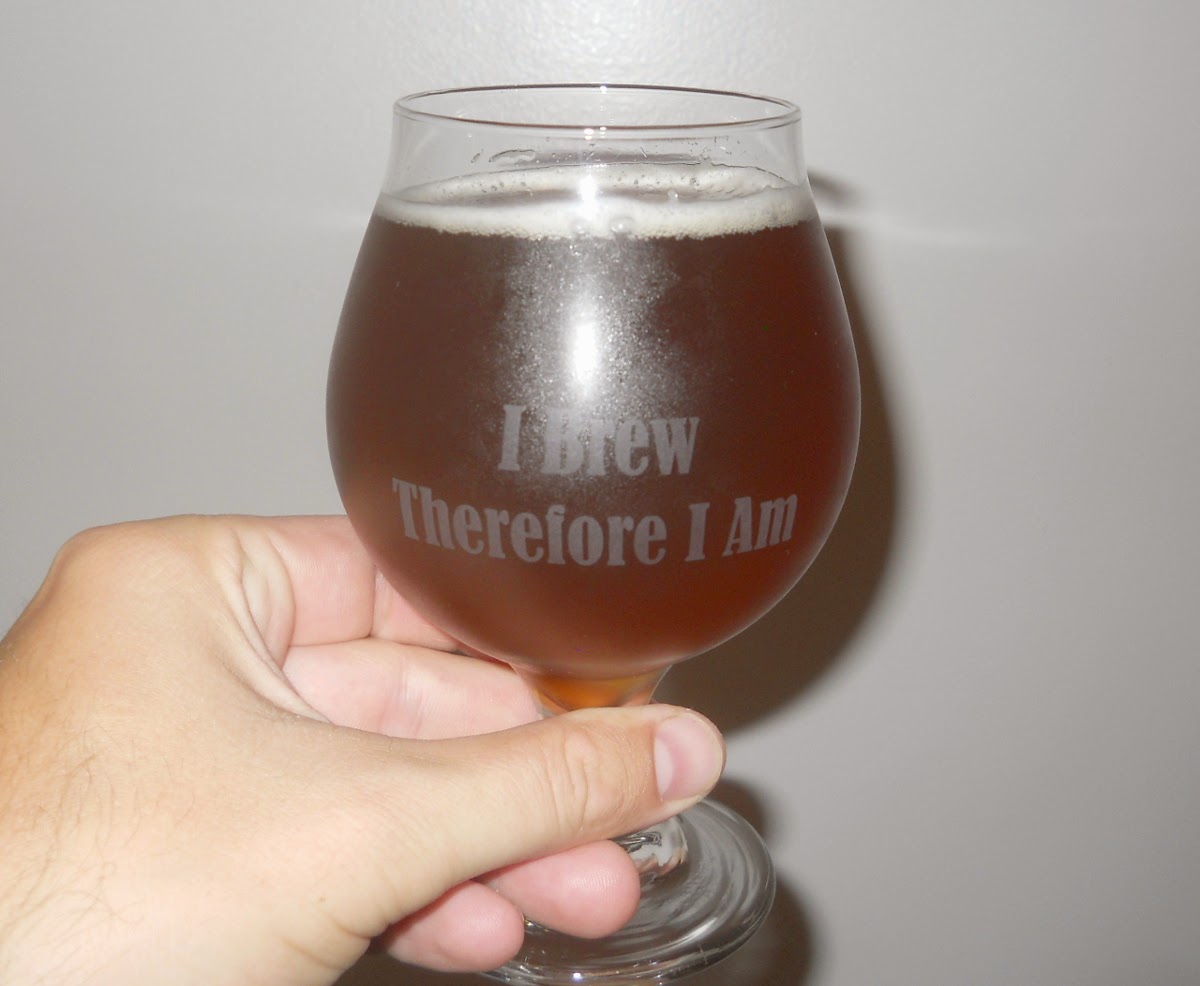
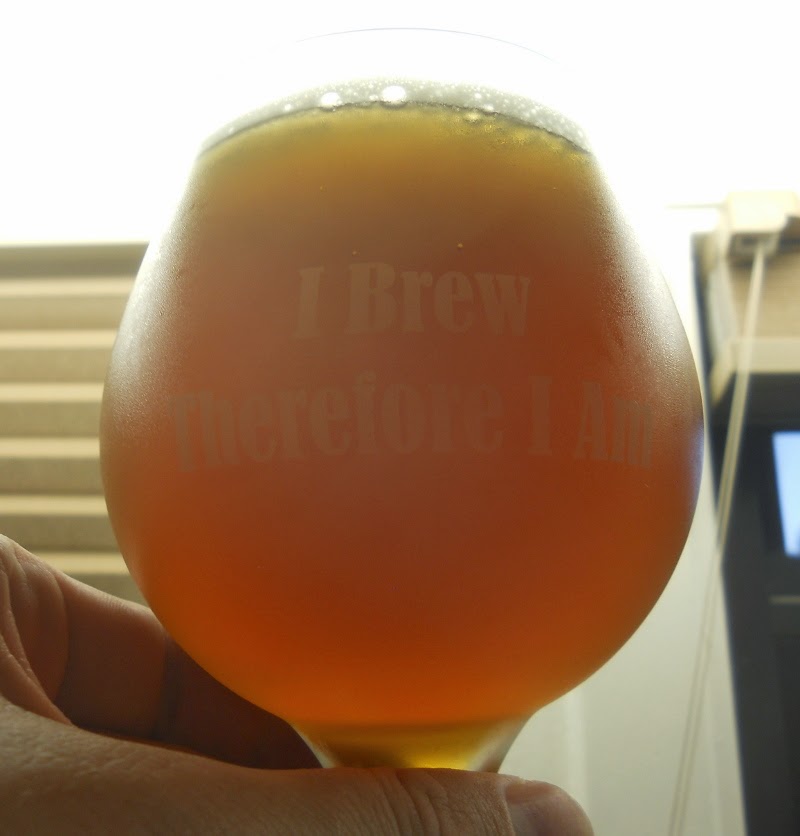
Back in March, at the start of my all-grain brewing, I brewed up Gondwana IPA. The resulting beer turned out unexpectedly tasty, and hooked me on Citra hops (especially for dry-hopping). Because I was still figuring out my techniques at the time, my mash efficiency was a little low (~57%), and the result was closer to a pale ale than a traditional IPA in some respects. Thus, I retooled the original recipe as a pale ale, cutting back some of the malt and utilizing Citra as the only hops for the brew. As before, I want a prominent hops aroma, so this beer will get a nice dry-hopping.
Gondwana Pale Ale (version 1.1)
- 9 lbs. 2 row malt
- 1 lb. Vienna malt
- 0.5 lb. cara-pils malt
- 0.5 lb. 40° crystal malt
- 1 oz. Citra hops (bittering, first addition; pellet form; 14.5% alpha, 3.9% beta)
- 1 oz. Citra hops (bittering, second addition)
- 1 tsp. Irish moss
- 1 pkg. Safale American dry yeast (US-05, 11 g)
- 2 oz. Citra hops (dry hopping)
Steps
- First, I preheated the mash tun with 9 gallons of water that was as hot as possible from the tap.
- In my brew pot, I heated 14 quarts of water to 170°. I added the milled grains to the mash tun with 1 tbs. of pH 5.2 stabilizer, and mashed in. The temperature stabilized at 154°. After 30 minutes, the temperature was 153°.
- After 60 minutes, added 1 gallon of water at 185°, and let it sit for 10 minutes or so. I drained the tun, extracting ~2.9 gallons of wort.
- Next, I added 3.2 gallons of water at 195°. This raised the mash temperature to ~175°, a little warmer than I wanted. So, I added 1 quart (.25 gallons) of ice cubes. This dropped the temperature down to 168°. I let the mix sit for 10 minutes before draining.
- I collected a total of 6.7 gallons of wort, with a preboil gravity of 1.043. This works out to a mash efficiency of ~73%.
- I heated the wort to boiling, aiming for a total of 60 minutes at boil. After 30 minutes, I added the first addition of hops.
- After 50 minutes, I added the Irish moss.
- After 58 minutes, I added the second addition of hops.
- After 60 minutes of boiling, I turned off the heat, removed the hops (they were all bagged), and chilled the wort to ~80°.
- Once the wort was chilled, I transferred it to the primary fermentation vessel. Along the way, it was oxygenated using my Venturi pump.
- The yeast was rehydrated in 2 cups of preboiled water at ~90°, and pitched into the wort.
- Starting gravity was 1.048 at 60 degrees, with ~5.3 gallons of wort. I can probably expect around 5% abv in the end.
- The beer is fermenting at 64°; after 1 week I will transfer it to the secondary fermenter and dry-hop for 2 weeks, prior to bottling.
Notes
- Total ingredient cost for this was $27.65. Assuming around a 5 gallon yield in the end, the cost per 12-oz. bottle will be around $0.55.
- In order to maximize extract efficiency, I have been using a double crush on the mill at my local homebrew shop. Based on a visual inspection of the milled grain, and on conversations with the owner, I decided to try just a single pass through the mill this time. Based on my efficiency, that was an okay decision.
- In the past, I had been a little frustrated by trying to raise the temperature of the grain bed during the second collection of wort. Thus, I tried adding much hotter water (~195°) than recommended by BeerSmith (168°), and got much better results both in terms of temperature as well as mash efficiency. There was a little fiddling to keep the temperature below 170°, so I might aim for around 185° to 190° next time.

 Andy's Brewing Blog