
Homebrewing is at its most fun for me in exploration. I’ll admit that with nearly 20 years of experience, I’m now pretty familiar with many ingredients and styles, so truly novel brews aren’t as common as they used to be. So, I was pretty excited when I read about a new malt from Gambrinus, called “Mars Malt,” which is marketed as a base malt that produces a red wort. The flavor description made it sound like a turbo-charged Munich, with all of the flavor characteristics one would expect there.
After seeing Denny Conn post on the AHA Forum about his plans to make a SMaSH altbier using Mars malt, I was inspired to make my own SMaSH recipe, aiming for an American amber ale. American ambers and altbiers are quite similar in strength, color, and bitterness, and so I think the recipes can be swapped around in creative ways. For an American amber ale SMaSH, I decided to focus on Centennial hops, because the pine and citrus work perfectly for that West Coast flavor. Yeast needed to be something clean and fast; although I often lean on WLP001 and BRY-97, I usually forget about Nottingham as another option. Although a British yeast, it’s another classic of American brewing, and does a good job of staying out of the way of the malt and hop flavors. Plus, Nottingham ferments fast and drops clear, both positive qualities for this project.
Because this was an experimental batch, I aimed for 2.75 gallons rather than my usual ~5 gallons. Gravity targeted Gambrinus’s recommended strength of 1.048 to maximize red color, and it also would keep the alcohol level in check. The hopping level was pretty standard for an American amber ale, and I kicked in some dry hops to maximize flavor and aroma. To avoid too minerally of water, I cut my tap water with some RO water, and built in epsom salt to boost the sulfates and enhance the hops.
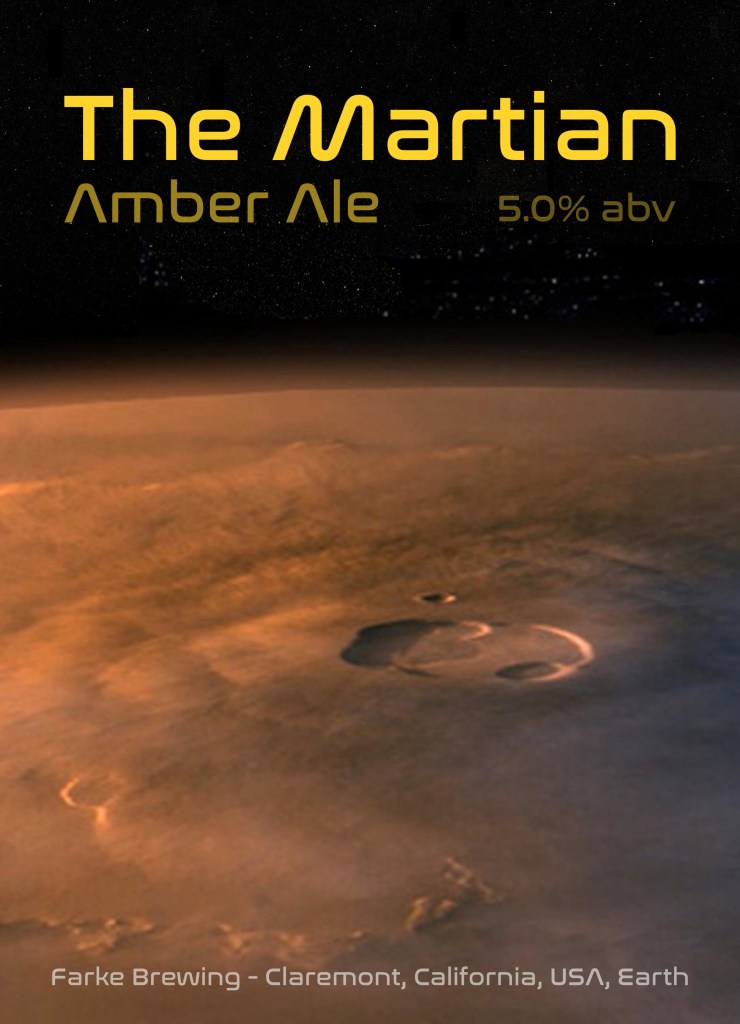
I had fun putting together a logo/label for this recipe–it’s fairly simple, with a NASA-sourced artist’s image of Mars viewed from orbit, with a NASA-inspired font. All were freely available, and none were AI.
The Martian Amber Ale
- 6 lb. Mars malt (Gambrinus)
- 0.25 tsp. BrewTanB, added to mash
- 0.5 oz. Centennial hop pellets (8.1% alpha), 60 minute boil
- 0.25 tsp. BrewTanB, 10 minute boil
- 1 Kick carrageenan tablet, 5 minute boil
- 0.5 oz. Centennial hop pellets (8.1% alpha), 5 minute boil
- 1 pkg. Nottingham ale dry yeast (Lallemand)
- 1.5 oz. Centennial hop pellets (8.1% alpha), dry hop in primary
Target Parameters
- 60 minute infusion mash, 152°, full volume mash
- 1.048 o.g., 1.008 f.g., 5.3% abv, 33 IBU, 14 SRM
- Water built from Claremont tap water and RO water to hit target parameters of 78 ppm Ca, 23 ppm Mg, 58 ppm Na, 107 ppm SO4, 78 ppm Cl, 85 ppm bicarbonate
- 2.75 gallon batch
Procedure
- I built the water up with 2.75 gallons of tap water (with a Campden tablet), 1.5 gallons of RO water, and 3 g of epsom salt.
- I heated the water to 158°, before adding the grains and holding at 152° for 60 minutes, with recirculation.
- After 60 minutes, I heated the mash to 168° for 10 minutes, and then pulled the grains.
- In total, I collected 3.9 gallons of runnings at a gravity of 1.041, for 73% mash efficiency.
- I brought the runnings to a boil, adding hops and finings per the recipe, maintaining a 60 minute boil.
- After 60 minutes, I chilled the beer to 68° and let it settle for a bit before transferring to the fermenter and pitching the yeast.
- I brewed this beer on 17 January 2026. It had a starting gravity of 1.049, a pretty good match for my target gravity.
- Because ambient temperatures were pretty cool, I let the beer sit out. It was at 66° by the next morning, with regular bubbling through the airlock.
- The beer was up to 70° by the morning of 19 January, so I moved the fermenter to a cooler room. This is still well within the optimal range for Nottingham, so I’m not too worried.
- The fermenter was down to 66° by the evening of 19 January, and I moved it to a warmer room overnight.
- The fermenter was down to 62° by noon on 20 January 2026. I added the dry hops at this point; when I opened the fermenter, the krausen had fallen pretty much entirely.
- I cold crashed the beer on 24 January 2026, and kegged using a closed transfer on 1 February 2026.
- Final gravity was 1.011, for 5.0% abv.
Tasting
- Appearance
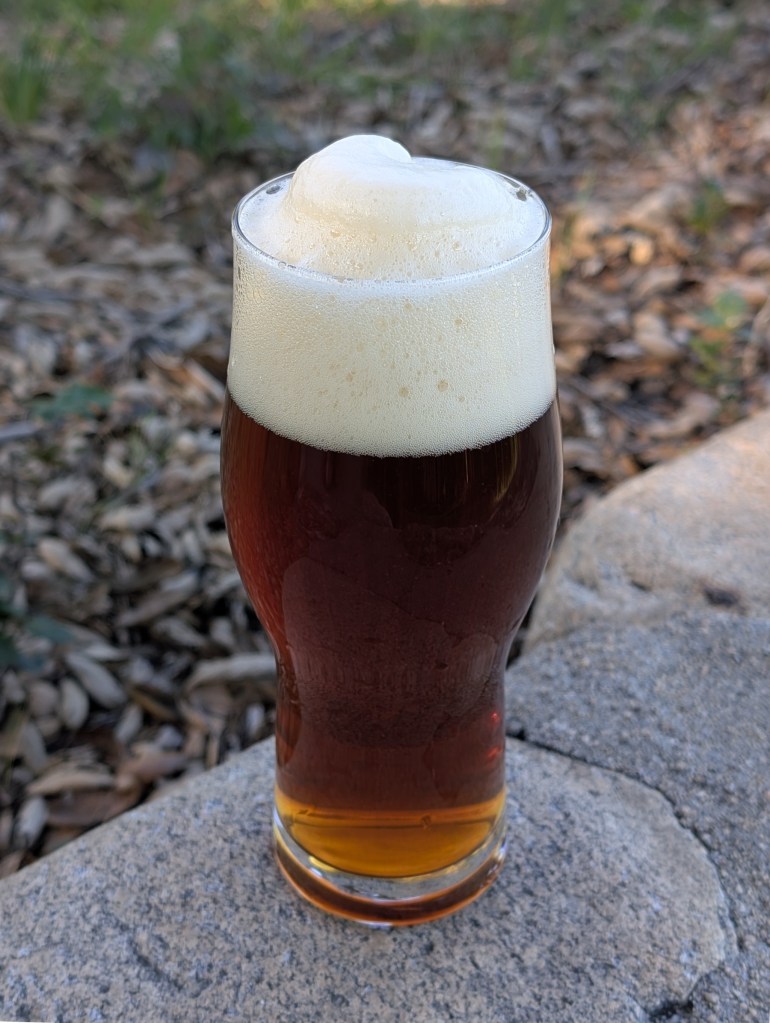
- Clear, reddish amber beer, with a tall and persistent ivory head–it’s fluffy and gorgeous!
- Aroma
- Prominent bready aroma, slightly toasty; more dark bread than light. Very malt forward. Resiny hops at a moderate level.
- Flavor
- Medium-high maltiness, with dark bread character. Bitter, with a citrus and pine hop character. Clean yeast quality.
- Mouthfeel
- Medium-light body, medium carbonation, dry finish.
- Would I Brew This Again?
- This is a pretty good SMaSH. The body is a touch thin, and I might recommend a mash at 156° or 158° in a future version. Alternatively, I might add a bit of crystal 20 or crystal 40. Overall, this is an interesting beer and a worthy experiment.
- Overall
- 7/10
 Andy's Brewing Blog