
It has been a long time since I last made a saison, back in 2018. It’s an interesting style, but one that I’m usually content to enjoy in a sporadic bottle, rather than a full keg. But, inspired by some reading and podcasts, I decided to give the style another go. My friend Justin was in town, so it was fun to have a brewing partner.
I patterned my recipe after Odds & Ends Saison from Modern Homebrew Recipes, and followed Drew Beechum’s guide to yeasts and yeast techniques via the Maltose Falcons. I used the saison article in the July/August 2018 Zymurgy magazine for my water profile.
This was a complicated batch in the end. The breaker on my Foundry gave up mid-boil, so I had to transfer to a kettle and finish over a propane burner. There’s never a dull moment while brewing! Things really went sideways on this batch, which conveniently provided the name. (Thankfully, it was an easy fix for the breaker issue, which involved swapping in a new breaker)
Sideways Saison
- 4.5 lb. Lamonta pale malt (Mecca Grade)
- 1 lb. flaked rye
- 1 lb. Viking Pilsner Zero Malt
- 1 oz. roasted barley (Bairds)
- 4 oz. rice hulls
- 0.5 lb. white sugar, added at end of boil
- 1.5 g. WLN1000 yeast nutrient (White Labs)
- 1 oz. Moutere hop pellets (19.5% alpha acid), 15 minute whirlpool
- 1 pkg. Belgian Saison yeast (Wyeast 3724), prepared in vitality starter
Target Parameters
- 1.057 s.g., 1.006 f.g., 6.7% abv, 30 IBU, 10 SRM
- Full volume mash, 149° for 60 minutes, 168° mash-out for 10 minutes
- Claremont tap water and RO water adjusted to hit target water parameters of 33 ppm Ca, 18 Mg, 34 Na, 103 SO4, 49 Cl, 63 HCO3, 18 ppm RA
Procedure
- A few hours before the mash, I made a vitality starter with a 16-oz. can of Propper Starter (Omega) along with 16 oz. of distilled water.
- I combined 2.25 gallons of Claremont tap water and 3 gallons of distilled water, adding 1 g gypsum and 3 g of epsom salt to hit my water parameters. Once I got the water to 154°, I added the grains (except for the roasted barley) along with 3.4 mL of 88% lactic acid, to adjust the pH.
- I held the mash temperature at 149° for 60 minutes, with recirculation. Then, I added the roasted barley, raised the mash to 168°, and held it there for 10 minutes before pulling the grains.
- In total, I collected 5 gallons of runnings with a gravity of 1.037, for 78% mash efficiency.
- The Foundry crapped out on the way to the boil, so I transferred the runnings to my big 10 gallon kettle and continued the process over my propane burner. I boiled for 90 minutes total, to up the gravity.
- I added hops and finings per the recipe.
- For some reason, I didn’t record the gravity, but I think it was around the target. I was able to estimate the starting gravity by measuring the final gravity and taking a final refractometer reading–which worked out to 1.055.
- I brewed this beer on 28 May 2023.
- Once the initial chill was done, I transferred it to the fermenter. I chilled the wort to 64° before pitching the yeast, and set the fermenter to 65°. I held it here for 3 days, before letting it free-rise.
- I raised the temperature to 72° on 31 May 2023, and then to 85° on 2 June 2023. This was a free-rise with ambient heat, rather than measuring the temperature of the fermenter.
- Despite using an “open” fermentation (aluminum foil over the airlock, rather than liquid in the airlock), I still got the “saison stall.” Gravity was only at 1.032 on 8 June 2023, so I left the beer at 85°.
- The beer was finally down to 1.009 on 19 July 2023. This works out to 6.1% abv.
Tasting
- Appearance
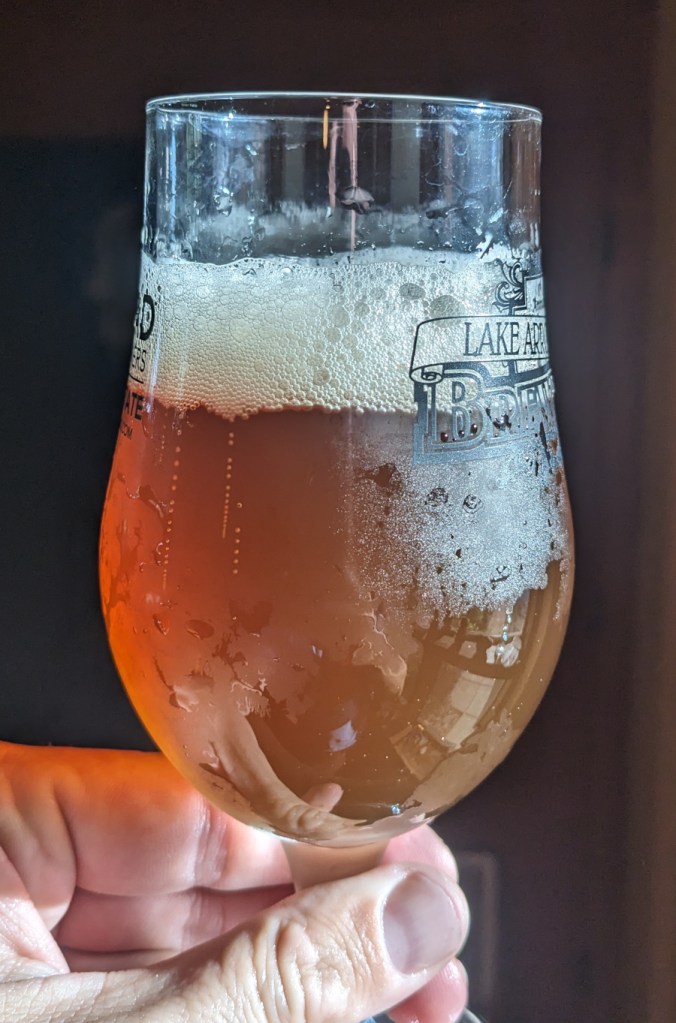
- Pours with a fluffy and persistent ivory head. The beer itself is medium amber and has a decent haze..
- Aroma
- Slightly earthy aroma, with a moderate level of pear character alongside some peppery spice. A tartness also comes through, which is really delightful.
- Flavor
- Spicy, slightly peppery flavor and a decent bit of ripe pear at the forefront, with only moderate bitterness. I get a bit of the rye flavor, but most of the flavor is in the world of the yeast.
- Mouthfeel
- Medium-light body, moderately high carbonation, moderately dry finish.
- Would I Brew This Again?
- This is a pretty good recipe! It is a bit darker than I am used to for a saison (especially the classic Saison Dupont), but I think it’s still well within the style. I personally might like one that is a little lighter bodied, and I wonder if the rye didn’t complicate matters some. I also might go for 100 percent pilsner malt, rather than American pale malt as the dominant grain, in order to streamline the flavor. The yeast qualities are quite nice, and hit a nice balance of interesting but not in-your-face. I feel that I got the fermentation parameters just about perfect. It was worth the extra fuss!
- Overall
- 9/10
 Andy's Brewing Blog