Big Hop Summer IPA

Although many of my IPAs have been on the session side, I do try to make a full strength version every once in awhile. In this recipe, I aimed for something highly drinkable and packed with hop flavor. Towards the first item, I mashed low and added some dextrose to keep things light. Towards the second end, I looped in some HOPBOX finds–Azacca, HBC 586, and Idaho Gem. Finally, I wanted to experiment with Lutra, a kveik strain that has a reputation of a quick and clean fermentation. It’s a bit of a kitchen sink beer, in order to use up some grains and hops, but it’s all with a purpose.
Big Hop Summer IPA

  • 5.25 lb. Golden Promise malt (Simpsons)
  • 5.25 2-row pale malt (Rahr)
  • 1.75 lb. Vienna malt (Weyermann)
  • 0.25 lb. Munich I malt (Weyermann)
  • 0.75 lb. dextrose (added to boil)
  • 0.75 oz. Bravo hop pellets (14.2% alpha), 60 minute boil
  • 1 Whirlfloc tablet, 5 minute boil
  • 1 oz. Azacca hop pellets (12.7% alpha), 15 minute whirlpool
  • 1 oz. HBC 586 hop pellets (11.8% alpha), 15 minute whirlpool
  • 1 oz. Idaho Gem hop pellets (14.2% alpa), 15 minute whirlpool
  • 1 pkg. Lutra kveik (dry), Omega OYL-071
  • 1 oz. Azacca hop pellets (12.7% alpha), dry hop in keg
  • 1 oz. HBC 586 hop pellets (11.8% alpha), dry hop in keg
  • 1 oz. Idaho Gem hop pellets (14.2% alpa), dry hop in keg

Tasting

  • Appearance
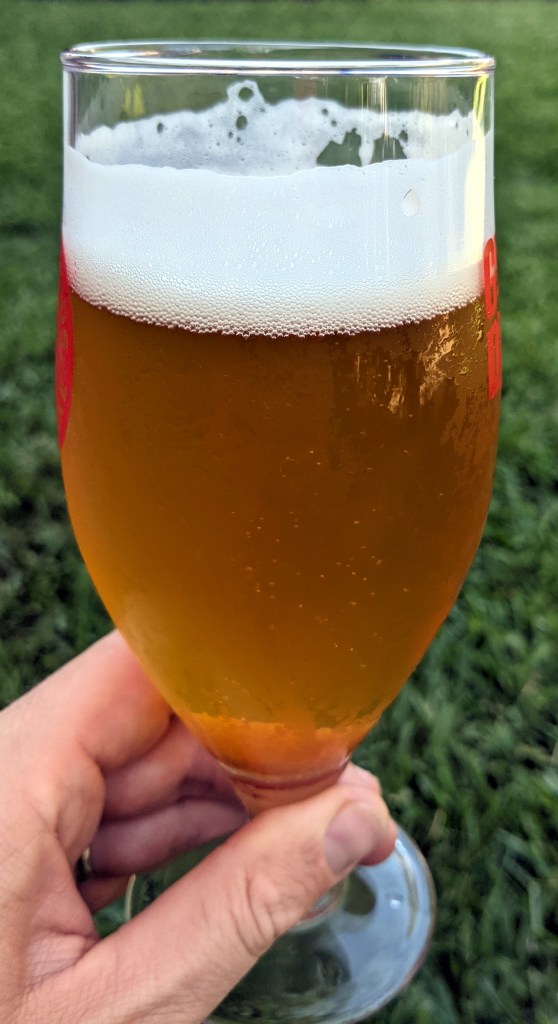
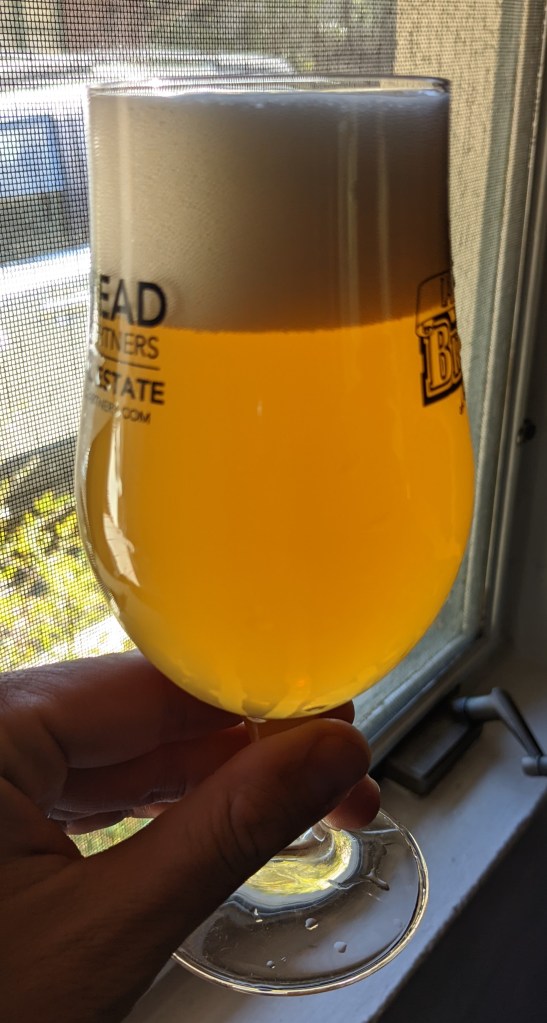
    • The beer pours as a hazy gold, with a persistent white head that leaves nice lacing down the side of the glass over time. I am surprised that the haze hasn’t dropped out, even after two months in the keg at temperatures below 40 degrees.
  • Aroma
    • Orange peel aroma at the front; very citrusy character overall.
  • Flavor
    • The balance is tipped towards the hops (no surprise), with a very citrusy and resin character. I also pick up a bit of stone fruit, which might be from the hops or perhaps from the yeast. There is a little bit of a “twang” of something somewhere in the background, which I suspect is from the yeast but I can’t be 100 percent certain. Even though Lutra is supposed to ferment clean, I’ve seen remarks that it is still a farmhouse-type strain, and they remain a bit rustic. As the beer sits on the tongue, I wonder if some of it is some citrus pith character. In any case, there is something that detracts a little bit from complete enjoyment of the beer by my tastes, but it’s not overwhelming, and it isn’t totally out of character for this kind of beer. The malt is in the background, as it should be, but provides a nice bit of body and a touch of malty flavor to balance against the hop bitterness.
  • Mouthfeel
    • Medium-light body, with moderate carbonation and a dry finish. It goes down super easy.
  • Would I Brew This Again?
    • I like the beer overall, but I might switch up the hop varieties. I tried Azacca years ago, it didn’t overwhelm me with awesome then, and I had a similar experience this time around. I think it’s just not a hop that does much for me. I’m surprised by how persistently hazy the beer has been, even after two months in the keg; the haze doesn’t terribly detract from the beer, but it’s just a bit more haze than I expected. Those remarks aside, this is a very drinkable beer, especially for something that clocks in at 6.7% abv. The combination of low mash temperature and dextrose addition likely contributed to keeping things on the lighter side.
  • Overall
    • 7.5/10

Byzantium IPA

With the summer months closing out, I wanted to do a final kveik batch. I targeted a 3 gallon yield, because I didn’t want to have a ton of higher-abv beer. Additionally, I made this a “quicker brew” session, by reducing the boil time to 45 minutes. I have no particular reason for the name, other than that it sounded cool.

Byzantium IPA

  • 8.25 lb. 2-row malt (California Select, Great Western)
  • 0.25 lb. 10L caramel malt (Briess)
  • 0.55 oz. CTZ (Columbus/Tomahawk/Zeus) hop pellets (15.8% alpha), first wort hop
  • 1 oz. Simcoe hop pellet (12.7% alpha), 5 minute boil
  • 0.65 oz. Centennial hop pellet (8.1% alpha), 5 minute boil
  • 1 tsp. yeast nutrient (WLN1000, White Labs), 5 minute boil
  • 1 Whirlfloc tablet, 5 minute boil
  • 1 pkg. Voss Kveik Ale Yeast (Lallemand)
  • 1 oz. Centennial hop pellets (8.1% alpha), 2 day dry hop
  • 1 oz. Simcoe hop pellets (12.7% alpha), 2 day dry hop

Target Parameters

  • 1.067 s.g., 1.013 f.g., 7.2% abv, 66 IBU, 5 SRM
  • 149° mash, 60 minutes, with 10 minute mash-out at 168°, and 1 gallon sparge
  • Claremont tap water with 3 g gypsum and 2 g epsom salt added at boil, to hit add 3 g gypsum, 2 g epsom salt to water just before boil, to hit 71 Ca, 21 Mg, 93 Na, 180 SO4, 105 Cl, 156 HC03, 65 RA, 128 ppm Alkalinity

Procedure

  • I mashed in with 4 gallons of water at 156°, adding 5 mL of 88% lactic acid. This hit a target mash temperature of 149°, and I held it here (with recirculation) for 60 minutes. After 60 minutes, I mashed out to 168°. I pulled the grain basket, and sparged with just under a gallon of hot water.
  • In total, I collected 4 gallons of runnings at a gravity of 1.057, for 73% mash efficiency. Nice!
  • I added gypsum, epsom salt, and the CTZ pellets, brought the wort to a boil, and added hops and such per the schedule. After 45 minutes, I turned off the heat and chilled to ~90°.
  • I transferred ~3.25 gallons of wort at a starting gravity of 1.064 into the fermenter, and pitched the yeast.
  • I brewed the beer on 21 August 2021, letting it sit at ambient, which was around 85°.
  • Fermentation took off quickly, overflowing the airlock (oops). I added the dry hops directly to the fermenter (with no bag) on 1 September 2021, and then kegged on 3 September 2021.
  • I kegged the beer using a semi-closed transfer, and the hops were quite a pain. I had some issues with clogged lines, etc. I probably should have cold-crashed to drop the hops out of the beer, or else bagged them in the first place. Ah well.
  • Final gravity was 1.014, for 6.6% abv.
  • To help clear the beer and hurry it towards serving, I added 0.5 tsp of gelatin in 0.75 cups water on 4 September 2021. At this time, I also agitated keg to finish carbonation.

Tasting

  • Appearance
    • This is a gold-colored beer with a slight haze; it pours with a quite persistent white head that leaves nice lacing on the side of the glass.
  • Aroma
    • The beer has a light citrus character for hops and a slight caramel malt aroma. There is no major yeast character, so the overall aroma is pretty clean. I would say it could use a little more hop character.
  • Flavor
    • The flavor is has a high level of bitterness, with a citrus pith character and a little bit of orange. The malt is in the background, with a slightly grainy aspect. There is a light…tartness?…in the yeast profile, that adds a bit of interest.
  • Mouthfeel
    • The beer has a medium-light body, moderate carbonation, and a dry finish.
  • Would I brew this again?
    • This is a worthy experiment…definitely better than the other kveik IPA I did, which suffered from clashing hops, malt, and yeast in initial tastings, and never quite came together even as it matured. I think the hop selection works better here, although as before I probably should use a more character-rich base malt such as Maris Otter. My hop handling also wasn’t great on this one, which I think dinged it a bit also. I should probably just add the hops in a bag next time. I lost volume as well as introduced a bit of O2 while messing around trying to clear clogs. That aside, it is a pretty beer.
  • Overall
    • 6.5/10

Dance Party IPA

This one was a total experiment for me! Experimental hops, experimental yeast, and experimental fermentation. My local homebrew shop had a new variety called Samba, with tropical characters that sounded pretty neat! So, I picked up a few ounces for a batch. I also had been meaning to try out Lallemand’s new dry Voss kveik strain, so grabbed some of those packets.

For this beer, I wanted a tropical/citrus character and fairly light drinkability, alongside a “full-strength” IPA. So, I combined Centennial, Samba, and Simcoe for a whirlpool as well as a dry hop addition.

Dance Party IPA

  • 12.5 lb. 2-row Xtra Pale Malt (Viking)
  • 0.75 lb. Carapils malt (Briess)
  • 1 oz. Magnum hop pellets (10.6% alpha), 60 minute boil
  • 1 Whirlfloc tablet, 5 minute boil
  • 1 oz. Centennial hop pellets (8.1% alpha), 15 minute whirlpool
  • 1 oz. Samba hop pellets (11.6% alpha), 15 minute whirlpool
  • 1 oz. Simcoe hop pellets (12.7% alpha), 15 minute whirlpool
  • 1 pkg. Voss Kveik Ale dry yeas (Lallemand)
  • 1 oz. Centennial hop pellets (8.1% alpha), dry hop in keg
  • 1 oz. Samba hop pellets (11.6% alpha), dry hop in keg
  • 1 oz. Simcoe hop pellets (12.7% alpha), dry hop in keg

Target Parameters

  • 1.059 s.g., 1.013 f.g., 6.1% abv, 62 IBU, 4 SRM
  • Claremont tap water, with Campden tablet and 5 g of gypsum added at the boil, to bump up the bitterness
  • 60 minute full volume infusion mash, 152°

Procedure

  • I mashed in with 7.25 gallons of water at 159°, to hit a mash temperature of 152°. I added 6 mL of 88% lactic acid, to adjust the mash pH.
  • After a 60 minute mash with recirculation at 152°, I bumped up the temperature to 168° for a 10 minute mash-out.
  • Following the mash, I removed the grain basket and brought the kettle to a boil.
  • In total, I had 6.3 gallons with a gravity of 1.050, for 66% mash efficiency. I added 5 g of gypsum to the boil, to bump up the sulfate.
  • I boiled for 60 minutes, adding finings and hops per the schedule.
  • After the boil, I did a 15 minute whirlpool at around 195°, and then chilled down to 90° and transferred to the fermenter.
  • Starting gravity was 1.050. I brewed this beer on 27 March 2021.
  • I pitched the packet of yeast directly, and began fermentation at 90°. After 18 hours, I raised the temperature to 95°, and then raised to 100° at the 24 hours mark after yeast pitch. After 72 hours, I lowered the temperature to 90°.
  • I kegged the beer on 7 April 2021, with the dry hops floating loose in the keg and a screen on the floating dip tube to filter out hops.
  • Final gravity was 1.013, for 5.8% abv.

Tasting

I didn’t have time to do a formal tasting on this one before the keg was kicked, but have a few general perceptions. First, the fermentation had a super clean character, and the kveik lives up to its reputation. I would totally do this fermentation profile again! Second, I really enjoyed the hop combo, but think that I probably overbittered it a bit, and the hops drowned out any potential malt character. There was a touch of astringency from the dry hops also, at times, which I think also detracted from the final flavor. So, if I redo this kind of IPA I might use a more character-rich base malt such as Vienna or Maris Otter and maybe a touch more of a crystal malt (e.g., crystal 20 or even crystal 40). That aside, the Samba hops did live up to their tropical reputation, and played well with the rest of the hops. It might be interesting to switch up the hop combos; I think this beer would be great with any combo of Samba, Citra, and/or Mosaic.

So…I would probably do this again, but modify things significantly. It was definitely worth the experiment, and I’ll likely dive into more kveik fermentations this summer! I give the beer itself a 5/10…not awful, but not quite where I want it to be either.

Christmas Warmer 2020

My beer tastes run towards the lighter, lower-alcohol side, but I sure do like a nice and robust beer in that stretch between Thanksgiving and New Year’s. I just finished the keg of Stygimoloch Bock, and this year’s Christmas Warmer went on tap in its place.

The goal for this batch was to have something with a bit of character and a bit of kick. I wanted a rich malt character, alongside a bit of spice. I looked through Gordon Strong’s Modern Homebrew Recipes, and found “Christmas Beer” as an inspiration. The malt proportions in my version are pretty similar to Strong’s recipe, but I did a ton of swapping for brand and even malt type. Golden Promise got replaced by Vienna, and Belgian Aromatic got swapped out for Honey Malt, among other things. The original recipe is far more English in character, including the hops and yeast, and I did away with that entirely! Instead of English ale yeast, I brought in Hornindal kveik. My logic was that its orange/citrus qualities would fill that space of orange zest in Strong’s recipe. Plus, I had the kveik on-hand, and thought it would be a fun variation.

Because this was a pretty experimental batch, and because I didn’t want ridiculous amounts of a spiced beer, I knocked the recipe back to 2.5 gallons. This gave me a chance to do a test-run for a small batch on my Foundry system. I quite like the result, but am glad that I don’t have endless quantities of it. Even a good spiced ale is best as a treat in moderation!

Christmas Warmer 2020

  • 3.5 lb. Vienna malt (Weyermann)
  • 1 lb. Munich II malt (Weyermann)
  • 1 lb. honey malt (Gambrinus)
  • 0.5 lb. Caramunich I malt (Weyermann)
  • 0.5 lb. caramel 40° malt (Briess)
  • 0.5 lb. flaked barley
  • 2 oz. chocolate malt (Briess)
  • 1 lb. honey, 1 minute boil
  • 1 oz. robust molasses (Grandma’s Brand)
  • 1 oz. Cascade whole hops (5.5% alpha), 30 minute boil
  • 1 tsp. Fermax yeast nutrient, 10 minute boil
  • 1 Whirlfloc tablet, 5 minute boil
  • Steeping spices (steeped for 10 minutes after boil)
    • 2 vanilla beans, cut and scraped
    • 3 cinnamon sticks
    • 6 coriander seeds, crushed
    • 1 whole nutmeg, chopped
    • 4 allspice berries, crushed
  • Hornindal kveik (repitched from previous batch)

Target Parameters

  • 1.068 s.g., 1.009 f.g., 7.7% abv, 19 SRM, 25 IBU, 3 gallon batch
  • Infusion mash, 154°, full volume; 60 minute boil
  • Claremont water, with Campden tablet to remove chloramines.

Procedure

  • I mashed in (using my Anvil Foundry) with 4.5 gallons of water at 160°, adding 2.5 mL of 88% lactic acid to adjust pH. I let this settle down to 154°, mashing for 50 minutes with recirculation. I then raised the mash to 168° over 10 minutes, let it rest for 10 minutes, removed the grains, and brought the runnings to a boil.
  • The mash yielded 4 gallons of wort at 1.041, for 62% mash efficiency. This was a bit below where I wanted to be, so I added 0.5 lb. of extra light DME, to raise the gravity.
  • I boiled for 60 minutes, adding the hops and other ingredients per the schedule.
  • After the boil but before chilling the wort, I steeped the spices in a bag for 10 minutes.
  • I cooled down to ~80°, transferred to the fermenter, and let it run at ambient. Because it was later in fall when I brewed this, ambient was around 70° or so for the start.
  • Starting gravity was 1.061. I brewed the beer on 20 October 2020.
  • I kegged the beer on 6 November 2020, and force carbonated.
  • Final gravity was 1.017, which works out to 5.8% abv. I’ve noticed that this kveik strain seems to underattenuate, measuring 61% to 71% in the batches I’ve done.

Tasting

  • Appearance
    • Deep amber beer with some haze; pours with a persistent beige head.
  • Aroma
    • Candied ginger, general spice, with a touch of citrus peel. Slight malty/biscuity character, and a slight tartness. There is a hint of cinnamon/spice as the beer warms up.
  • Flavor
    • Medium-low bitterness, and a light tartness (from the kveik?). There is a subtle spice character, with a bit of cinnamon and molasses that become more prominent as the beer warms.
  • Mouthfeel
    • Medium body, moderate carbonation. The finish is off-dry and fairly smooth.
  • Would I brew this again?
    • This is a pretty good beer, but still needs a little work. For my personal conception of a “holiday beer,” I’d like a bit more base malt character. For a rebrew, I might use all Munich I as the base, and also add some dark crystal malt (maybe crystal 80 or crystal 120?). The beer could also use a little more sweetness–perhaps from lactose or crystal malt–to round out the profile. The level of bitterness is about perfect. Finally, I might change the yeast to an English ale yeast rather than kveik. In sum, this is a perfectly drinkable experiment, and will be worth a future revision.
  • Overall
    • 6/10

Kveik the Keg Brown Ale

As the days turn towards winter, I’m in a dark [beer] mood. This is the time of year when I really like having a stout, porter, brown ale, or even an amber ale on tap to round out my beer choices.

To kick things off for the fall/winter dark beer season, I brewed up “Kveik the Keg Brown Ale.” It’s a total experiment, pulling together something that’s vaguely an American-style brown ale, with a repitch of the Hornindal kveik culture used in my recent pale ale. The idea was to make a sessionable beer holding ample malt character and a citrus highlight…something like a “chocolate orange” feel. I modified this from the Wasatch Premium Ale recipe in the Brewing Session Beers book by Jennifer Talley, because it looked like it had many of the initial features I was hoping for. For the malt base, I mixed American 2-row and light Munich malt, supplemented by a hefty dose of crystal 75, some chocolate malt, and a touch of Carafa Special III for color. For hops, I used all whole-Cascade hops. The Hornindal culture, which produces a subtle citrus character, would hopefully work alongside the Cascade. As you’ll see in the tasting notes, this was a pretty successful experiment!

Kveik the Keg Brown Ale

  • 6.25 lb. 2-row brewer’s malt (Great Western)
  • 2.5 lb. Munich light malt (Chateau)
  • 1 lb. crystal 75 malt (Great Western)
  • 2.6 oz. Carafa Special III malt (Weyermann)
  • 2.5 oz. chocolate malt (Briess)
  • 1 oz. Cascade whole hops (5.5% alpha), 60 minute boil
  • 0.5 oz. Cascade whole hops (5.5% alpha), 30 minute boil
  • 1.5 oz. Cascade whole hops (5.5% alpha), 10 minute boil
  • 1 tsp. yeast nutrient, 10 minute boil
  • 1 Whirlfloc tablet, 5 minute boil
  • Hornindal Kveik (Omega OYL-091), repitched from previous batch
  • 1 oz. Cascade whole hops (5.5% alpha), dry hop in fermenter

Target Parameters

  • 1.044 s.g., 1.011 f.g., 4.4% abv, 18 SRM, 33 IBU
  • Infusion mash, 156°, batch sparge; 60 minute boil
  • Claremont water, with Campden tablet to remove chloramines.

Procedure

  • I mashed in with 3.4 gallons of water at 166°, to hit my mash target of 156°. After 40 minutes, I added 1.5 gallons of hot water (~175°), to raise the mash temperature to 164°. I let this sit for 10 minutes, vorlaufed, and collected the first runnings.
  • Next, I added 3.75 gallons of hot water, to hit a ~164° mash temperature. I let this sit for 10 more minutes, vorlaufed, and collected the second runnings.
  • In total, I collected 7.3 gallons of runnings at a gravity of 1.038, for 76% mash efficiency.
  • I brought the runnings to a boil, and added hops, nutrients, and finings per the indicated schedule. After 60 minutes, I turned off the heat, chilled the wort down to 89°, and transferred it to the fermenter.
  • I brewed this beer on 19 September 2020. Starting gravity was 1.045, pretty close to my target. I pitched around 8 ounces of yeast slurry (which had been harvested a week prior), and saw signs of fermentation within 90 minutes of pitching the yeast! Within 18 hours, there was vigorous fermentation. What a solid start for this culture! I fermented this at ambient temperatures.
  • On 23 September, I added 1 oz. of dry hops directly to the fermenter.
  • I kegged the beer on 3 October 2020, adding 2.8 oz. of corn sugar boiled in 1 cup of water. The keg sat at ambient for ~10 days, before I topped up the pressure using force carbonation.
  • Final gravity was 1.017, down from 1.045, for 3.6% abv.
Kveik the Keg Brown Ale

Tasting

  • Appearance
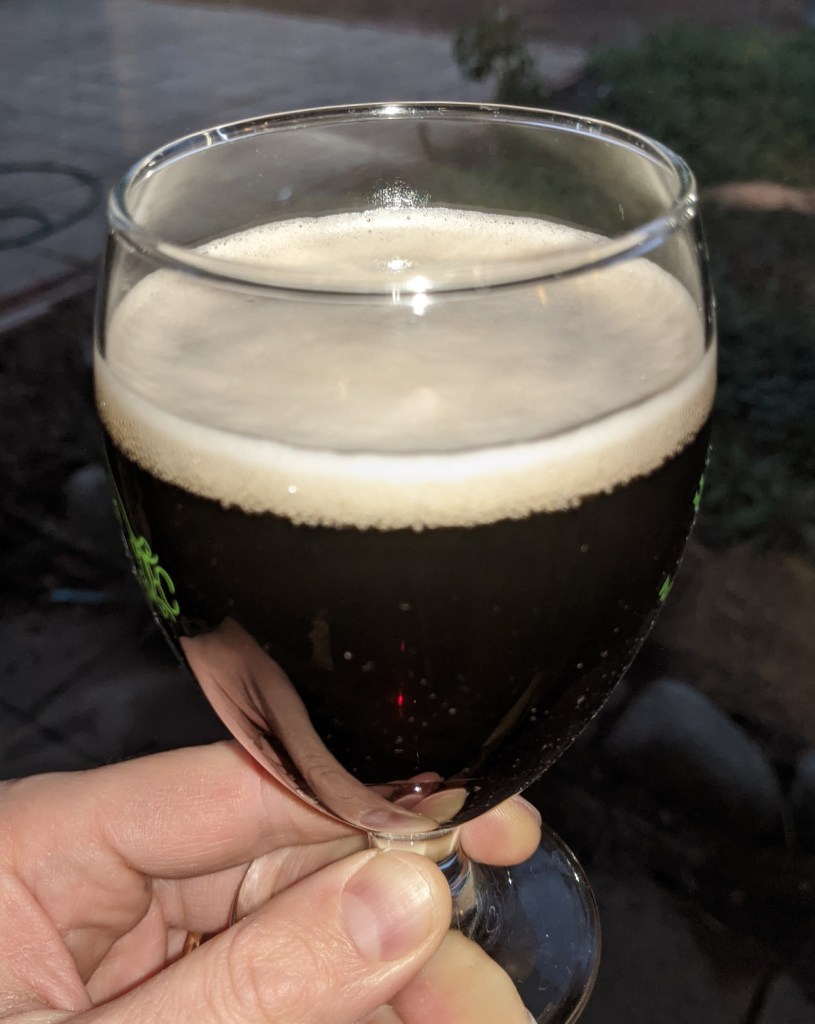
    • Very clear, deep brown beer with a persistent ivory head. It is exceptionally pretty!
  • Aroma
    • Moderate chocolate character to the malt aroma, with a slight citrus character, presumably from the yeast and hops. Very clean!
  • Flavor
    • The beer has a surprisingly rich, bready malt base (must be that Munich malt!), with a dark caramel and chocolate character behind that. Bitterness is at a moderately high level, but not over the top relative to the malt. There is definitely an orangey citrus character in play here.
  • Mouthfeel
    • Moderate carbonation, with a fairly light body and a crisp finish. There is a very slight bit of what might be astringency on the extended finish, but it’s barely noticeable. It’s not harsh at all, but does seem a touch out of balance with the rest of the beer.
  • Would I brew this again?
    • Yes! I might make a few minor modifications, perhaps to dial the bitterness back just a touch and maybe reduce the dry hopping level or dry hopping time. I think the beer would also benefit from swapping out the 2-row base malt with a Vienna or Maris Otter-type malt, to enrich the malt character. All that said, it’s overall a pretty good beer. I really like how the kveik culture worked in this beer, and it’s pretty nice to find something for this yeast that’s not yet another oversaturated IPA. I’ll probably be brewing more beers like this down the road!