Mosaic SMaSH Session Pale Ale

I wanted a quick-and-easy hoppy beer in the sessionable zone, so I threw together a SMaSH recipe with mostly on-hand ingredients. Maris Otter served as the base, for something a little more flavorful than average 2-row. I have a pound of Mosaic on-hand; I haven’t brewed with that variety in forever, and it’s interesting enough to stand on its own. Finally, I needed a yeast decision. This one required a quick turn-around to go on tap, so kveik was an obvious choice. My fantastic LHBS (Pacific Brewing Supplies in San Dimas) had a new brand in stock, a company called Kveik Yeastery. Looking through their products, a variety called Stalljen seemed perfect–it promised tropical fruit, mango, and pineapple, with citrus behind that. Reading a bit more about the yeast, I’m not sure if there are other commercial versions sold; if anyone knows differently, I’m happy to learn more. As a final note, this beer was set up as a “short and shoddy” style mash and boil, with 30 minutes on each.

Mosaic SMaSH Session Pale Ale

  • 10.5 lb. Maris Otter pale ale malt (Thomas Fawcett)
  • 0.5 tsp. BrewTanB (mash)
  • 1.25 oz. Mosaic hop pellets (10.7% alpha), 20 minute boil
  • 0.5 tsp. BrewTanB, 10 minute boil
  • 1 Kick Carrageenan tablet, 5 minute boil
  • 1.75 oz. Mosaic hop pellets (10.7% alpha), 10 minute whirlpool
  • 1 pkg. Stalljen kveik (Kveik Yeastery #K.22)
  • 3 oz. Mosaic hop pellets (10.7% alpha), dry hop

    Target Parameters

    • 30 minute infusion mash, 152°, full volume mash
    • 1.049 o.g., 1.012 f.g., 4.8% abv, 41 IBU, 5 SRM
    • Claremont tap water adjusted to hit 75 ppm Ca, 26 ppm Mg, 102 ppm Na, 164 ppm SO4, 130 ppm Cl, 10 ppm bicarbonate, RA=-60

    Procedure

    • Starting with 7 gallons of water, I added 7.2 mL of 88% lactic acid, 4 g of gypsum, and 2 g of epsom salts, in order to hit my water targets.
    • I heated the mash water to 157°, added the grains, and mashed at 152° with recirculation for 30 minutes. I then raised the mash to 168° for a 10 minute mash-out, before removing the grains.
    • My post-mash gravity was a bit underwhelming at 1.035 — that’s only 56% mash efficiency, well below my norm. Based on past results with the Fawcett Maris Otter, I’m thinking this is a malt that needs a full 60 minute mash at least; it certainly hasn’t overwhelmed me with its efficiency. Although I hadn’t planned a session ale, this is where I kicked things into session ale territory. I double-checked my mill gap, and all was OK there, so I can’t blame the mill.
    • I brought the runnings to a boil, but I upped the boil vigor a bit (85% power on the Foundry) and extended the boil to 60 minutes (instead of the planned 30 minutes).
    • After the boil, I added the last bit of hops and then chilled down to 93°. I transferred to the fermenter, pitched the yeast, and fermented at ambient.
    • I brewed this beer on 16 August 2025. Starting gravity was 1.043.
    • Vigorous fermentation kicked off within four hours of adding the yeast; the fermenter temperature was down to 68° by the next morning.
    • I added the dry hops on 21 August 2025, and cold crashed the beer on 24 August 2025.
    • I kegged the beer using a closed transfer on 30 August 2025. Final gravity was 1.012, for 4.1% abv.

    Tasting

    • Appearance
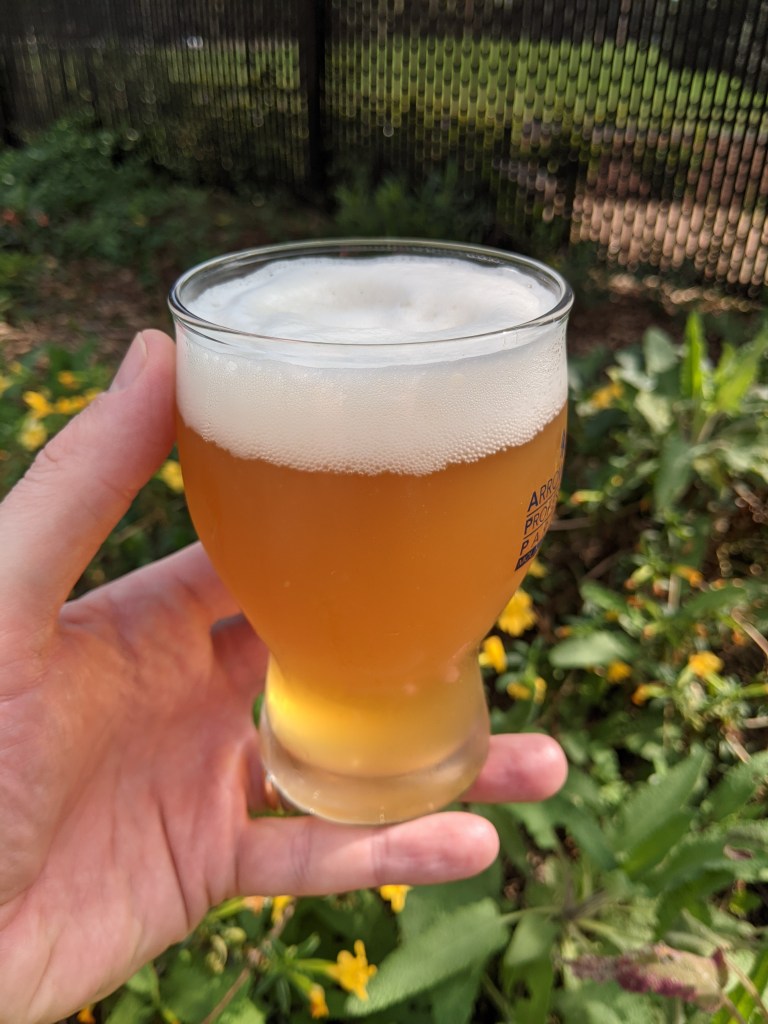
      • This is a hazy, light yellow beer that pours with a fluffy and persistent white head. The lacing is gorgeous!
    • Aroma
      • Aroma is dominated by a fresh citrus and blueberry hop character at a medium-high level. There is minimal malt or yeast character that I can pick up.
    • Flavor
      • Bitterness is at a high level, with slight astringency and hop bite. There is a medium-low level of malt flavor, with a grainy/malty-sweet character. The hops have a citrus and pine quality, with slight mango; it’s backed up by the citrusy notes presumably from the yeast.
    • Mouthfeel
      • Medium level of carbonation; light body and a dry finish with slight astringency.
    • Would I Brew This Again?
      • The core concept of this beer is great, but it definitely suffered from the low starting gravity. The astringency is annoying, but otherwise it’s a pretty decent beer. I would definitely do a version of this recipe again, with a higher gravity. Stalljen is a fantastic kveik strain; it’s unobtrusive and works well with Mosaic. I didn’t pick up the slight “twang” or tartness I get with Lutra (my other favorite strain), and I wouldn’t necessarily know this is a kveik otherwise. The persistent haze might be a negative in some recipes, but it’s so beautiful in this particular beer. Thinking ahead, I might aim for the same level of hops in a future version, with a starting gravity around 1.054. That would take a greater amount of malt as well as a longer mash.
    • Overall
      • 6/10

    Kveik Pale Ale

    It happened…I’ve given in to a brewing trend, and am trying a recipe with kveik. As you’ll see in some upcoming posts, I’ve in fact tried a few kveik recipes at this point. This is my first one, and admittedly not my favorite.

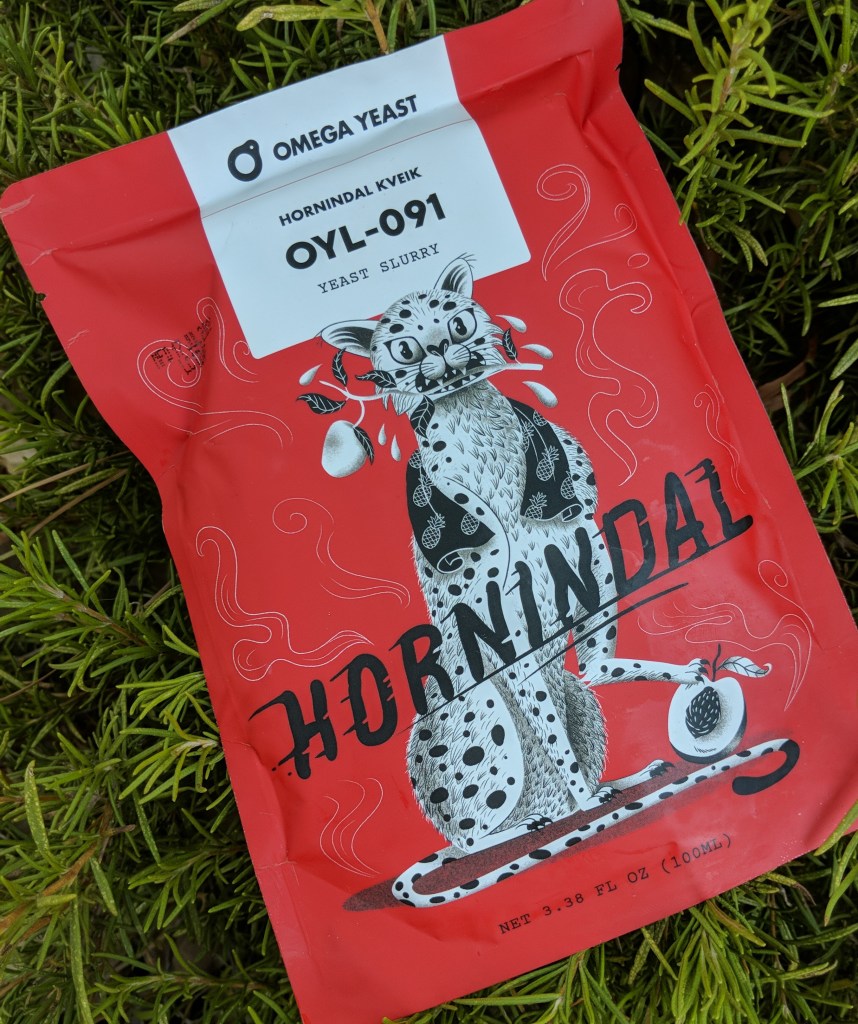
    red package of yeast from Omega Yeast, Hornindal Kveik strain, with cartoon of cat on front
    Kveik culture from Omega

    For those not familiar with it, kveik is essentially a Norwegian farmhouse ale culture, with a rich cultural history that has likely been over-analyzed by those outside of the original neighborhoods where the yeast originated. I’ve been intrigued by their stated qualities of fermenting cleanly in excess of 90°, which almost sounds too good to be true. It wasn’t, in the end!

    The recipe is inspired by a kit recipe from Atlantic Brew Supply, with major adjustments to pretty much everything. Many of the kveik-centered recipes out there are super-high alcohol, and that just doesn’t interest me. Session ales forever! I looked around at a few different kveik strains, and Hornindal from Omega seemed to hit the balance of a citrusy character that I wanted. I went with my usual session pale ale strategy of Vienna plus some Munich and a little crystal malt. For the hops, I grabbed a South African experimental variety, U1/108, from my local homebrew shop.

    Kveik Pale Ale

    • 8 lb. Vienna malt (Weyermann)
    • 1 lb. Munich light malt (Chateau)
    • 0.5 lb. Crystal 40 malt (Great Western)
    • 0.75 oz. Magnum hop pellets (13.2% alpha), 30 minute boil
    • 1 tsp. Fermax yeast nutrient, 10 minute boil
    • 1 Whirlfloc tablet
    • 1 oz. African Experimental U1/108 hop pellets (15.0% alpha), 5 minute boil
    • 1 oz. African Experimental U1/108 hop pellets (15.0% alpha), 15 minute whirlpool
    • 3 oz. African Experimental U1/108 hop pellets (15.0% alpha), dry hop in keg
    • 1 pkg. Hornindal Kveik (Omega OYL-091)

    Target Parameters

    • 1.043 s.g., 1.011 f.g., 4.3% abv, 6 SRM, 41 IBU
    • Infusion mash, 156°, batch sparge; 45 minute boil
    • Claremont water, with Campden tablet to remove chloramines and 2 g of gypsum added to boil kettle.

    Procedure

    • I mashed in with 3.25 gallons at 168°, to hit a 158° mash temperature. I also added 4 mL of 88% lactic acid to the mash, to adjust pH.
    • The mash temperature was down to 156° after 45 minutes. At this point, I added 1.5 gallons for the first sparge, which raised the temperature to 162°. After 10 minutes, vorlaufed and collected the first runnings. Next, I added 3.6 gallons for the second sparge, with a vorlauf after 10 minutes.
    • In total, I collected 7 gallons with a gravity of 1.039, for 77% mash efficiency.
    • In the kettle, I added 2 g gypsum, and the broil everything to a boil. I boiled for 45 minutes, adding hops and other items per the schedule.
    • After flame-out, I chilled the wort to below 185° and then added 1 oz. of whirlpool hops. Hops were between 175° and 180° for 10 minutes. Then, I continued chilling.
    • After I chilled the wort down to 90°, I let it settle for 1 hour and then transferred to the fermenter and pitched the kveik.
    • The fermenter showed minor activity within 6 hours, and vigorous bubbling within 18 hours. At this point, I measured ~85° degrees for fermenter temperature, with 80° degrees ambient in the garage. I started fermentation on September 5, and fermentation seemingly was done by 9 Sept 2020.
    • I kegged the beer on 13 September 2020, adding dry hops in a baggie at that time. As has been my usual practice lately, I did a mixture of keg priming and force carbonation, targeting 2.7 volumes of CO2. I added 2.8 oz of corn sugar dissolved in one cup water for this first stage, and after a week topped up the CO2 using my cylinder.
    • Final gravity is 1.017, for 3.6% abv.

    Tasting

    • Appearance
      • A hazy gold beer, with a pillowy, fine, and very persistent white head
    • Aroma
      • Aroma is malt-centered, very bready and showing a bit of caramel. Hop aroma is surprisingly low.
    • Flavor
      • Very hoppy, with a slightly rough bitterness. The malt in the background has a bready and toasty quality.
    • Mouthfeel
      • Light bodied, slightly astringent finish, probably from the dry hops. Moderately high carbonation.
    • Would I brew this again?
      • Not with this particular hopping regimen. The malt character is fine, and the yeast character is fantastically clean for having been fermented at high temperature, but the hops just don’t do it for me. I wonder if it’s a combination of the hop variety with the low starting gravity, so that the hops aren’t balanced more by the malt. I also think I overhopped on the dry-hopping, so I can’t blame it all on the hop variety. Honestly, the beer was far better before I added the dry hops! That said, I’m super impressed by the yeast, and harvested a ton for use in some upcoming batches.
    • Overall
      • 4/10