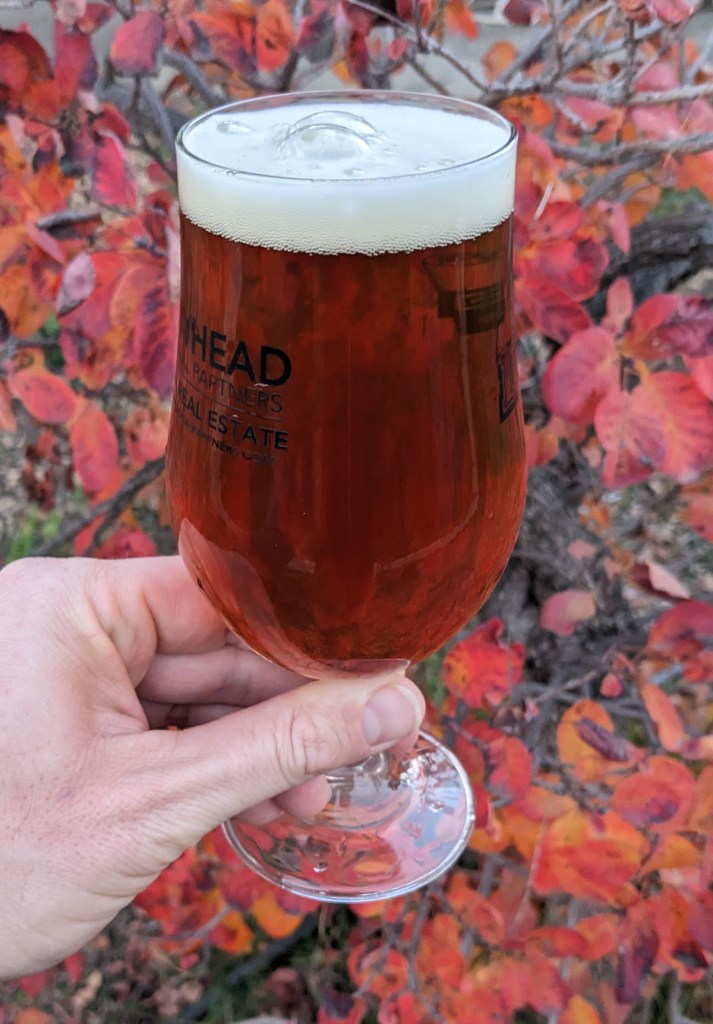
Live Oak Canyon Ale 2024

As is tradition, I crafted a special batch for the Thanksgiving celebration, a multi-day affair with friends and family. This is a time when I like to roll out a special batch, often a bigger beer that can be savored in smaller (or bigger) pours. Last winter, I experimented with a wood-aged imperial red IPA, and it was so good that I decided to roll it forward into this year’s Thanksgiving beer. It was an extra fun brewing session, in that I hosted my homebrew club to assist with the brew day!
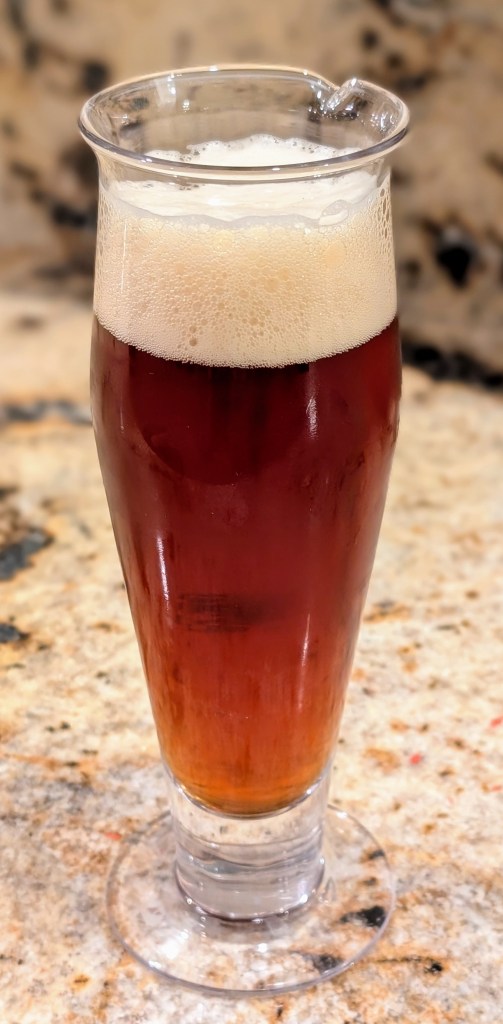
Stylistically, this is an imperial red IPA, or something like it. It’s very much a beer from yesteryear, in the thick of the IBU wars–big, bold, and unapologetically in your face. Versus the 2023 version, the 2024 edition is pretty much the same grist but different hops to reflect what I had on-hand. I used Moutere as my bittering hops, in order to finish out the ounce left in my hop stash; the addition of Centennial and Simcoe at the whirlpool and dry hop stages is different from last year (which used HBC 522 and Talus).

Live Oak Canyon Ale

  • 10.5 lb. 2-row malt (Briess)
  • 13 oz. caramel malt 120L (Briess)
  • 0.5 tsp. BrewTanB, added to mash
  • 1 oz. Moutere hop pellets (19.5% alpha), 60 minute boil
  • 0.25 tsp. BrewTanB, 10 minute boil
  • 0.75 lb. corn sugar, 5 minute boil
  • 1 Whirlfloc tablet, 5 minute boil
  • 2 oz. Centennial hop pellets (8.1% alpha), 15 minute whirlpool
  • 1 pkg. WLP001 (White Labs), California Ale dry yeast
  • 1 medium toast American oak Beer Stix carboy stick, added to primary and carried over to keg
  • 2 oz. Simcoe hop pellets (12.4% alpha), dry hop in keg

Target Parameters

  • 1.092 s.g., 1.015 f.g., 10.4% abv, 113 IBU, 17 SRM
  • Infusion mash, held at 152° for 60 minutes and 168° for 10 minutes, with sparge
  • Claremont tap water, with Campden tablet, adjusted with minerals to achieve 58 ppm Ca, 23 ppm Mg, 54 ppm Na, 155 ppm SO4, 60 ppm Cl, 10 ppm CO3, -47 ppm RA

Procedure

  • Starting with 5.6 gallons of water, I added 4 mL of 88% lactic acid to neutralize the carbonates. Then, I added 2 g epsom salts and 2 g gypsum, to achieve my target water profile.
  • I heated the strike water to 161°, added the grains, and hit a 152° mash temperature. I also added 4 mL of 88% lactic acid, to adjust the pH.
  • After a 60 minute mash and recirculation, I raised the mash temperature to 168° for 10 minutes, before pulling the grains.
  • I had neglected to pull the sparge water from the strike water, so I had to sparge with ~0.5 gallons of water, which topped up my volume a bit beyond that which was intended. This meant a longer boil.
  • In total, I collected 5.35 gallons of runnings with a gravity of 1.055, for 70% mash efficiency.
  • I boiled for 45 minutes before starting the formal timer, which meant a 105 minute boil total.
  • After the initial 45 minutes of boiling, I began adding hops and other finings per the recipe, with corn sugar added at the very end.
  • After the boil, I chilled the beer down to around 78°, before transferring to the fermenter and chilling to 64° in my fermentation chamber and pitching the yeast.
  • I brewed this beer on 12 October 2024; it had a starting gravity of 1.085. Once pitching the yeast, I fermented at 64°.
  • I soaked the oak stick in water overnight, and then put it into the microwave for around 90 seconds to flash steam and sanitize. I spritzed the oak with StarSan, before adding it to the fermenter. The oak was added to the primary fermenter on 15 October 2024.
  • I kegged the beer on 31 October 2024, adding the dry hops in a baggie and also transferring the oak to the keg. I left the beer at ambient for this phase.
  • Final gravity was 1.016, for 9.3% abv.
  • I left the keg at ambient until 6 November 2024, when I removed the dry hops and oak, moved the keg to the conditioning chamber, and let it condition and carbonate at 34°.

Tasting

  • Appearance
    • This is a deep reddish amber beer, very clear, which pours with a persistent and fine ivory head. It’s very pretty!
  • Aroma
    • The nose has a citrus and fresh pine hop aroma at a moderate level, with vanilla-type woodiness and light caramel behind that. The wood comes through more prominently as the beer warms, along with a light alcohol aroma.
  • Flavor
    • Very bitter, with resin and citrus pith qualities, and a hint of fresh orange zest; there is a modest level of woodiness as the beer warms up. A light and sweet caramel flavor is at the back end.
  • Mouthfeel
    • Medium body, moderate carbonation, dry finish.
  • Would I Brew This Again?
    • This is a good one! I think that last year’s version was maybe a touch better; perhaps Simcoe and Centennial don’t quite hit the mark for what the beer needs. The recipe upon which I based this beer used a mix of Simcoe and Mosaic, so I might try those in a future iteration. Either way, this is a highly drinkable beer for as big as it is, even if in the “sipping beer” category.
  • Overall
    • 9/10

Mahajanga Imperial IPA

It’s the cooler season here in SoCal, so I like a higher strength beer every once in awhile. To that end, I wanted to do an old-school double IPA–something with big malt and piney hop character. So, I returned to the Maharajah Imperial IPA recipe from Craft Beer for the Homebrewer, with my own paleontological spin on it. I made some malt and hop substitutions for what was on-hand, but overall it has the same feel as my previous version. I also added some dextrose to dry out the beer a touch; with the combo of darker malts, I didn’t want it to end up feeling syrupy. I aimed for a batch volume of around 3.5 gallons–firstly, because I don’t want 5 gallons of a beer with this high of alcohol, and secondly because I figured I would lose a bit of volume to the heavy hopping level.

Mahajanga Imperial IPA

  • 11 lb. 2-row malt (Rahr)
  • 6 oz. Special B malt (Dingemans)
  • 4 oz. Aromatic Munich Malt 20L (Briess)
  • 12 oz. dextrose
  • 1.5 oz. Centennial hop pellets (8.1% alpha), 60 minute boil
  • 1 oz. Amarillo hop pellets (10.5% alpha), 30 minute boil
  • 0.5 oz. Amarillo hop pellets (9.5% alpha), 30 minute boil
  • 1 tsp. BruTanB, 10 minute boil
  • 1 Whirlfloc tablet, 5 minute boil
  • 1.75 g yeast nutrient (WLN1000, White Labs), 5 minute boil
  • 1 oz. Centennial hop pellets (8.1% alpha), 5 minute whirlpool
  • 1 oz. Talus hop pellets (6.2% alpha), 5 minute whirlpool
  • 2 pkg. American West Coast Ale yeast BRY-97 (Lallemand)
  • 1 oz. Centennial hop pellets (8.1% alpha), dry hop in keg
  • 1 oz. LUPMAX Chinook hop pellets (17.0% alpha), dry hop in keg
  • 1 oz. Talus hop pellets (6.2% alpha), dry hop in keg

Target Parameters

  • 1.083 s.g., 1.011 f.g., 102 IBU, 12 SRM, 9.6% abv
  • Full volume mash at 149° for 60 minutes, 10 minute mash-out at 168°
  • Claremont tap water adjusted to hit target of 68 ppm Ca, 7 ppm Mg, 92 ppm Na, 108 ppm sulfate, 110 ppm chloride, 156 ppm bicarbonate

Procedure

  • I mashed in with 5.25 gallons of water at 158° and added 5.5 mL of 88% lactic acid, to hit a target rest temperature of 149°. I held it here for 60 minutes, before raising the temperature to 168°.
  • After the mash, I pulled the grains and sparged with about 0.75 gallons of hot water, to rinse the residual sugars out.
  • In total, I collected 5 gallons of runnings with a gravity of 1.060, for 70% mash efficiency. This is good on the one hand, but it meant I had to boil a little harder and longer to get the volume down.
  • I added 2 g of gypsum to the boil, to hit my water target, and also added the corn sugar at this time.
  • I boiled for around 75 minutes, adding the hops and finings per the schedule. After the boil, I chilled a few degrees and then added the whirlpool hops, recirculating for 10 minutes during this process.
  • I chilled the beer the rest of the way, down to around 68°, before transferring to the fermenter and adding the yeast.
  • Starting gravitry was 1.074, a bit short of my goal; I should have boiled a bit longer, because I had plenty of volume. I brewed this beer on 20 November 2022, and fermented at 68°.
  • I kegged the beer on 10 December 2022, with a final gravity of 1.012 and 8.3% abv. I’m pretty happy with that! I bagged the hops and added them to the keg. It didn’t take long for the beer to drop clear at serving temperatures!

Tasting

  • Appearance
    • Gorgeous! This is a beautifully clear beer–one of the quickest and best I’ve gotten for an IPA–that pours with a tall, persistent, fine, and off-white head.
  • Aroma
    • Pine and resiny hop aroma, with a hint of deep caramelly malt behind that. There is a very slight bit of alcohol apparent when warmed.
  • Flavor
    • High level of piney hop bitterness at the front, with a bit of citrus pith.
  • Mouthfeel
    • Medium body, medium carbonation. The beer has a very slightly dry finish, but not over the top dry.
  • Would I Brew This Again?
    • Yes! This beer is incredibly drinkable; a little too much so, in fact. It goes down smoother than its ABV allows, and there is no solventy alcohol character that sometimes happens in these kinds of homebrews. The end result was a classic “old school” IPA.
  • Overall
    • 10/10

Mahajanga IPA

Although my tastes tilt towards lower alcohol (<5.5% abv) beers, I like something a bit stronger as a treat now and then. I’ve previously enjoyed Avery Brewing Brewing Company’s Maharaja, a 10% abv double (triple?) IPA, and found a clone recipe in Craft Beer for the Homebrewer. I modified the hops in my version, with Chinook in place of Columbus and Centennial on the boil. On the dry hop end of things, I was much closer to the original recipe.

The name is a play on Avery’s brew, honoring a city in northwestern Madagascar where I spent a bit of time during my fieldwork in that country.

Mahajanga IPA

  • 10.5 pounds 2-row malt (Great Western)
  • 7 oz. biscuit malt (Dingemans)
  • 6 oz. crystal 120 (Great Western)
  • 1 oz. Chinook whole hops (13.1% alpha), 60 minute boil
  • 1 oz. Chinook whole hops (13.1% alpha), 30 minute boil
  • 1 lb. pilsen light dry malt extract, 10 minute boil
  • 1 Whirlfloc tablet, 5 minute boil
  • 1 tsp. Fermax yeast nutrient, 5 minute boil
  • 2 oz. Centennial hop pellets (8.1% alpha), 10 minute whirlpool
  • 1 pkg. Safale American Ale yeast (US-05)
  • 1 oz. Centennial hop pellets (8.1% alpha), dry hop in keg
  • 1 oz. Chinook whole hops (13.1% alpha), dry hop in keg
  • 1 oz. Simcoe hop pellets (13.6% alpha), dry hop in keg

Target Parameters

  • 1.088 o.g., 1.013 f.g., 10% abv, 113 IBU, 13 SRM
  • Claremont tap water, with 2 g of gypsum added at end of boil
  • Full volume mash, 90 minutes at 147°, mash out to 168°, ferment at 65°

Procedure

  • I mashed in full volume with ~5 gallons of water at 156°, to hit a mash temperature of 147°. I added ~4 mL of 88% lactic acid to adjust the mash pH.
  • After a 90 minute mash, I brought it up to 168° and held for 10 minutes before removing the grains.
  • I hit around 57% mash efficiency, with ~1.058 gravity for 4 gallons of runnings. This is pretty low, so I knew I would have to add a pound of DME.
  • I brought the runnings to a boil, adding hops, DME, and kettle finings per the recipe.
  • I added 2 g of gypsum at the end of the boil.
  • Approximately 3.4 gallons of wort went into the fermenter. I gave this 30 seconds of pure O2, and then pitched the yeast. It fermented at ambient (~64°).
  • I brewed the beer on 25 November 2020, and it had a starting gravity of 1.077.
  • I kegged the beer on 19 December 2020, adding the dry hops at that time. Final gravity was 1.014, for 8.5% abv. I’m thrilled that the beer attenuated fairly well!
  • I removed the dry hops on 27 December 2020, to avoid overhopping or harshness.

Tasting

  • Appearance
    • The beer has an orangish, burnished gold color; it’s slightly hazy, but not overly so. It pours with a persistent ivory head with really nice lacing.
  • Aroma
    • Slight caramel malt quality, and a prominent hop character of citrus rind and pine resin. There is no yeast character or hot alcohol character, which is awesome!
  • Flavor
    • The beer is quite bitter, with a grapefruit rind and pine resin character to the bitterness. The malt flavor is somewhat grainy, and relatively moderate compared to the hops. Yeast character is very clean. This is a hop-forward beer!
  • Mouthfeel
    • Medium-light body, with an off-dry finish and moderate carbonation.
  • Would I brew this again?
    • Overall, this is a great recipe that just requires some hop adjustment. The hop character is a bit one-dimensional, with the Chinook dominating everything else. If I rebrew this, I’ll go closer to the original recipe, and ditch Chinook for all but a small dry hop addition. The malt character is about perfect, with enough body to stand up to the hops. The yeast management was perfect on this one–it attenuated well, and the yeast character was clean rather than boozy or fusel-ridden.
  • Overall
    • 6/10