
I have made weissbiers (hefeweizens) a few times previously, with decent but not consistent results. This is a style that can be quite enjoyable or quite awful, so I invested some time into learning more of the underlying ingredients and techniques for a tasty, traditional recipe. An article at brau!magazine was incredibly useful, with lots of detailed suggestions. I reformulated my previous Humboldt’s Hefeweizen (because I like the name) for this batch.
My first big decision–perhaps the most important–was yeast choice and fermentation control. Without a good yeast character, you don’t have a good hefeweizen (in my opinion). I am fairly committed to using dry yeast whenever possible because the convenience can’t be beat, and I wanted to give Lallemand’s Munich Classic another chance. My previous attempt was okay, but had little of the yeast character I wanted. That batch was fermented cool (~65°), and I knew I should up the temperature a bit to get more “oomph” to the yeast. So, I aimed for 67°. Working backwards, I decided a ferrulic acid rest would be critical–my previous batch didn’t use that, and I think that factor also set back beer quality.
My second decision concerned the grist. Past beers were ~45 to 55 percent wheat, and I wanted to increase that. This time around, I aimed for over 60 percent wheat, in hopes that it would 1) be more true to style; and 2) tilt the head quality in a positive direction.
I had fun formulating the batch and figuring out what would give the best results. The end product was definitely worth it!
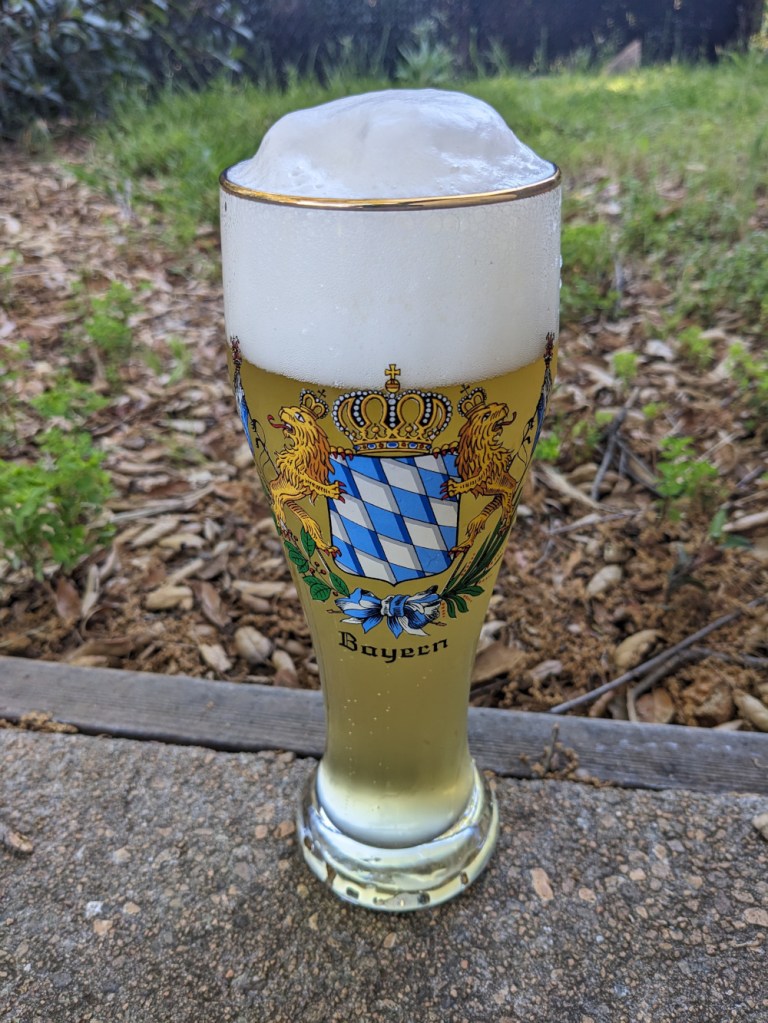
Humboldt’s Hefeweizen 2024
- 6.75 lb. red wheat malt (Briess)
- 4 lb. pilsner malt (Rahr)
- 0.5 lb. rice hulls
- 0.5 tsp. BrewTanB (mash)
- 1 oz. Sterling whole hops (4.5% alpha estimated), 45 minute boil
- 0.5 tsp. BrewTanB, 10 minute boil
- 1 tsp. yeast nutrient (White Labs WLN1000)
- 1 pkg. Munich Classic Wheat Beer yeast (Lallemand)
Target Parameters
- 1.049 o.g., 1.010 f.g., 5.2% abv, 14 IBU, 5 SRM
- Full volume mash, no sparge, 113° mash for 20 minutes, 145° mash for 45 minutes, 162° mash for 30 minutes
- RO and Claremont tap water, mixed to hit 10 ppm Ca, 4 ppm Mg, 18 ppm Na, 16 ppm SO4, 19 ppm Cl, 3 ppm CaCO3, RA=-7, effective hardness=10 ppm.
Procedure
- I collected 2.5 gallons of Claremont tap water and neutralized it with 1.76 mL of 88% lactic acid and a small bit of Campden tablet. Then, I added 5 gallons of RO water, to hit my mash water profile.
- I started the mash at 113° for 20 minutes, to enable a ferulic acid rest. Then, I raised the mash to 145° for 45 minutes, and finally ended at 162° for 30 minutes. Once the mash was done, I pulled the grains and heated the runnings to a boil.
- The kettle had 6.6 gallons of runnings with a gravity of 1.040, for 65% mash efficiency. This was a touch lower than I anticipated, but that may be due to the high amount of wheat.
- Once the kettle was boiling, I added finings per the schedule and then turned off the heat after 60 minutes. A slightly greater boil vigor was used to increase gravity. I chilled the wort to 66° and then transferred to the fermenter.
- I brewed this beer on 14 April 2024. Starting gravity was 1.048, nearly exactly to target.
- After pitching the yeast, I started fermentation at ambient for a few hours, and then transferred the fermenter into my fermentation chamber set for 67°. Fermentation seemed to take off pretty quickly!
- I kegged the beer on 24 April 2024. The beer had an amazing aroma–a decent amount of spicy phenol and a hint of banana; exactly what I was looking for! I carbonted to a higher level, around 3.5 volumes of CO2.
- Final gravity was 1.014, for 4.4% abv.
Tasting
- Appearance
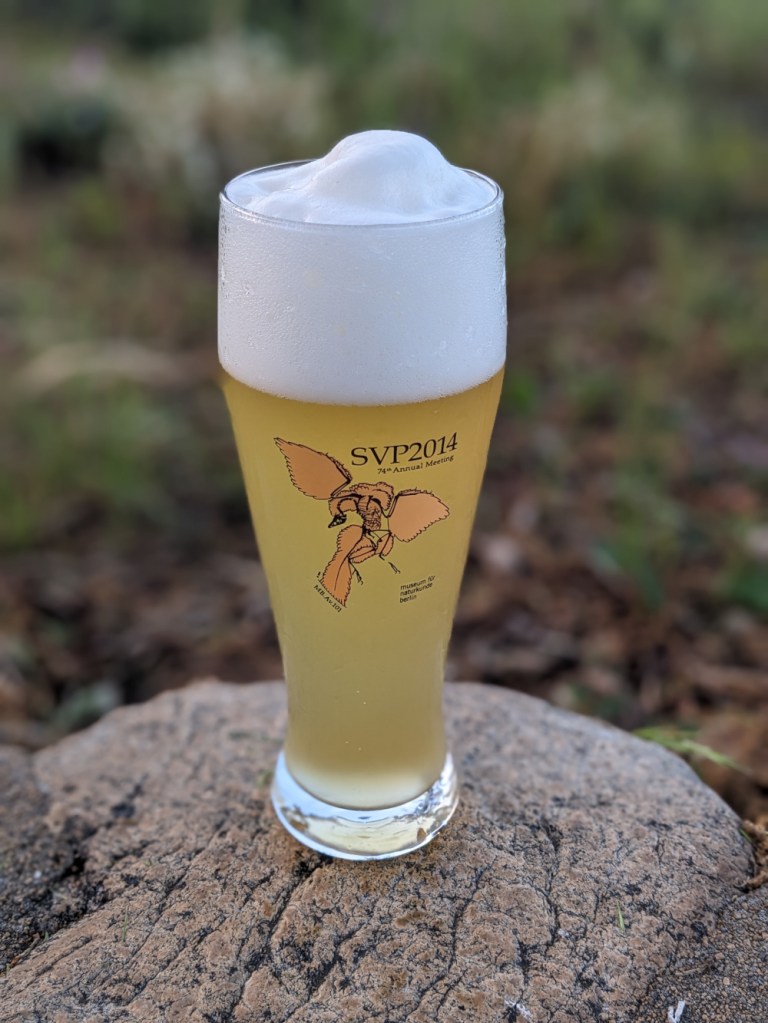
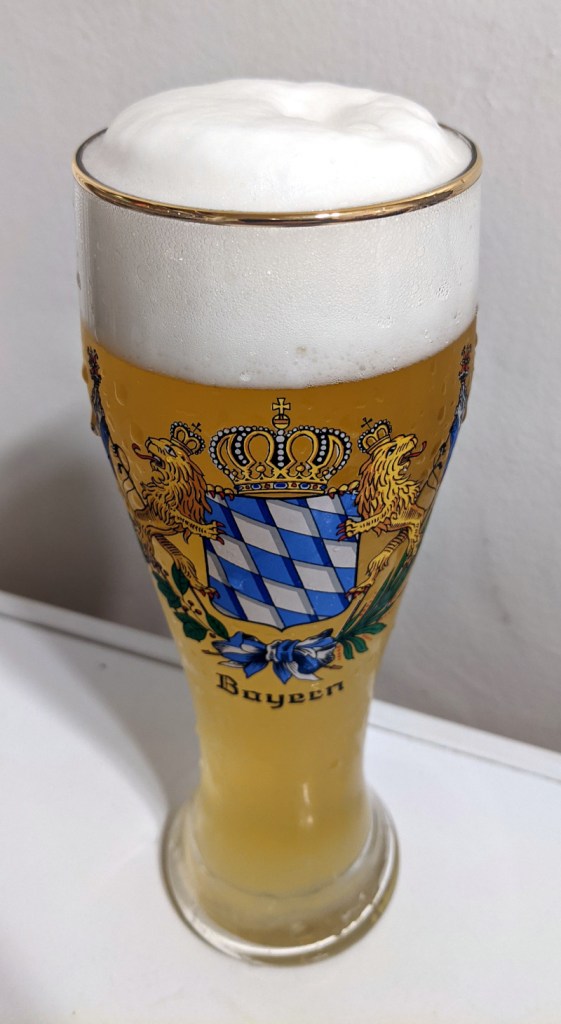
- Pours with a merangue-like, tall, gorgeous white head that sticks around for ages and leaves gorgeous lacing on the glass. The beer itself is straw yellow and hazy beer. It’s exactly as a fresh hefeweizen should be!
- Aroma
- Yeast at the forefront, with a medium-high level of yeast character–primarily clove plus a touch of banana.
- Flavor
- Even balance of clove and banana, and a light dough malt character behind that. Low level of bitterness.
- Mouthfeel
- Light body. medium-high carbonation, smooth, lightly dry finish (from the hops?).
- Would I brew this again?
- This is the best hefeweizen I have made. Everything ran perfectly, and I wouldn’t change a thing. The yeast quality is perfect, head is perfect, all is amazing. It had a sulphur aroma and flavor early on; this faded in a few days.
- Overall
- 10/10
 Andy's Brewing Blog