
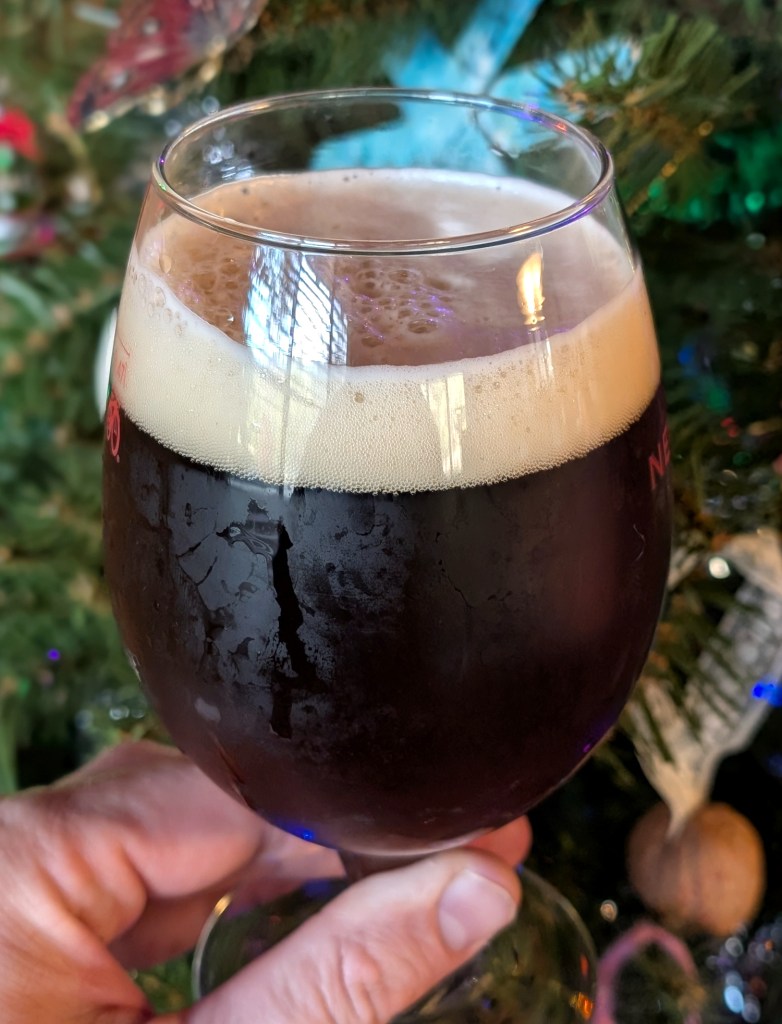
I like to make a holiday beer every once in awhile, for drinking during the Christmas and New Year’s stretch. It’s an opportunity to do a smaller batch of something unusual, which might not warrant a full 5 gallons. This year, I chose a version of a recipe from Gordon Strong’s Modern Homebrew Recipes, called “Winter in Antwerp.” It’s a spiced Belgian ale, roughly in the realm of a dark pale ale (yes, that’s an oxymoron). I made some malt substitutions and also used the Abbaye dry yeast, although the overall “feel” is pretty close.
Winter in Antwerp 2024
- 4 lb. 2-row brewer’s malt (Great Western)
- 2 lb. Vienna malt (Weyermann)
- 0.5 lb. aromatic malt 20L (Briess)
- 0.5 lb. caramel malt 60L (Briess)
- 0.5 lb. Caramunich II (Weyermann)
- 0.5 lb. Munich dark malt (Viking)
- 0.25 lb. biscuit malt (Dingemans)
- 2 oz. chocolate malt (Bairds)
- 2 oz. Special B malt (Dingemans)
- 0.5 oz. Liberty hop pellets (5.0% alpha), 60 minute boil
- 1 oz. Liberty hop pellets (5.0% alpha), 10 minute boil
- 0.5 oz. Liberty hop pellets (5.0% alpha), 5 minute boil
- 1 vanilla bean, split, scraped, and steeped for 5 minutes after the boil
- 1 cinnamon stick, steeped for 5 minutes after the boil
- 1 pkg. Abbaye Belgian ale yeast (Lallemand)
Target Parameters
- 1.068 s.g., 1.021 f.g., 6.2% abv, 30 IBU, 24 SRM
- Full volume infusion mash, held at 156° for 60 minutes and 168° for 10 minutes
- Claremont tap water with Campden tablet, with approximate ppm of 110 Cl, 50 SO4, 40 Ca, 156 HCO3, 12 Mg, 87 Na
Procedure
- I heated 5 gallons of water (with Campden tablet) to 163°, and then mashed in the grains. I held the mash temperature, with recirculation, at 156° for 60 minutes before raising the temperature to 168° for a 10 minute mashout.
- Once I pulled the grains, I collected 4.5 gallons of runnings at a gravity of 1.049, for 71% mash efficiency.
- I brought the runnings to a boil, adding hops and finings per the recipe. After 60 minutes, I turned off the heat and added the spices in a mesh bag. Because the cinnamon was a bit old, I added two sticks (broken up). After a 5 minute steep, I removed the spices and continued the chilling process.
- I chilled the wort to 78° before transferring to the fermenter. I chilled the rest of the way, down to 68°, in the fermentation chamber. I pitched the yeast at 68°, holding at this temperature for fermentation. Expecting a vigorous fermentation, I used a blow-off tube.
- Starting gravity was 1.065. I brewed this beer on 17 November 2024.
- I kegged the beer on 30 November 2024. Final gravity was 1.024, for 5.4% abv.
Tasting

- Appearance
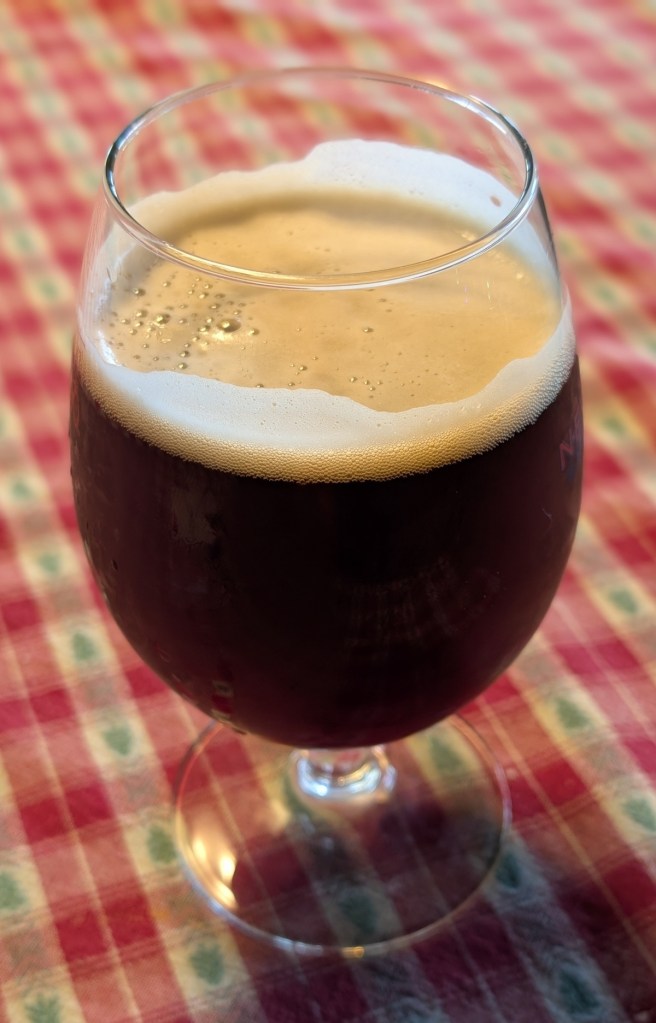
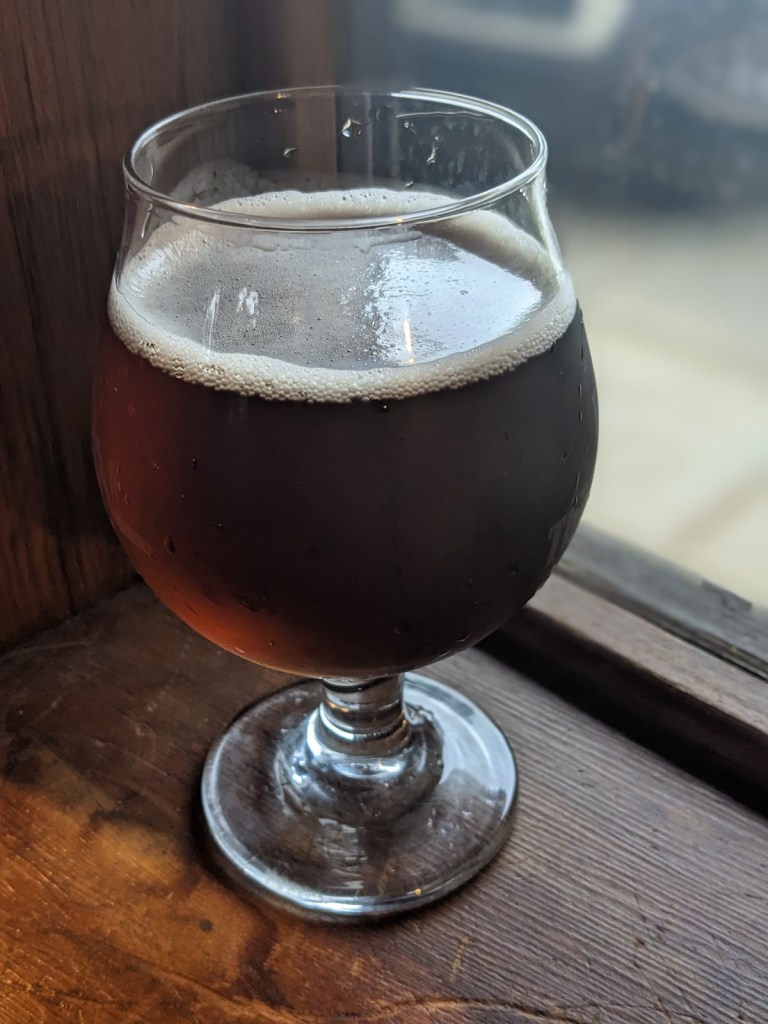
- Deep reddish amber beer, very clear; pours with a creamy and persistent ivory head. It’s very pretty!
- Aroma
- Some dried dark fruit character as the beer warms and a hint of very ripe banana. Rich maltiness, but just a hint. Very faint cinnamon as it warms.
- Flavor
- Bread crust malt character, dried dark fruit in the yeast, medium level of bitterness. Less complex than I expected!
- Mouthfeel
- Medium body, medium high carbonation, very slightly dry finish.
- Would I Brew This Again?
- This is a good beer but nothing special. I was hoping for a bit more spice character, but there isn’t really any. I would probably increase the spicing rate a touch. For a similar beer next time, I would condition longer. It needs more body and malt “oomph”! Given all of the crystal malts, I’m surprised it doesn’t give the impression of more body. Perhaps for this kind of beer, it would benefit from a higher starting gravity or swapping in Munich for the 2-row malt. I would also age it for awhile longer. Another challenge is that I have this beer in my conditioning chamber, at around 35°, so it takes awhile to warm up after pouring. It’s definitely better at warmer temperatures!
- Overall
- 6/10
 Andy's Brewing Blog