Byzantium IPA

With the summer months closing out, I wanted to do a final kveik batch. I targeted a 3 gallon yield, because I didn’t want to have a ton of higher-abv beer. Additionally, I made this a “quicker brew” session, by reducing the boil time to 45 minutes. I have no particular reason for the name, other than that it sounded cool.

Byzantium IPA

  • 8.25 lb. 2-row malt (California Select, Great Western)
  • 0.25 lb. 10L caramel malt (Briess)
  • 0.55 oz. CTZ (Columbus/Tomahawk/Zeus) hop pellets (15.8% alpha), first wort hop
  • 1 oz. Simcoe hop pellet (12.7% alpha), 5 minute boil
  • 0.65 oz. Centennial hop pellet (8.1% alpha), 5 minute boil
  • 1 tsp. yeast nutrient (WLN1000, White Labs), 5 minute boil
  • 1 Whirlfloc tablet, 5 minute boil
  • 1 pkg. Voss Kveik Ale Yeast (Lallemand)
  • 1 oz. Centennial hop pellets (8.1% alpha), 2 day dry hop
  • 1 oz. Simcoe hop pellets (12.7% alpha), 2 day dry hop

Target Parameters

  • 1.067 s.g., 1.013 f.g., 7.2% abv, 66 IBU, 5 SRM
  • 149° mash, 60 minutes, with 10 minute mash-out at 168°, and 1 gallon sparge
  • Claremont tap water with 3 g gypsum and 2 g epsom salt added at boil, to hit add 3 g gypsum, 2 g epsom salt to water just before boil, to hit 71 Ca, 21 Mg, 93 Na, 180 SO4, 105 Cl, 156 HC03, 65 RA, 128 ppm Alkalinity

Procedure

  • I mashed in with 4 gallons of water at 156°, adding 5 mL of 88% lactic acid. This hit a target mash temperature of 149°, and I held it here (with recirculation) for 60 minutes. After 60 minutes, I mashed out to 168°. I pulled the grain basket, and sparged with just under a gallon of hot water.
  • In total, I collected 4 gallons of runnings at a gravity of 1.057, for 73% mash efficiency. Nice!
  • I added gypsum, epsom salt, and the CTZ pellets, brought the wort to a boil, and added hops and such per the schedule. After 45 minutes, I turned off the heat and chilled to ~90°.
  • I transferred ~3.25 gallons of wort at a starting gravity of 1.064 into the fermenter, and pitched the yeast.
  • I brewed the beer on 21 August 2021, letting it sit at ambient, which was around 85°.
  • Fermentation took off quickly, overflowing the airlock (oops). I added the dry hops directly to the fermenter (with no bag) on 1 September 2021, and then kegged on 3 September 2021.
  • I kegged the beer using a semi-closed transfer, and the hops were quite a pain. I had some issues with clogged lines, etc. I probably should have cold-crashed to drop the hops out of the beer, or else bagged them in the first place. Ah well.
  • Final gravity was 1.014, for 6.6% abv.
  • To help clear the beer and hurry it towards serving, I added 0.5 tsp of gelatin in 0.75 cups water on 4 September 2021. At this time, I also agitated keg to finish carbonation.

Tasting

  • Appearance
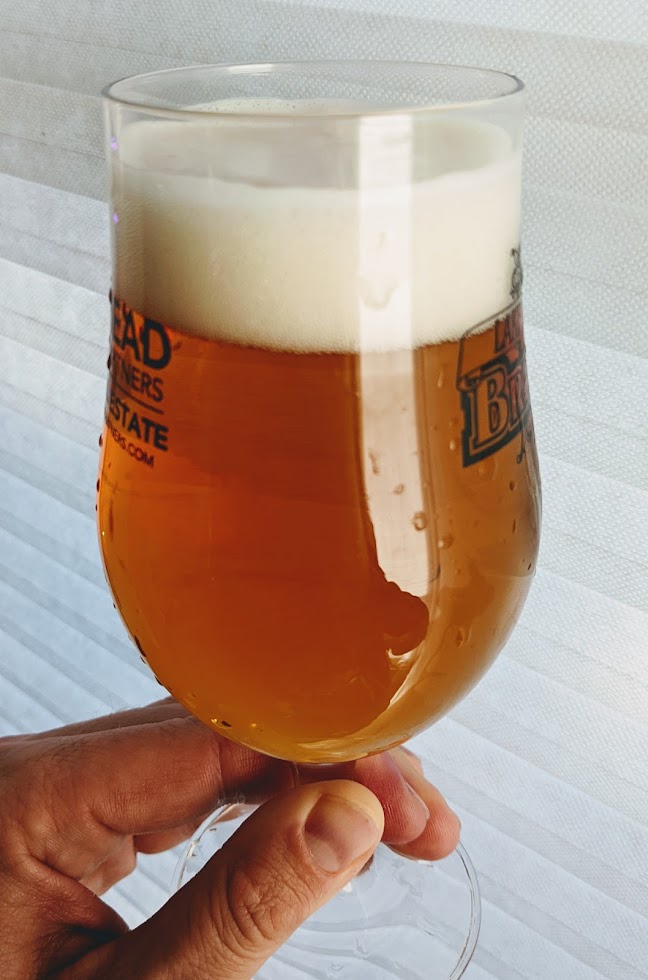
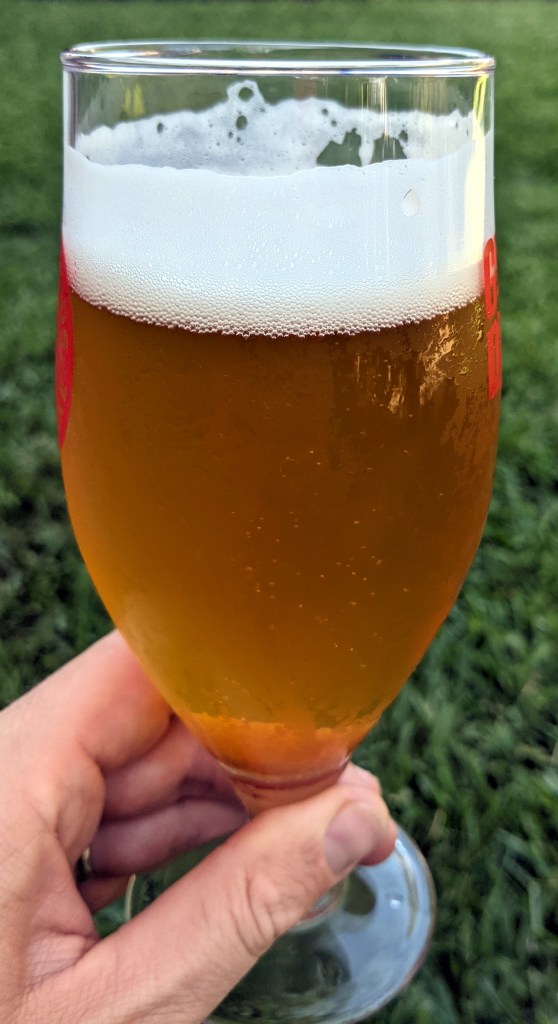
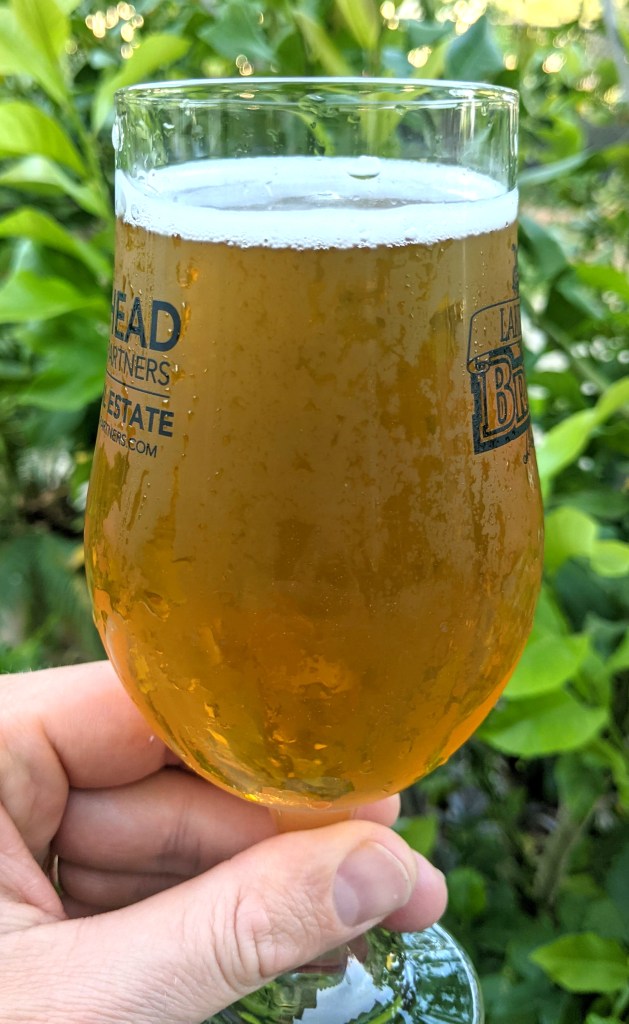
    • This is a gold-colored beer with a slight haze; it pours with a quite persistent white head that leaves nice lacing on the side of the glass.
  • Aroma
    • The beer has a light citrus character for hops and a slight caramel malt aroma. There is no major yeast character, so the overall aroma is pretty clean. I would say it could use a little more hop character.
  • Flavor
    • The flavor is has a high level of bitterness, with a citrus pith character and a little bit of orange. The malt is in the background, with a slightly grainy aspect. There is a light…tartness?…in the yeast profile, that adds a bit of interest.
  • Mouthfeel
    • The beer has a medium-light body, moderate carbonation, and a dry finish.
  • Would I brew this again?
    • This is a worthy experiment…definitely better than the other kveik IPA I did, which suffered from clashing hops, malt, and yeast in initial tastings, and never quite came together even as it matured. I think the hop selection works better here, although as before I probably should use a more character-rich base malt such as Maris Otter. My hop handling also wasn’t great on this one, which I think dinged it a bit also. I should probably just add the hops in a bag next time. I lost volume as well as introduced a bit of O2 while messing around trying to clear clogs. That aside, it is a pretty beer.
  • Overall
    • 6.5/10

Pannotia White IPA 2021

It’s been two years since I last brewed my white IPA (the original hazy IPA!), so now is as good of a time as any to make it again. The recipe I used this year isn’t too far off from my previous one.

Pannotia White IPA 2021

  • 6.75 lb. Viking 2-row Xtra pale malt
  • 2.5 lb. white wheat malt (Briess)
  • 1 lb. white wheat malt (Great Western)
  • 1.5 lb. Viking Pilsner Zero Malt
  • 1 lb. flaked wheat
  • 0.75 lb. flaked oats
  • 0.5 lb. rice hulls
  • 1 oz. Amarillo hop pellets (9.5% alpha), 60 minute boil
  • 0.25 oz. Magnum hop pellets (10.1% alpha), 60 minute boil
  • 2.62 g (1 tsp.) WLN1000 yeast nutrient (White Labs), 5 minute boil
  • 0.35 oz. bitter orange peel, 1 minute boil
  • 0.15 oz. coriander seed, 1 minute boil
  • 1 oz. Amarillo hop pellets (9.5% alpha), 10 minute whirlpool
  • 1 oz. Citra hop pellets (12.8% alpha), 10 minute whirlpool
  • 1 oz. Galaxy hop pellets (13.4% alpha), 10 minute whirlpool
  • 1 pkg. Whiteout Belgian Ale Yeast (Imperial Yeast #B44)
  • 1 oz. Citra hop pellets (12.8% alpha), dry hop in keg
  • 1 oz. Galaxy hop pellets (13.4% alpha), dry hop in keg
  • 1 oz. Mosaic hop pellets (11.2% alpha), dry hop in keg

Target Parameters

  • 1.062 o.g., 1.015 f.g., 6.2% abv, 60 IBU, 4 SRM
  • 60 minute full volume mash at 152°, with mash-out at 168°
  • Claremont tap water, with 8 g gypsum

Procedure

  • I mashed in with 7.5 gallons of water at 159°, to hit a mash temperature of 152°. I added 5.5 mL of 88% lactic acid to adjust the pH.
  • After 60 minutes (with recirculation), I raised the temperature to 168° and held it there for 10 minutes, before removing the grains.
  • In total, I collected 6.3 gallons of runnings with a gravity of 1.051, for 64% mash efficiency.
  • I added the gypsum to the kettle and brought the runnings to a boil, adding hops and finings per the recipe. After a 60 minute boil, I turned off the heat, whirlpooled the final hop addition, and then chilled down to around 75°, before transferring to the fermenter.
  • I chilled the wort the rest of the way down to ~66°, before pitching the yeast.
  • I brewed this beer on 15 May 2021, and fermented at 66°. Starting gravity was 1.058.
  • On 24 May 2021, I raised the fermenter to ambient, around 75°.
  • On 29 May 2021, I kegged the beer. Final gravity was 1.015, which works out to 5.7% abv. I added the hops in a bag, and chilled the beer down to 33°, removing the hops on 1 June 2021.

Tasting

  • Appearance
    • Light gold, with a moderate haze that has dropped fairly clear over the weeks it was on tap. The beer pours with a frothy and persistent white head.
  • Aroma
    • Light citrus hop character, with spicy yeast phenols and light coriander.
  • Flavor
    • The beer has an up-front citrus bitterness with citrus zest and pithy character. There is a light malty/doughy malt character, and a nice spicy yeast character as appropriate for a Belgian wit yeast.
  • Mouthfeel
    • The beer has a medium-light body, moderate carbonation, and a dry finish. It’s pretty good!
  • Would I brew this again?
    • Yep! This is a nice recipe. The beer is best before too much yeast settles out, and I think it would be tasty with a touch more carbonation, but even after a month or two in the keg, it’s still a very drinkable beer.
  • Overall
    • 9/10

Pliny the Elder Clone

Pliny the Elder is probably one of the most highly regarded and sought-after beers in the US, but I think I’ve only had it once. I remember it being pretty good, but not mind-blowing…but then again, that was awhile ago. Even so, I thought it would be fun to make a clone to fill the “high ABV beers” space for a little while.

The clone recipe is from the Brew Your Own Big Book of Homebrewing, although various versions are fairly readily available elsewhere. I scaled it down to ~3 gallons, because I didn’t really want a massive quantity of something around 8 percent abv.

Pliny the Elder Clone

  • 7.75 lb. 2-row Xtra pale malt (Viking)
  • 4 oz. Carapils malt (Briess)
  • 3 oz. caramel 40L malt (Briess)
  • 9.6 oz. corn sugar (added to boil)
  • 2.55 oz. Magnum hop pellets (10.1% alpha), 90 minute boil
  • 0.3 oz. Chinook whole hops (13.1% alpha), 90 minute boil
  • 0.65 oz. CTZ hop pellets (15.8% alpha), 45 minute boil
  • 0.6 oz. Simcoe hop pellets (12.7% alpha), 30 minute boil
  • 1.35 oz. Centennial hop pellets (8.1% alpha), 15 minute whirlpool
  • 0.6 oz. Simcoe hop pellets (12.7% alpha), 15 minute whirlpool
  • 1 pkg. Safale American ale yeast (US-05)
  • 2 oz. Columbus (Tomahawk) hop pellets (14.2% alpha), dry hop in keg
  • 1 oz. Centennial hop pellets (8.1% alpha), dry hop in keg
  • 1 oz. Simcoe hop pellets (12.7% alpha), dry hop in keg

Target Parameters

  • 1.071 s.g., 1.010 f.g., 8.2% abv, 276 IBU (100+ IBU at best!), 5 SRM
  • Claremont tap water with Campden tablet to remove chloramine
  • Infusion mash at 150° for 60 minutes, with pour-over sparge

Procedure

  • I mashed in with 3.75 gallons of water at 159° and 4 mL of 88% lactic acid, to hit a mash temperature of 150° for 60 minutes, with recirculation after 10 minutes. Then, I heated to 168° and held there for 10 minutes. Then, I removed the grain basket, and sparged slowly with 1.6 gallons of hot water.
  • After the mash, I collected 4.75 gallons of runnings with a gravity of 1.054, for 79% mash efficiency. Sparging seems to be the ticket for great efficiency in these high gravity small batch mashes.
  • I brought the runnings to a boil, adding hops and finings per the recipe.
  • After a total of 90 minutes on the boil, I chilled down to 70°, transferred to the fermenter, and pitched the yeast.
  • I brewed this beer on 10 April 2021. Starting gravity was 1.072, right about where I wanted it! I fermented at 66°.
  • I kegged the beer on 23 April 2021, and dry hopped with a sack of hops in the keg. There was quite a bit of trub on the bottom of the fermenter!
  • Final gravity was 1.015, for 7.6% abv.

Tasting

  • Appearance
    • The beer has a rich gold color, with a slight chill haze. It took about two weeks in the keg before it dropped fairly clear. There is a low ivory head that is fine and fairly persistent.
  • Aroma
    • The aroma is hop forward, with an initial citrus and very slight tropical fruit character, and a light caramel malt quality. Fermentation profile is pretty clean.
  • Flavor
    • The flavor is very hop forward, with a high level of bitterness (no surprises). The bitterness has a citrus pith character, with slight grapefruit, and fairly clean. The bitterness is not quite as complex as I might like. The malt character is fairly low, with a slight doughy character.
  • Mouthfeel
    • The beer has a medium body with moderate carbonation, and an extended bitter finish that isn’t overly dry. I feel that the body could be a bit lighter on this one.
  • Would I brew this again?
    • The beer is okay, but the hops feel a bit one-note. This is a surprise, given the quantity of hops involved as well as the dry hop in the keg. I might switch in some more aggressively tropical hops next time, to make this a bit more interesting. I would also mash this at a slightly lower temperature, to dry out the final product a bit. Finally, I would adjust my dry hop strategy–this quantity of hops really generates a lot of detritus, even after sitting for awhile, and I think it would be better served by dry hopping in the fermenter with a careful transfer under CO2.
  • Overall
    • 5/10

Dance Party IPA

This one was a total experiment for me! Experimental hops, experimental yeast, and experimental fermentation. My local homebrew shop had a new variety called Samba, with tropical characters that sounded pretty neat! So, I picked up a few ounces for a batch. I also had been meaning to try out Lallemand’s new dry Voss kveik strain, so grabbed some of those packets.

For this beer, I wanted a tropical/citrus character and fairly light drinkability, alongside a “full-strength” IPA. So, I combined Centennial, Samba, and Simcoe for a whirlpool as well as a dry hop addition.

Dance Party IPA

  • 12.5 lb. 2-row Xtra Pale Malt (Viking)
  • 0.75 lb. Carapils malt (Briess)
  • 1 oz. Magnum hop pellets (10.6% alpha), 60 minute boil
  • 1 Whirlfloc tablet, 5 minute boil
  • 1 oz. Centennial hop pellets (8.1% alpha), 15 minute whirlpool
  • 1 oz. Samba hop pellets (11.6% alpha), 15 minute whirlpool
  • 1 oz. Simcoe hop pellets (12.7% alpha), 15 minute whirlpool
  • 1 pkg. Voss Kveik Ale dry yeas (Lallemand)
  • 1 oz. Centennial hop pellets (8.1% alpha), dry hop in keg
  • 1 oz. Samba hop pellets (11.6% alpha), dry hop in keg
  • 1 oz. Simcoe hop pellets (12.7% alpha), dry hop in keg

Target Parameters

  • 1.059 s.g., 1.013 f.g., 6.1% abv, 62 IBU, 4 SRM
  • Claremont tap water, with Campden tablet and 5 g of gypsum added at the boil, to bump up the bitterness
  • 60 minute full volume infusion mash, 152°

Procedure

  • I mashed in with 7.25 gallons of water at 159°, to hit a mash temperature of 152°. I added 6 mL of 88% lactic acid, to adjust the mash pH.
  • After a 60 minute mash with recirculation at 152°, I bumped up the temperature to 168° for a 10 minute mash-out.
  • Following the mash, I removed the grain basket and brought the kettle to a boil.
  • In total, I had 6.3 gallons with a gravity of 1.050, for 66% mash efficiency. I added 5 g of gypsum to the boil, to bump up the sulfate.
  • I boiled for 60 minutes, adding finings and hops per the schedule.
  • After the boil, I did a 15 minute whirlpool at around 195°, and then chilled down to 90° and transferred to the fermenter.
  • Starting gravity was 1.050. I brewed this beer on 27 March 2021.
  • I pitched the packet of yeast directly, and began fermentation at 90°. After 18 hours, I raised the temperature to 95°, and then raised to 100° at the 24 hours mark after yeast pitch. After 72 hours, I lowered the temperature to 90°.
  • I kegged the beer on 7 April 2021, with the dry hops floating loose in the keg and a screen on the floating dip tube to filter out hops.
  • Final gravity was 1.013, for 5.8% abv.

Tasting

I didn’t have time to do a formal tasting on this one before the keg was kicked, but have a few general perceptions. First, the fermentation had a super clean character, and the kveik lives up to its reputation. I would totally do this fermentation profile again! Second, I really enjoyed the hop combo, but think that I probably overbittered it a bit, and the hops drowned out any potential malt character. There was a touch of astringency from the dry hops also, at times, which I think also detracted from the final flavor. So, if I redo this kind of IPA I might use a more character-rich base malt such as Vienna or Maris Otter and maybe a touch more of a crystal malt (e.g., crystal 20 or even crystal 40). That aside, the Samba hops did live up to their tropical reputation, and played well with the rest of the hops. It might be interesting to switch up the hop combos; I think this beer would be great with any combo of Samba, Citra, and/or Mosaic.

So…I would probably do this again, but modify things significantly. It was definitely worth the experiment, and I’ll likely dive into more kveik fermentations this summer! I give the beer itself a 5/10…not awful, but not quite where I want it to be either.

English IPA

Two years ago I made a down-the-middle English IPA, which was a super satisfying beer. I decided it was time to do a re-brew, with slight modifications for my upgraded brewing system as well as ingredients on-hand.

deep gold beer in clear glass

English IPA

  • 12 lb. Maris Otter ale malt (Crisp)
  • 10 oz. white wheat malt (Briess)
  • 8 oz. biscuit malt (BlackSwaen)
  • 6 oz. crystal 120 malt (Great Western)
  • 6 oz. crystal 60 malt (Great Western)
  • 1 oz. Magnum hop pellets (10.1% alpha), 60 minute boil
  • 1 oz. East Kent Goldings (EKG) hop pellets (5.0% alpha), 15 minute boil
  • 1 oz. Fuggles hop pellets (4.7% alpha), 15 minute boil
  • 1 Whirlfloc tablet, 5 minute boil
  • 1 oz. East Kent Goldings (EKG) hop pellets (5.0% alpha), 10 minute whirlpool
  • 2 pkg. Nottingham ale yeast (Lallemand)
  • 3 oz. East Kent Goldings (EKG) hop pellets (5.0% alpha), dry hop in keg

Target Parameters

  • 1.063 s.g, 1.016 f.g., 6.2% abv, 51 IBU, 12 SRM
  • Full-volume infusion mash, 154° for 60 minutes
  • Water built from Claremont tap water with mineral additions.

Procedure

  • I heated 7.5 gallons of water to 163°, adding 8 g of gypsum and a Campden tablet.
  • I mashed in with the grains, maintaining the temperature at 154° for 60 minutes. Next, I raised the temperature to 168° for the mashout.
  • In total, I collected 6.4 gallons of runnings with a gravity of 1.054, for 67% mash efficiency. This is pretty close to my target, so I’m quite happy with this result.
  • I boiled for 60 minutes, adding hops and kettle finings per the recipe. After the boil, I chilled and transferred to the fermenter.
  • I brewed this beer on 16 January 2021. It had a starting gravity of 1.064. I fermented at 66°.
  • I kegged the beer on 13 February 2021, putting the hops in a baggie in the keg. Final gravity was 1.019, for 5.9% abv.

Tasting

  • Appearance
    • Clear with a deep gold color; the thin white head is moderately persistent.
  • Aroma
    • Malt, light caramel character, with a low level of fruity yeast character. The hop aroma is a bit underwhelming, with little to speak of.
  • Flavor
    • Moderately high, slightly herbal bitterness, but not over the top. It is a moderately-high malty beer, with a bit of caramel and toffee in the malt character. The bitterness is really smooth, and very nicely balanced against the malt.
  • Mouthfeel
    • Medium-full body with moderate carbonation and an off-dry finish. The beer is very smooth for the level of bitterness!
  • Would I Brew This Again?
    • This is a pretty good beer overall. The color and clarity are gorgeous, as is the malt character. I would like a bit more hop aroma in the nose and a bit more hop flavor, beyond just the bitterness. I might try switching up the dry hop combination for future versions.
  • Overall
    • 7/10