
I’ve never made a gose before! This confession is probably not terribly surprising for those who know my brewing preferences, because I find most sour beers a little too annoying to deal with. Kettle sours take time, and other sour processes are prone to contamination of subsequent batches in the same equipment. Plus, I find many sours just a little too sour to be drinkable beyond a half glass. That said, gose is only lightly tart and lower alcohol, which puts it into the space of beers I enjoy. I think the main thing deterring me from the style in the past was the annoyance of having to dial in the sourness without overshooting (undershooting?) the pH.
Then, I spotted a neat recipe in the January 2025 Zymurgy magazine–a brew called “Salty One Gose” that won gold in the European Sour Ale category at NHC 2024. Crafted by Jonathan Hernandez of Waterville, Maine, the beer drew my interest because it used kettle soured sauergut added to the main kettle in order to hit the perfect level of sourness. So, you’re essentially blending wort for a desired result.
I modified this beer only slightly from the original recipe. The published version was 6 gallons, so I reduced it towards a 5.25 gallon batch. I also adjusted the amount of pilsner malt required downwards, anticipating high efficiency (as is typical of my batches with minimal grain volumes). I used a mix of Viking and MCM malt, because I had a pound of the latter on-hand to use up. Finally, I used whole Saaz hop cones from South Dakota; hops are a minor consideration for this style, so I wasn’t too concerned about alpha level, aroma, or flavor.
Coriander choice took some thought–although I have it on-hand for cooking, it had been in the pantry for a few years, and I was worried about freshness. So, I ordered a small quantity online; the package didn’t document origin of the spice, but when I smelled the crushed seeds they had the fresh lemon quality I was looking for.
Recipe Name
- 1 gallon sauergut (added to kettle at boil)
- 1 lb. pilsen light DME (Briess)
- 1 pkg. Wildbrew Sour Pitch (Lallemand)
- 3.5 lb. white wheat malt (Briess)
- 2.5 lb. pilsner zero malt (Viking)
- 1 lb. pilsner malt (Montana Craft Malting)
- 2 oz. rice hulls
- 0.5 tsp. BrewTanB, added to mash
- 1 oz. Saaz whole hops (est. 1.5% alpha), 60 minute boil
- 0.5 tsp. BrewTanB, 10 minute boil
- 8 g. coriander seed, crushed, 10 minute boil
- 13.1 g kosher salt, added at end of boil
- 1 pkg. Köln Kölsch-style yeast (Lallemand)
Target Parameters
- Full volume mash with 5 minute rest at 131°, 40 minute rest at 147°, 30 minute rest at 161°, and 10 minute rest at 168°
- 1.042 o.g., 1.007 f.g., 4.6% abv, 5 IBU, 3 SRM
- Mash water adjusted to 37 ppm Ca, 20 ppm SO4, and 51 ppm Cl.
Procedure
- Two days before the primary brew day (April 3), I measured out 1.1 gallons of RO water (4.164 kg), added 1 lb. of Briess pilsen light dry malt extract, 1.5 tsp. (7.5 mL) of 88% lactic acid, and then boiled this for 4 minutes. Next, I chilled the wort to 90°, before pitching the entire packet of the lacto culture.
- I started the initial culture on the evening of 3 April 2025, kept a heating pad under it, and wrapped it in a blanket, to hold temperature at 85° to 90°.
- By April 5, the pH looked to be around 3.2 or 3.3 as measured by pH strips. This was brew day!
- I mashed in with 6.5 gallons of RO water and mineral adjustments, with 0.9 g gypsum and 2.6 g calcium chloride. I heated the strike water to 134°; once the grains were added, I held the temperature at 131° for 5 minutes, before heating to 147° for 40 minutes, raising to 161° for 30 minutes, and then mashing out at 168° for 10 minutes.
- Because I had such a low volume of grains, I had exceptional mash efficiency at 1.034 with 6.9 gallons, for 89% mash efficiency.
- As the main runnings were coming to a boil, I boiled the saurgut prepared earlier and added it to the kettle, getting a pre-boil gravity of 1.035.
- I brought the kettle to a boil, adding hops, BrewTanB, coriander, and salt per the recipe. After a full 90 minute boil, I turned off the heat and chilled to 72° before transferring to the fermenter.
- I chilled the wort to 64° in the fermenter, holding it at that temperature for initial fermentation.
- I brewed the beer on 5 April 2025, and had a starting gravity of 1.043.
- I kegged the beer on 18 May 2025, with closed transfer. Final gravity was 1.009, for 4.5% abv.
- My tasting at the time of kegging showed it to be an exceptional beer–the coriander flavor and aroma were perfect, as was the salt balance. After the initial carbonation and tastes, I decided to up the carbonation to about 3.2 volumes.
Tasting
- Appearance
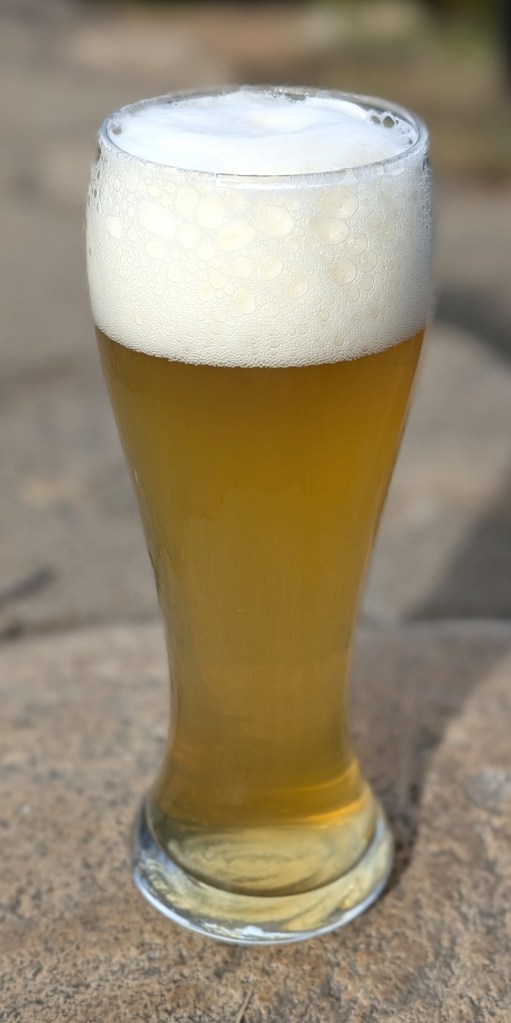
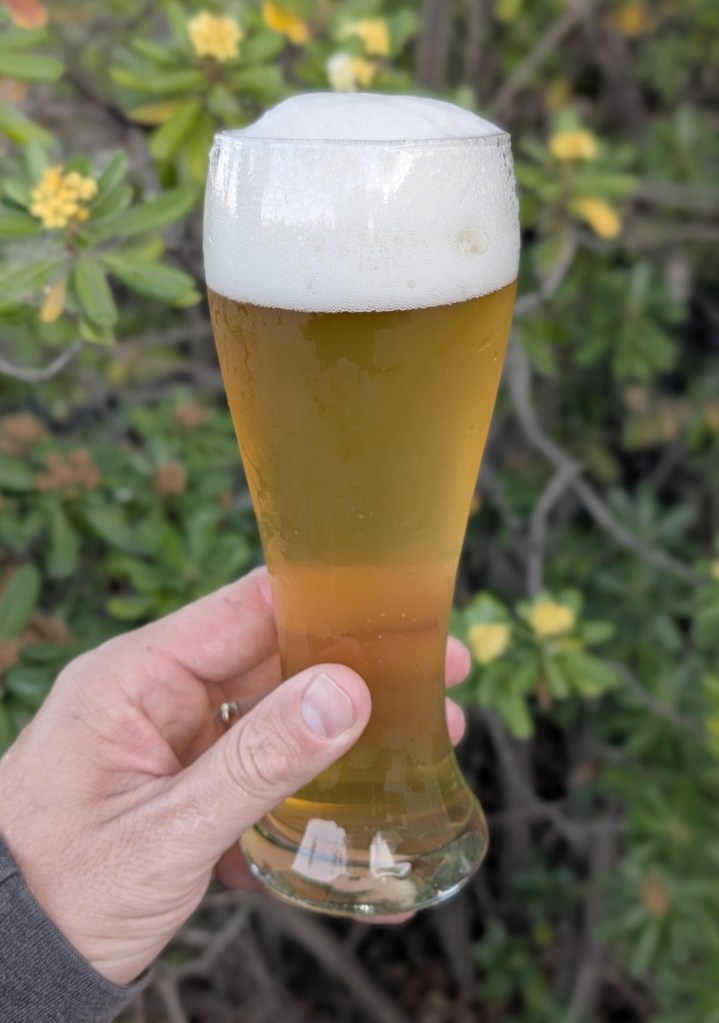
- A light yellow, moderately hazy beer, pouring with a fluffy white head of excellent persistence; the head leaves lacing down the side of the glass.
- Aroma
- Bright, medium-light aroma of coriander and fresh sea breeze; a light bread dough aroma behind that
- Flavor
- Lightly and pleasantly tart; a light lemony coriander flavor alongside fresh sea breeze from the salt. “Doughy” malt flavor of medium intensity. Low bitterness, with no hop character to speak of.
- Mouthfeel
- Rounded mouthfeel, high level of carbonation, dry mouthfeel on the finish, medium-light body. Very drinkable and very refreshing!
- Would I Brew This Again?
- Yes! This is an amazing beer and a solid first attempt at a gose. I had to adjust the carbonation upwards a bit, because it was a bit flabby on my first few pours, but once that was dialed in it notched the beer to perfection. The coriander and salt balance are spot-on, as is the level of tartness. I might use K-97 next time around, to retain the haze at a slightly higher level for longer, but this is just an awesome beer as is. I especially like the partial kettle sour method, so that I was able to hit a low level of acidity with minimal fuss.
- Overall
- 10/10
 Andy's Brewing Blog