
La Chouffe is a darned good beer, and I will often get a pour if I find it on-tap at a quality alehouse (shout-out to The Back Abbey!). Belgian Blond Ale (or Belgian Blonde Ale) is not a style I have brewed previously, so it’s time to rectify that! I did a bit of research to find a clone recipe for La Chouffe, and a version from Brewer’s Friend inspired my own version, along with “The Gnome” recipe in Gordon Strong’s Modern Homebrew Recipes. The original recipe on Brewer’s Friend used decoction, but I decided to just put a little melanoidin malt into the grist instead. I also included a mash rest at 126°, in an attempt to improve the head.
Because this is an experimental beer, and a high alcohol one at that, I decided to make a small (3 gallon) batch.
Unruly Gnome Belgian Blond Ale
- 7.75 lb. pilsner malt (Rahr)
- 3 oz. melanoidin malt (Weyermann)
- 0.5 tsp. BrewTanB (mash)
- 12 oz. clear candi sugar (added to boil)
- 1 oz. Styrian Goldings hop pellets (3.2% alpha), 60 minute boil
- 0.5 oz. Saaz hop pellets (2.0% alpha), 15 minute boil
- 0.25 tap. BrewTanB, 10 minute boil
- 0.5 Whirlfloc tablet, 5 minute boil
- 0.5 oz. Saaz hop pellets (2.0% alpha), 5 minute boil
- 0.5 tsp. yeast nutrient WLN1000 (White Labs), 5 minute boil
- 6 g. coriander seeds (Turkish), 5 minute boil
- 1 pkg. Abbaye Belgian ale yeast (Lallemand)
Target Parameters
- 1.068 s.g., 1.009 f.g., 7.9% abv, 6 SRM, 21 IBU
- Full volume step mash, with 15 minutes at 126°, 90 minutes at 146°, and 10 minutes at 168°; 60 minute boil
- Water built up from RO and Claremont tap water, to hit water target parameters of 50 ppm Ca, 4 ppm Mg, 45 ppm Na, 56 ppm SO4, 82 ppm Cl, 10 ppm bicarbonate, RA=-30.
Procedure
- To get my strike water, I mixed 2.5 gallons Claremont tap water and 2.5 gallons distilled water, added 2.1 mL of 88% lactic acid, 1/4 Campden tablet, 1 g CaCl, and 1 g CaSO4.
- I heated the strike water to 131°, added the grains and 1 tbs. of 10% phosphoric acid, and held the mash at 126° for 15 minutes, before raising the temperature to 146° for 90 minutes. Then, I raised the mash to 168° for 10 minutes before pulling the grains.
- In total, I collected 4.5 gallons of runnings at a gravity of 1.050, for 75% mash efficiency.
- I brought the runnings to a boil, adding finings per the recipe. After a 60 minute boil, I turned off the heat and chilled to 74° before transferring to the fermenter and pitching the yeast.
- I brewed this beer on 7 December 2024. Starting gravity was 1.070.
- I had vigorous fermentation within 18 hours of pitching the yeast; temperature was down to 72°, and so I moved the fermenter into the fermentation chamber on 8 December 2024, and set it at 74°.
- Fermentation (as evidenced by bubbling) was pretty much done by 10 December 2024.
- I kegged the beer on 23 December 2024, adding 1 oz. of corn sugar in 0.5 cups of water for carbonation, and let it sit at room temperature.
- Final gravity was 1.011, for 7.8% abv.
Tasting
- Appearance
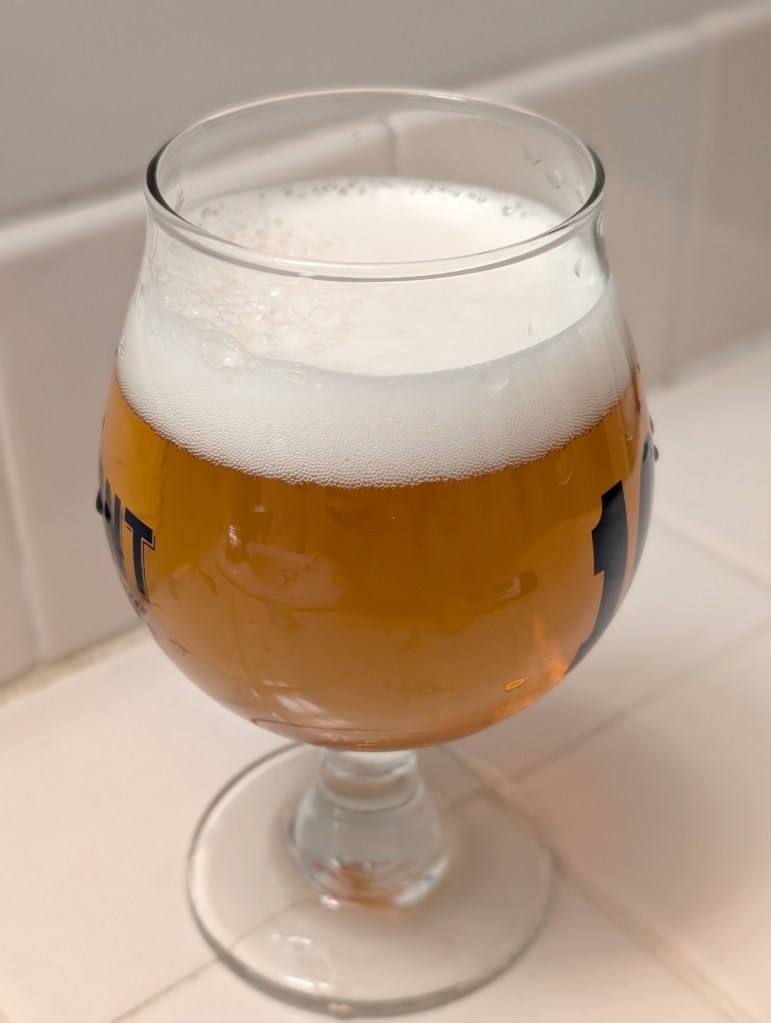
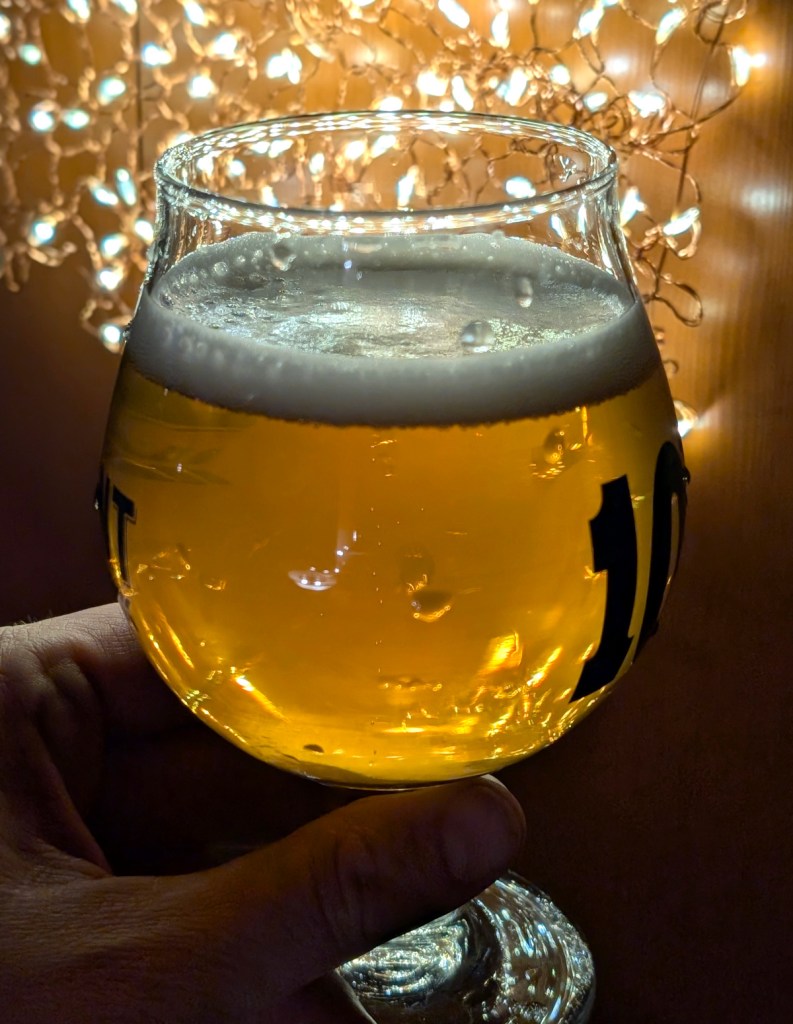
- Very clear gold beer that pours with a creamy and persistent white head of foam. It’s quite pretty! I’ll note that it clarified a bit more after the photos were taken (about 10 days before this post).
- Aroma
- Moderate spicy phenolic notes, but overall pretty clean. A little light caramel malt comes through, and some citrus quality with light alcohol notes as it warms.
- Flavor
- Moderately high bitterness, crackery malt at a moderate level, with a touch of candy. Balance is towards the hops a bit. Orange peel citrus comes through as the beer warms. The yeast is perhaps a touch more prominent than what I remember in the commercial beer.
- Mouthfeel
- Highly carbonated, light body, dry finish. It drinks very easily!
- Would I Brew This Again?
- This is a good start. The yeast was perhaps a bit forward in the early samplings of the beer, but it has mellowed considerably over time. It might benefit from lower temperatures with this dry yeast strain, or a different strain at least relative to the style ideal (probably Ardennes for my next version, which isn’t available in dry yeast form; Belle Saison is another dry yeast I’m considering). Even so, this beer is dangerously drinkable! I might dial hops back a touch, perhaps to 15 IBU or so. The bitterness on the finish is just a touch harsher than I like. The coriander doesn’t come through, so I could safely ditch it; I don’t think anything would be lost. I might also try a fresher coriander from a different source area, which could also help.
- Note added 10 February 2025: The beer has cleared to brilliant now!
- Overall
- 8/10
 Andy's Brewing Blog