
Easy Days Ale

My lighter-colored beers lately have been primarily lagers, but it is nice to switch this up from time to time. So, I decided to create an experimental ale recipe that hit the target of being sessionable, flavorful (with some malt character and a bit of hop character too), and light in color. It doesn’t really conform to any style, although I guess you could make an argument that it’s an American(ish) blonde ale. No matter what you call it, it’s pretty darned good! I also have the memory of sharing a few glasses of this with a good friend who was going through a pretty rough spot in life…although it sounds cheesy (and perhaps it is), so much of brewing isn’t just the end product, but the memories that go with each glass and the people with whom it is shared.

Easy Days Ale

  • 4 lb. Finest Maris Otter Malt (Crisp)
  • 4 lb. 2-row Xtra Pale Malt (Viking)
  • 1.5 lb. white wheat malt (Briess)
  • 11 oz. caramel 10L malt (Briess)
  • 4 oz. Melanoidin malt (Weyermann)
  • 4 oz. rice hulls
  • 0.25 oz. Magnum hop pellets (10.1% alpha), 60 minute boil
  • 1 Whirlfloc tablet, 5 minute boil
  • 0.8 oz. Simcoe hop pellets (12.7% alpha), 15 minute whirlpool
  • 1 pkg. Safale American ale yeast (US-05)

Target Parameters

  • 1.047 s.g., 1.011 f.g., 4.7% abv, 18 IBU, 6 SRM
  • Claremont tap water, treated with Campden tablet to remove chlorine
  • Full volume infusion mash at 154°, 60 minutes

Procedure
  • I mashed in with 7.25 gallons of water at 160°, to target 154° for 60 minutes, with recirculation. I added 7.5 mL of 88% lactic acid, to reduce the mash pH. After 60 minutes, I raised the mash to 168° for 10 minutes, before removing the grains.
  • In total, I collected 6.4 gallons of runnings with a gravity of 1.041, for 67% mash efficiency.
  • I brought the runnings to a boil, adding hops and finings per the recipe. After a 60 minute boil, I turned off the heat and added the whirlpool hops for a 15 minute whirlpool.
  • After the whirlpool, I chilled the wort down to ~75°, before putting it into the fermentation chamber and chilling it the rest of the way to 68°.
  • I brewed the beer on 16 April 2021, and it had a starting gravity of 1.048.
  • I fermented at 68° until 23 April 2021, when I moved the beer to ambient temperatures.
  • I kegged the beer on 6 May 2021, and noted a final gravity of 1.015. This is a bit higher than expected, working out to 4.3% abv.

Tasting

  • Appearance
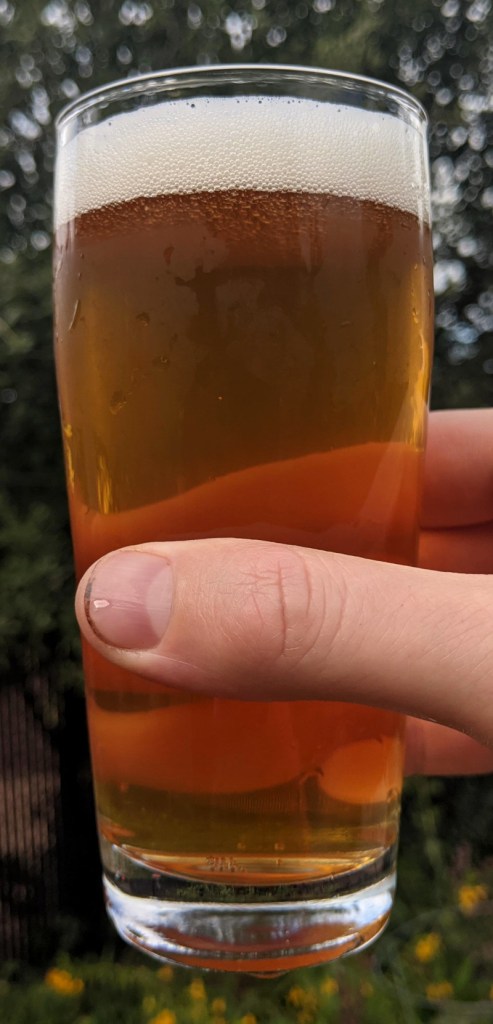
    • Medium gold with slight haze, moderately persistent white head
  • Aroma
    • Lightly malty; light bread dough character, with a light hint of caramel. No hop aroma.
  • Flavor
    • Moderate doughy, light malty character; relatively low, clean bitterness; a light tartness from the wheat that is pretty pleasant.
  • Mouthfeel
    • Moderately light body; smooth finish; moderate carbonation.
  • Would I brew this again?
    • This is a very solid session ale; it’s nothing spectacular, but I’m OK with that. I think it would benefit from a little more hop character; the bitterness is fine, but I think a little dry hop charge or a hop stand would help to liven this up a bit. It’s very drinkable, and makes a nice go-to on the tap selection. The malt character is pretty nice; it’s a little more interesting than the usual “2 row+crystal” malt zone that many ales of this type occupy.
  • Overall
    • 9/10

Christmas Warmer 2020

My beer tastes run towards the lighter, lower-alcohol side, but I sure do like a nice and robust beer in that stretch between Thanksgiving and New Year’s. I just finished the keg of Stygimoloch Bock, and this year’s Christmas Warmer went on tap in its place.

The goal for this batch was to have something with a bit of character and a bit of kick. I wanted a rich malt character, alongside a bit of spice. I looked through Gordon Strong’s Modern Homebrew Recipes, and found “Christmas Beer” as an inspiration. The malt proportions in my version are pretty similar to Strong’s recipe, but I did a ton of swapping for brand and even malt type. Golden Promise got replaced by Vienna, and Belgian Aromatic got swapped out for Honey Malt, among other things. The original recipe is far more English in character, including the hops and yeast, and I did away with that entirely! Instead of English ale yeast, I brought in Hornindal kveik. My logic was that its orange/citrus qualities would fill that space of orange zest in Strong’s recipe. Plus, I had the kveik on-hand, and thought it would be a fun variation.

Because this was a pretty experimental batch, and because I didn’t want ridiculous amounts of a spiced beer, I knocked the recipe back to 2.5 gallons. This gave me a chance to do a test-run for a small batch on my Foundry system. I quite like the result, but am glad that I don’t have endless quantities of it. Even a good spiced ale is best as a treat in moderation!

Christmas Warmer 2020

  • 3.5 lb. Vienna malt (Weyermann)
  • 1 lb. Munich II malt (Weyermann)
  • 1 lb. honey malt (Gambrinus)
  • 0.5 lb. Caramunich I malt (Weyermann)
  • 0.5 lb. caramel 40° malt (Briess)
  • 0.5 lb. flaked barley
  • 2 oz. chocolate malt (Briess)
  • 1 lb. honey, 1 minute boil
  • 1 oz. robust molasses (Grandma’s Brand)
  • 1 oz. Cascade whole hops (5.5% alpha), 30 minute boil
  • 1 tsp. Fermax yeast nutrient, 10 minute boil
  • 1 Whirlfloc tablet, 5 minute boil
  • Steeping spices (steeped for 10 minutes after boil)
    • 2 vanilla beans, cut and scraped
    • 3 cinnamon sticks
    • 6 coriander seeds, crushed
    • 1 whole nutmeg, chopped
    • 4 allspice berries, crushed
  • Hornindal kveik (repitched from previous batch)

Target Parameters

  • 1.068 s.g., 1.009 f.g., 7.7% abv, 19 SRM, 25 IBU, 3 gallon batch
  • Infusion mash, 154°, full volume; 60 minute boil
  • Claremont water, with Campden tablet to remove chloramines.

Procedure

  • I mashed in (using my Anvil Foundry) with 4.5 gallons of water at 160°, adding 2.5 mL of 88% lactic acid to adjust pH. I let this settle down to 154°, mashing for 50 minutes with recirculation. I then raised the mash to 168° over 10 minutes, let it rest for 10 minutes, removed the grains, and brought the runnings to a boil.
  • The mash yielded 4 gallons of wort at 1.041, for 62% mash efficiency. This was a bit below where I wanted to be, so I added 0.5 lb. of extra light DME, to raise the gravity.
  • I boiled for 60 minutes, adding the hops and other ingredients per the schedule.
  • After the boil but before chilling the wort, I steeped the spices in a bag for 10 minutes.
  • I cooled down to ~80°, transferred to the fermenter, and let it run at ambient. Because it was later in fall when I brewed this, ambient was around 70° or so for the start.
  • Starting gravity was 1.061. I brewed the beer on 20 October 2020.
  • I kegged the beer on 6 November 2020, and force carbonated.
  • Final gravity was 1.017, which works out to 5.8% abv. I’ve noticed that this kveik strain seems to underattenuate, measuring 61% to 71% in the batches I’ve done.

Tasting

  • Appearance
    • Deep amber beer with some haze; pours with a persistent beige head.
  • Aroma
    • Candied ginger, general spice, with a touch of citrus peel. Slight malty/biscuity character, and a slight tartness. There is a hint of cinnamon/spice as the beer warms up.
  • Flavor
    • Medium-low bitterness, and a light tartness (from the kveik?). There is a subtle spice character, with a bit of cinnamon and molasses that become more prominent as the beer warms.
  • Mouthfeel
    • Medium body, moderate carbonation. The finish is off-dry and fairly smooth.
  • Would I brew this again?
    • This is a pretty good beer, but still needs a little work. For my personal conception of a “holiday beer,” I’d like a bit more base malt character. For a rebrew, I might use all Munich I as the base, and also add some dark crystal malt (maybe crystal 80 or crystal 120?). The beer could also use a little more sweetness–perhaps from lactose or crystal malt–to round out the profile. The level of bitterness is about perfect. Finally, I might change the yeast to an English ale yeast rather than kveik. In sum, this is a perfectly drinkable experiment, and will be worth a future revision.
  • Overall
    • 6/10

Kölschy Kölsch

My homebrew club had a kölsch-style ale scheduled as our March contest beer. Well…world events meant that we couldn’t get together. But, I could still do my own tasting at home!

I decided to go for a super-simple beer, with a minimalist grain bill. Last year, I did a kölsch with the Kolsch malt from Schill malting. It turned out pretty well, but was a bit darker than acceptable for the style. So, I used around 1/3 of this malt and the rest was pilsen malt, to lighten up the beer and make the flavor a touch more subtle. I have read in several places that wheat malt is not frequently used in “traditional” grain bills, so I chose to leave this out. Finally, I used Liberty hops for an American twist, and chose WLP029 (White Labs’ German Ale/Kolsch yeast).

As for the recipe name…well, I wasn’t feeling that creative!

Kölschy Kölsch

  • 7.25 lb. Superior Pilsen Malt (Great Western Malting)
  • 3.5 lb. Kölsch (Schill Malting)
  • 1.5 oz. Liberty hop pellets (4.3% alpha), 60 minute boil
  • 1 Whirlfloc tablet, 5 minute boil
  • 0.5 oz. Liberty hop pellets (4.3% alpha), 5 minute boil
  • 2 pkg. German Ale / Kölsch yeast, WLOP024 (White Labs)

Target Parameters

  • 60 minute infusion mash, 151°, batch sparge
  • 1.047 o.g., 1.010 f.g., 4.9% abv, 24 IBU, 4 SRM
  • “Cologne-ish water”, built from 8.5 gallons of RO water with 3.5 g baking soda, 4.5 g of epsom salt, 4.0 g of calcium chloride, and 2.5 g of gypsum, to hit 52 ppm Ca, 14 ppm Mg, 30 ppm Na, 98 ppm SO4, 60 ppm Cl, 78 ppm HCO3, RA=19 ppm, alkalinity=64 ppm

Procedure

  • I mashed in with 3.6 gallons of water at 162°, to hit a 150° mash temperature. It was down to 146° after 45 minutes.
  • After 60 minutes, I added 1.25 gallons of water at 185°, let sit for 10 minutes, and vorlaufed before collecting the first runnings.
  • Next, I added 3.6 gallons of water at 185°, let sit for 10 minutes, vorlaufed, and collected the remainder of the runnings.
  • In total, I collected 7.2 gallons of runnings with a gravity of 1.041, for 76% efficiency.
  • I brought the kettle to a boil, adding hops and other ingredients per the recipe.
  • After a 60 minute boil, I turned off the heat and chilled the wort, before transferring to the fermenter and pitching the yeast.
  • Starting gravity was 1.050, and I fermented at 65°.
  • I brewed the beer on 25 January 2020, and had vigorous fermentation within 24 hours. I moved the beer to ambient conditions on 1 February 2020.
  • I kegged the beer on 29 February 2020, and was able to save around 1/2 quart of yeast for a future brew (probably an altbier).
  • Final gravity was 1.010, which equates to 5.3% abv.

Tasting

  • Appearance
    • Clear, nearly brilliant. Light gold color, with a fine white head. The head is low but persistent around the edges of the glass.
  • Aroma
    • Sweet graininess, with a light touch of honey and apple–almost a Riesling-type character. No hop aroma.
  • Flavor
    • Grainy and lightly sweet grain character, with a subdued apple or pear-like fruitiness. Hop flavor is minimal, although the bitterness is a little stronger than I anticipated.
  • Mouthfeel
    • Moderately light body; crisp, but not overly dry. There is a lingering hop bitterness in the finish…it hangs around perhaps a touch more than is completely enjoyable for my taste.
  • Would I Brew This Again?
    • This is a pretty good beer, with a nice flavor and appearance. I feel like the malt character is a bit stronger than I really want for this style, so I might go with a 100% pilsner or pilsner+American 2-row version in the future, or mix in some Vienna malt instead. That said, though, it’s a solid version of a kölsch!
  • Overall
    • 8.5/10