
As a delicate yet flavorful lager, Munich helles has a reputation as a style that is difficult to brew well. My previous three versions have all been pretty decent, and after a few years’ hiatus I wanted to give the style another try. A recipe from the May-June 2018 BYO magazine presented a different take from my previous batches, and was worth an attempt in order to explore my taste preferences. The main difference is that it cut out Munich malt, leaning on pilsner malt with just a touch of character malt to accent things. I modified the BYO version slightly, taking out acidulated malt and using lactic acid instead, replaced Tradition hops with Perle, and moved all late addition hops to the 5 minute mark at the end of the boil. The latter was because I wanted to emphasize aroma and not boil off the volatiles. I also reduced the calculated bitterness a touch (20 IBU vs. 17 IBU). For yeast, I had two packets of White Labs’ dry Munich Lager (WLP860); I had picked them up at White Labs last year, and this was a perfect chance to use them.
Recipe Name
- 9 lb. Viking Pilsner Zero malt
- 5 oz. Carahell malt (Weyermann)
- 3 oz. Carafoam malt (Weyermann)
- 0.5 tsp. BrewTanB, added to mash
- 0.65 oz. Perle hop pellets (6.3% alpha), 60 minute boil
- 0.5 tsp. BrewTanB, 10 minute boil
- 1 Whirlfloc tablet, 5 minute boil
- 1 oz. Hallertauer Mittelfrueh hop pellets (2.5% alpha), 5 minute boil
- 2 pkg. Munich Lager WLP830 dry yeast (White Labs)
- 1 pkg. Diamond Lager dry yeast (Lallemand)
- 1 oz. Biofine Clear, added to keg
Target Parameters
- Infusion mash, 45 minutes at 144°, 45 minutes at 160°, 10 minutes at 168°, full volume mash
- 1.045 o.g., 1.008 f.g., 4.9% abv, 17 IBU, 4 SRM
- Water built from scratch with RO water, to hit 55 ppm Ca, 61 ppm SO4, 53 ppm Cl, RA=-39
Procedure
- I built my water up from scratch, starting with 7.25 gallons of RO water, to which I added 3 g of calcium chloride and 3 g of gypsum. I heated this to 148°, before adding the BrewTanB, grains, and 0.2 mL of 88% lactic acid.
- I held the mash at 144° for 45 minutes, with recirculation, before increasing the temperature to 160° and holding it there for another 45 minutes. Finally, I had a 10 minute mash-out at 168°, before pulling the grains.
- In total, I had 6.5 gallons of runnings with a gravity of 1.039, for 71% mash efficiency.
- I brought the runnings to a boil, adding hops and finings per the recipe. After a 60 minute boil, I turned off the heat and then chilled to 75° before transferring to the fermenter. I chilled the wort the rest of the way down to 48° before pitching the yeast.
- I brewed the beer on 19 June 2025. Starting gravity was 1.039 – right on the numbers!
- Fermentation was held at 50°. There was no sign of fermentation, neither krausen nor bubbles in the airlock, by 21 June 2025. So, I pitched a packet of Diamond Lager yeast just to be safe. Later reading shows this strain tends to be a slow starter and quiet fermenter, so I perhaps was a bit too hasty. Next time, I might take a sample and see if the gravity had changed. In this case, it was better to be safe than sorry.
- I cold crashed the beer on 17 July 2025, and kegged it on 4 August 2025 using a closed transfer. At this point, the beer was pretty hazy but had an amazing flavor.
- I added Biofine Clear on 25 August 2025.
- Final gravity was 1.010, down from 1.045, which equates to 4.7% abv.
Tasting
- Appearance
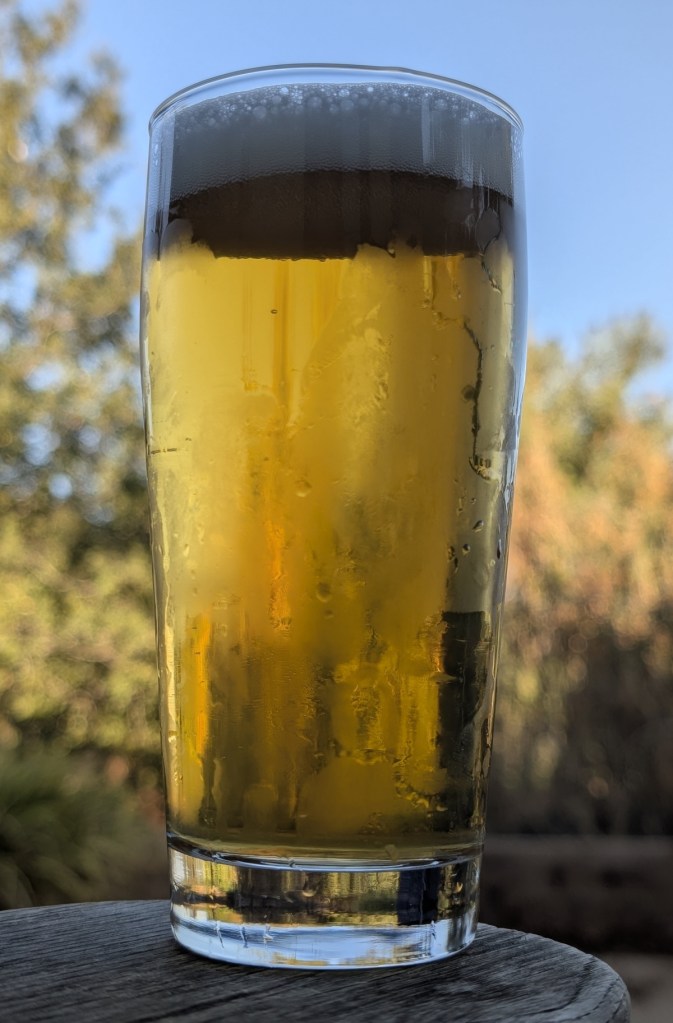
- Light yellow and brilliantly clear, with a persistent fine white head.
- Aroma
- Clean fermentation profile, medium-low malt with a sweet malty character. Hops very faint.
- Flavor
- Medium level of malty sweet flavor, with a low level of spicy hops behind that. It tastes good, but inoffensive.
- Mouthfeel
- Medium-light body, moderate carbonation, smooth and slightly dry finish.
- Would I Brew This Again?
- This beer is technically great, but it just doesn’t grab my attention in any particularly way. It’s clean, clear, and decently flavorful, but needs a touch more malt character. Versus previous recipes, I skipped Munich malt on this one, and that set things back a bit. I might try a different pilsner malt, too, but either way the malt needs a bit more of “something.”
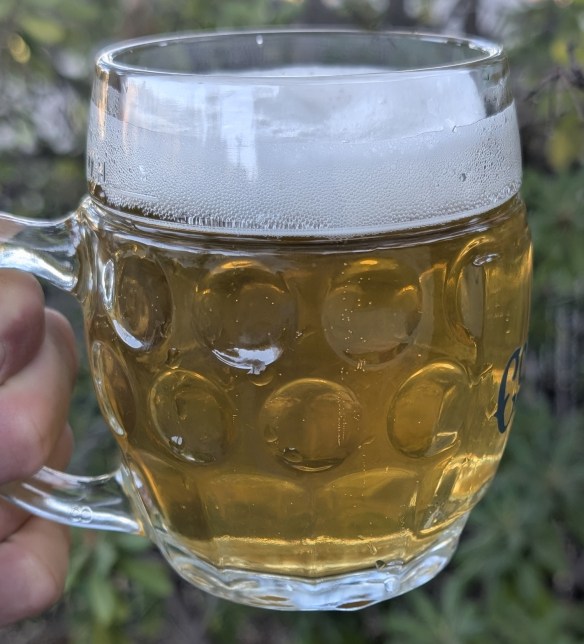
- Note added later: I tried this beer again, in a big mug, and it hit a bit differently. The malt character was more prominent, and it goes down easily. I’m not going to adjust my ranking based on this, other than to say that it’s a very drinkable beer, and would be a crowd pleaser, even if not the most interesting beer for me. I guess not every beer needs to be interesting!
- This beer is technically great, but it just doesn’t grab my attention in any particularly way. It’s clean, clear, and decently flavorful, but needs a touch more malt character. Versus previous recipes, I skipped Munich malt on this one, and that set things back a bit. I might try a different pilsner malt, too, but either way the malt needs a bit more of “something.”
- Overall
- 7/10
 Andy's Brewing Blog
Pingback: Old Franconia Lager | Andy's Brewing Blog