
The holidays aren’t just for dark beers–anything with a decent bit of “heft” to it in flavor, alcohol, body, or some combination of those can be a great sipper next to the fire. Looking to expand my brewing repertoire, I returned to wood-aged beers, with a riff on an Imperial Red IPA from beloved local brewery Claremont Craft Ales. The original, called Happy Days, is an exceptional beer that has taken gold at the GABF (twice!), among a ton of other awards. It weighs in at 9.5% abv, so isn’t a casual beer–but it goes down smoothly nonetheless!
A clone recipe for Happy Days is available, and it’s a surprisingly simple brew. It starts out with just three malts — 2-row, crystal 150L, and a dash of chocolate malt for color, with some dextrose to dry out the beer. CTZ, Mosaic, and Simcoe round out the hop bill…and that’s it! This beer is a testament to how great recipe design and careful handling come together to make something exceptional.
For my own version, I used Happy Days as a starting point, but not the end. One goal was to play with wood aging, so the beer departs from a “clone” pretty much right away. Second, I wanted to try out some different hops, partly to see how they worked and partly to use up my (admittedly too large) hop stash.
I kept the target gravity around the same as the original Happy Days, but dropped the chocolate malt from the recipe. It seemed to be there only for color adjustment, and I just didn’t need it to hit my goals in the current batch. I had crystal 120 but not crystal 150 on-hand, so that was another malt adjustment. I aimed for around the same level of bitterness, but chose HBC 522 and Talus as my flavor/aroma hops. They seemed to have roughly similar qualities to the original recipe. Finally…I needed to figure out an oaking strategy. I didn’t want this beer to be an oak bomb, and I also didn’t want an extended barrel aging process that would kill the hop character. So, I elected to use the BeerStix product, aging a textured slab of wood in the primary as well as a bit in the keg.
The end result was pretty satisfying–one of the better experimental beers I’ve made! I am both glad and sad I did only a small batch–glad because I didn’t need 5 gallons of a 10% abv beer; and sad because this beer really is a smooth drinker, pretty darned tasty, and gone distressingly quickly.
The name for this beer comes from a canyon near where we live…it conveniently has “oak” in the name, so was a logical choice for a wooded beer.
Live Oak Canyon Ale
- 10.5 lb. 2-row malt (Briess)
- 13 oz. caramel malt 120L (Briess)
- 1 oz. Warrior hop pellets (13.4% alpha), 60 minute boil
- 0.5 oz. Magnum hop pellets (16.5% alpha), 60 minute boil
- 0.75 lb. corn sugar, 5 minute boil
- 1 Whirlfloc tablet, 5 minute boil
- 2 oz. HBC 522 hop pellets (9.4% alpha), 15 minute whirlpool
- 1 pkg. WLP001 (White Labs), California Ale dry yeast
- 1 medium toast American oak Beer Stix carboy stick, added to primary and carried over to keg
- 2 oz. LUPOMAX Talus hop pellets (12.0% alpha), dry hop in keg
Target Parameters
- 1.093 s.g., 1.015 f.g., 10.5% abv, 125 IBU, 17 SRM
- Infusion mash, held at 152° for 60 minutes and 168° for 10 minutes, with sparge
- Claremont tap water, with Campden tablet, adjusted with minerals to achieve 58 ppm Ca, 23 ppm Mg, 54 ppm Na, 155 ppm SO4, 60 ppm Cl, 10 ppm CO3, -47 ppm RA
Procedure
- Starting with 5.6 gallons of water, I added 4 mL of 88% lactic acid to neutralize the carbonates. Then, I added 2 g epsom salts and 2 g gypsum, to achieve my target water profile.
- I heated the strike water to 161°, added the grains, and hit a 152° mash temperature. I also added 4 mL of 88% lactic acid, to adjust the pH.
- After a 60 minute mash and recirculation, I raised the mash temperature to 168° for 10 minutes, before pulling the grains and sparging with ~0.9 gallons of water.
- In total, I collected 5.25 gallons of runnings with a gravity of 1.058, for 72% mash efficiency. This was great…but meant that I needed to boil for a full 60 minutes before adding hops — so, the beer had a total of a 120 minute boil.
- After the initial 60 minutes of boiling, I began adding hops and other finings per the recipe, with corn sugar added at the very end.
- After the boil, I chilled the beer down to around 68°, before transferring to the fermenter.
- I brewed this beer on 4 November 2023; it had a starting gravity of 1.089. Once pitching the yeast, I let it ride at ambient (around 62°).
- Visible evidence of fermentation was present within 24 hours, and the beer was up to around 68° and had vigorous fermentation by 6 November 2023. On the morning of 7 November, the beer had climbed to 74°, so I put it into the conditioning chamber to drop it down over the course of the day. Unfortunately, I overshot a bit and it went all the way down to 45°. I pulled it out to ambient again, and it steadily rose to 62° by 9 November 2023. At this point, I put a thick towel around the beer to raise and maintain the temperature.
- I soaked the oak stick in water overnight, and then put it into the microwave for around 90 seconds to flash steam and sanitize. I spritzed the oak with StarSan, before adding it to the fermenter. The oak was added to the primary fermenter on 7 November 2023.
- I kegged the beer on 19 November 2023, adding the dry hops in a baggie and also transferring the oak to the keg.
- Final gravity was 1.016, for 9.9% abv.
- I left the keg at ambient until 27 November 2023, when I removed the dry hops and oak, moved the keg to the conditioning chamber, and let it condition and carbonate at 34°.
Tasting
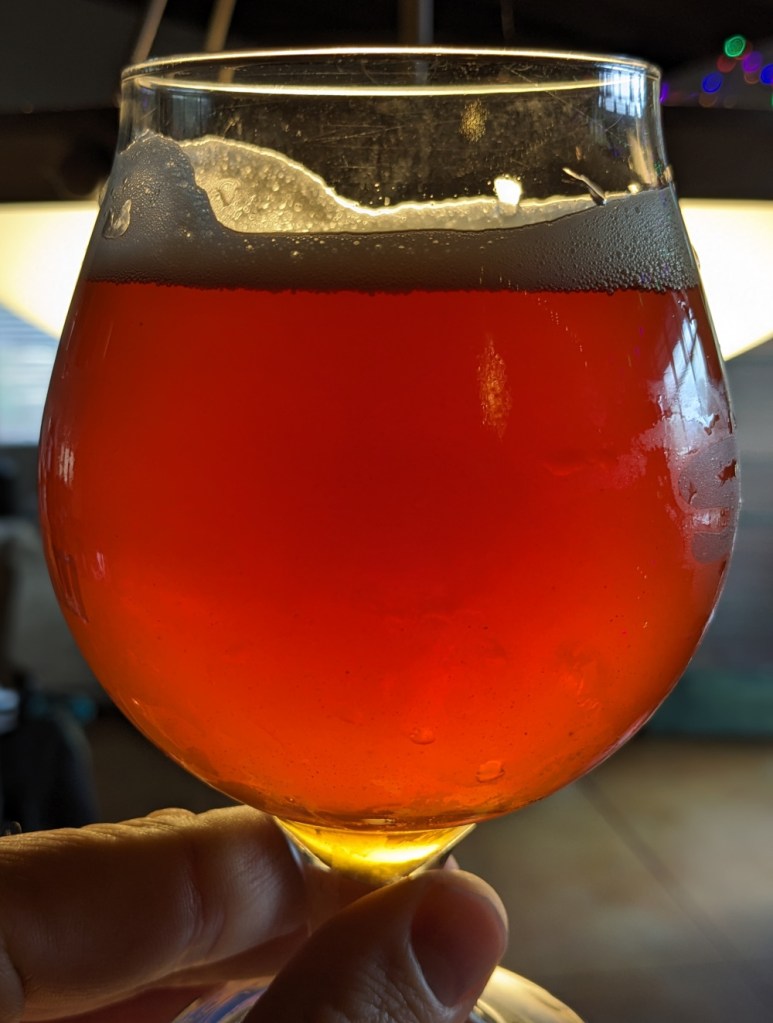
- Appearance
- The beer has a deep reddish amber color, with a slight haze; it pours with a creamy and persistent ivory head. Gorgeous!
- Aroma
- Pine, sweet orange, and resin, with a hint of woody oakiness. As the beer warms up, the wood comes through more prominently.
- Flavor
- Hop forward, very bitter beer, with a hint of orange and resiny bitterness, and some woody character behind that. Caramel maltiness is at a moderate level. This woodiness holds mainly until the back end of the palate and the finish, which complements the hops nicely.
- Mouthfeel
- Medium carbonation, medium body, off-dry finish.
- Would I Brew This Again?
- What a wonderful experiment! This has been an incredibly enjoyable beer, with high drinkability. Overall, it’s an awesome winter seasonal brew.
- Overall
- 10/10
 Andy's Brewing Blog