Amber Ale, Vanilla Porter, and Irish Stout Updates

A few updates condensed into one post. . .

Vanilla Voay Porter
This experimental brew (recipe, update, and update) was bottled on Saturday, December 10. This gave the vanilla extract/pods around two weeks in the secondary fermenter – the chopped and scraped pods floated on the surface, and many of the tiny seeds were everywhere in the fermenter.

Final gravity was 1.016, from a starting gravity of 1.056, giving 5.25% alcohol by volume. Final yield was just over 5 gallons of beer(!), with 30 12-oz. bottles, 12 1-pt. bottles, and 4 22-oz. bottles.

Four days after bottling, I was impatient and opened one of the small bottles. Carbonation was still very slight, but the flavor and aroma were delicious. A faint vanilla scent, but a rich vanilla flavor (not overpowering though, thankfully). I’m very excited to see how this is going to mature over the next few weeks!

Fake Tire Amber Ale
One week after brewing, I transferred my Fat Tire clone into the secondary fermenter. The aroma was very estery, with a strong banana component. I might have been a little worried, except the yeast strain is known to do this. The gravity was around 1.014 at this point, and hadn’t changed at all when I racked the beer into the bottling bucket today (December 17, 19 days after brewing). This gives 5% alcohol by volume, a little less than the 5.2% of real Fat Tire.

From this batch, I got 20 12-oz. bottles, 14 1-pt. bottles, and 1 22-oz. bottle. Next time I might try scaling the recipe up a bit.

When preparing to bottle, I’m very impressed by the absolute clarity of the beer. This bodes well for the final product (which I’ll probably test in a week’s time – Christmas Eve!).

Coopers Irish Stout
The Irish stout I made a few weeks ago has matured into a wonderfully drinkable brew. The head is a nice caramel-color, and isn’t overwhelming, but certainly sticks around the edges of the glass after pouring. The flavor has a hint of malt and is dominated by the roasted grains, and has a nice dry finish (as expected for the style). As I noted at the time of bottling, it’s not a very exciting beer (middle of the road flavor – good but no really unusual highlights), but it’s certainly a solid one.

This kit was cheap, fast, easy, and tasty – perfect for the beginning or end of the brew season when I just want to crank something out! I’ll admit that it’s not quite as much fun as doing everything from scratch, but then again that’s also a welcome break sometimes. I expect I’ll probably do this kit (or a similar one) again!

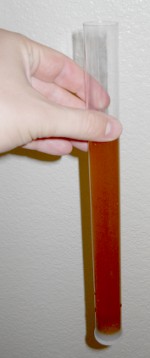
Irish stout, in the glass

Fake Tire Amber Ale

I’ve always liked Fat Tire (from New Belgium Brewing), and have previously found clone recipes to be a good way to experiment with various styles and flavors. Thus, tonight’s brew was modeled after two different Fat Tire recipes I found kicking around the Internet. These are followed reasonably closely, except for the hops – I used what I had on hand, so this will almost certainly modify the resultant into something Fat Tire-ish rather than a spot-on Fat Tire (if such a thing is genuinely possible). Thus, I’m calling this batch. . .

Fake Tire

  • 5 pounds plain extra-light DME
  • 0.5 lb Munich light malt
  • 0.5 lb Carapils malt
  • 0.5 lb biscuit malt
  • 0.5 lb crystal malt (20° Lovibond)
  • 0.5 lb crystal malt (40° Lovibond)
  • 1.0 oz chocolate malt
  • 1.0 oz. Cascade hops (60 minutes boil)
  • 1.0 oz. Mt. Hood hops (5 minutes boil)
  • 1 tsp. Irish moss (15 minutes boil)
  • Wyeast 1272 (American Ale II)

Steps

  • I heated 3.5 gallons of tap water to 154° F (usually hovering around 156° to 158°), and steeped the grains for 45 minutes. Then, I sparged the grains with 0.5 gallons of tap water at 154°.
  • After bringing the mixture to a boil, I turned off the heat and added the malt. I brought it back to a boil, and threw in the Cascade hops.
  • After boiling for 45 minutes, I added 1 tsp. of Spanish moss.
  • After boiling for another 10 minutes (for 55 minutes total boil), I added the Mt. Hood hops.
  • After 5 more minutes (60 minutes total of boiling), I cooled the wort with my chiller, added cold tap water to a total of 4.5 gallons, and pitched the yeast. Pitching temperature was 74° F, and starting gravity was measured at 1.052. The wort is a nice amber color (as befits an amber ale).

As I refined the recipe, I played around with some calculators for IBU and starting gravity. I got an estimated boil gravity (4 gallon boil) of 1.077; with a top-up to 5 gallons, this gives an estimated IBU of 20.7 and estimated starting gravity of 1.061. My actual starting gravity was a little lower, at 1.052. Part of this discrepancy could be the sludge I left in the bottom of the brew pot, and the other could just be errors in the brew calculator.

New Belgium officially gives an “OG” of 12.6 and an “FG” of 2.2 for Fat Tire, which I think is on the Brix scale (even if not stated). This translates to 1.051 and 1.009. Thus, my original gravity is quite close! We’ll see if this comparability is maintained through fermentation. (as a side-note, they measure 18.5 IBU and 5.2% ABV, too)

I’ve never fermented with American Ale II before, so I’m curious to see how it works out. Judging by the Wyeast website, this should be a nice little strain.

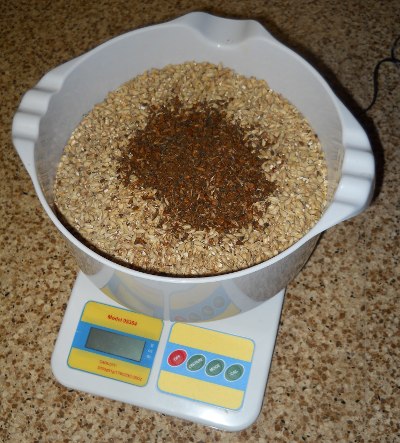
The grains, waiting to steep