Old Speckled Hen Homage

As a semi-mass-market English ale, Old Speckled Hen is one of my favorites. I think it’s mainly due to the name and associated nostalgia of my early days of better beer exploration, but in any case it’s something I come back to from time to time. A decade ago, I attempted a clone, which turned out okay but not great. This beer has been kicking around in my head ever since, and I even buy a bottle (or can) from time to time. It’s a legitimately enjoyable beer! Given that continued fascination, it was time for another attempt.
My new version is based on two recipes posted online, somewhat different from the previous template I used. The current edition leans into a more complex malt bill, reducing the previous substantial addition of crystal 120 and adding a major addition of crystal 40. I also used this as a chance to try out a dry version of WLP066 (London Fog Ale Yeast), which seemed to target much of what I was looking for in yeast character. A constant is the use of Maris Otter as the base malt, along with Lyle’s Golden Syrup to provide another flavorful fermentable.

Old Speckled Hen Homage

  • 9.5 lb. Maris Otter pale ale malt (Thomas Fawcett)
  • 1 lb. crystal 40 malt (Great Western)
  • 3 oz. caramel 120 malt (Briess)
  • 11.4 oz. Lyle’s Golden Syrup (added to boil)
  • 1 oz. Challenger hop pellets (5.6% alpha), 60 minute boil
  • 1 oz. East Kent Goldings hop pellets (5.4% alpha), 20 minute boil
  • 1 Whirlfloc tablet, 5 minute boil
  • 1 oz. East Kent Goldings hop pellets (5.4% alpha), 5 minute boil
  • 1 pkg. London Fog ale dry yeast (WLP066)

Target Parameters

  • 1.054 s.g., 1.013 f.g., 35 IBU, 10 SRM, 5.3% abv
  • Full volume mash with 60 minutes at 156° and 10 minutes at 168°; 60 minute boil
  • Claremont tap water, with Campden tablet added

Procedure

  • I heated 7.35 gallons of water to 162°, adding a Campden tablet to remove chloramines. I added the grains with 5.5 mL of 88% lactic acid, and let them mash at 156° for 60 minutes. Next, I raised the mash temperature to 168° for 10 minutes and then pulled the grains.
  • In total, I collected 6.25 gallons of runnings with a gravity of 1.046, for 73% mash efficiency.
  • I brought the mash to a boil, adding hops and finings per the recipe. After a 60 minute boil, I turned off the heat and chilled to 70° before transferring to the fermenter.
  • I brewed this beer on 24 December 2025. Starting gravity was 1.052; I am fermenting at ambient, around 65°.
  • I kegged the beer on 7 February 2025, adding 2.5 oz. of corn sugar to the keg dissolved in 0.5 cup of boiling water.
  • I let the keg sit for around 2 weeks before chilling down to ~35° until a free space opened up on my keezer.
  • Final gravity was fairly high, at 1.019, for 4.4% abv.

Tasting

  • Appearance
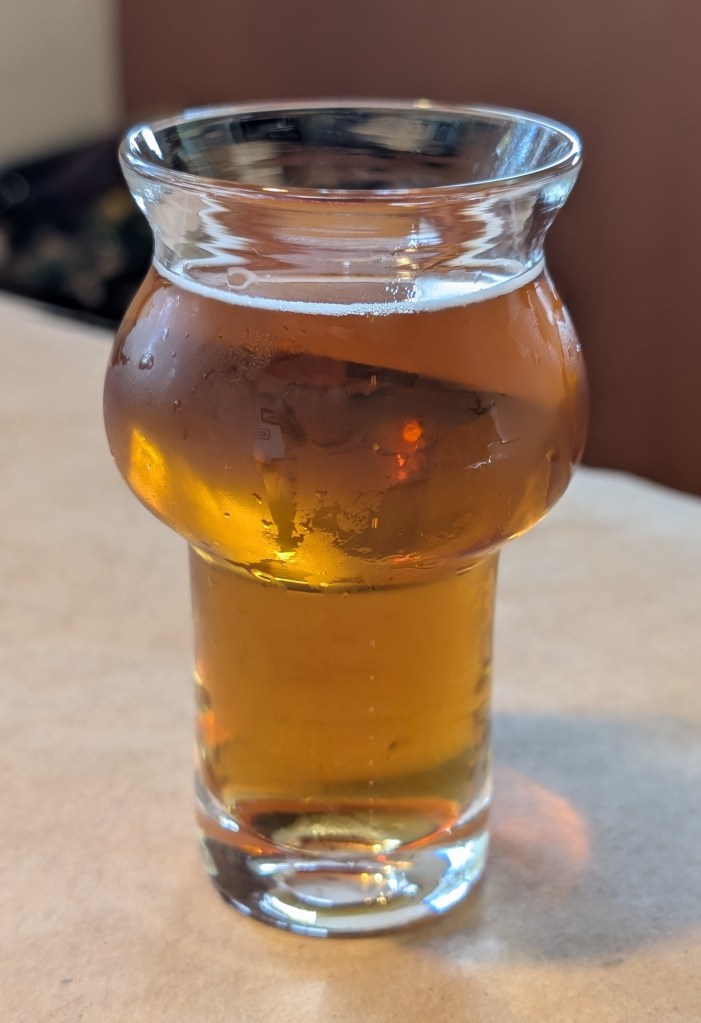
    • A very clear, light amber beer, which pours with a thin ivory head that quickly subsides. It’s a bit lighter in color than the original inspiration.
  • Aroma
    • Caramel notes are most prominent, with a little bit of candy, and a touch of light fruitiness behind that.
  • Flavor
    • Caramel and malty notes are at a moderate level. Medium-high bitterness. The hops, especially in initial tastes, have a woody and moderately herbal quality, in addition to a touch of earthiness. I don’t particularly care for the herbal notes here. I’m guessing they are coming from the hops; it doesn’t match EKG, so perhaps the Challenger is the culprit?
  • Mouthfeel
    • Moderate carbonation, medium body, smooth and slightly dry finish.
  • Would I Brew This Again?
    • This is definitely closer to what I want for an Old Speckled Hen clone, but the hops need a rework. I would probably ditch the Challenger and lean in on EKG entirely, or find another hop to sub in. The herbal notes I get here are more than I care for, but not something that totally wrecks the beer; it’s just not to my personal taste. It might be something with this lot of EKG (if that’s the true culprit), because I didn’t have that concern previously. The malt and yeast all do well, although I might go 50/50 on the crystal 40 and crystal 120 in order to round out the malt profile and deepen the color. I love the gentle fruitiness on the yeast and also how it dropped so clear. This is a very pretty beer!
  • Overall
    • 6/10

Nut Nut Brown Ale

I particularly enjoy dark English-style beers during the winter, and brown ale is a particularly nice style for my tastes. So, I put together a British Brown Ale recipe from an amalgamation of various online versions.

Nut Nut Brown Ale

  • 10 lb. Golden Promise malt (Simpsons)
  • 4 oz. crystal 75 malt (Bairds)
  • 4 oz. chocolate malt (Bairds)
  • 3 oz. Special B malt (Dingemans)
  • 1.25 oz. East Kent Goldings hop pellets (5.0% alpha), 60 minute boil
  • 0.25 oz. Fuggles hop pellets (4.6% alpha), 60 minute boil
  • 1 Whirlfloc tablet, 5 minute boil
  • 1 pkg. Windsor ale yeast (Lallemand)

Target Parameters

  • 1.047 o.g., 1.013 f.g., 4.5% alpha, 27 IBU, 17 SRM
  • Full volume mash at 156° for 60 minutes and 10 minute mash-out at 168°
  • Claremont tap water with Campden tablet

Procedure

  • I mashed in with 7 gallons of water at 162°, to hit a target mash temperature of 156°. I added 6 mL of 88% lactic acid to adjust the pH, at the start of the mash. After 60 minutes of recirculation, I increased the temperature to 168° and held it there for 10 minutes, before pulling the grains.
  • I collected 6.1 gallons of runnings at a gravity of 1.044, for 69% mash efficiency.
  • I brought the kettle to a boil, adding hops and finings per the recipe. After a 60 minute boil, I turned off the heat, chilled the wort, and transferred it to the fermenter.
  • I brewed this beer on 19 November 2022. It had a starting gravity of 1.049. I held the temperature at 68° for fermentation.
  • I kegged the beer on 10 December 2022. It had a final gravity of 1.025, for 3.1% abv. This was surprisingly low attenuation, which I attribute to the high mash temperature.

Tasting

  • Appearance
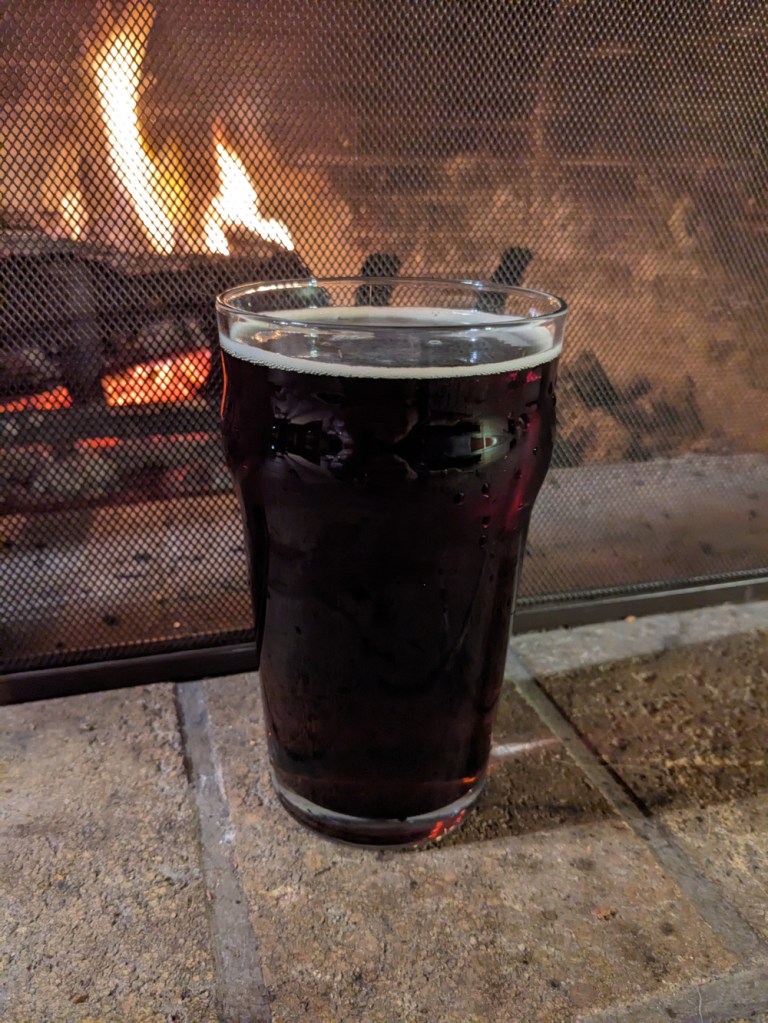
    • Deep cinnamon brown color with brilliant clarity; pours with a thin and persistent off-white head. Very pretty!
  • Aroma
    • Coffee and chocolate; light yeasty esters too; very pleasant.
  • Flavor
    • Cocoa and rich bread crust in the malt; moderate bitterness; slight yeasty esters again like in the aroma, with a very pleasant quality.
  • Mouthfeel
    • Medium-light body, moderate carbonation, smooth finish with a very very slightly dry quality.
  • Would I Brew This Again?
    • It’s not perhaps the most exciting style for me (relative to a porter or stout), but this is a super tasty beer that has come into its own. It’s interesting that it doesn’t taste nearly as thick as it should given the final gravity. The caramel qualities that this style is supposed to have aren’t terribly prominent, and the bread crust character is a bit off for the style also. This is a really interesting beer, but not to the literal BJCP standards. It would be a 10 on its own, but I gave it a 6 given the style considerations. It should probabkly have more caramel malts in the grist to hit the style marks.
  • Overall
    • 7/10

Dark Mild 2021

As part of a general interest in brewing session beers, I recently tried my hand at a dark mild. Thanks to Ron Pattinson’s excellent work on historic English brewing, I’ve learned that the original dark milds were in fact beyond session strength, and have evolved to be low alcohol. Either way, the modern take is supposed to be a style that is full of flavor and light on ethanol.

My particular version was formulated after looking at a few other recipes, with consideration of what supplies I had on hand. Conveniently, I had some Maris Otter to finish out, and a few other English malts. I had planned on using a packet of English ale yeast from Cellar Science, but it just so happened that I kegged an oatmeal stout right before brewing the mild. Because the stout used Nottingham yeast, I decided to pitch the mild directly onto the yeast cake (after removing a cup or two, to reduce the potential effects of overpitching). I’ll admit this strategy also served my laziness, because then I didn’t have to completely clean and sanitize a new fermenter right in the midst of the brewing process.

To go for a more “authentic” cask-like serving style, I carbonated the beer to only 2.0 volumes. My keezer is set a bit cooler than ideal (~40°), so flavors don’t really start to pop until the beer warms.

Dark Mild 2021

  • 6.75 lb. Finest Maris Otter ale malt (Crisp)
  • 0.5 lb. crystal 75 (Bairds)
  • 0.25 lb. Carafa Special I (Weyermann)
  • 0.25 lb. coffee malt (Simpsons)
  • 2 oz. black malt (Briess)
  • 0.75 oz. East Kent Goldings hop pellets (5.0% alpha), 60 minute boil
  • 1 Whirlfloc tablet, 5 minute boil
  • Nottingham ale yeast (Lallemand), pitched onto partial yeast cake from previous batch

Target Parameters

  • 1.036 o.g., 1.010 f.g., 3.3% abv, 20 IBU, 20 SRM
  • Mash held at 156° for 60 minutes, and 10 minute mash-out at 168°
  • Claremont tap water, treated with Campden tablet

Procedure

  • I heated 6.75 gallons of water to 161°, and mashed in with the grains to hit a temperature of 156°. I added 5 mL of 88% lactic acid to hit ~5.35 pH (estimated), and held at 156° with recirculation for 60 minutes.
  • After 60 minutes, I raised the mash temperature to 168° for 10 minutes, and then removed the grains.
  • In total, I collected 6.1 gallons of runnings with a gravity of 1.035, for 73% mash efficiency.
  • I boiled for 60 minutes, adding hops and finings per the recipe. After 60 minutes, I turned off the heat and chilled down to pitching temperature (~68°).
  • Starting gravity was 1.040, a bit higher than targeted.
  • I transferred the beer onto the yeast cake from my previous batch of Eagle Face Oatmeal Stout. Prior to transfer, I removed ~2 cups of yeast in order to avoid overpitching.
  • Once the yeast was pitched, I sealed up the fermenter and moved it indoors to ferment at ambient of around 65°.
  • I brewed the beer on 11 December 2021, and kegged it on 26 December 2021
  • Final gravity was 1.020, for 2.6% abv. I carbonated to around 2.0 volumes. Within about a week of kegging, the beer had dropped completely clear.

Tasting

  • Appearance
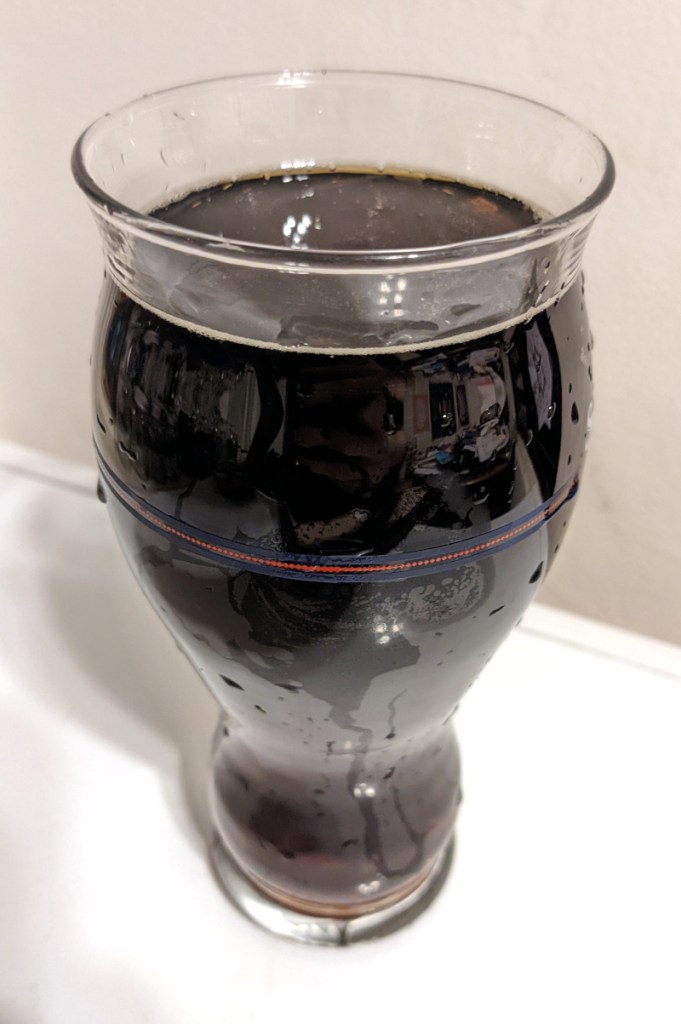
    • Pours with a light tan head that rapidly disperses; the beer itself is pretty clear and a deep mahogany in color.
  • Aroma
    • Light chocolate and coffee on the nose, and no major yeast character.
  • Flavor
    • Coffee and dark chocolate and some faint roasted notes, and a bit of biscuit character in the malt. There is faint dried stone fruit quality in the yeast. Bitterness is low, and the finish very much tips towards the malt.
  • Mouthfeel
    • Light body, low carbonation, off-dry finish with very slight astringency.
  • Would I brew this again?
    • I really like this beer! For such a low alcohol brew, it packs a really punch of malt character. It is eminently drinkable, but also very interesting in flavor. I wouldn’t mind a little more yeast character, perhaps some extra fruity notes, but that is a fairly minor critique. I may well try this recipe again, and will certainly brew a dark mild again. It is a style with a fair bit of latitude, which is worth exploring.
  • Overall
    • 8/10