
Every year, I make a beer for our Thanksgiving celebration with friends (or at least in honor of Thanksgiving, during years when we couldn’t travel). Previous batches have included Stygimoloch Bock, Ill Tempered Gnome Clone, and Thanksgiving IPA 2017. In general, I like a Thanksgiving beer that is a bit fuller-bodied and maltier, versus an easy sipper like a blonde ale.
For 2023, I wanted to turn the dials to the max, and so I honed in on English barleywine for my style. This is a style that rewards a loooong conditioning time, so I knew I had to work on it sooner than later. The November 2022 BYO magazine came to the rescue, with a recipe called Winter’s Barleywine. My version was modified rather heavily from the BYO version, to accommodate ingredients on-hand; thus I had a combination of American, German, and English ingredients and a naming idea for this batch. The beer was brewed at the end of January, allowing a full nine months of fermentation and conditioning.
I targeted a 2.5 gallon batch, because I really don’t need 5 gallons of a 10% abv beer.
Thanksgiving Transatlantic Barleywine
- 8 lb. Golden Promise pale ale malt (Simpsons)
- 0.75 lb. Mela malt (Great Western)
- 0.5 lb. Caramel 60 malt (Briess)
- 0.25 lb. Caramunich II malt (Weyermann)
- 0.25 lb. Caravienne malt (Weyermann)
- 0.65 oz. Magnum hop pellets (16.5% alpha), 60 minute boil
- 1 oz. Fuggles hop pellets (4.6% alpha), 10 minute boil
- 0.75 lb. brown sugar, light, 10 minute boil
- 1 Whirlfloc tablet, 5 minute boil
- 1 oz. Cascade whole hops (5.5% est. alpha), 5 minute boil
- 1.25 g. WLN1000 yeast nutrient (White Labs), 5 minute boil
- 1 oz. Willamette hop pellets (5.0% alpha), 10 minute whirlpool
- 2 pkg. English ale dry yeast (CellarScience)
- 1 oz. Willamette hop pellets (5.0% alpha), dry hop for 1 week in primary
Target Parameters
- 60 minute infusion mash, held at 149° for 60 minutes, with 10 minutes at 168°, sparge
- 1.105 o.g., 1.015 f.g., 12.3% abv, 74 IBU, 17 SRM
- Claremont tap water, with Campden tablet
Procedure
- I mashed in with ~5 gallons of water at 157°, to hit a strike temperature of 149°. Upon adding the grains, I also added 2.5 mL of 88% lactic acid to adjust the pH.
- Following 60 minutes of recirculation at 149°, I raised the temperature to 168° and held it there for 10 minutes. Then, I removed the grain basket, let it drain, and sparged with 0.5 gallons of water.
- I collected around 4.25 gallons of runnings with a gravity of 1.058, for 70% mash efficiency. Because this was a bit below my target of 1.070, I decided to boil for awhile before adding the hops.
- After 30 minutes, my gravity was down to 1.065. I decided to continue boiling for another 30 minutes. before adding the first charge of hops.
- Following the initial 60 minute boil, I added the hops and finings per the recipe, and then turned off the heat following the full 120 minutes.
- I chilled to 66°, transferred to the fermenter, and pitched the two packets of yeast. Starting gravity was 1.093.
- I brewed this beer on 21 January 2023, fermenting at 66°. On 26 January 2023, I pulled it to ambient and let it free-ride for the rest of fermentation.
- I added the dry hops in a baggie on 21 February 2023.
- I kegged the beer on 25 February 2023, removing the hops and adding 1.5 oz. of corn sugar boiled in 0.75 cups of water. Final gravity was 1.023, for 9.4% abv.
- Sealing the beer under pressure, I let it sit at ambient until late October, when I pulled it into my keezer and applied some carbon dioxide to increase the carbonation.
- The beer still had a fair bit of haze when I sampled it in early November, so on 14 November 2023, I added ~1/4 tsp. of gelatin boiled in ~1/4 cup of water, to clarify the beer further.
Tasting
- Appearance
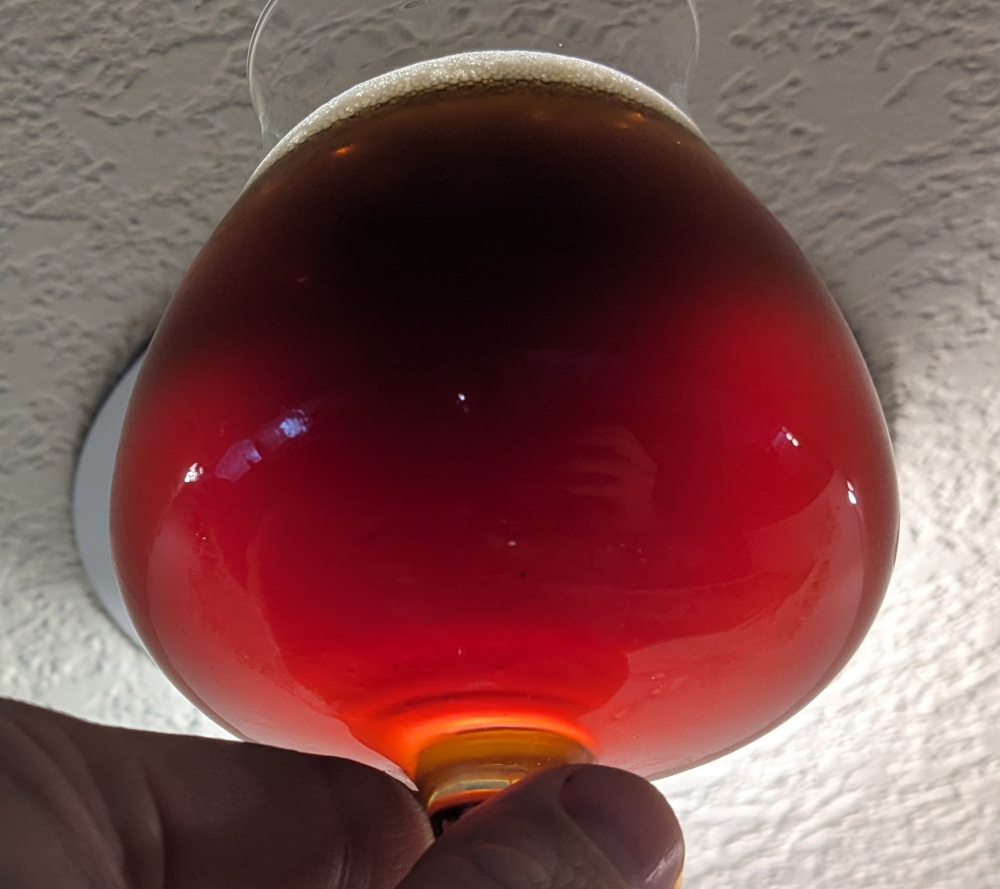
- The barleywine pours with a tall, thick ivory head that subsides over time to pretty much nothing by the end of the glass (over an hour or two). The beer itself is deep amber in color and red highlights, with some chill haze.
- Aroma
- The aroma changes a fair bit as the beer warms up. Caramel and malty notes are prominent. There is a moderate earthy note hop note when cooler, and alcohol notes become more prominent as the beer warms up (almost too much at around 56°).
- Flavor
- A big and rich maltiness with caramel is dominant, with some subtle honey at the back end as well as some dark fruit qualities. Hop bitterness is medium-high, with resin and earthy qualities, but it definitely takes a back seat to the malt. The beer is best described as “chewy,” like a cookie.
- Mouthfeel
- The beer has a full mouthfeel, with moderate carbonation. It has a smooth finish, with some sweetness on the back end.
- Would I Brew This Again?
- Yes! Next time, though, I would let it age out for awhile, but this batch is already on its last legs. Aging would help to mellow the alcohol character; interestingly, I don’t pick that up in the flavor so much as the aroma in the current state of the beer.
- Overall
- 6.5/10
 Andy's Brewing Blog