Mosaic SMaSH Session Pale Ale

I wanted a quick-and-easy hoppy beer in the sessionable zone, so I threw together a SMaSH recipe with mostly on-hand ingredients. Maris Otter served as the base, for something a little more flavorful than average 2-row. I have a pound of Mosaic on-hand; I haven’t brewed with that variety in forever, and it’s interesting enough to stand on its own. Finally, I needed a yeast decision. This one required a quick turn-around to go on tap, so kveik was an obvious choice. My fantastic LHBS (Pacific Brewing Supplies in San Dimas) had a new brand in stock, a company called Kveik Yeastery. Looking through their products, a variety called Stalljen seemed perfect–it promised tropical fruit, mango, and pineapple, with citrus behind that. Reading a bit more about the yeast, I’m not sure if there are other commercial versions sold; if anyone knows differently, I’m happy to learn more. As a final note, this beer was set up as a “short and shoddy” style mash and boil, with 30 minutes on each.

Mosaic SMaSH Session Pale Ale

  • 10.5 lb. Maris Otter pale ale malt (Thomas Fawcett)
  • 0.5 tsp. BrewTanB (mash)
  • 1.25 oz. Mosaic hop pellets (10.7% alpha), 20 minute boil
  • 0.5 tsp. BrewTanB, 10 minute boil
  • 1 Kick Carrageenan tablet, 5 minute boil
  • 1.75 oz. Mosaic hop pellets (10.7% alpha), 10 minute whirlpool
  • 1 pkg. Stalljen kveik (Kveik Yeastery #K.22)
  • 3 oz. Mosaic hop pellets (10.7% alpha), dry hop

    Target Parameters

    • 30 minute infusion mash, 152°, full volume mash
    • 1.049 o.g., 1.012 f.g., 4.8% abv, 41 IBU, 5 SRM
    • Claremont tap water adjusted to hit 75 ppm Ca, 26 ppm Mg, 102 ppm Na, 164 ppm SO4, 130 ppm Cl, 10 ppm bicarbonate, RA=-60

    Procedure

    • Starting with 7 gallons of water, I added 7.2 mL of 88% lactic acid, 4 g of gypsum, and 2 g of epsom salts, in order to hit my water targets.
    • I heated the mash water to 157°, added the grains, and mashed at 152° with recirculation for 30 minutes. I then raised the mash to 168° for a 10 minute mash-out, before removing the grains.
    • My post-mash gravity was a bit underwhelming at 1.035 — that’s only 56% mash efficiency, well below my norm. Based on past results with the Fawcett Maris Otter, I’m thinking this is a malt that needs a full 60 minute mash at least; it certainly hasn’t overwhelmed me with its efficiency. Although I hadn’t planned a session ale, this is where I kicked things into session ale territory. I double-checked my mill gap, and all was OK there, so I can’t blame the mill.
    • I brought the runnings to a boil, but I upped the boil vigor a bit (85% power on the Foundry) and extended the boil to 60 minutes (instead of the planned 30 minutes).
    • After the boil, I added the last bit of hops and then chilled down to 93°. I transferred to the fermenter, pitched the yeast, and fermented at ambient.
    • I brewed this beer on 16 August 2025. Starting gravity was 1.043.
    • Vigorous fermentation kicked off within four hours of adding the yeast; the fermenter temperature was down to 68° by the next morning.
    • I added the dry hops on 21 August 2025, and cold crashed the beer on 24 August 2025.
    • I kegged the beer using a closed transfer on 30 August 2025. Final gravity was 1.012, for 4.1% abv.

    Tasting

    • Appearance
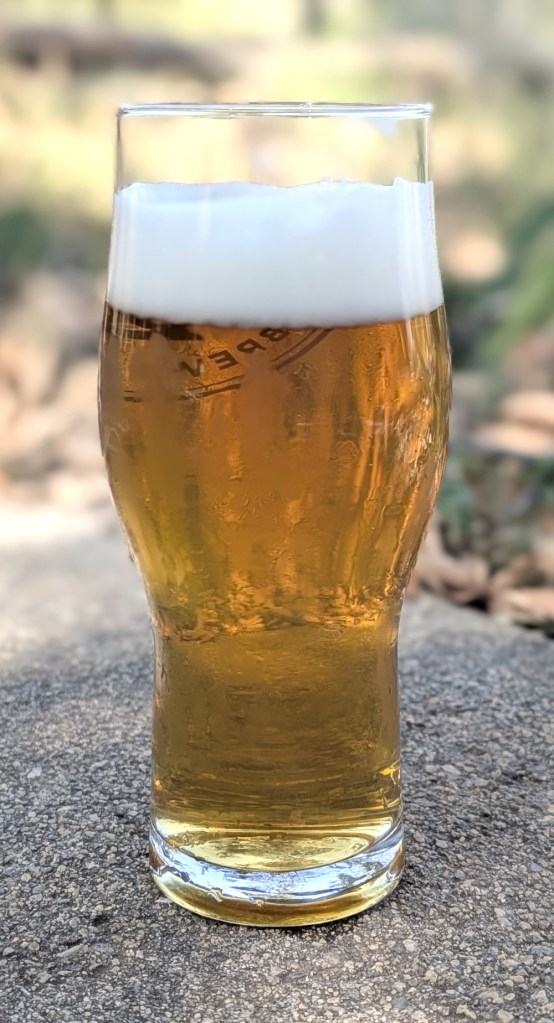
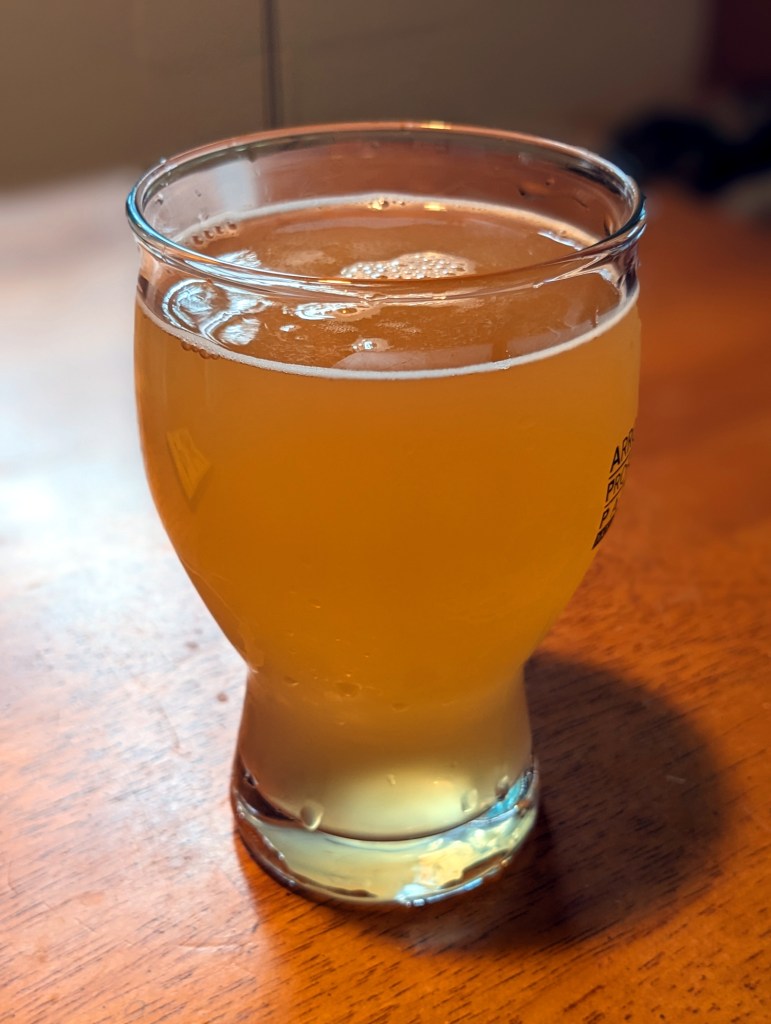
      • This is a hazy, light yellow beer that pours with a fluffy and persistent white head. The lacing is gorgeous!
    • Aroma
      • Aroma is dominated by a fresh citrus and blueberry hop character at a medium-high level. There is minimal malt or yeast character that I can pick up.
    • Flavor
      • Bitterness is at a high level, with slight astringency and hop bite. There is a medium-low level of malt flavor, with a grainy/malty-sweet character. The hops have a citrus and pine quality, with slight mango; it’s backed up by the citrusy notes presumably from the yeast.
    • Mouthfeel
      • Medium level of carbonation; light body and a dry finish with slight astringency.
    • Would I Brew This Again?
      • The core concept of this beer is great, but it definitely suffered from the low starting gravity. The astringency is annoying, but otherwise it’s a pretty decent beer. I would definitely do a version of this recipe again, with a higher gravity. Stalljen is a fantastic kveik strain; it’s unobtrusive and works well with Mosaic. I didn’t pick up the slight “twang” or tartness I get with Lutra (my other favorite strain), and I wouldn’t necessarily know this is a kveik otherwise. The persistent haze might be a negative in some recipes, but it’s so beautiful in this particular beer. Thinking ahead, I might aim for the same level of hops in a future version, with a starting gravity around 1.054. That would take a greater amount of malt as well as a longer mash.
    • Overall
      • 6/10

    Scaphohippus Pale Ale

    My latest hoppy brew involves a pale ale recipe from the Maltose Falcons’ 50th anniversary recipe book. It’s a nice volume with some interesting recipes across a variety of styles. The book is by design geared for members of the club, with a decent bit of inside baseball and anecdotes and stuff, but for someone who likes field-tested recipes (versus rando ones posted online), it’s a worthy addition to a home library. I found some of the recipes to be a bit hard to follow in the formatting or presentation (e.g., lines of text with odd breakpoints that made it hard to discern what went where; limited procedural guidance for some batches–I can’t fault them too much, because it is a compendium of recipes from a whole bunch of people across decades of time), so I wouldn’t recommend it for the novice brewer, but most folks who are in the intermediate to advanced stages of brewing should be very capable of putting the recipes to work.

    In any case, a recipe called “Halfcolt Pale Ale” caught my eye as a contemporary pale ale of reasonable ABV that incorporated ingredients I mostly had on hand. I made some modifications, both for the base malts and to use hop pellets versus the cryo products, and away I went on my interpretation. Two versions of the recipe were included in the book; one is a commercial scaled version and the other is a homebrew version. Beyond batch size, there are some significant differences between recipes. Most notably, the homebrew version lists bitterness at 76 IBU, whereas the commercial version is published at 50 IBU. I elected to dry the much more bitter homebrew version, partly because I wanted a robustly in-your-face beer. In the printed version of the recipe, the line alignment for hop additions made it ambiguous which were whirlpool and which were dry hops, so I made some informed guesses.

    This recipe gets the name of “Scaphohippus Pale Ale,” because this extinct equine was about half the size of a regular horse (i.e., a “halfcolt”).

    Recipe Name

    • 8.75 lb. 2-row brewer’s malt (Great Western)
    • 1 lb. Maris Otter pale malt (Thomas Fawcett)
    • 0.5 lb. Carafoam (Weyermann)
    • 6 oz. Victory malt (Briess)
    • 4 oz. Viking Caramel 100 malt (crystal 40)
    • 0.5 tsp. BrewTanB, added to mash
    • 0.25 oz. Simcoe hop pellets (12.4% alpha), first wort hop and 60 minute boil
    • 1 oz. Cascade hop pellets (7.3% alpha), 20 minute boil
    • 1 oz. Simcoe hop pellets (12.4% alpha), 20 minute boil
    • 0.5 tsp. BrewTanB, 10 minute boil
    • 1 Whirlfloc tablet, 5 minute boil
    • 1 oz. Simcoe hop pellets (12.4% alpha), 20 minute whirlpool
    • 0.5 oz. Amarillo hop pellets (10.4% alpha), 20 minute whirlpool
    • 1 pkg. California ale dry yeast (WLP001, White Labs)
    • 1 oz. Amarillo hop pellets (10.4% alpha), dry hop for 12 days
    • 1 oz. Cascade hop pellets (7.3% alpha), dry hop for 12 days
    • 1 oz. Simcoe hop pellets (12.4% alpha), dry hop for 12 days

    Target Parameters

    • 60 minute infusion mash, 150°, full volume mash
    • 1.049 o.g., 1.009 f.g., 5.3% abv, 75 IBU, 6 SRM
    • Claremont tap water adjusted to hit a profile of 86 ppm Ca, 19 ppm Mg, 89 ppm Na, 192 ppm SO4, 110 ppm Cl, and 156 ppm bicarbonate.

    Procedure

    • I collected 7.4 gallons of tap water, adding a Campden tablet, 3 g epsom salt, and 5 g gypsum to hit my water target parameters.
    • I heated the strike water to 156° and added the grains along with 5.7 mL of 88% lactic acid, holding the temperature at 150° for 60 minutes while recirculating. Then, I raised the temperature to 168° for 10 minutes before removing the grains.
    • In total, I collected 6.5 gallons of runnings with a gravity of 1.041, for 67% mash efficiency.
    • I brought the runnings to a boil, adding first wort hops, additional hops, and finings per the schedule.
    • After a 60 minute boil, I turned off the heat, added the whirlpool hops, and recirculated for 20 minutes before chilling the rest of the way.
    • I transferred the wort to the fermenter and chilled to 68° before pitching the yeast. Starting gravity was 1.051. I brewed this beer on 24 May 2025 and held it at 68° for fermentation.
    • I added the dry hops on 1 June 2025 and cold crashed the beer on 4 June 2025.
    • I kegged the beer on 13 June 2025, using a closed transfer followed by forced carbonation. Final gravity was 1.009, for 5.6% abv.
    • At my first taste of the beer on 25 June 2025, it was very clear, nearly brilliant, and absolutely delicious.

    Tasting

    • Appearance
      • Very clear, gold beer, which pours with a dense and persistent white head. It’s absolutely gorgeous in the glass!
    • Aroma
      • Medium level of citrus and a touch of pine in the hop aroma. Not much malt or yeast comes through; perhaps a hint of maltiness as it warms up?
    • Flavor
      • High level of resiny bitterness, with orange citrus qualities and a slight grapefruit pith edge. There is a moderate level of a clean, malty flavor, with hints of caramel and biscuit.
    • Mouthfeel
      • Medium body, medium level of carbonation, dry finish.
    • Would I Brew This Again?
      • This is a really enjoyable hoppy ale! It tilts more towards IPA (and a traditional west coast version at that) than pale ale due to the aggressive bittering, and so stylistic grounds were the main reason I didn’t give it a 9 or 10. The hop flavor and aroma are great; I think I’ve got my hop handling and kegging techniques pretty dialed in now to maximize flavor and freshness over the long haul. If I were to brew this again, I’d notch back the bitterness for future brews down to 50 or 60 IBU, but everything else hits well.
    • Overall
      • 7/10

    Old Speckled Hen Homage

    As a semi-mass-market English ale, Old Speckled Hen is one of my favorites. I think it’s mainly due to the name and associated nostalgia of my early days of better beer exploration, but in any case it’s something I come back to from time to time. A decade ago, I attempted a clone, which turned out okay but not great. This beer has been kicking around in my head ever since, and I even buy a bottle (or can) from time to time. It’s a legitimately enjoyable beer! Given that continued fascination, it was time for another attempt.

    My new version is based on two recipes posted online, somewhat different from the previous template I used. The current edition leans into a more complex malt bill, reducing the previous substantial addition of crystal 120 and adding a major addition of crystal 40. I also used this as a chance to try out a dry version of WLP066 (London Fog Ale Yeast), which seemed to target much of what I was looking for in yeast character. A constant is the use of Maris Otter as the base malt, along with Lyle’s Golden Syrup to provide another flavorful fermentable.

    Old Speckled Hen Homage

    • 9.5 lb. Maris Otter pale ale malt (Thomas Fawcett)
    • 1 lb. crystal 40 malt (Great Western)
    • 3 oz. caramel 120 malt (Briess)
    • 11.4 oz. Lyle’s Golden Syrup (added to boil)
    • 1 oz. Challenger hop pellets (5.6% alpha), 60 minute boil
    • 1 oz. East Kent Goldings hop pellets (5.4% alpha), 20 minute boil
    • 1 Whirlfloc tablet, 5 minute boil
    • 1 oz. East Kent Goldings hop pellets (5.4% alpha), 5 minute boil
    • 1 pkg. London Fog ale dry yeast (WLP066)

    Target Parameters

    • 1.054 s.g., 1.013 f.g., 35 IBU, 10 SRM, 5.3% abv
    • Full volume mash with 60 minutes at 156° and 10 minutes at 168°; 60 minute boil
    • Claremont tap water, with Campden tablet added

    Procedure

    • I heated 7.35 gallons of water to 162°, adding a Campden tablet to remove chloramines. I added the grains with 5.5 mL of 88% lactic acid, and let them mash at 156° for 60 minutes. Next, I raised the mash temperature to 168° for 10 minutes and then pulled the grains.
    • In total, I collected 6.25 gallons of runnings with a gravity of 1.046, for 73% mash efficiency.
    • I brought the mash to a boil, adding hops and finings per the recipe. After a 60 minute boil, I turned off the heat and chilled to 70° before transferring to the fermenter.
    • I brewed this beer on 24 December 2025. Starting gravity was 1.052; I am fermenting at ambient, around 65°.
    • I kegged the beer on 7 February 2025, adding 2.5 oz. of corn sugar to the keg dissolved in 0.5 cup of boiling water.
    • I let the keg sit for around 2 weeks before chilling down to ~35° until a free space opened up on my keezer.
    • Final gravity was fairly high, at 1.019, for 4.4% abv.

    Tasting

    • Appearance
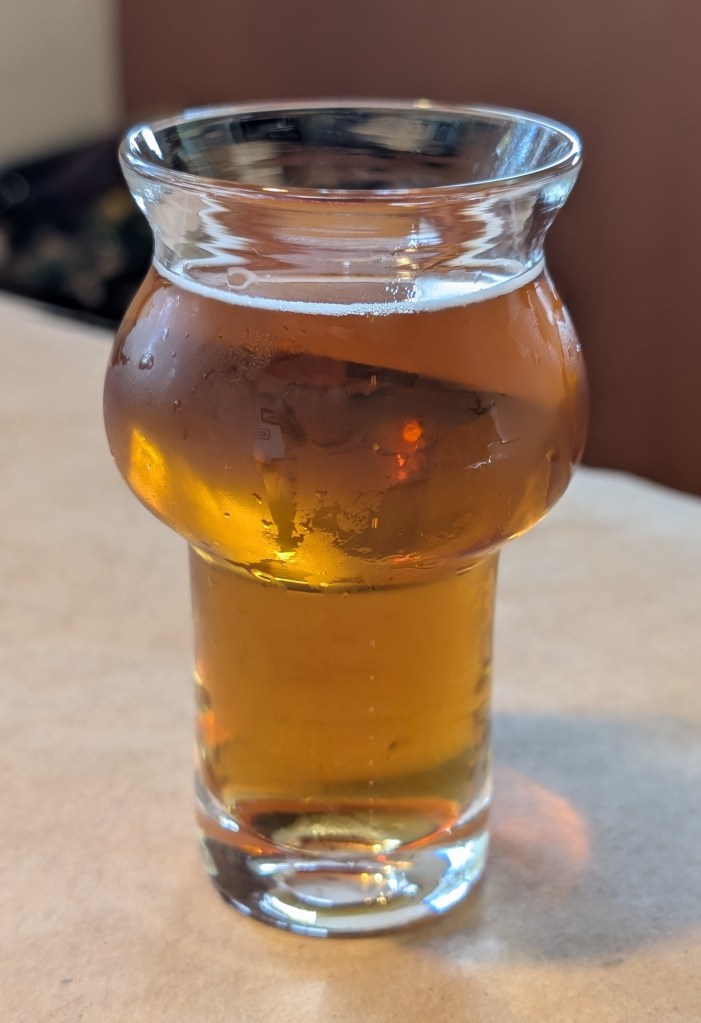
      • A very clear, light amber beer, which pours with a thin ivory head that quickly subsides. It’s a bit lighter in color than the original inspiration.
    • Aroma
      • Caramel notes are most prominent, with a little bit of candy, and a touch of light fruitiness behind that.
    • Flavor
      • Caramel and malty notes are at a moderate level. Medium-high bitterness. The hops, especially in initial tastes, have a woody and moderately herbal quality, in addition to a touch of earthiness. I don’t particularly care for the herbal notes here. I’m guessing they are coming from the hops; it doesn’t match EKG, so perhaps the Challenger is the culprit?
    • Mouthfeel
      • Moderate carbonation, medium body, smooth and slightly dry finish.
    • Would I Brew This Again?
      • This is definitely closer to what I want for an Old Speckled Hen clone, but the hops need a rework. I would probably ditch the Challenger and lean in on EKG entirely, or find another hop to sub in. The herbal notes I get here are more than I care for, but not something that totally wrecks the beer; it’s just not to my personal taste. It might be something with this lot of EKG (if that’s the true culprit), because I didn’t have that concern previously. The malt and yeast all do well, although I might go 50/50 on the crystal 40 and crystal 120 in order to round out the malt profile and deepen the color. I love the gentle fruitiness on the yeast and also how it dropped so clear. This is a very pretty beer!
    • Overall
      • 6/10

    Beam Me Up Pale Ale 2024

    I love pale ales, and I love this recipe! I made this last year and decided to give it another try. I upped the hops a touch to get a little more bitterness, and the malt brands are slightly different. Either way, it’s basically the same beer – simple grist, simple hops, simple yeast.

    Beam Me Up Pale Ale

    • 12 lb. 2-row pale malt (Briess)
    • 0.5 lb. Viking caramel 100 (crystal 40) malt – (Viking)
    • 0.5 tsp. BrewTanB, in mash
    • 2.0 oz. Cascade whole hops (5.5% estimated alpha acid), 60 minute boil
    • 1.0 oz. Cascade whole hops (5.5% estimated alpha acid), 15 minute boil
    • 0.5 tsp. BrewTanB, 10 minute boil
    • 1 Whirlfloc tablet, 5 minute boil
    • 2.0 oz. Cascade whole hops (5.5% estimated alpha acid), 5 minute boil
    • 2 pkg. BRY-97 (Lallemand)

    Target Parameters

    • 1.057 s.g., 1.015 f.g., 5.5% abv, 55 IBU, 6 SRM
    • Full volume mash, 156° for 60 minutes, 168° mash-out for 10 minutes
    • Claremont tap water adjusted with lactic acid

    Procedure

    • I mashed in with 7.6 gallons of water at 162°, to hit a target rest of 156°. I added 5.5 mL of 88% lactic acid to adjust the pH.
    • I recirculated for 60 minutes during the mash, raising it to 168° for a 10 minute mash-out.
    • After the mash, I removed the grains. In total, the mash yielded 6.6 gallons of runnings with a gravity of 1.047, for 67% mash efficiency.
    • Once the runnings were boiling, I added hops and kettle finings per the recipe. After 60 minutes, I turned off the heat and chilled to 82° and transferred the wort to the fermenter. I continued chilling down to 66° before pitching the yeast, holding the fermenter at 66° for the primary fermentation.
    • I brewed the beer on 17 August 2024. Starting gravity was 1.057.
    • I kegged the beer using a closed transfer, on 1 September 2024. Final gravity was 1.013, for 5.8% abv.

    Tasting

    • Appearance
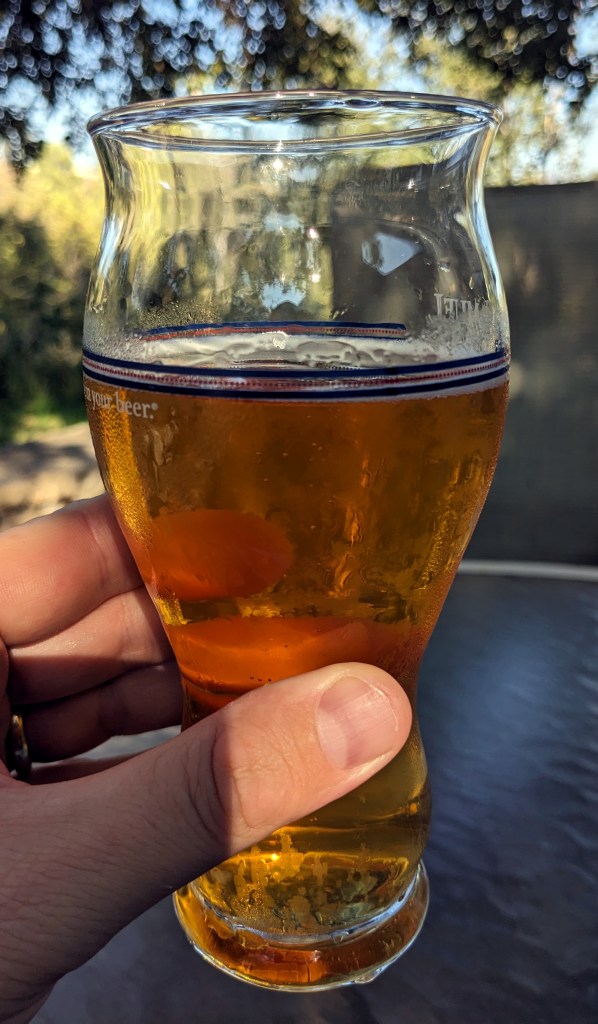
      • Deep gold beer, clear, with a fairly persistent white head
    • Aroma
      • Slight caramel malty note, and a moderate citrus aroma. It has a very orange-like quality.
    • Flavor
      • Medium bitterness, with a floral orange quality. Light caramel maltiness. This is a tasty beer!
    • Mouthfeel
      • Medium body, moderate level of carbonation, smooth and slightly dry finish.
    • Would I brew this again?
      • This is a wonderful American pale ale recipe! I see no need to make any changes – it’s just plain tasty. The citrus character is fantastic!
    • Overall
      • 10/10

    The French Connection Pale Ale

    A recent HOPBOX had a few varieties of French hops, which ranged from lager-type to IPA-ready varieties. Wanting to experiment a bit and also make an end-of-summer-drinkable-pale-ale, I created “French Connection Pale Ale.” Because my fermentation space was limited, I opted for a kveik–once again, the faithful Lutra. It’s not over-the-top in flavor, with mild citrusy qualities that would play well with the hops. I kept the grist on the lighter side, with just 2-row and caramel 20, in order to tilt towards easy drinkability and also contrast with the “old school” pale ale I brewed recently.

    The French Connection Pale Ale

    pale beer in glass
    • Lamonta Pale American barley malt (Mecca Grade)
    • 0.5 lb. caramel malt 20L (Briess)
    • 1.5 oz. Barbe Rouge hop pellets (6.6% alpha), 60 minute boil
    • 0.5 tsp. BrewTanB, 10 minute boil
    • 1 Whirlfloc tablet, 5 minute boil
    • 1 pkg. dry Lutra Kveik (Omega #OYL-071)
    • 2 oz. Mistral hop pellets (4.2% alpha), dry hop in keg
    • 0.5 oz. Barbe Rouge hop pellets (6.6% alpha), dry hop in keg

    Target Parameters

    • 1.049 s.g., 1.010 f.g., 5.2% abv, 37 IBU, 6 SRM
    • Full volume mash, 152° for 60 minutes, 168° mash-out for 10 minutes
    • Claremont tap water adjusted to hit target water parameters of to hit target of 91 ppm Ca, 23 ppm Mg, 84 ppm Na, 196 ppm SO4, 120 ppm Cl, 20 ppm HCO3, RA=-62

    Procedure

    • I collected 7.5 gallons of tap water and added 6.25 mL of 88% lactic acid, to knock out the carbonates. Then, I added 5 g of Epsom salts and 5 g of gypsum in order to hit my target water.
    • I heated the water to 157° in order to hit a mash temperature of 152°. I added 3 mL of 88% lactic acid to adjust the mash pH…only to realize I shouldn’t have done this! I hadn’t adjusted my water profile in the recipe, so this would result in a pH of ~4.9. Oops! I figured I would just roll with it by this point, and let the beer find its pH in the end.
    • I mashed at 152° for 60 minutes, with recirculation, before raising the mash to 168° for 10 minutes. I then pulled the grains.
    • In total, I collected 6.75 gallons with a gravity of 1.041, for 70% mash effciency.
    • I brought the kettle to a boil, adding hops and finings per the recipe. After 60 minutes, I turned off the heat and chilled to 84° and transferred to the fermenter.
    • I brewed this beer on 19 August 2023. Starting gravity was 1.046.
    • After pitching the yeast, I fermented the beer at ambient.
    • I kegged the beer on 7 September 2023. It had a final gravity of 1.012, for 4.5% abv.

    Tasting

    • Appearance
      • This is a straw-colored, hazy beer, with a thin white head. The head is somewhat persistent around the margins of the glass, but nothing special.
    • Aroma
      • A bit of berry as the beer warms up as well as some citrus; very fresh fruit character. I even get a bit of melon (cantaloupe/honeydew) at times.
    • Flavor
      • Hop-forward, especially in a fresh hop flavor. Bitterness is medium, and the hops come across with a bit of orange and even more berry character–especially currant and others. It’s more of a “generic berry” quality than anything. In some tastings, I get more citrus, but overall that is in the background. Malt quality is fairly innocuous, as expected. There is a bit of the “kveik flavor,” but it’s quite minimal.
    • Mouthfeel
      • Medium light body, moderate carbonation, and very very slightly dry finish. It’s an easy drinking beer!
    • Would I Brew This Again?
      • This is a pretty good “modern American pale ale,” and it is quite drinkable. I wouldn’t say it’s an earth-shaking beer, but the hops definitely are enjoyable. They are a nice departure from “citrus/pine bomb” territory. I would recommend these varieties for others who want to branch out. I got a strong vegetal/allium quality on the first few pours of this, but that is long gone thankfully.
    • Overall
      • 8/10 — the haze dings it a bit for my taste, but otherwise it’s pretty solid.