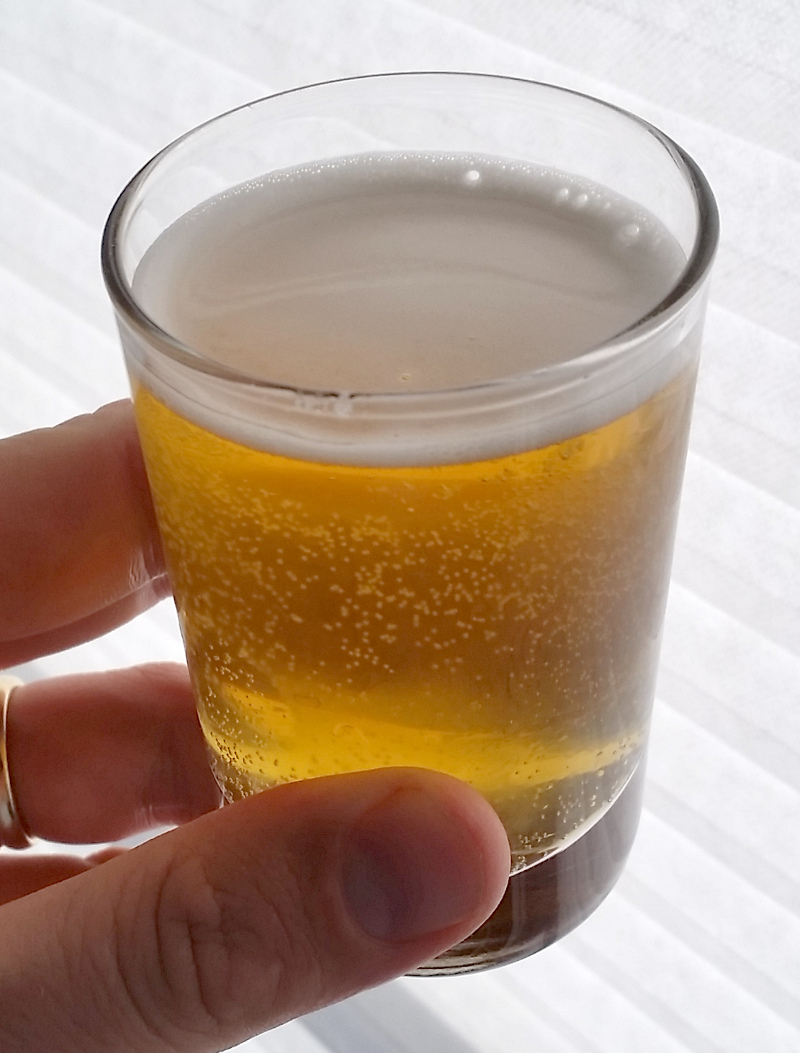
Honey Fuggle Ale

I recently ran across a fun-looking recipe in BYO (December 2015 issue), for a clone of Firestone Walker’s 805. I was in the mood to make a blonde ale, and particularly in the mood to make a new recipe of blonde ale. With a few minor modifications (US Fuggles instead of Willamette for the hops, and a touch less wheat malt, to use up my stash without having to buy more), I had everything in order.

The original recipe suggested building up from RO water; given the highly mineralized nature of our tap water, that seemed like a good idea. I’ve noticed that many of my lighter-flavored beers come across as a bit “flabby”, and suspect that the water is behind it. So, I bought a bunch of distilled water and some more brewing minerals. For the 3.75 gallons of mash water, I added 7 g of calcium chloride and just under 1/4 tsp. of 10% phosphoric acid. The 4.9 gallons of sparge water were treated with just 1/4 tsp. of 10% phosphoric acid.

I have to say that I really enjoy the honey malt addition in this one–it adds a deliciously sweet and distinct character to the wort. Although it certainly isn’t a malt for all occasions, it’s a nice ingredient to keep in the back of my mind for other batches. I’m intrigued to see how the honey malt plays out in a blonde ale like this one.

I had planned to use my culture of Conan (Yeast Bay’s “East Coast Ale” yeast), but when growing up the culture I noticed the aroma was a bit “off” from the first few generations. It wasn’t awful–just not quite right. So, I made a decision to toss it and go with dry yeast instead. The yeast didn’t really owe me anything–I got three good batches out of it, so that seemed to be plenty fine. I’m not sure if it was a contamination issue, or if the yeast had just drifted genetically.

20160521_072106

Grains ready for the mash tun.

Honey Fuggle Ale

  • 8.25 lbs. 2-row malt (Great Western Malting Co.)
  • 0.75 lbs. honey malt
  • 0.5 lb. white wheat malt
  • 1 oz. US Fuggle hops pellets (4.5% alpha, 3.1% beta), 60 minute boil
  • 1 oz. US Fuggle hops pellets (4.5% alpha, 3.1% beta), 5 minute steep after boil
  • 1 tsp. Irish moss (10 minute boil)
  • 1/4 tsp. yeast nutrient (10 minute boil)
  • 1 pkg. Nottingham dry yeast (Danstar)
  • Brewing water prepared as follows:
    • 3.75 gallons of mash water, with 7 g. calcium chloride and 1/4 tsp. 10% phosphoric acid
    • 4.9 gallons of sparge water, with 1/4 tsp. 10% phosphoric acid

Brewing Targets

  • Mash temperature = 156°
  • Original gravity = 1.045 (actual = 1.048)
  • Color = 5 SRM
  • IBU = 19

Procedure

  • I mashed in with 3.75 gallons of water at 167.9°, to hit a mash temperature of 157°. The mash was down to 152° after 60 minutes.
  • I collected the first runnings, and then added 4.9 gallons of water at 185°, to bring the mash bed up to right at 170°. I let it sit for 10 minutes, vorlaufed, and collected the rest of the wort.
  • I collected 7.2 gallons of wort at a gravity of 1.039, for 81% efficiency! Wow! I am not sure if this was the result of my water treatment, or something else, but it was certainly unexpectedly high.
  • I brought the wort to a boil, and added the various ingredients per the schedule in the recipe.
  • After 60 minutes, I added the final dose of hops and chilled the wort down to 80°. After transferring it into my carboy, I let it cool in the fermentation chamber for an hour or two, down to 68°, and then sprinkled the yeast on the wort.
  • The starting gravity was 1.048, and I am fermenting the beer at 68°. This beer was brewed on Saturday, 21 May 2016.

New World Blonde Ale

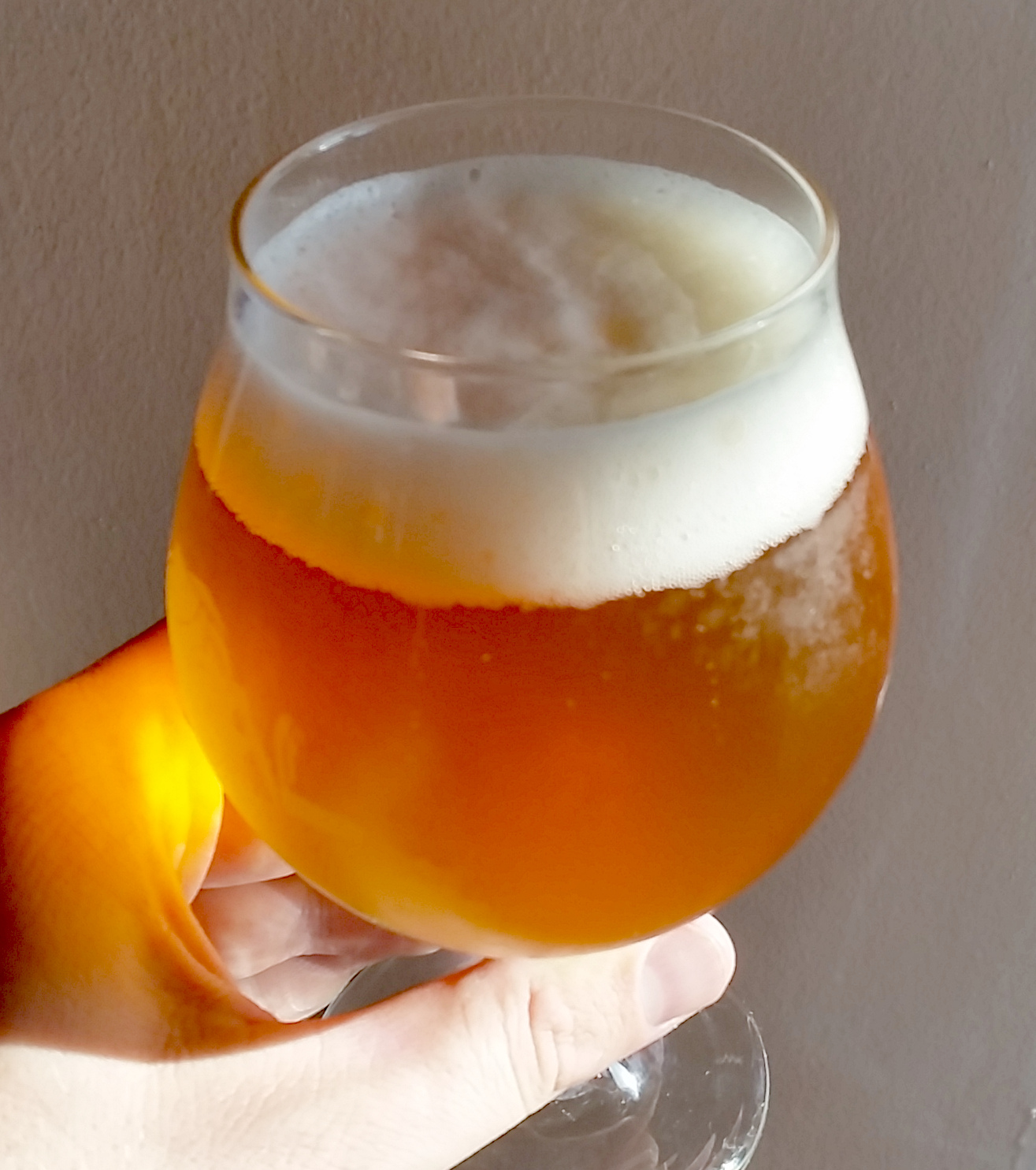
20160415_190959Time to make a classic summer beer! For this batch, I wanted to try something different, by mixing techniques used on two previous blonde ales that have turned out well. Firstly, following my Summer Blonde Ale, I elected to keep a simple grain bill. This meant mostly 2-row malt, with a touch of dark Munich malt (somewhere in the 10 to 20 lovibond range). However, I wanted a slightly more complex hops character, so I followed a version of the hopping schedule from my Citra Blonde Ale, in that all of the hops were added in the last 10 minutes of the boil. I had two ounces of the experimental HBC 438, and this seemed like a fine batch in which to highlight those.
New World Blonde Ale

  • 9 lbs. 2-row (Great Western Malting Co.)
  • 9 oz. Dark Munich malt
  • 0.5 oz. HBC 438 hops pellets (16.6% alpha, 6.2% beta, 10 minute boil)
  • 0.5 oz. HBC 438 hops pellets (16.6% alpha, 6.2% beta, 5 minute boil)
  • 1 oz. HBC 438 hops pellets (16.6% alpha, 6.2% beta, 5 minute whirlpool)
  • 1 tsp. Irish moss (10 minute boil)
  • 1 pkg. California Ale Yeast (WLP001, White Labs), in 1L starter

Procedure

  • 48 hours in advance, I prepared the yeast in a 1L starter
  • I mashed in with 3.5 gallons of water at 161º, to hit a mash temperature of 149º. The mash was down to 149º after 40 minutes. After 60 minutes, I added 1.5 gallons of water at 180º, which raised the mash bed to 152º. I vorlaufed and collected the first runnings, and then added another 3.5 gallons of water at 180º, let it sit for 10 minutes, and then collected the remainder of the wort.
  • All told, I collected 6.8 gallons of wort at a gravity of 1.040, for 78% efficiency.
  • I boiled for 60 minutes, adding the hops and Irish moss per the schedule.
  • After flame-out, I chilled the wort down to 75º, transferred to the fermenter, and pitched the yeast slurry.
  • The starting gravity was 75º. I brewed this on 15 April 2016, and fermented it at 66º for six days.
  • The beer was kegged on 21 April 2016. At this point, it had a final gravity of 1.008, which equates to 4.9% abv.

Beer Tasting: Citra Blonde Ale

Time to taste the Citra Blonde Ale! It has been in the keg for about two and a half weeks, and turns out to be an incredible beer.

  • The Basics
    • Original gravity = 1.049; final gravity = 1.015; abv = 4.5%; estimated IBU = 19
  • Appearance
    • Clear with just a very faint haze. The head is white, medium-fine, of moderate size, and persistent.
  • Aroma
    • Very lightly malty, with a refreshing hint of citrus.
  • Flavor
    • “Juicy” is the best descriptor; that flavor is robust but not overwhelming. The hops are definitely in the foreground, and I can pick out light citrus. It’s really interesting how “juicy” this beer is – I can’t say I’ve ever picked up on this before in my beers, but it’s definitely there. It’s almost like a bit of watermelon was squeezed into the beer. The hops are noticeable more for the flavoring and aroma than bitterness.
  • Mouthfeel
    • Moderate body and carbonation, as is appropriate for this style.
  • Would I brew this again?
    • Absolutely! This is an incredibly tasty beer, which really nails a unique set of flavors and aromas. I love pretty much everything about it! The special techniques–including no-sparge–as well as the Citra hops added up to something quite nice. It’s interesting how different it is as a blonde ale from my other favored recipe, the Summer Blonde Ale.
  • Overall Rating
    • 10 / 10

Citra Blonde Ale

During the warm months, it’s nice to have some refreshing beers on-hand. The wheat beer is rapidly dwindling, and I suspect the same will be true also for my session IPA. So, it’s best to get out in front of the inevitably empty keg and brew up a replacement!

In the interests of maximum drinkability to the greatest number of friends and family, I’m aiming for a blonde ale. Although my “house” blonde recipe is quite tasty, I wanted to branch out and try something different.

Gordon Strong’s Modern Homebrew Recipes had a beer called “New World Blonde,” which was intriguing in terms of the malt bill as well as the technique. The malt bill was interesting because it was a little more complex than my usual blonde ale recipe. The suggested technique departed from my usual, in that it was a no-sparge step mash. The single wort collection schedule is supposed to provide a slightly richer malt flavor. The step mash is presumably to incorporate a protein rest for the pilsner malt. Because I am just mashing in a cooler, I am somewhat limited in the types of steps I can incorporate, but this recipe was simple enough (target of 132° to 152° to 168°) that I could approximate it. Of course, I couldn’t quite raise the final step as high as needed (I maxed out at 161°), but for my purposes I deemed it sufficient.

I made a few minor changes from Strong’s recipe, primarily to use all Citra hops (his called for 1 oz. of Australian Galaxy too, but I didn’t want to buy yet another bag of hops that would only be partly consumed) as well as to switch to WLP051 from the recommended Wyeast 1272. In terms of overall process, I hit my temperature targets fairly well, and my actual efficiency was a bit better than estimated prior to the brew.

Citra Blonde Ale

  • 5 lbs. 2-row malt (Great Western Malting Co.)
  • 5 lbs. Pilsner malt
  • 0.75 lbs. 10° Munich malt
  • 0.5 lbs. Caravienne malt
  • 0.5 oz. Citra hops (13.2% alpha, 4.0% beta), 10 minute boil
  • 0.5 oz. Citra hops (13.2% alpha, 4.0% beta), 5 minute boil
  • 1 oz. Citra hops (13.2% alpha, 4.0% beta), 5 minute steep
  • 1 tbs. 5.2 pH stabilizer (added to mash)
  • 1 Whirlfloc tablet, 10 minute boil
  • 1 pkg. California Ale V yeast (WLP051), prepared in 0.75 L starter 12 hours in advance
Procedure
  • I mashed in with 5.1 gallons of water at 139.5°; the mash temperature settled at 133.8°. After 15 minutes, the mash was down to 133°.
  • Next, I added 2 gallons of boiling water, which raised the mash temperature to 153°. Temperature was down to 150.4° after 30 minutes and 148° after 45 minutes.
  • After 60 minutes (past the first boiling water addition), I added 7 quarts of boiling water for the mash-out, which raised the temperature to 161°.
  • After 15 minutes, I vorlaufed and then drained the mash tun completely.
  • In total, I collected 7.3 gallons of wort at a gravity of 1.042. This works out to 75% efficiency – a bit higher than expected!
  • I brought the wort to a boil, for a total of 90 minutes.
  • At 10 minutes and 5 minutes remaining, I threw in the appropriate hops additions. At flame-out, I removed the first two hops bags and added the final bag (1 oz.).
  • I chilled the wort down to 80°, transferred to the fermenter, and pitched the yeast.
  • Starting gravity was 1.049 (confirmed on both refractometer and hydrometer). The beer showed signs of fermentation within 7 hours of pitching. I brewed this beer on August 8, 2015.

Beer Tasting: Summer Blonde Ale 1.1

My Summer Blonde Ale 1.1 has been carbonating and conditioning in the keg for the past month, so now is as good of a time as any to sample it. We’ve really been enjoying this beer, and I think it’s definitely earned its place as a “go-to” summer recipe.

  • The Basics
    • Starting gravity = 1.047; final gravity = 1.009; abv = 5.0%; IBU = 21 (estimated)
  • Appearance
    • Clear (but not brilliant), light golden color; fine and fairly persistent white head.
  • Aroma
    • Lightly malty and ever so slightly fruity.
  • Flavor
    • Smooth and very lightly fruity maltiness; a delicate bitterness but certainly not prominent on that end.
  • Mouthfeel
    • Medium carbonation, within bounds for the style; a light and smooth body with a nice light finish (just a hint of malt and hops).
  • Would I brew this again?
    • Certainly! This is my second iteration of the recipe (and first one to be kegged). Pretty much everything about it is spot-on as an easy-drinking summer beer. It also got pretty good marks at the recent homebrew club meeting, so I’ll count that as a positive too.
  • Overall rating
    • 9/10