

Excitement at the brewery! I just got my first stainless steel fermenter, thanks to a clearance deal at my local homebrew shop*. The fermenter is nothing fancy, but the price was right and I have been meaning to start transitioning away from glass carboys in the name of safety and easier sanitation.
Since last report, I have had three brewing sessions, for a kölsch, a Czech dark lager, and an American IPA.
Kölsch is my homebrewing club’s March contest beer. I vacillated a bit on recipe design, but settled for a version without wheat, which supposedly better matches “typical” kölsch in Cologne. Pilsner malt makes up 2/3 of the grist, and kölsch malt (from Schill malting) makes up the remainder. I elected to run with American hops, swapping in Liberty instead of German varieties. It seems to be moving along pretty well, and I will keg it in a week or two before lagering until the contest.
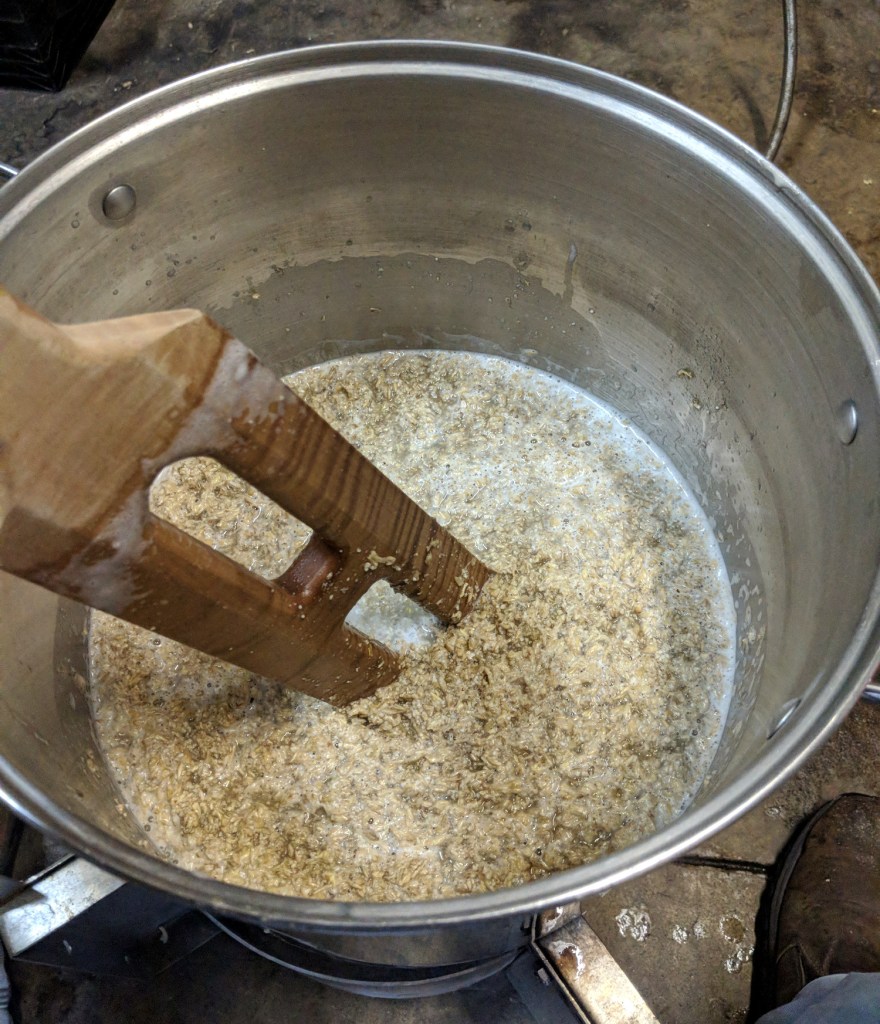
The Czech dark lager is the inaugural batch for my new stainless steel fermenter. I’ve never brewed this style before, but wanted to try it as a dark lager option for the taps.
Finally, the American IPA is taken from a recipe in Homebrew Recipe Bible. It used some hop varieties I haven’t brewed with much (particularly Ahtanum, along with CTZ and Chinook), and some familiar favorites (Cascade, Amarillo, Centennial, and Simcoe). Although I’m fairly comfortable formulating an American IPA recipe, I think it’s good to sample some external recipes on occasion, to see what flavor combinations others like. It keeps me out of a rut!
In the lagering chamber, I have the German pils and red rye lager. I had a near disaster with that a few days back, when I shifted some things around and didn’t notice that the probe on my temperature controller had fallen out of the chamber. The result was an overnight freeze of the kegs! Luckily, the damage seems to be minimal, and I thawed them out over a day or two. One interesting phenomenon–as the beers thawed, they stratified heavily, forming a sort of eisbock. Unfortunately, it meant I had to agitate the kegs a bit to remix the beer, setting back a week of quiet lagering. Hopefully the haze will continue to settle before I serve. When I tasted the beers following thawing (and after agitation), I didn’t notice any major flavor damage. I normally tape the temperature probe in place on a fermenter (to make sure the fermenter temperature is accurately measured), but leave it loose when lagering in the keg. I learned a valuable lesson–find some way to secure the temperature probe inside my lagering chambers!
Right now, I have a festbier, a session porter, and a pale ale on tap. It fits my tap philosophy well, of having something lighter, something darker, and something hoppier on tap at all times.
*If you’re in the San Dimas area, Pacific Brewing Supplies is an awesome, family-run (and family-friendly) business. They have a broad, well-stocked inventory, and the owners are super knowledgeable.
 Andy's Brewing Blog